A reference example in C Locrian
Seven notes, an unusual center
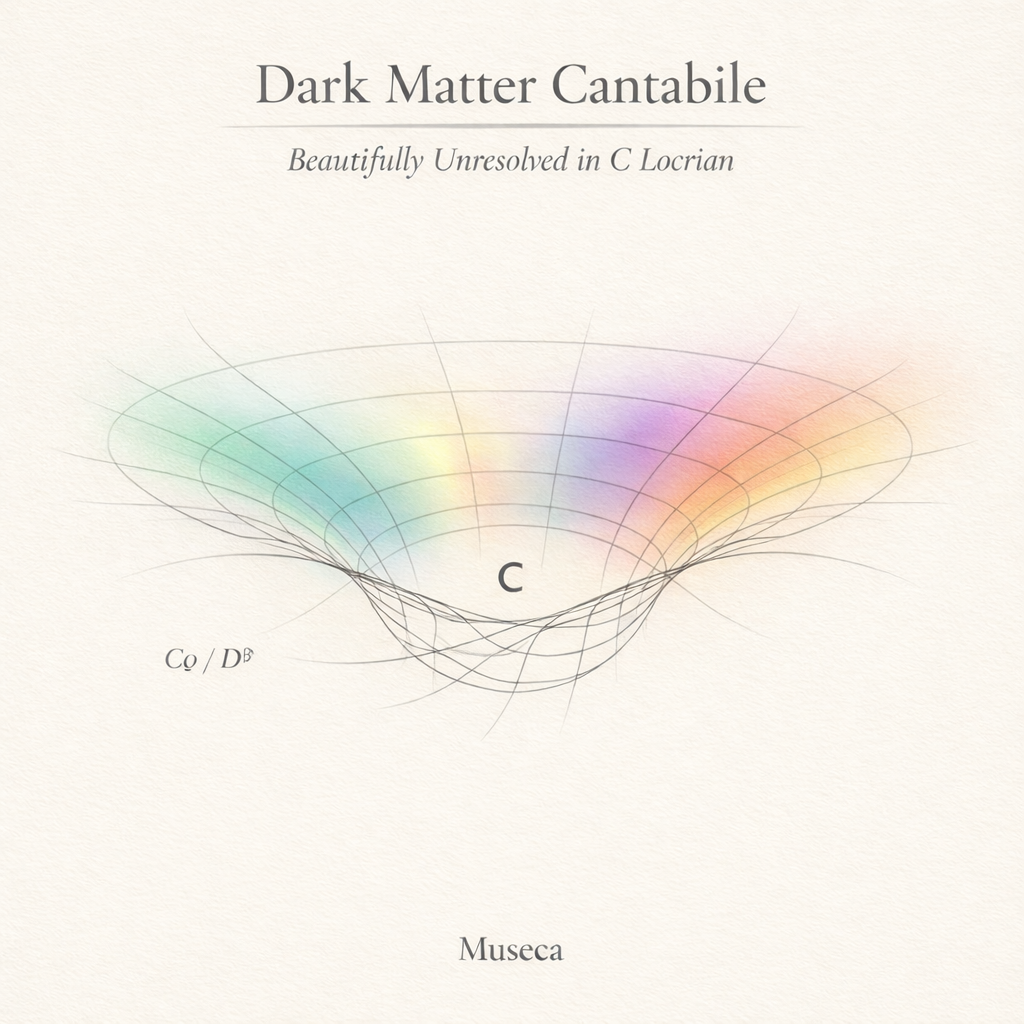
The defining friction: D♭ lies only a semitone above the center C. G♭ replaces the perfect fifth G and forms a tritone with C. The resulting tonic triad is C–E♭–G♭, a diminished chord.
CE♭G♭C diminished triad
A familiar major or minor tonic chord supplies a perfect fifth. Locrian does not. Instead, a composer can hold C as a pedal and use its nearby D♭ and G♭ as recurring expressive landmarks.
Transposition: Several selections use E♭ Locrian instead. Their pitches change, but the same relative intervals and musical idea remain.
Companion framework · The Lumen Arc
A spectrum of modal brightness
The Lumen Arc proposes hearing diatonic modes as a spectrum of relative brightness, rather than memorizing them only as rotations of a scale. Within that interpretive model, Locrian occupies the shadowed end—not because darkness is undesirable, but because its characteristic intervals produce distinctive tonal gravity.
LydianIonianMixolydianDorianAeolianPhrygianLocrian
Left: relatively brighter in this model. Right: relatively darker. This is a pedagogical metaphor, not an objective rating of beauty, emotional effect, or artistic merit.
Locrian is often called the least stable diatonic mode. These recordings propose a productive question: can a listener become comfortable with its tonal center without needing its altered intervals to disappear?
Read The Lumen Arc · Free PDF edition