
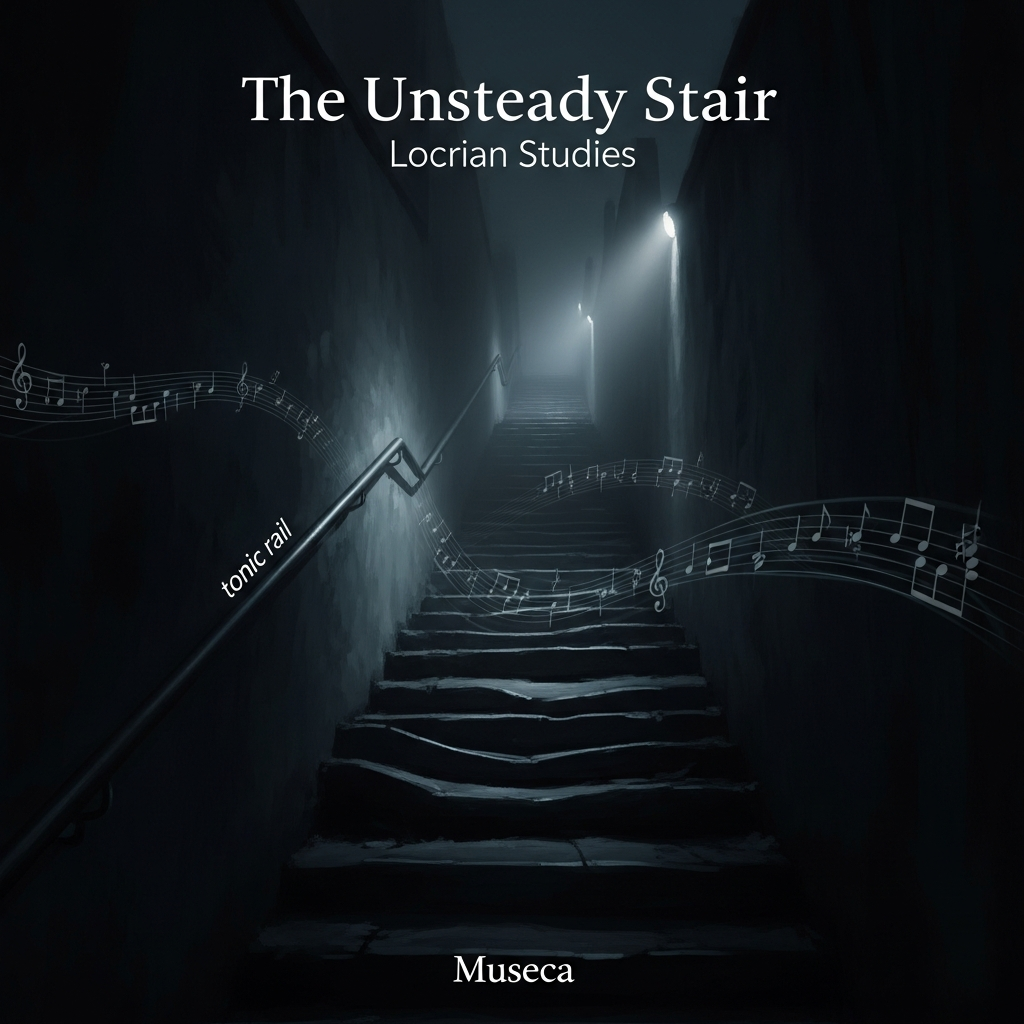
The Unsteady Stair: Locrian Studies
The Unsteady Stair: Locrian Studies is a suite of original solo piano miniatures written in the rare and quietly magnetic world of E♭ Locrian. Locrian is often described as unstable because its defining tones—the lowered second (♭2) and lowered fifth (♭5)—undercut the feeling of safe arrival. In this album, that instability becomes the point: not chaos, but psychological tension—the sensation of stepping forward while the ground subtly shifts.
Each piece is built around a guiding image: E♭ as a handrail. The tonic returns again and again—sometimes as a pedal, sometimes as a recurring landing—while Locrian’s “wrong-step” colors slip in like intrusive thoughts. The music favors intimacy over spectacle: close voicings, veiled resonance, half-pedal fog, and silences that feel intentional. Instead of resolving problems, these studies illuminate them, letting dissonance hover long enough to become expressive.
Structured as a prelude + study hybrid, the album moves through distinct facets of the mode—whispered ♭2 inflections, tritone pivots, ghost-waltz motion, chorale shadows, brittle stair-step gaps—before opening into a final Fantaisie, where the entire language returns in transformed forms. The Unsteady Stair is not a demonstration of theory; it is a diary of a particular sensation: beautiful, unsettled, and strangely inevitable—one piano, one tonal center, and a staircase that keeps climbing into fog.
Liner Notes
Handrail
The album begins by establishing its single act of faith: E♭ as a place you can return to. A low anchor holds while the surface flickers with uncertainty, as if the room itself is breathing. The silences are deliberate—spaces where the mind fills in what the harmony refuses to confirm.
♭2 Whisper
Here the unease becomes intimate. The lowered second arrives like a private interruption—soft, persistent, and impossible to ignore once you’ve heard it. The writing leans on pauses and close intervals, creating the sense of a thought repeated under the breath until it changes the meaning of every “home” note.
Tritone Fog
Locrian’s broken fifth turns the air cold. A rocking pulse suggests calm, but the recurring tritone pivot keeps tilting the floor. The piece swells without ever becoming dramatic—more like pressure building behind a closed door—then recedes into mist, unresolved but strangely quieted.
Paper-Muted Étude
A study in nervous continuity: motion that cannot stop, but refuses to shout. The repeated-note shimmer feels like tremor rather than virtuosity, and the short sustain keeps everything close to the ear—dry, brittle, intimate. The ending cuts cleanly, as if the hand slipped off the rail.
Glass Harmonics
This is Locrian seen through moonlight. A deep anchor holds below while high-register filigree hangs in the air like frost on a window. The mode’s sharpest tones appear as glints—brief, delicate, and strangely beautiful—until the music thins into a floating, spectral coda.
Nocturne of the Broken Fifth
A nocturne that sings, but never settles. The melody repeatedly touches the “wrong” step—the lowered fifth—then retreats, as if apologizing for honesty. Beneath it, arpeggios provide tenderness rather than comfort. The result is a love-song with a bruise: lyrical, restrained, and quietly haunted.
Stairwell Steps
The stair becomes literal. Staccato bursts and sudden gaps create vertigo—moments where you expect the next step and meet air instead. The tension escalates through speed and absence rather than volume, and the final stop arrives abruptly, controlled, inevitable.
Dissociation Waltz
A dance that remembers being a dance. The pulse is light, even elegant, but the missteps—Locrian’s altered degrees—keep the smile from becoming reassurance. It feels like watching a waltz through fogged glass: charming silhouettes, unclear faces, and a brightness that won’t fully resolve.
Chorale Behind the Wall
Soft block chords suggest a hymn heard from another room. The voicings lean on suspensions and inner friction, avoiding the closure a chorale usually promises. E♭ returns beneath the surface like a low hum in the building—steady, present, not comforting—until the piece fades into a hush.
Mirror of the Scale
A psychological study in reflection. Motives imitate and invert as if the music is watching itself think, with the tritone acting as a recurring fault-line. The meter feels slightly off-balance, not for cleverness, but to keep the listener subtly ungrounded. The ending refuses to “solve” anything—only to stop insisting.
Fantaisie: Fog Architecture
The final movement gathers every earlier language into a single, free-form ascent. Themes return changed: the handrail becomes a beacon, the whispers become declarations, the gaps become collapses. One large climax rises from the fog and breaks, and what remains is afterglow—quiet, unfinished, and deeply human. The staircase does not end; it simply disappears into mist, leaving the ear still searching for the next step.
Playlist
- Handrail Museca 1:33
- ♭2 Whisper Museca 1:53
- Tritone Fog Museca 2:03
- Paper-Muted Étude — Solo Piano (E♭ Locrian) Museca 0:58
- Glass Harmonics — Solo Piano (E♭ Locrian) Museca 1:29
- Nocturne of the Broken Fifth — Solo Piano (E♭ Locrian) Museca 2:15
- Stairwell Steps — Solo Piano (E♭ Locrian) Museca 1:13
- Dissociation Waltz — Solo Piano (E♭ Locrian) Museca 1:03
- Chorale Behind the Wall — Solo Piano (E♭ Locrian) Museca 1:34
- Mirror of the Scale — Solo Piano (E♭ Locrian) Museca 1:45
- Fantaisie: Fog Architecture — Solo Piano (E♭ Locrian) Museca 2:59