
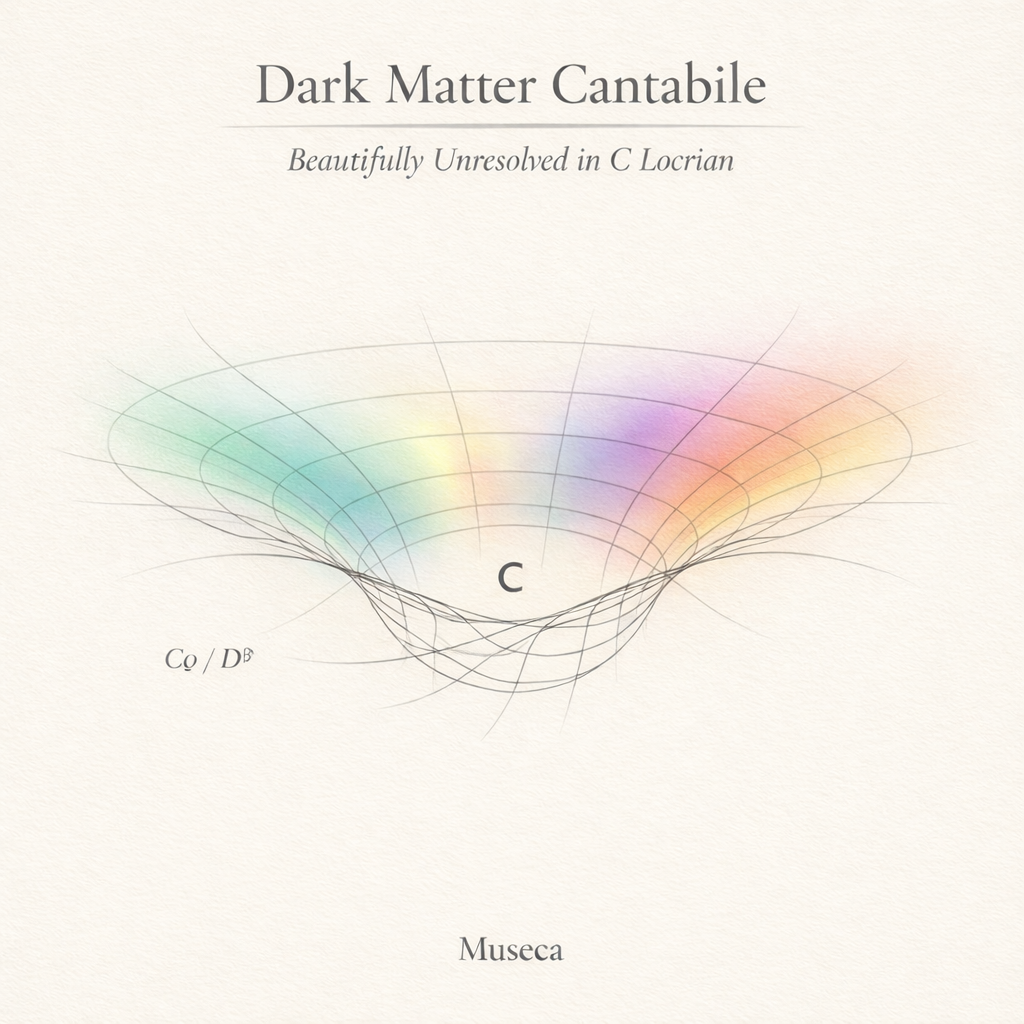
Dark Matter Cantabile — Beautifully Unresolved in C Locrian
This album is an exploration of Locrian as a complete musical environment, not a momentary color. In conventional tonal practice, harmony tends to behave like a narrative: tension is introduced, intensified, and then resolved through cadence. Here, the governing idea is different. C Locrian is treated as a stable gravitational field—coherent, singable, and emotionally continuous—while deliberately refusing the familiar mechanisms of arrival.
Technically, the album’s identity is defined by three interlocking behaviors:
1) Pitch gravity built from controlled friction.
C Locrian (C–D♭–E♭–F–G♭–A♭–B♭) is anchored by a persistent C pedal—sometimes audible, sometimes implied by register and repetition—so the ear accepts C as “home.” Against that home, the mode’s defining tones remain constantly present: D♭ (♭2), the semitone neighbor that presses immediately against the tonic, and G♭ (♭5), the diminished fifth that denies the tonic its normal stability. Instead of being treated as occasional dissonances, ♭2 and ♭5 function as structural pillars, making the darkness of Locrian feel inevitable yet balanced.
2) A harmonic engine that circles a boundary rather than traveling toward a destination.
Much of the album’s motion is generated by a recurring oscillation between C half-diminished (Cø: C–E♭–G♭–B♭) and D♭ (♭II) colors (often enriched as D♭maj7/9-type sonorities). This iø–♭II loop is a Locrian-native way of creating continuity: it provides clear identity and forward motion without invoking functional dominant-to-tonic logic. The result is “perpetual motion” harmony—music that progresses by return and recontextualization, not by arrival.
3) Form without cadence: suspension as the truth of the ending.
The phrase “no cadence” does not mean the music lacks structure; it means the album avoids the harmonic punctuation that signals finality (the tonal equivalent of a period). Rather than resolving tension through cadential closure, these tracks end through dissolve codas—textures thinning, attacks softening, reverb tails lengthening, and the harmonic field remaining intact as the sound recedes. The listener is left not with a solved equation, but with the sensation that the world continues beyond the frame.
Within this system, variation is achieved primarily through motif and orchestration, not key changes or harmonic travel. A short motif repeats until it becomes environment, then evolves by shifting density, register, and instrumental emphasis. Strings are central to the aesthetic because they can embody the Locrian paradox at the timbral level: sul tasto warmth and veil (human intimacy) blended with sul ponticello shimmer and edge (spectral unease). Piano, pads, and soft pulses provide a restrained kinetic undercurrent—enough motion to sustain attention, never enough to force a conventional climax.
A signature structural gesture recurs throughout the record: the midpoint violin “door.” The music withholds brightness long enough that, when the violins bloom mid-track, the effect reads as revelation rather than decoration. A later plateau expands that revelation into sustained radiance, and then the album returns to its core ethic: not closure, but beautiful, disciplined suspension.
In short, Dark Matter Cantabile presents Locrian as an art of coherence without comfort—a singing line held inside a tension field that never collapses into resolution. It is music built on the strength of an unresolved center: gravity you can hear, darkness you can inhabit, and beauty that exists precisely because it refuses to “arrive.”
Liner Notes
Continuum Theme — C Locrian
The album’s reference axis: a repeating motif is anchored by a C-centered floor while D♭ (♭2) presses against that center and G♭ (♭5) stains the harmony with tritone gravity. The music develops by orchestration rather than harmonic travel—strings shifting between veiled warmth and spectral edge. The midpoint violin bloom is the record’s defining revelation: brightness arrives not as rescue, but as Locrian tension turning radiant; the ending dissolves without cadential closure.
Event Horizon Lull
A more “lullaby” profile built on the same physics: the C pedal is steady, and the Cø → D♭ loop circles like a slow orbit rather than a progression. Pulses remain soft and understated, acting as breath rather than rhythm section. The midpoint door is earned by restraint—high strings are withheld long enough that their arrival reads as tenderness inside danger. The coda thins to suspension, refusing a final tonic landing.
Glass Orbit (Canon Door)
Here the motif splits into a quiet canon—piano and inner strings echo each other in staggered entrances, creating the sense of multiple lines circling the same center. The harmony remains Locrian-native (Cø colored against D♭), but the contrapuntal treatment generates motion without “changing chords.” The midpoint bloom widens the stereo and register, and the late plateau feels like a rotating halo of tension rather than a climax that resolves.
Half-Diminished Prayer (Felt Piano)
Felt piano softens the attack profile, turning the motif into something confessional: less “statement,” more murmured insistence. The half-diminished sonority becomes prayer-like—stable in repetition, unstable in interval content. Strings lean toward sul tasto warmth, and the piece finds its power in limited harmonic vocabulary, deepening the ♭2/♭5 identity by lingering rather than escalating. The ending recedes as if the harmony continues beyond audibility.
Ponticello Halo (Harmonics Lift)
This track makes the Locrian shimmer explicit: harmonics and ponticello haze bring out the upper partials, so the tension feels luminous rather than heavy. The motif is unchanged in principle, but timbre redefines it—what was “shadow” becomes “iridescence.” The midpoint door is more crystalline than warm, and the late plateau glows with spectral light while the bass anchor keeps the world from resolving into conventional consonance.
Silent Reactor (Sub-Pulse)
A restrained sub/industrial pulse operates like an internal engine—steady enough to imply inevitability, subtle enough not to become genre percussion. Above it, the motif loops in the familiar Locrian boundary-field, with C as the floor and D♭ as the pressure point. The midpoint bloom rides on increased density rather than new harmony; the plateau feels pressurized, then the pulse and layers peel away into a long, controlled dissolve.
Null Cathedral (Wide Reverb Choir)
A vast acoustic illusion: the strings behave like a choir without voices, creating architecture out of sustain and reverb. Harmony remains “unresolved by design,” but the space makes that suspension feel monumental. The motif is stretched and aerated; attacks are softened; resonance becomes the primary event. The midpoint door opens into a larger room rather than a louder one, and the coda fades as if the building remains after the sound leaves.
Ash of the First Light (Breath Track)
The album’s most minimal statement: maximum negative space, the motif reduced to fragments and implication. The C center is felt more than declared; D♭ and G♭ appear as brief glints that define the mode without overstatement. The midpoint bloom is deliberately gentle—more unveiling than swell—followed by a plateau that stays quiet and luminous. The track ends in pure suspension, like breath released but not concluded.
D♭ Halo (Upper-Neighbor Obsession)
This piece foregrounds Locrian’s closest pressure point: D♭ (♭2) becomes the recurring upper neighbor that cannot be shaken. The effect is intimate and uneasy—almost romantic in contour, but permanently destabilized by the semitone adjacency to the tonic. The motif’s persistence turns the neighbor-tone into a signature “halo,” and the late plateau intensifies the insistence rather than resolving it. The dissolve coda leaves the question open.
The Fifth Shadow (G♭ Bell-Tone)
Here G♭ (♭5) is treated as a bell-like emblem—less a dissonance than a tolling color that marks the entire harmonic field. The half-diminished gravity becomes especially audible: each return to the motif reinforces the lack of a secure fifth above C. The midpoint door arrives as brightness layered over instability, and the plateau feels ritualistic—radiant tension sustained on purpose—before the track fades without punctuation.
Low Meridian (Abyss Register)
The register drops, and the album’s gravitational metaphor becomes physical: bass strings and low piano intensify the sense of pull. The motif feels heavier, more inevitable, yet still cantabile in contour—singing inside the abyss. The midpoint bloom reads as “light under pressure,” and the plateau achieves density without triumph. The ending withdraws layers rather than resolving harmony, keeping Locrian’s truth intact.
Undertow Cantabile (Low Meridian II)
A companion to Low Meridian, but with a different current: where the previous track feels like a plunge, this one feels like being pulled. The melodic surface is more overtly singing—cantabile phrasing above a steady C-centered undertow—while the harmony keeps returning to the same boundary between Cø and D♭ color. The midpoint door opens with a smoother legato contour, and the late plateau lingers as afterglow rather than impact, dissolving without arrival.
Abyssal Romance (Violin Bloom Finale)
The closing statement allows full Romantic swelling—long-breathed violin lines, lush string expansion, and a melody that feels openly devoted—yet the harmonic floor remains Locrian. The romance is therefore not “resolution,” but radiance inside tension: C holds, D♭ and G♭ remain present, and the love-theme never cadences into safety. The midpoint bloom is unapologetically beautiful; the late plateau is the album’s widest opening; the final dissolve confirms the record’s ethic: no slam-shut, only suspension.
Bonus Track: Abyssal Romance (Second Bloom Reprise)
A second angle on the finale’s love-theme—similar materials, different bloom geometry. The melody and swell feel re-voiced rather than rewritten: changes in register, density, and string color shift the emotional shading while the Locrian field stays intact. It functions as an afterglow coda to the whole album—romance sustained in midair—fading out with the same deliberate refusal of cadential closure.
Playlist
- Continuum Theme — C Locrian Museca 4:38
- Event Horizon Lull (C Locrian) Museca 4:15
- Glass Orbit (Canon Door) Museca 4:33
- Half-Diminished Prayer (Felt Piano) Museca 4:57
- Ponticello Halo (Harmonics Lift) Museca 4:11
- Silent Reactor (Sub-Pulse) Museca 5:00
- Null Cathedral (Wide Reverb Choir) souledout 3:54
- Ash of the First Light (Breath Track) souledout 5:50
- D♭ Halo (Upper-Neighbor Obsession) Museca 4:45
- The Fifth Shadow (G♭ Bell-Tone) Museca 4:18
- Low Meridian (Abyss Register Finale) Museca 5:27
- Undertow Cantabile (Low Meridian II) Museca 4:15
- Abyssal Romance (Violin Bloom Finale) Museca 4:11
- Abyssal Romance (Second Bloom Reprise) Museca 3:25