
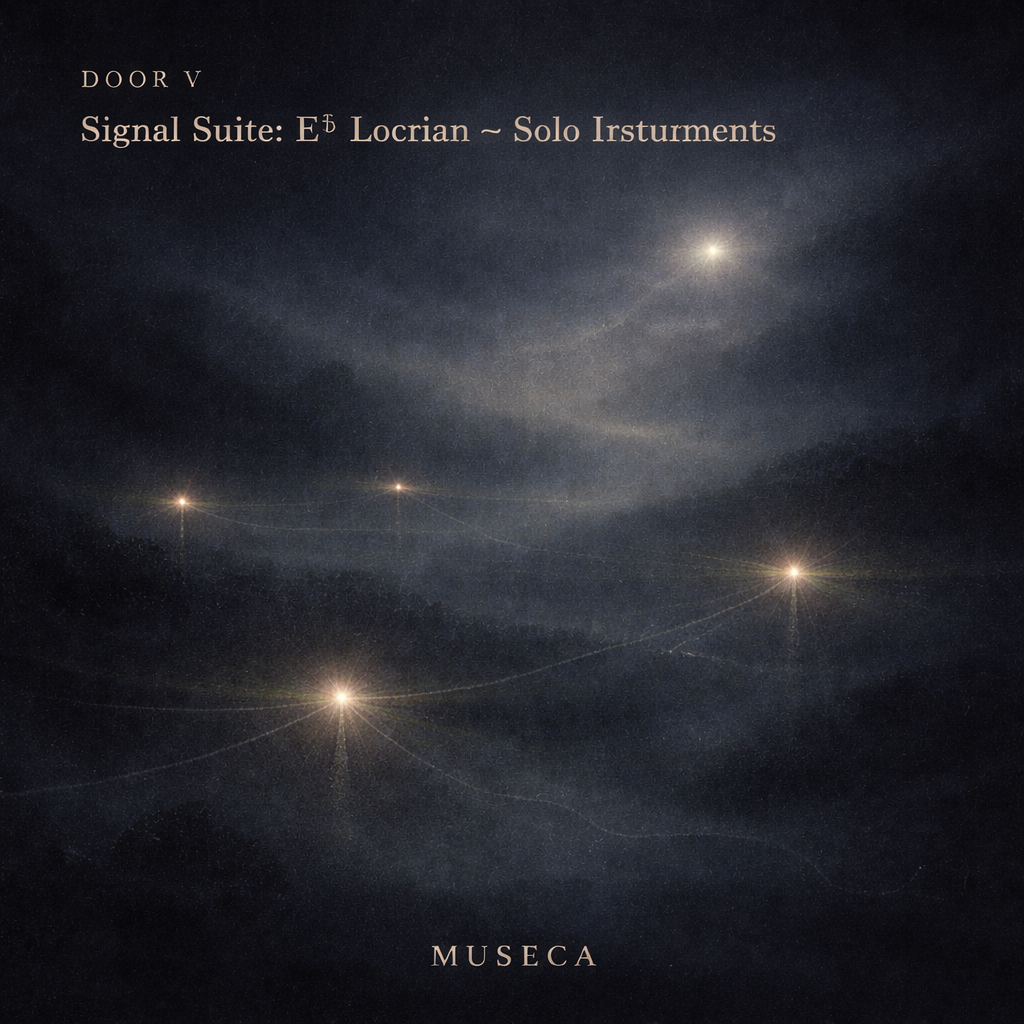
Door V — Signal Suite: E♭ Locrian — Solo Instruments
Can Locrian be timbrally vivid across instruments?
This album asks a different question from the earlier doors. Instead of treating Locrian as atmosphere, narrative, or system, Signal Suite presents it as color carried by individual voices. Each piece is built around a single featured instrument, allowing the mode to be heard not as a fixed mood, but as a shifting timbral identity.
E♭ Locrian remains the common ground throughout the suite, but its instability changes character from instrument to instrument. In the oboe, it becomes fragile and inward. In the French horn, distant and searching. In the muted trumpet, nocturnal and dry. In the bass clarinet, tactile and shadowed. The viola, cello, harp, and bandoneon each reveal a different contour of the same harmonic condition. What stays constant is the missing fifth—the unresolved structural gap that gives Locrian its singular tension.
Because the textures are sparse and the writing is chamber-scaled, timbre itself becomes form. Register, breath, bow pressure, attack, and resonance carry as much expressive weight as melody or harmony. These are not orchestral demonstrations, but intimate studies in how one mode can inhabit many bodies without losing its identity.
Signal Suite shows that Locrian is not monochrome. It does not merely darken whatever it touches; it refracts differently through each instrument, producing a family of related but distinct interior worlds. Here, the mode becomes audible as signal: solitary, suspended, and vividly alive in tone alone.
Liner Notes
Haunted Street Waltz
The suite opens with a solitary urban memory. The bandoneon or accordion carries the Locrian atmosphere through a restrained 3/4 pulse, suggesting a dance that persists even after the dancers have disappeared. The unstable harmonic field prevents the waltz from settling into nostalgia; instead, it drifts between elegance and unease. The effect is intimate and slightly ghosted, like music heard from across an empty street at dusk.
Locrian Reed Letter — Oboe
Here the Locrian language becomes personal and confessional. The oboe’s fragile reed tone lends itself to a line that feels spoken rather than sung. Stepwise motion and suspended phrases evoke the feeling of a letter being written slowly, with pauses between thoughts. The missing harmonic foundation of the mode leaves the oboe suspended in its own voice, creating a tone that is thoughtful, inward, and quietly vulnerable.
Flat 2 Whisper
The cello explores one of Locrian’s defining intervals: the lowered second scale degree. In this piece, that pitch behaves like a subtle disturbance in the melodic line, coloring the harmony from within rather than announcing itself dramatically. Bow pressure remains restrained and the register intimate, allowing the instrument’s natural warmth to coexist with a gentle harmonic instability.
Valley Signal
The French horn introduces distance into the suite. Its spacious phrasing and rounded timbre suggest a call carried across a landscape—less proclamation than presence. Locrian transforms the horn’s normally heroic character into something quieter and more searching. The result feels like a signal heard from far away, echoing through open air without ever resolving into certainty.
Ghost Signal
A muted trumpet shifts the suite toward nocturnal territory. The dry attack and breath in the tone produce a sound that feels almost disembodied, as though the instrument were sending a message through darkness. The Locrian framework keeps the line suspended, reinforcing the impression of a transmission that never fully arrives.
Black Velvet Step
The bass clarinet deepens the palette with its dark, velvety resonance. The melodic motion is slow and deliberate, allowing the low register to unfold gradually. Locrian here becomes tactile—felt as weight and shadow rather than tension. Each phrase moves carefully forward, as though the instrument were testing the ground before committing to the next step.
Shadow Thread
The viola occupies the interior register of the ensemble, a place often associated with the hidden voice of harmony. In this piece it becomes a quiet narrator, weaving a thin melodic thread through the Locrian landscape. The writing emphasizes subtle bow control and gentle dynamic shifts, allowing the instrument’s natural introspection to guide the mood.
Moonlit Spectral
The suite closes with the harp, whose transparent textures reveal a different side of Locrian. Plucked sonorities shimmer briefly before dissolving, creating an atmosphere that feels luminous but unresolved. Rather than offering closure, the piece leaves the harmonic field suspended in quiet resonance, as though the music were dissolving into the night air.
Playlist
- 1) Haunted Street Waltz Museca 2:34
- 2) Locrian Reed Letter — Oboe Museca 2:15
- 3) Flat 2 Whisper Museca 3:55
- 4) Valley Signal Museca 2:49
- 5) Ghost Signal Museca 3:20
- 6) Black Velvet Step Museca 3:05
- 7) Shadow Thread Museca 3:20
- 8) Moonlit Spectral Museca 2:33