
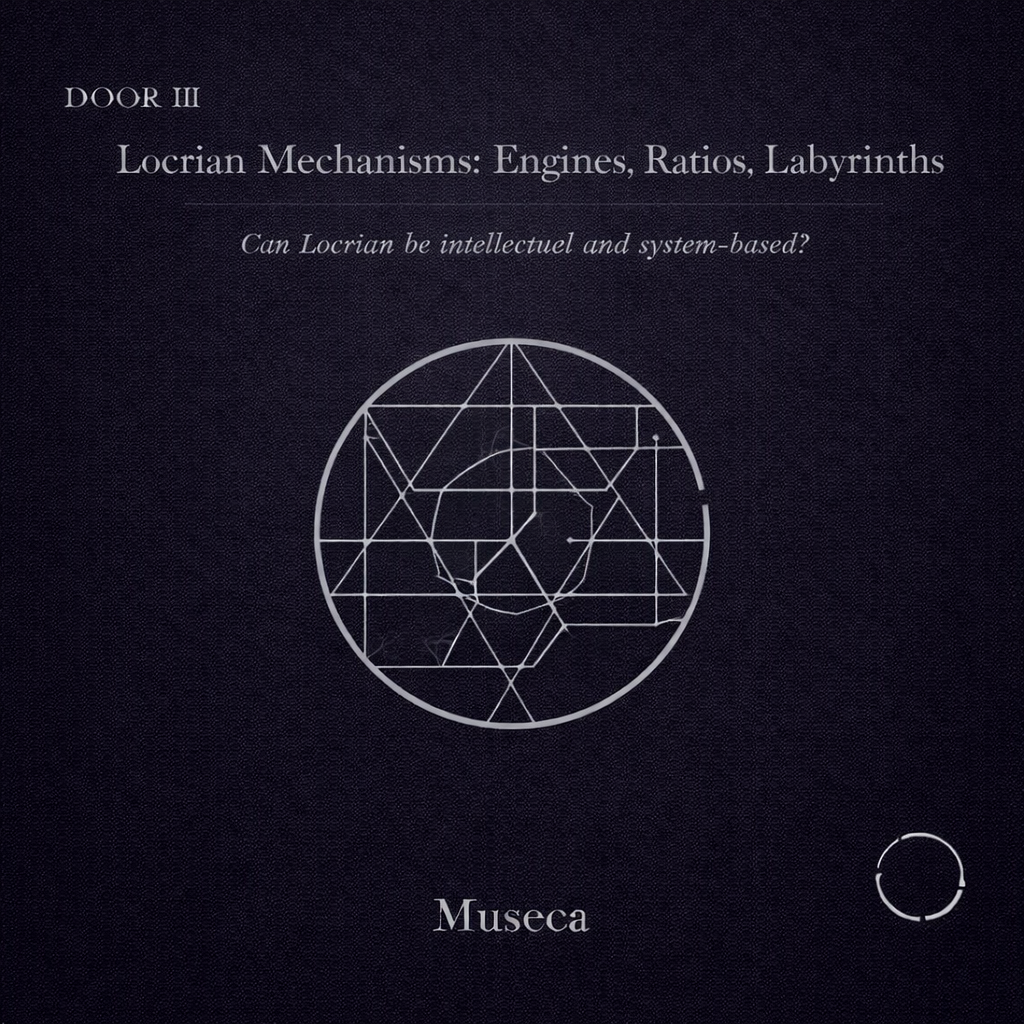
Door III — Locrian Mechanisms: Engines, Ratios, Labyrinths
Can Locrian be intellectual and system-based?
This album approaches Locrian not as an emotional color or narrative device, but as a formal system. Here, the mode functions as a governing constraint—an operating condition within which musical processes are allowed to unfold, but never resolve. The diminished fifth is not treated as tension to be softened; it is the structural fact around which everything else is organized.
Locrian Mechanisms explores Locrian through ratios, phasing, modular repetition, and rule-based construction. Pieces are generated by proportional relationships, layered cycles, or constrained pitch fields rather than by melody or harmonic progression. Motion exists, but direction is withheld. The listener is not guided toward arrival; instead, they are placed inside self-contained engines that run according to their own internal logic.
The music often feels architectural or mechanical—not cold, but exact. Patterns interlock, drift, and realign, creating labyrinths of sound that reward focused listening. Small changes carry disproportionate weight, and the absence of traditional cadence becomes a feature rather than a limitation. Locrian’s instability is not dramatized; it is normalized.
This door demonstrates that Locrian can sustain intellectual rigor without collapsing into abstraction for its own sake. When treated as a system rather than a mood, the mode reveals a different kind of clarity—one grounded in structure, proportion, and disciplined constraint.
Liner Notes
Locrian 3:2 Pulse Engine
This piece is constructed around a persistent 3:2 ratio, allowing rhythmic proportion to dictate form rather than harmonic motion. The Locrian pitch field remains fixed while the pulse relationship generates forward energy. Tension arises not from modulation, but from the listener’s continuous recalibration of competing metric centers.
Locrian 4:3 Suspended Atmosphere
Here the emphasis shifts to suspension and imbalance. A 4:3 proportional framework governs layering and entry points, while harmony avoids any stabilizing intervallic anchor. The result is a hovering sound field in which motion is perceptible but direction is withheld.
Locrian 5:4 Labyrinth
This work applies just-intonation logic inside a Locrian context. Micro-adjusted intervals and proportional spacing create a maze-like harmonic environment where familiar relationships feel subtly skewed. The ear senses internal order without ever finding an exit.
Phase Machine in Locrian
Phasing processes drive this piece. Identical figures slowly drift out of alignment, producing emergent patterns that feel mechanical yet unpredictable. Locrian functions as the invariant condition, ensuring that even when textures realign, resolution never occurs.
Strict Locrian — Max Variant
This track enforces the mode in its most uncompromising form. No modal borrowing, no relief tones, no registral softening. Density, repetition, and register do the expressive work, demonstrating how constraint alone can generate intensity.
Locrian + Altered Color
An overlay system introduces Super Locrian color tones without allowing functional harmonic behavior. The interaction between the base Locrian field and altered inflections creates friction that feels structural rather than expressive, like two incompatible systems occupying the same space.
Altered / Super Locrian — Singularity Cut
This is the album’s most concentrated study. Material is compressed, repetition is severe, and contrast is minimal. Altered symmetry replaces development, pushing the system toward saturation rather than expansion.
Iwato–Locrian Crossover Variant
Two non-functional modal systems are interlocked through rule-based exchange. Pentatonic contours suggest ritual clarity, while the Locrian foundation destabilizes any sense of grounding. The hybrid remains coherent without resolving into either source.
Continuum Theme — C Locrian
The album closes with continuous transformation rather than sectional form. Gradual shifts in density, register, and emphasis occur without clear boundaries, reinforcing the idea of Locrian as a sustained condition—an environment that evolves internally but never arrives elsewhere.
Continuum Theme — C Locrian (Version 2)
Playlist
- Locrian 3:2 Pulse Engine Museca 4:40
- Locrian 4:3 Suspended Atmosphere Museca 3:15
- Locrian 5:4 Labyrinth Museca 3:25
- Phase Machine in Locrian Museca 2:53
- Strict Locrian — MAX Variant Museca 6:03
- Locrian + Altered color Museca 4:55
- Altered / Super-Locrian (melodic minor mode 7). Singularity Cut — C Altered (Super-Locrian) Museca 6:02
- Iwato Locrian-crossover variant Museca 3:29
- Continuum Theme — C Locrian+ Museca 4:38
- Continuum Theme — C Locrian (version 2) Museca 5:15