
Introduction
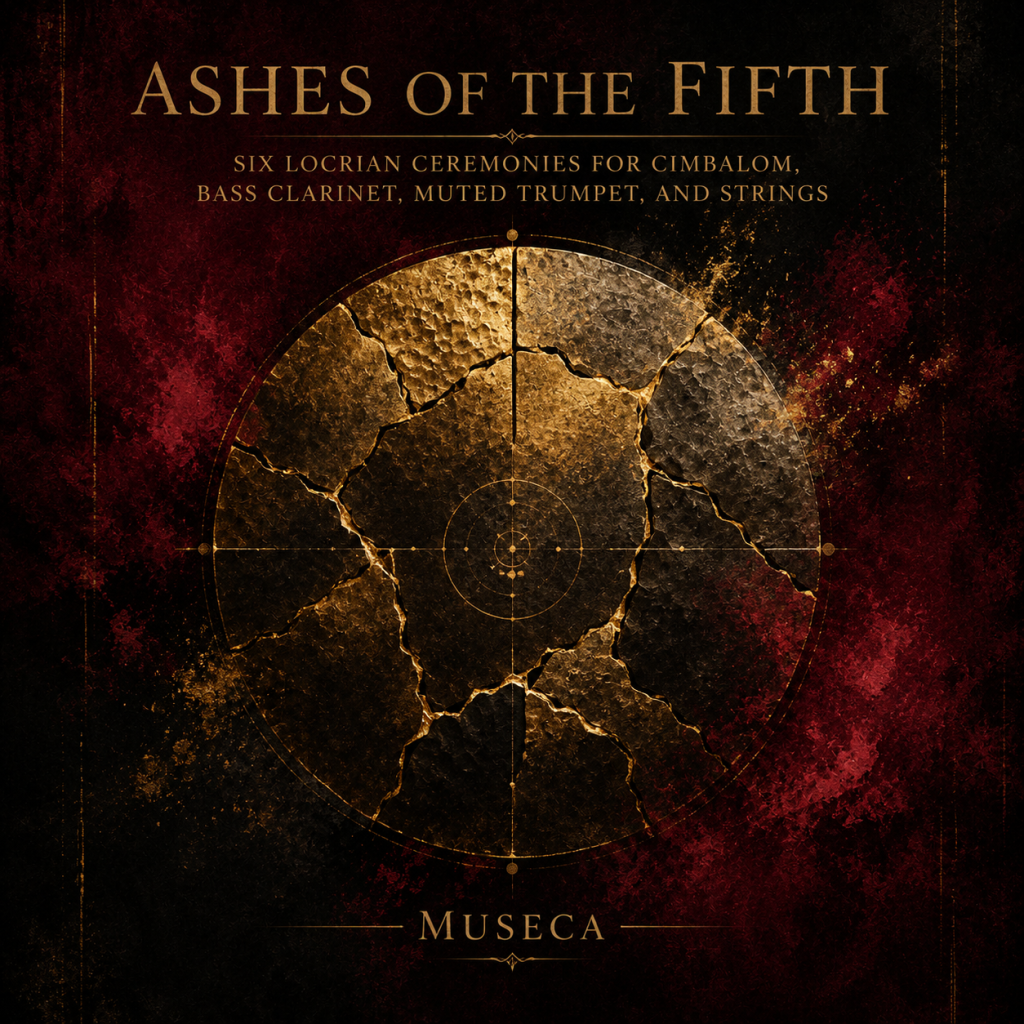
Ashes of the Fifth is a study in unstable center. Written in the Locrian mode and conceived for the unusual chamber ensemble of cimbalom, bass clarinet, muted trumpet, and strings, the album explores what happens when musical gravity remains present, yet never fully settles into authority. In most tonal and modal traditions, the perfect fifth acts as a pillar: it reinforces the tonic, confirms orientation, and gives the ear a sense of architectural confidence. Locrian removes that pillar. What remains is not simply darkness, but a rarer and more psychologically charged condition: a center that exists without sovereignty.
This album takes that condition as its expressive premise. The cimbalom gives the music a metallic, splintered resonance, turning harmonic instability into something tactile and immediate. The bass clarinet provides the shadowed core, carrying lines that sound inward, nocturnal, and burdened with thought. The muted trumpet enters as distance itself—an austere public signal heard through walls, across empty rooms, or from the far end of memory. Around them, the strings create the atmosphere in which the mode breathes: tremulous, suspended, restrained, and at times almost ceremonial.
The six tracks do not treat Locrian as a novelty or an academic exercise. Instead, they inhabit it as a complete world—one of fracture without collapse, ritual without certainty, and beauty without resolution. The result is music that feels haunted yet controlled, dramatic yet refined. Ashes of the Fifth does not try to repair the missing pillar at the heart of the mode. It listens to the space left behind and discovers within that absence a new kind of elegance.
Liner Notes
Ashes of the Fifth
The opening track establishes the album’s governing premise with immediate clarity: the Locrian mode is not treated as mere darkness, but as damaged structure. The cimbalom introduces a brittle metallic field in which resonance itself seems cracked, while the bass clarinet gives the tonic a shadowed but undeniable presence. The muted trumpet is used sparingly, almost like a distant ceremonial memory, and the strings enter not to stabilize the harmony but to widen its uncertainty. The result is a threshold piece—an entrance into a world where center exists, yet cannot fully reign.
Black Glass Procession
Here the music acquires ritual motion. The piece suggests a procession, but one whose symbolic order has outlived its original meaning. The cimbalom’s repeated figures glint like fractured reflections on dark polished stone, while the strings provide a slow, controlled movement beneath the surface. The bass clarinet carries a grave melodic line that never quite resolves into affirmation, and the muted trumpet functions as a distant public signal, formal but withheld. Locrian becomes ceremonial here, not as triumph, but as persistence under fracture.
Trumpet Behind the Wall
This track is built on distance, concealment, and spatial tension. The muted trumpet is heard less as a solo presence than as an apparition—remote, filtered, and almost architectural in effect. Against that distance, the bass clarinet occupies the near field, darker and more intimate, while the cimbalom shifts from pulse to shimmer, becoming metallic dust, coded memory, or quiet signal. The strings suspend the harmonic space rather than drive it forward, allowing the Locrian center to feel enclosed, watched, and withheld. The piece unfolds like sound traveling through stone corridors and half-open doors.
The Fractured Ceremony
The fourth track is the most overtly dramatic movement of the cycle. Here the album’s ceremonial language becomes sharper and more exposed. The cimbalom is more forceful, the strings more agitated, and the exchanges between muted trumpet and bass clarinet more pointed and theatrical. Yet even at its most dramatic, the music avoids bombast. Its energy is disciplined, ritualized, and controlled. The Locrian mode is allowed to show its public face here: not chaos, but a formal order whose foundation has been subtly broken.
Nocturne for a Broken Root
This is the inward heart of the album. The track draws away from the ceremonial and returns to the private wound at the center of the mode. The bass clarinet sings with unusual tenderness, revealing that Locrian can carry not only menace or tension, but lament. The cimbalom becomes sparse and resonant, less rhythmic than spectral, while the muted trumpet appears only as a distant, almost reluctant witness. String harmonics and soft suspensions create an atmosphere of fragility and suspended breath. What emerges is a music of wounded intimacy: the sound of a center grieving its own incompleteness.
Hollow Crown
The final piece gathers the album’s ceremonial materials and empties them of triumph. The title suggests authority without foundation, arrival without fulfillment, and symbolic grandeur with its central beam removed. The muted trumpet returns with greater gravity, the strings widen the emotional field, and the bass clarinet once again holds the unstable center with quiet force. Around them, the cimbalom closes the cycle in luminous fracture, offering not resolution but a final shimmering acknowledgment of what cannot be repaired. The album ends where it has always stood: in the austere beauty of a structure still standing after its pillar has vanished.
Playlist
- Track 1 - Ashes of the Fifth Museca 2:43
- Track 2 - Black Glass Procession Museca 3:23
- Track 3 - Trumpet Behind the Wall Museca 3:24
- Track 4 - The Fractured Ceremony Museca 2:35
- Track 5 - Nocturne for a Broken Root Museca 3:12
- Track 6 - Hollow Crown Museca 3:10