Skip to content

Museca · Curated Listening Collection No. 21

The Beauty of Locrian

Finding beauty without resolution

Locrian has long carried a reputation for instability, darkness, and an inability to arrive. Yet a diminished fifth need not extinguish melody, and a lowered second need not prevent tenderness. This collection invites the ear into Locrian on its own terms: as an expressive world capable of piano intimacy, lyrical strings, unaccompanied instrumental voices, luminous atmosphere, chamber jazz, and compelling rhythm. Twenty-four Museca recordings from the Locrian Lounge unfold in six movements. No final escape into major-key reassurance is required. The listener is invited to discover a different kind of beauty: a musical home that remains beautifully unresolved.

24 recordings9 source albums6 movements1 hr 16 min
Dark Matter Cantabile album artworkLocrian Letters artwork
Art from Dark Matter Cantabile and Locrian Letters
Locrian is not beautiful despite its instability. Its instability can be the very source of its beauty.

Two minutes of musical theory

What Makes Locrian Sound Different?

Locrian is the seventh mode of the diatonic collection. Its characteristic lowered second (♭2) and diminished fifth (♭5) make its tonic triad diminished rather than major or minor. This is why conventional tonic harmony offers less stability here. But a tonal center can still be established through a pedal note, repetition, register, rhythmic emphasis, and recurring melodic gestures.

A reference example in C Locrian

Seven notes, an unusual center

C1
D♭♭2
E♭♭3
F4
G♭♭5
A♭♭6
B♭♭7

The defining friction: D♭ lies only a semitone above the center C. G♭ replaces the perfect fifth G and forms a tritone with C. The resulting tonic triad is C–E♭–G♭, a diminished chord.

CE♭G♭C diminished triad

A familiar major or minor tonic chord supplies a perfect fifth. Locrian does not. Instead, a composer can hold C as a pedal and use its nearby D♭ and G♭ as recurring expressive landmarks.

Transposition: Several selections use E♭ Locrian instead. Their pitches change, but the same relative intervals and musical idea remain.

Companion framework · The Lumen Arc

A spectrum of modal brightness

The Lumen Arc proposes hearing diatonic modes as a spectrum of relative brightness, rather than memorizing them only as rotations of a scale. Within that interpretive model, Locrian occupies the shadowed end—not because darkness is undesirable, but because its characteristic intervals produce distinctive tonal gravity.

LydianIonianMixolydianDorianAeolianPhrygianLocrian

Left: relatively brighter in this model. Right: relatively darker. This is a pedagogical metaphor, not an objective rating of beauty, emotional effect, or artistic merit.

Locrian is often called the least stable diatonic mode. These recordings propose a productive question: can a listener become comfortable with its tonal center without needing its altered intervals to disappear?

A journey from theory to listening

Six Ways of Hearing the Same Mode

These six movements are a sequence of discoveries: first the notes, then the melody, then the instrumental voice, followed by luminous atmosphere, rhythmic life, and finally an ending that never abandons Locrian.

A Simple Listening Method

First listen: experience each track without trying to identify notes. Second listen: hear the recurring tonal center and the friction created by the lowered second and diminished fifth. Third listen: focus on emotion, melody, timbre, and groove. Ask whether Locrian’s instability enlarges the beauty rather than preventing it.

The page uses the original album liner notes and stated compositional frameworks to guide these observations. The prompts are invitations to listen, not claims based on a note-for-note audio transcription.

Listen from beginning to end

The Beauty of Locrian — Complete Playlist

Twenty-four existing Museca recordings, carefully sequenced through six movements. The final four tracks remain within Locrian: the collection does not switch into Lydian or a major-key resolution.

  1. Handrail Museca 1:33
  2. ♭2 Whisper Museca 1:53
  3. Moonlit Spectral — Solo Harp Museca 2:19
  4. Half-Diminished Prayer (Felt Piano) Museca 4:57
  5. Continuum Theme — C Locrian Museca 4:38
  6. Undertow Cantabile (Low Meridian II) Museca 4:15
  7. Abyssal Romance (Violin Bloom Finale) Museca 4:11
  8. Cantabile at the Edge (Final Door) Museca 2:34
  9. Shadow Thread — Solo Viola Museca 2:18
  10. Locrian Reed Letter — Solo Oboe Museca 1:59
  11. Ghost Signal — Solo Muted Trumpet Museca 1:30
  12. Black Velvet Step — Solo Bass Clarinet Museca 1:15
  13. Glass Cathedrals Museca 4:15
  14. Event Horizon Lullaby Museca 2:55
  15. Prayer with No Final Amen Museca 3:29
  16. Ivory Gravity Museca 2:52
  17. Rain Over the Diminished Fifth Museca 3:27
  18. Haunted Street Waltz Museca 2:34
  19. The Body Learns the Abyss Museca 4:14
  20. Locrian 3:2 Pulse Engine Museca 4:40
  21. D♭ Halo (Upper-Neighbor Obsession) Museca 4:45
  22. The Fifth Bell (G♭ Door) Museca 3:18
  23. Nocturne for a Broken Root Museca 3:12
  24. Abyssal Romance (Second Bloom Reprise) Museca 3:25

The Cue player uses Museca’s existing audio files; no recordings have been duplicated. In the WordPress editor, the Cue shortcode may appear as text; the audio player is displayed in Preview and on the published page.

Six movements · Twenty-four individual listening notes

The Guided Listening Journey

Each movement has a short introduction, four track annotations, original-album links, and a focused listening experiment. The aim is to teach listeners to hear Locrian’s expressive possibilities rather than merely to recognize its scale.

I

Movement I · Tracks 01–04

An Unsteady Home

The tonic · ♭2 · Half-diminished harmony

The first four pieces let the listener learn Locrian in intimate detail. A piano handrail establishes an identifiable center, the flattened second applies close harmonic pressure, a solo harp reveals fragile beauty, and felt piano makes the half-diminished world sing.

Listening experiment

First find the repeated pitch that feels like home. Does the music reach that center without producing the usual major or minor chord of arrival? Pay particular attention to the half-step just above it.

  1. HandrailThe Unsteady Stair: Locrian Studies

    First, locate the recurring E♭. Its deliberate return gives the ear a handrail even when neighboring pitches make the terrain seem unstable.

  2. ♭2 WhisperThe Unsteady Stair: Locrian Studies

    Attend to the note only a semitone above the center. The lowered second is small in pitch distance yet powerful as expressive pressure.

  3. Moonlit Spectral — Solo HarpLocrian Letters

    The harp makes the mode delicate and resonant. Hear how plucked attack and decaying overtones can turn harmonic unease into a kind of suspended tenderness.

  4. Half-Diminished Prayer (Felt Piano)Dark Matter Cantabile

    Soft piano voicings make the half-diminished sonority intimate. Listen for consonance and dissonance coexisting instead of alternating as problem and solution.

II

Movement II · Tracks 05–08

The Diminished Fifth Can Sing

Melody · Romance · Emotional continuity

The absence of a perfect fifth does not abolish lyrical expression. Four pieces from two C Locrian albums explore melodic continuity, violin warmth, low-register singing lines, and musical endings that do not require a familiar cadence.

Listening experiment

Follow the principal melody rather than analyzing each chord. Does it possess a shape you can remember or sing back? Separate the beauty of a melodic phrase from the stability of its harmonization.

  1. Continuum Theme — C LocrianDark Matter Cantabile

    An anchored C allows the melody to return without relying on a major or minor tonic chord. Does the melodic line sound assured above an unusual harmonic foundation?

  2. Undertow Cantabile (Low Meridian II)Dark Matter Cantabile

    The low-register melodic world treats Locrian as singing material rather than an alarm signal. Follow the phrasing and the relationship of melody to repeated harmonic ground.

  3. Abyssal Romance (Violin Bloom Finale)Dark Matter Cantabile

    The violin’s lyrical bloom suggests emotional warmth despite the absence of an ordinary perfect-fifth tonic. Notice how texture can intensify a beautiful phrase.

  4. Cantabile at the Edge (Final Door)The Mercy of Unfinished Things

    A compact C Locrian ending sustains its tonal identity while letting the line remain open. Distinguish a satisfying artistic conclusion from a conventional harmonic cadence.

III

Movement III · Tracks 09–12

One Mode, Many Voices

Viola · Oboe · Muted trumpet · Bass clarinet

Four solo instruments share E♭ Locrian, allowing timbre to become the principal variable. Bow pressure, breath, muted metal, and low woodwind resonance reshape the same interval language into contrasting emotional worlds.

Listening experiment

Compare tone color, attack, register, vibrato, and decay. Which instrument sounds most intimate or uncertain? Does that feeling come from Locrian’s pitch relationships, the instrument’s physical voice, or both?

  1. Shadow Thread — Solo ViolaLocrian Letters

    Hear the same E♭ Locrian interval language through the viola’s inward, bodily tone. What feels like tension when sounded on a piano may feel like a confession here.

  2. Locrian Reed Letter — Solo OboeLocrian Letters

    The oboe brings exposed breath and narrow expressive focus. Listen for how single-line phrasing can imply Locrian even without a chordal accompaniment.

  3. Ghost Signal — Solo Muted TrumpetLocrian Letters

    A short, dry muted-trumpet signal changes the mode’s emotional posture. Compare its concentrated attack with the viola’s sustained intimacy.

  4. Black Velvet Step — Solo Bass ClarinetLocrian Letters

    The bass clarinet gives Locrian a shadowed low voice. Register and timbre alter the sense of gravity while the mode’s characteristic intervals remain.

IV

Movement IV · Tracks 13–16

Light Within the Shadow

Ambient radiance · Prayer · Gentle tension

Locrian remains the musical environment throughout this movement. Spacious textures, an event-horizon lullaby, sacred-ambient writing, and piano intimacy demonstrate that its distinctive harmonic gravity can feel contemplative rather than threatening.

Listening experiment

Listen for the difference between peace and harmonic certainty. Can sustained color, soft timbre, and recurring tonal gravity make the music beautiful while the diminished fifth remains part of its identity?

  1. Glass CathedralsDoor I — Glass Cathedrals

    A floating center and slow-moving upper voices create a luminous harmonic space. The music suggests that tonal uncertainty can be inhabitable, even inviting.

  2. Event Horizon LullabyDoor I — Glass Cathedrals

    The lullaby image allows restraint and suspended atmosphere to coexist. Listen for calm that emerges without substituting a more reassuring major-key ending.

  3. Prayer with No Final AmenThe Many Rooms of Locrian

    A sacred-ambient room of Locrian is prayerful without promising resolution. Ask whether musical stillness must imply harmonic certainty.

  4. Ivory GravityThe Mercy of Unfinished Things

    Piano and gentle string color keep C Locrian central while the melodic surface becomes more tender. The listener hears attraction to a pitch center rather than a functional cadence.

V

Movement V · Tracks 17–20

Locrian Finds Its Rhythm

Noir jazz · Waltz · Ritual groove · 3:2 pulse

Musical beauty can be physical as well as contemplative. Chamber jazz, a haunted bandoneon waltz, a ritual groove, and a proportional rhythmic engine show how style and pulse transform Locrian’s character without replacing the mode itself.

Listening experiment

Focus initially on the bass and rhythmic foundation. When the beat feels established, listen upward to the modal harmony. Does rhythmic certainty demand harmonic resolution?

  1. Rain Over the Diminished FifthThe Many Rooms of Locrian

    A chamber-noir jazz environment reveals the mode as urban, intimate, and rhythmically poised. Focus on bass clarinet, muted trumpet, and the atmosphere around the pulse.

  2. Haunted Street WaltzDoor V — Signal Suite

    The bandoneon or accordion brings measured dance phrasing into E♭ Locrian. The waltz’s rhythmic predictability contrasts with the mode’s unusual harmonic gravity.

  3. The Body Learns the AbyssThe Many Rooms of Locrian

    Ritual-oriented groove brings physical motion to the same unstable center. Does a convincing pulse make the harmony more comfortable—or simply more engaging?

  4. Locrian 3:2 Pulse EngineDoor III — Locrian Mechanisms

    Layered rhythmic proportions create a confident engine. Follow its interlocking pulse and notice how a self-sustaining rhythmic form can coexist with nonresolving harmony.

VI

Movement VI · Tracks 21–24

Beauty Without Arrival

The ♭2 returns · The fifth becomes color · No final escape

The collection returns to the defining intervals, then turns toward a nocturnal chamber work and a lyrical reprise. The final piece stays in C Locrian. It does not transform the musical thesis into a Lydian or major-key victory: the ending is complete because it has learned how to inhabit uncertainty.

Listening experiment

Revisit the first movement mentally while listening to the last. Has Locrian changed, or has your listening changed? When the reprise ends, consider whether the composition feels complete without an orthodox tonal cadence.

  1. D♭ Halo (Upper-Neighbor Obsession)Dark Matter Cantabile

    Return to C Locrian’s close neighbor, D♭. Hear how an insistent semitone relationship can organize a full musical experience without requiring functional resolution.

  2. The Fifth Bell (G♭ Door)The Mercy of Unfinished Things

    The flattened fifth becomes a bell-like focus. Listen to how this structural tritone, normally treated as instability, becomes an expressive landmark.

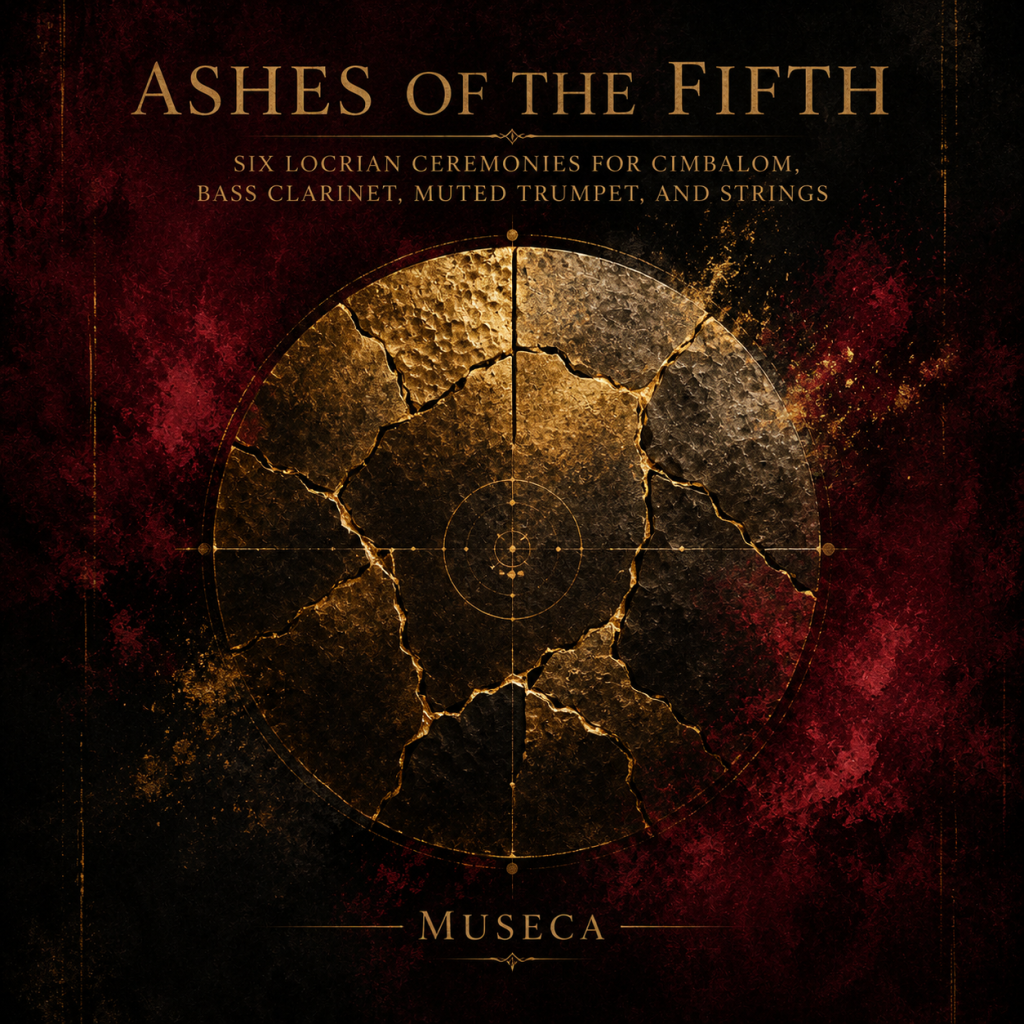
  3. Nocturne for a Broken RootAshes of the Fifth

    Cimbalom, dark woodwind color, muted brass, and strings create a nocturnal chamber meditation on a tonal center with no perfect-fifth support.

  4. Abyssal Romance (Second Bloom Reprise)Dark Matter Cantabile

    The concluding lyrical reprise remains within the album’s C Locrian field. Rather than escaping to Lydian or major-key light, its final sound invites the listener to accept beauty without ordinary arrival.

A composition need not resolve into a familiar consonance to feel complete. Sometimes the music has changed what the listener recognizes as home.

Three listening comparisons

Hear the Difference for Yourself

Return to these pairs after hearing the full collection. They reveal how Locrian stays recognizable while its expressive character changes.

Tracks 02 and 21

One Semitone, Two Worlds

Compare the short piano sketch ♭2 Whisper with the more sustained D♭ Halo. Both place an upper-neighbor semitone at the center of their musical identity.

Tracks 07 and 11

The Violin and the Mute

Hear Locrian’s lyric potential through a soaring violin, then its compact intensity through solo muted trumpet. Tone color transforms the listener’s emotional interpretation.

Tracks 15 and 19

Prayer and Pulse

Contrast the sacred-ambient restraint of Prayer with No Final Amen with the rhythmic confidence of The Body Learns the Abyss. One mode, two different senses of time.

The original Locrian Lounge recordings

Nine Source Albums

The playlist is a new listening narrative assembled from nine existing Museca projects. Each original album retains its own structure and artistic purpose; the links below open the complete works.

Cover artwork associated with The Unsteady Stair: Locrian Studies

E♭ Locrian · Solo piano · A recurring tonal handrail

The Unsteady Stair: Locrian Studies

Eleven concise piano miniatures establish E♭ as an audible center while the flattened second, tritone, silence, and veiled resonance challenge ordinary harmonic arrival.

Cover artwork associated with Locrian Letters

E♭ Locrian · Ten solo voices · Instrumental color

Locrian Letters

Ten solo instrument portraits demonstrate how the same modal identity takes on different emotional qualities through harp, oboe, strings, muted trumpet, bass clarinet, and other timbres.

Cover artwork associated with Dark Matter Cantabile

C Locrian · Singing lines · Half-diminished gravity

Dark Matter Cantabile

A fourteen-part world of lyrical and orchestral Locrian, with C as a recurring center and C half-diminished and D♭ colors providing motion without conventional cadences.

Cover artwork associated with The Mercy of Unfinished Things

C Locrian · Piano and strings · Dissolving endings

The Mercy of Unfinished Things

Eight compact meditations demonstrate how musical coherence can arise through recurring pitch centers, subtle orchestral change, and deliberate refusal of a traditional final cadence.

Cover artwork associated with Door I — Glass Cathedrals

Locrian atmosphere · Luminous suspension · Ambient chamber

Door I — Glass Cathedrals

The first door of the seven-album Locrian series presents the mode as an inhabitable, softly illuminated atmosphere rather than merely a source of harmonic threat.

Cover artwork associated with The Many Rooms of Locrian

Noir jazz · Sacred ambient · Ritual groove

The Many Rooms of Locrian

Six genre encounters share Locrian’s unstable center, including jazz, prayerful minimalism, rhythmic motion, cabaret, and folk-inflected chamber writing.

Cover artwork associated with Door V — Signal Suite

E♭ Locrian · Instrumental signals · Bandoneon

Door V — Signal Suite

A suite of exposed instrumental voices treats breath, bow, attack, register, and resonance as defining expressive features of the same mode.

Cover artwork associated with Door III — Locrian Mechanisms

Proportional rhythm · 3:2 structures · Modal system

Door III — Locrian Mechanisms

A study of Locrian as an organized system rather than a mood, using interlocking rhythmic ratios and musical processes that move without customary harmonic arrival.

Cover artwork associated with Ashes of the Fifth

Cimbalom · Bass clarinet · Muted trumpet · Chamber

Ashes of the Fifth

A six-part chamber world explores the absent perfect fifth through metallic resonance, distant brass signals, low woodwind color, and suspended strings.

Companion music education · Museca Library

From the Listening Room to the Bookshelf

For those interested in the theory underlying this unusual beauty, these two Museca textbooks provide complementary perspectives.

Further exploration

Where to Listen Next

This collection deliberately concludes within Locrian. If you want to explore a change from Locrian to Lydian, visit the separate Seven Doors cycle after finishing the playlist. For comparisons with other unresolved modal worlds, the existing collection Beautifully Unresolved offers a wider perspective.

The brightness-spectrum diagram is a pedagogical interpretation taken from the conceptual framework of The Lumen Arc. Track annotations reflect the documented compositions and their liner notes; no claim is made that every interval in the recordings has been independently transcribed.