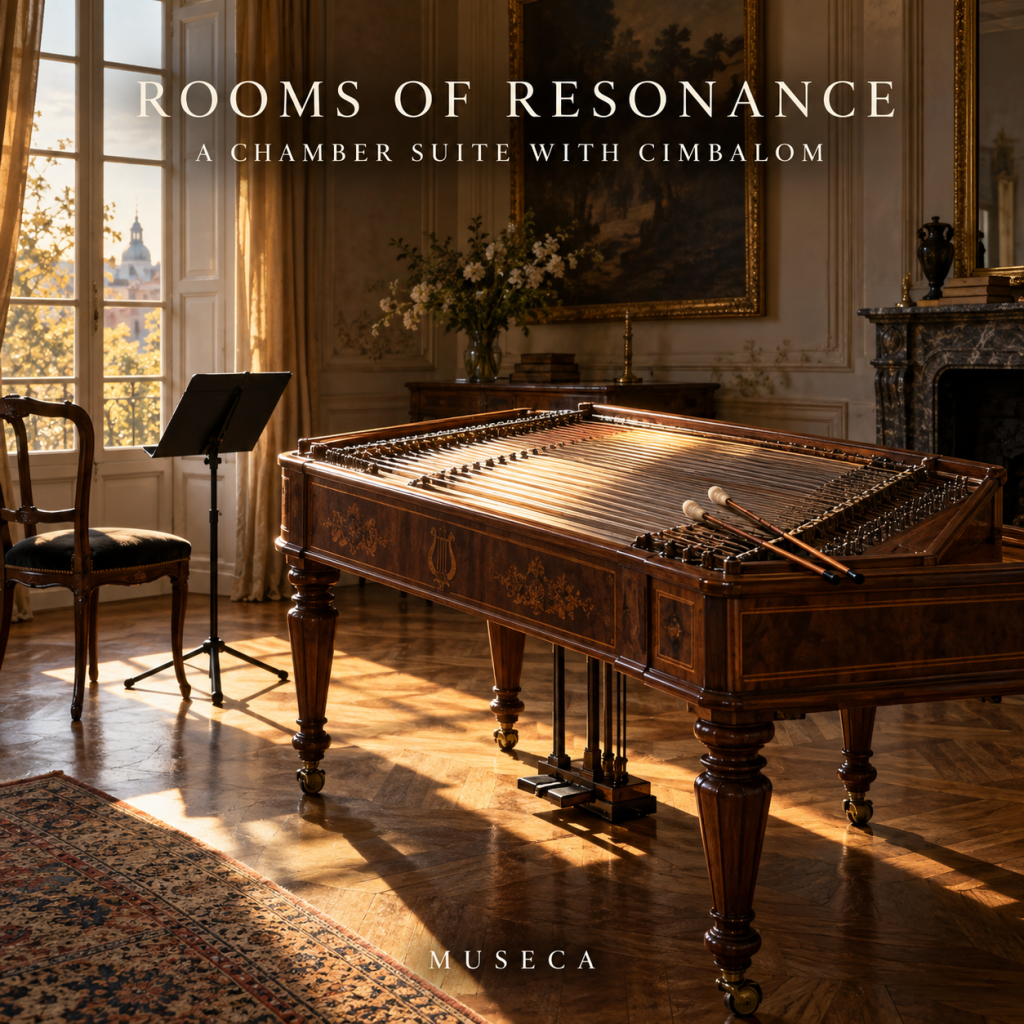
Cimbalom · Chamber ensemble
Rooms of Resonance
A chamber suite in which cimbalom resonance converses with strings, piano, bass clarinet, and carefully placed instrumental colors.

Museca · Curated Listening Collection No. 09
The Art of Musical Dialogue
An instrument can speak. Another can answer, finish its sentence, challenge it, or make silence mean something new. Conversations Without Words invites listeners to hear instrumental parts as characters rather than isolated sounds. Across twenty-four Museca compositions, a cimbalom and its chamber companions share musical space; a sitar and Harmon-muted trumpet respond across traditions; unusual pairings reveal a third, unexpected color; and orchestral ideas travel from voice to voice. The solo harp offers a different perspective: an instrument in conversation with its own resonance and the memory of a larger orchestral world.
The art of dialogue begins with the willingness to hear what another voice is saying.
A musician’s listening guide
Instrumental dialogue is not always a literal question-and-answer melody. It can happen through independent lines, changing tone color, the timing of entrances, and the expressive use of silence. These four listening lenses offer a starting point for each movement.
01 · Gesture
One voice presents a figure; another replies, imitates, completes, or gently contradicts it.
02 · Independence
Two or more lines maintain distinct musical identities while contributing to a shared whole.
03 · Character
Register, attack, resonance, and instrumental color create relationships even when melodies do not exchange.
04 · Attention
A pause can be an invitation; a fading note can create room for another sound to mean more.
The complete collection
Twenty-four existing Museca recordings arranged into one six-movement exploration of musical listening and exchange. Begin with “The Listening Room,” and follow how the instrumental relationships become increasingly varied.
All compositions are by Museca. The curated Cue playlist references existing audio files from the original album pages; no duplicate recordings were uploaded.
An inquiry in six movements
Each composition includes a brief listening prompt. These notes are questions and perspectives intended to encourage discovery, not to dictate a single interpretation of the music.
Tracks 01–04 · Presence · Attention · The first gesture
A conversation begins not with virtuosity, but with the ability to hear another voice. The cimbalom opens the space, sitar and muted trumpet meet as equals, and woodwind colors become characters in their own right.
Start with listening itself. Notice how the cimbalom’s ringing sound leaves room for another voice to enter.
Hear how the sitar and Harmon-muted trumpet establish a shared space without surrendering their different identities.
Listen for how one woodwind’s distinctive color changes the emotional meaning of the surrounding ensemble.
Treat the idea of a mirror as an invitation: what does one instrumental color reveal about another?
Tracks 05–08 · Contrast · Complement · An emerging response
Contrasting instrumental attacks, registers, and expressive shapes begin to cooperate. A cello meets a horn; the cimbalom prompts a new idea; even a solo harp suggests dialogue through echo and memory.
Attend to the different attacks and decays of the paired sounds—how does one voice make space for the next?
Compare the cello’s string voice with the horn’s brass warmth. When do they blend, and when do they remain separate?
A modest musical gesture can start a conversation. Follow how it invites another idea rather than merely repeating.
A solo harp can answer itself through returning figures, resonance, and the memory of a previous phrase.
Tracks 09–12 · Rare pairings · Timbral identity · Night
Unusual partners challenge the ear’s expectations. Instead of blending everything into sameness, these compositions make a virtue of difference—sometimes with a shared mood, sometimes with an audible distance.
Listen for the tension between fragile color and expressive weight in an unusual instrumental partnership.
Notice the apparent distance between instrumental gestures and the way their placement can imply coded exchange.
Sitar and muted trumpet share the same nocturnal atmosphere while retaining distinct articulation and phrasing.
How does the color of a reed-like voice interact with the softness of the surrounding musical texture?
Tracks 13–16 · Counterpoint · Exchange · Transformation
Musical dialogue becomes more intricate. Distinct lines coexist, ideas travel across an orchestra, contrasting sonorities illuminate one another, and a nocturnal duet demonstrates the expressive role of restraint.
Try following one line without losing the other. Musical independence can produce cooperation rather than conflict.
Hear how an idea can change character as it passes among instrumental families.
Listen for contrast as a relationship: each timbre can make the other seem warmer, cooler, sharper, or softer.
Return to the sitar–trumpet duet and consider how silence between phrases contributes to their exchange.
Tracks 17–20 · Variation · Collective voice · A larger horizon
The conversation widens. Variation changes an idea’s identity, a choir of winds shares a musical breath, unusual pairings become an ensemble, and a solitary harp recalls a grander Romantic world.
Hear how a musical thought changes when another voice, register, or texture reframes it.
Instead of one soloist, listen for several wind voices shaping a shared harmonic and melodic space.
Think of the ensemble as a workshop: distinct musical materials are assembled into one evolving texture.
The solo harp introduces a different kind of dialogue, between present melody and remembered emotion.
Tracks 21–24 · Decay · Listening space · The afterword
The final movement asks a subtle question: when does the conversation end? Resonance continues after a note, a drone creates space for a new response, and the last harp nocturne leaves the final thought suspended.
Listen to what continues after an attack fades. Silence can carry the next question.
A continuing resonance creates a space in which small changes can become acts of response.
Listen for a conversation sustained not by urgency, but by patience and contrasting instrumental breath.
The closing solo-harp voice leaves the dialogue inside one instrument: a remembered phrase becomes its own answer.
The original musical worlds
Five album families are represented here, with both volumes of Arcana Pairings included. Follow each artwork to explore the original album and its independent musical identity.
Cimbalom · Chamber ensemble
A chamber suite in which cimbalom resonance converses with strings, piano, bass clarinet, and carefully placed instrumental colors.
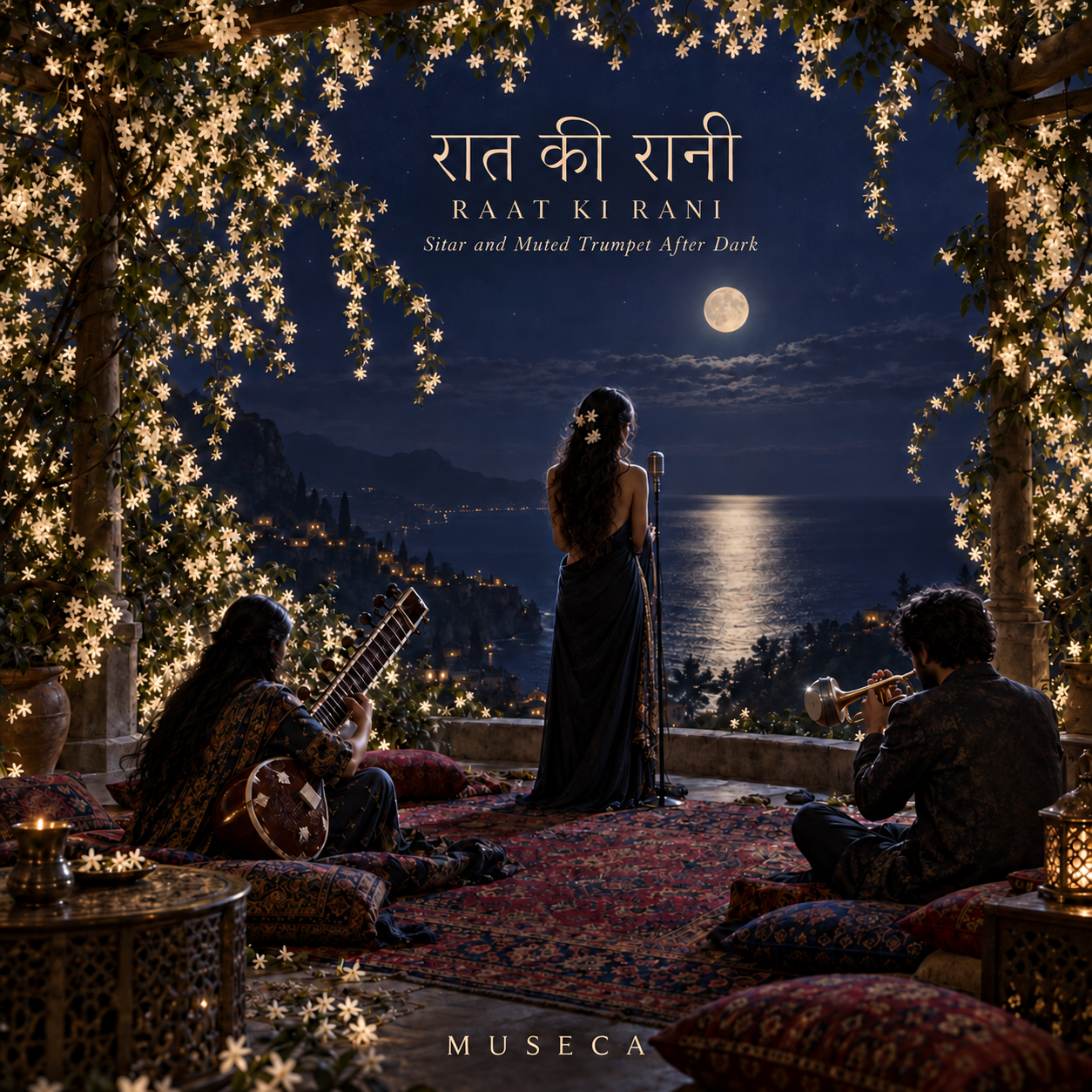
Sitar · Harmon-muted trumpet
Two distinctive voices—one plucked, one breathed—meet as equal partners in the changing atmosphere of night.
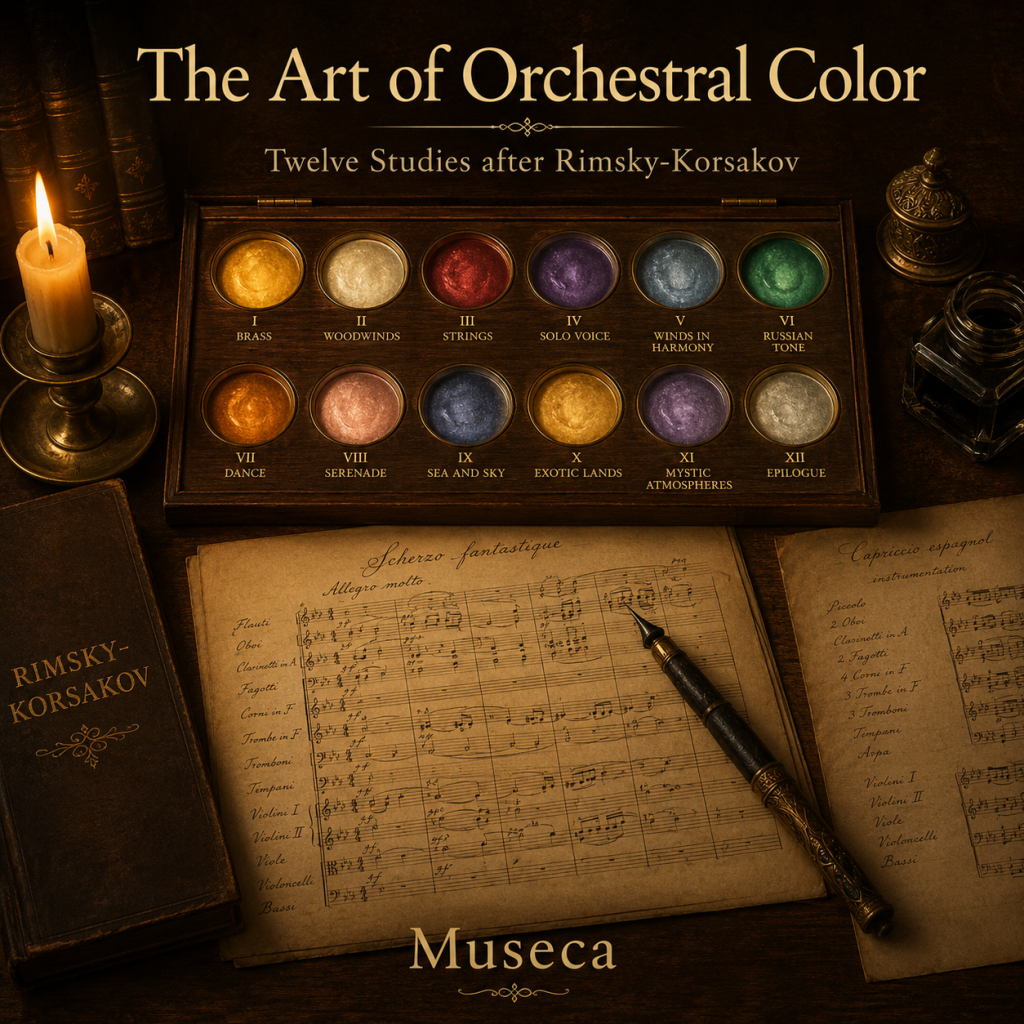
Orchestration · Timbre · Ensemble
A collection of studies in the expressive personalities of instrumental families, voicing, blending, contrast, and restraint.
Rare pairings · Acoustic imagination
Unconventional musical partnerships reveal the expressive possibilities of contrasting breath, bow, pluck, resonance, and silence.
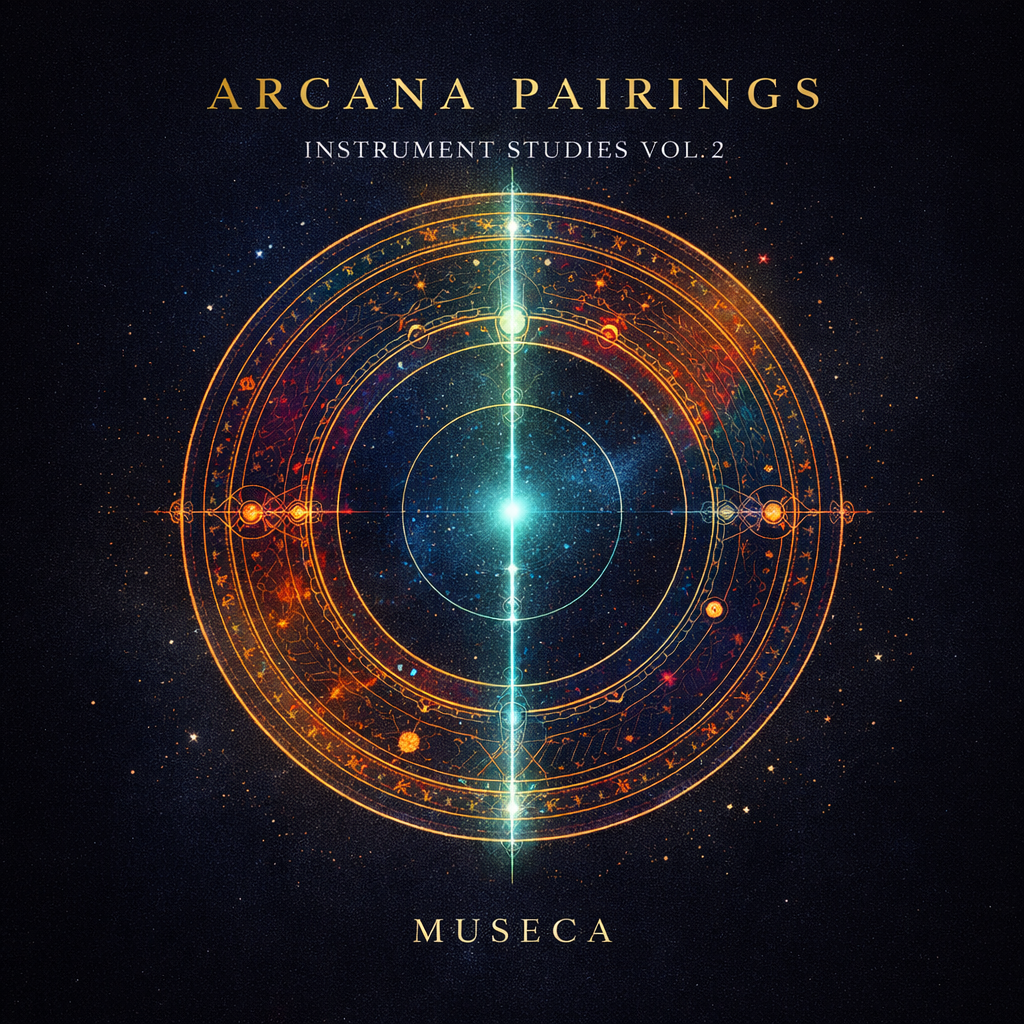
Hybrid textures · Instrumental experiments
A second collection of unusual partners explores unexpected blends of antique resonances, reeds, metallic color, and modern space.
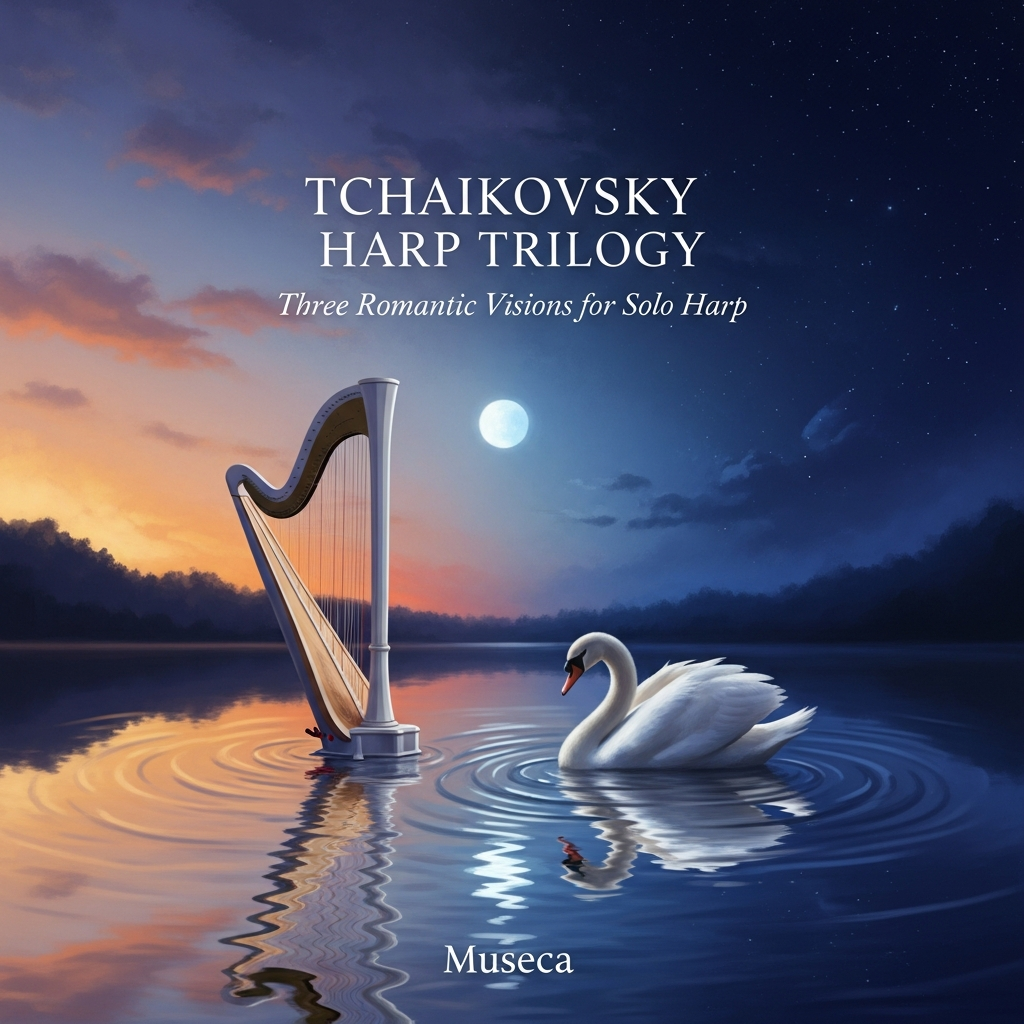
Solo harp · Memory · Inner dialogue
Three intimate solo-harp pieces converse with their own echoes and the memory of a wider Romantic orchestral language.
Companion reading · Museca Library
For listeners who would like to go deeper, this Museca textbook explores how instruments produce their characteristic sounds, how they function within ensembles, and how compatible or unexpectedly contrasting instruments can be paired to create new expressive possibilities. It makes a natural companion to the listening methods explored in Conversations Without Words.
Explore Comprehensive Instrument Studies