
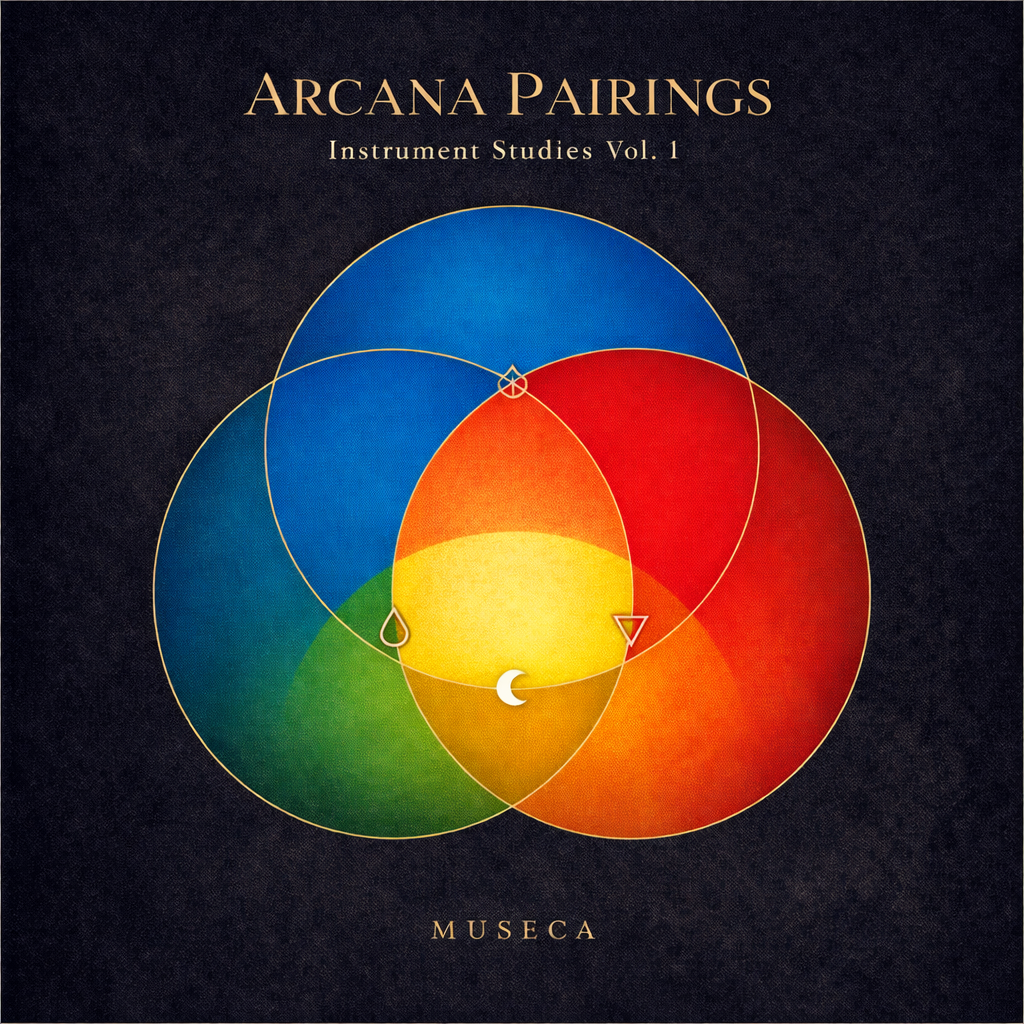
Arcana Pairings Vol. 1, is a Museca album built on a simple compositional wager: that the most distinctive new soundscapes often emerge not from adding more instruments, but from choosing unusual partners and giving each a clear job to do. These pieces begin as “pairing recipes”—carefully selected combinations of timbre, register, and envelope that naturally interlock: breath against bow, pluck against velvet wind, struck shimmer against drone, punctuated rhythm against spacious silence.
The term “esoteric” here does not mean obscure for its own sake. It means specific—instruments whose voices carry strong identities, and whose blends are rarely heard together in conventional ensembles. By pairing them across traditions and imagining them in a shared chamber space, the music reveals new emotional geometries: lament that feels intimate rather than grand, trance that remains delicate instead of loud, noir that whispers instead of declares. Each track is organized around a disciplined role split—lead, bed, pulse, punctuation—so the ear can follow the architecture even as the colors feel unfamiliar.
What results is not a museum of world instruments, nor an attempt at ethnographic authenticity. It is a set of timbre-first studies: nocturnes, laments, ritual rooms, desert minimalism, pointillist suspense—each one a small world where the instruments do not merely coexist, but converse. The album invites listening the way one reads a book of strange constellations: not to recognize what you already know, but to discover how new combinations can reshape the sky.
Liner Notes
Breath Cloud Shrine
Pairing: shakuhachi (bamboo flute) + viola/cello + shō (subbed as airy reed-organ pad).
This pairing is built around breath meeting sustain. The shakuhachi leads with tone that includes air, grain, and silence—an instrument that sounds as if it is thinking. The viola/cello provides the human warmth and continuous line that the breath cannot hold for long, while the shō-style chord cloud turns harmony into atmosphere rather than progression. Together they create a sacred “room” where melody is a ritual gesture, the strings are the body, and the shō is the architecture.
Ash of Pomegranates
Pairing: duduk (subbed as oboe/English horn) + low strings + frame drum (daf/bendir).
Here the lead voice is chosen for its near-vocal sadness—duduk’s mournful character translated through oboe/English horn phrasing. Low strings are paired not for drama, but for compassion: a warm, steady bed that absorbs the reed’s grief without competing. The frame drum is the crucial third element, supplying a soft heartbeat that keeps the lament grounded and inevitable. The result is longing with structure—emotion that moves forward one pulse at a time.
Nocturne of Velvet Reed
Pairing: koto (subbed as plucked zither/harp) + bass clarinet + vibraphone/soft mallets.
This is a study in contrast between shimmer and shadow. The koto-like plucked instrument provides glittering articulation and rhythmic identity—tiny sparks in the dark. Bass clarinet is paired because it can be both harmonic and textural: a “dark velvet” voice that wraps around the plucks, extending them into a continuous nocturnal line. Vibraphone adds a glassy halo, not as melody but as afterimage, turning every gesture into a lingering glow.
Glass Fairytale, Bitter-Sweet
Pairing: santur (hammered dulcimer) + harp + bassoon.
Santur and harp share resonance, but with opposite attacks: one strikes, one releases. That tension is the core of the soundscape—sparkle against wash, point against shimmer. Bassoon is paired as the grounding storyteller: woody, lyrical, and slightly ironic, capable of carrying tenderness without sentimentality. The combination creates a fairytale color palette that feels beautiful and haunted at once, as if the story knows its ending.
Quartz Trance Study
Pairing: mbira (subbed as kalimba) + string quartet (con sordino).
This track is designed around interlock. Mbira’s repeating patterns generate a trance that does not rely on volume—just inevitability. Muted strings are paired because they can become a living pad without overt orchestral drama; con sordino turns the quartet into breathy velvet, a soft harmonic fog that supports the metallic clarity of the mbira. Together they produce “trance clarity”: hypnotic motion with intimate dynamics, like light passing through crystal.
Tender Ache Engine
Pairing: erhu (subbed as violin with erhu-like slides) + English horn + drone bed (harmonium/shō/synth).
Erhu’s power is its crying glide between pitches—emotion in the spaces between notes. English horn is paired as a second, slower voice with a different kind of sorrow: less cry, more confession. The drone bed is essential because it removes the need for harmonic “events,” allowing the pain to unfold in long arcs without resolution tricks. This pairing makes ache feel tender rather than tragic: two voices suspended over a steady, compassionate floor.
Desert Minimal: Deep Line
Pairing: ney (subbed as breathy flute) + contrabass + delicate hand percussion (riq/shaker).
This is a register-and-air pairing. The ney-like flute lives in breath and fragility; it needs a foundation that does not crowd it. Contrabass is paired as a deep horizon—drones and sparse pizzicato that define space without filling it. Light hand percussion supplies a dry micro-groove, giving the piece a sense of walking without ever turning it into a beat-driven track. The blend creates desert minimalism: wide air, deep ground, and small human time.
Cabaret Mask (Brushes & Silk)
Pairing: shamisen (subbed as plucked mandolin/banjo attack) + brushed snare + double bass.
This pairing is about percussive charm. The shamisen-like lead is chosen for its snap and theatrical bite—melody that arrives as rhythm. Brushed snare is paired to keep the groove intimate and sly, like a cigarette-smoke swing rather than a jazz club shout. Double bass anchors the scene with elegant understatement, allowing the plucked lead to flirt, mock, and wink without losing the floor. The result is “cabaret-meets-theatre”: playful sophistication with a shadow behind the smile.
Luminous Stillness (Tanpura Room)
Pairing: bansuri (bamboo flute) + tanpura/sitar drone + very sparse felt piano (as punctuation).
This track is built on drone as truth. The tanpura bed provides a stable center that turns harmony into a continuous glow rather than a sequence of chords. Bansuri is paired because its breathy tone naturally merges with drone shimmer; it can float without needing harmonic motion. Piano appears only as punctuation—gentle commas at the ends of phrases—so the modern element does not become the lead. The pairing yields luminous stillness: a room where time is held, not measured.
Noir Pointillism
Pairing: muted trumpet + bass clarinet + vibraphone (+ brushed kit/upright bass as support).
This is a noir palette made from “dots” rather than lines. Muted trumpet is paired for its intimate edge—brass that whispers and questions instead of declaring. Bass clarinet provides the shadow architecture: low, velvety counterlines that suggest danger without volume. Vibraphone is the light on wet pavement—glassy sustain that turns short notes into lingering suspense. Together they form pointillist tension: the story is told in fragments, and the silence between them does as much work as the notes.
Playlist
- Track 1 — Breath Cloud Shrine Museca 4:38
- Track 2 — Ash of Pomegranates Museca 4:14
- Track 3 — Nocturne of Velvet Reed Museca 3:40
- Track 4 — Glass Fairytale, Bitter-Sweet Museca 2:59
- Track 5 — Quartz Trance Study Museca 4:12
- Track 6 — Tender Ache Engine Museca 3:48
- Track 7 — Desert Minimal: Deep Line Museca 4:09
- Track 8 — Cabaret Mask (Brushes & Silk) Museca 3:25
- Track 9 — Luminous Stillness (Tanpura Room) Museca 4:27
- Track 10 — Noir Pointillism Museca 3:43
Vol. 1 Instrumentation Map (Track → Instruments)
| Track | Instruments (Wikipedia links) |
|---|
| 1. Phoenix Breath Study | Shakuhachi · Viola (or Cello) · Shō |
| 2. Lament Thread Study | Duduk · Low strings: Cello + Double bass · Frame drum family: Frame drum (incl. Daf, Bendir) |
| 3. Nocturnal Lacquer Study | Koto · Bass clarinet · Soft mallets: Vibraphone (or Marimba) |
| 4. Bittersweet Fairytale Study | Santur (or Hammered dulcimer) · Harp · Bassoon |
| 5. Mute Constellations Study | Mbira · String quartet · Mute (music) |
| 6. Tender Ache Study | Erhu · Cor anglais (English horn) · Drone bed: Harmonium (or Synthesizer) |
| 7. Desert Minimalism Study | Ney · Double bass · Hand percussion: Riq (or Shaker ) |
| 8. Cabaret-Meet-Theatre Study | Shamisen · Snare drum + Brush (percussion) · Double bass |
| 10. Noir Suspense Study | Trumpet + Mute (music) · Bass clarinet · Vibraphone |