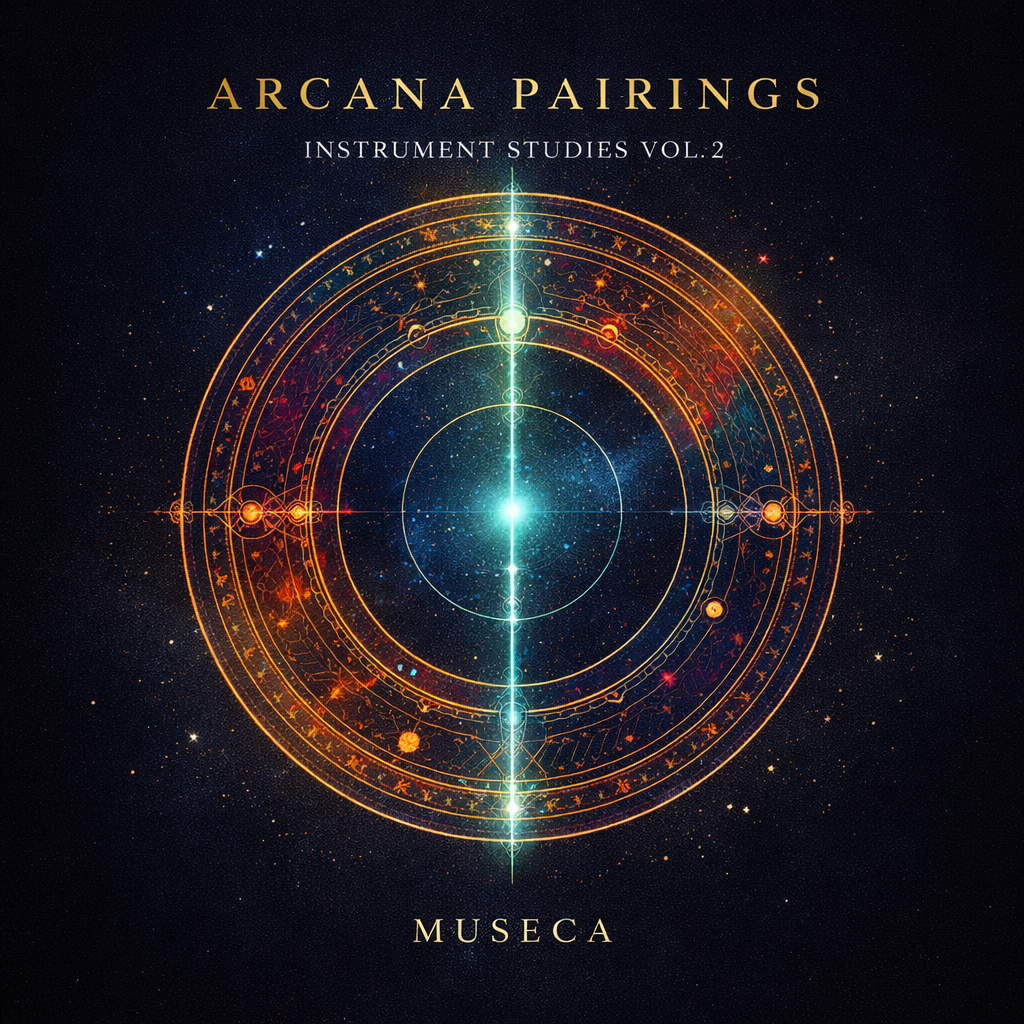
Arcana Pairings: Instrument Studies Vol. 2 continues the project’s central premise: that the most original soundscapes are often created not by adding more layers, but by choosing unlikely partners—and letting their natural acoustics do the storytelling. Each track is built as a controlled experiment in timbre: breath against metal, antique resonance against modern space, folk engines set inside chamber-like restraint. The goal is not novelty for its own sake, but the discovery of new blend zones—places where two unfamiliar voices fuse into a third, more interesting identity.
Where Vol. 1 established the language of “esoteric pairings,” Vol. 2 expands the palette into new territories: deeper low-end instruments, more fragile high-frequency shimmer, and hybrid textures that feel both ancient and engineered. Some pairings behave like coded signals—celesta glints over subterranean winds—while others feel like lost ensembles resurrected in a modern room: glassy harmonics, gut-string warmth, reed choirs, and hand-played pulses that imply time without overpowering it. Throughout the album, each combination is organized by a clear role split—lead, bed, pulse, punctuation—so even the strangest blends remain legible and intentional.
This volume is best approached like a cabinet of curated artifacts: ten small worlds with distinct atmospheres, each one defined by the chemistry of its chosen instruments. These are not genre tracks as much as sonic chambers—places where timbre becomes narrative, and pairing becomes composition.
Liner Notes
The Cipher Lantern
Pairing: Bass flute (alto flute color) + Contrabassoon (tuba/bassoon weight) + Celesta
This pairing is designed as a signal-and-shadow soundscape: breathy low flute as the carrier wave, a subterranean low-wind foundation that feels more like gravity than melody, and celesta as the “coded light” that flickers through the texture. The result is intimate but cinematic—soft illumination moving across a dark floor, where the smallest high notes feel consequential.
Salt Cathedral
Pairing: Glass harmonica shimmer (celesta + airy synth) + Viola da gamba warmth (gut-string cello color) + Theorbo plucks (lute/classical guitar)
Here the goal is fragile resonance—tones that seem to glow and dissolve. The glass layer provides the crystalline halo, the gamba-like strings bring antique human warmth, and the theorbo/lute plucks add quiet architectural detail, like footsteps on stone. The blend reads as sacred without being ecclesiastical: an “alchemy page” of harmonics, air, and wood.
The Reed Mirror
Pairing: Soprano saxophone + Accordion + Glockenspiel (light) + Brush kit (support)
This is an elegant contradiction: a bright, focused reed against an instrument that literally breathes chords. The accordion acts as living harmony—pulsing, sighing, and reshaping the air around the sax—while glockenspiel provides small reflective flashes, like glints in a mirror. Brushes keep time without declaring it, preserving the dream-cabaret balance between poise and unease.
Oracle on the Wire
Pairing: Hardanger-fiddle spirit (fiddle/violin with sympathetic resonance) + Nyckelharpa color (bowed-string choir) + Bodhrán pulse + Drone undertone
Two bowed folk timbres are paired for their complementary “grain”: one sings bright and direct, the other speaks through reedy resonance and inner motion. The soft drum grounds the track in ritual time—steady, earthy, never showy—while the drone creates the sensation of an old signal continuing beneath the surface. It feels like folklore translated into a precise chamber study.
Wind Over Stone
Pairing: Uilleann pipes (or intimate bagpipe color) + Hurdy-gurdy drone engine (accordion + bowed strings substitute) + Bone-click/woodblock punctuation
This pairing is about continuous tone and weather. The pipes supply a voice that is both melodic and already harmonized by its own drone logic. The hurdy-gurdy engine deepens that continuity into a turning, mechanical breath—ancient machinery—while small percussive clicks mark the edges like stones underfoot. The sound is old-world, but the framing is modern: restrained, spacious, and cinematic.
Ember & Ivory
Pairing: Kaval / wooden shepherd flute + Qanun / zither shimmer + Darbuka fingertip groove + Dark low pad
Dry air meets bright metal. The shepherd flute leads with a direct, human line that benefits from space; the qanun-like plucks supply luminous filigree without stealing focus. A fingertip drum groove provides motion that stays intimate rather than “club,” and the low pad functions like dusk—warming the edges and holding the whole scene in a single atmosphere.
The Astral Workshop
Pairing: Oud (nylon guitar substitute) + Kamancheh voice (violin substitute) + Tabla groove + Subtle drone
This is the most “crafted” chamber of the volume: plucked micro-ornaments and bowed vocal lines interlock over articulate hand rhythm. The oud provides elegant geometry—quick turns, precise attacks—while the bowed line brings breath and emotional contour. Tabla gives the piece its intelligence: complex enough to feel alive, controlled enough to stay transparent. It reads like artisanship in motion—intricate, not busy.
Bone Choir Minimal
Pairing: Bass recorder (recorder color) + Serpent/low brass shadow (tuba substitute) + Small church organ bed
Three breath-based voices create a “choir” without singers. The recorder line is pale and human, the low brass is a slow-moving shadow, and the organ bed is the air that holds them together. Because there is almost no percussion, the ear starts to hear timbre as harmony—small changes in breath, attack, and resonance become the narrative. It is minimalism as devotion: focused, dark-warm, and quietly inexorable.
The Luminous Trapdoor
Pairing: Clavichord intimacy (harpsichord substitute) + Muted trombone whispers + Handpan pulse
This pairing lives on the edge of elegance and strangeness. The antique keyboard sound provides close, tactile articulation—music you can almost feel under the fingertips—while muted trombone adds a surreal vocal quality, like a thought spoken under the breath. Handpan gives a soft, luminous pulse that feels ceremonial rather than percussive. The “trapdoor” is the moment these three disparate identities suddenly agree and become one mood.
Glass Meridian
Pairing: Ondes Martenot aura (theremin/analog synth substitute) + Bass trombone bed + Tubular bells + Bowed cymbal shimmer
A line of light across deep shadow. The ondes/theremin-like lead is chosen for its uncanny continuity—pitch that feels like it’s being poured rather than played. Bass trombone supplies weight without aggression, turning the low end into a calm tectonic plate. Bells and bowed cymbal create the “glass” layer: distant, ceremonial highlights that suspend time. The track becomes a meridian—an axis where sacred timbre meets futuristic space.
Playlist
- Track 1 — The Cipher Lantern Museca 2:14
- Track 2 — Salt Cathedral Museca 2:38
- Track 3 — The Reed Mirror Museca 2:36
- Track 4 — Oracle on the Wire Museca 3:32
- Track 5 — Wind Over Stone Museca 3:35
- Track 6 — Ember & Ivory Museca 3:50
- Track 7 — The Astral Workshop Museca 3:36
- Track 8 — Bone Choir Minimal Museca 2:15
- Track 9 — The Luminous Trapdoor Museca 3:40
- Track 10 — Glass Meridian Museca 4:15
Vol. 2 Instrumentation Map (Track → Instruments)
| Track | Instruments (Wikipedia links) |
|---|---|
| 1. The Cipher Lantern | Bass flute · Contrabassoon · Celesta |
| 2. Salt Cathedral | Glass harmonica · Viola da gamba (viol) · Theorbo |
| 3. The Reed Mirror | Soprano saxophone · Accordion · Glockenspiel |
| 4. Oracle on the Wire | Hardanger fiddle · Nyckelharpa · Bodhrán |
| 5. Wind Over Stone | Uilleann pipes · Hurdy-gurdy · Woodblock (for “bone-click” punctuation) |
| 6. Ember & Ivory | Kaval · Qanun · Darbuka |
| 7. The Astral Workshop | Oud · Kamancheh · Tabla |
| 8. Bone Choir Minimal | Recorder (bass recorder) · Serpent · Pipe organ |
| 9. The Luminous Trapdoor | Clavichord · Trombone (with Mute (music)) (Wikipedia) · Handpan |
| 10. Glass Meridian | Ondes Martenot · Bass trombone · Tubular bells · Cymbal (bowed cymbal technique) |