
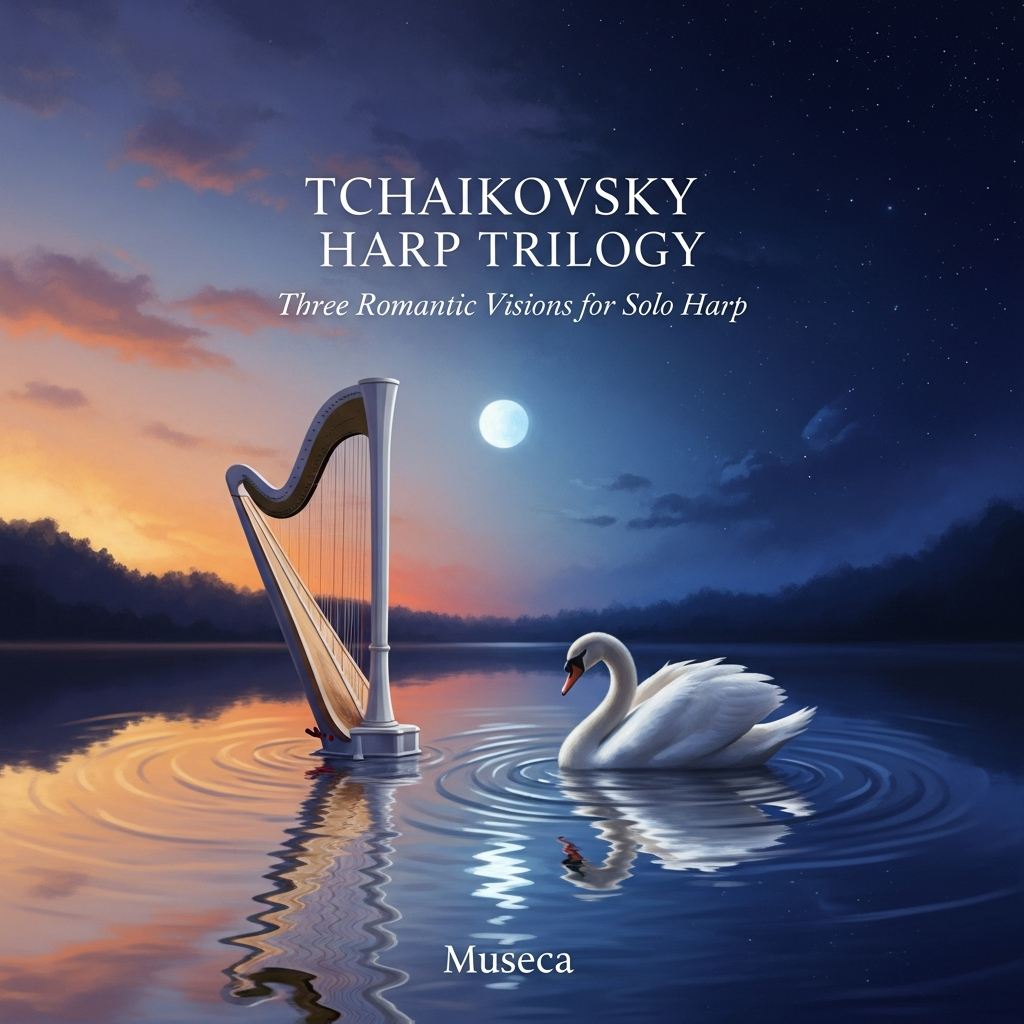
Three Romantic Visions for Solo Harp Inspired by Pyotr Ilyich Tchaikovsky
Introduction: The Soul of the Romantic Harp
In the music of Pyotr Ilyich Tchaikovsky, emotion is both confession and craft — a dialogue between the heart’s private tremors and the public language of melody.
The harp, though never Tchaikovsky’s primary instrument, held a special role in his orchestral imagination.
It was the voice of the ineffable, the shimmer that appears when feeling surpasses articulation.
In his ballets and symphonies alike, the harp stands where words fail: between love and loss, dream and memory.
The Tchaikovsky Harp Trilogy is an act of translation — not from one language to another, but from the symphonic to the intimate, from orchestral grandeur to the solitary breath of a single instrument.
In these three pieces, Museca distills the essence of Tchaikovsky’s Romantic world — its tenderness, nostalgia, and tragedy — into a pure harp language that feels both timeless and reborn.
The trilogy unfolds as a cycle of emotional metamorphosis:
- Ballad for the Sleeping Swan opens in serenity — a reverie drawn from the luminous stillness of Swan Lake and The Sleeping Beauty.
Its melody moves like water, revealing the lyric heart that beat beneath Tchaikovsky’s ballet scores. - The Waltz of Memory recalls the elegant melancholy of a vanished ballroom — a graceful dance where joy and remembrance are inseparable.
It is not the waltz of celebration, but the waltz of reflection — a turning of time itself. - Nocturne of the Fallen Swan closes the cycle in the twilight key of B minor, echoing the desolation and release of the Pathétique Symphony.
Here, sorrow becomes beauty, and beauty becomes silence.
Together, the three works form a triptych of transformation — love remembered, love idealized, love transcended.
They trace a path familiar to every Romantic soul: from the awakening of feeling to the acceptance of its impermanence.
If Tchaikovsky’s music often sought solace in orchestral fullness, Museca’s harp finds it in resonant solitude — each plucked string a confession, each decay a benediction.
In sound and spirit, this album is both homage and conversation: a meditation on the tenderness of vulnerability, the gravity of beauty, and the eternal human need to turn pain into music.
“The harp was Tchaikovsky’s confidant — the instrument he used when words failed him.”
Ballad for the Sleeping Swan
Andante cantabile – D♭ major
The harp sings alone at twilight. Its melody drifts like a swan’s reflection over mirrored water.
Soft, rolling arpeggios breathe with the rhythm of memory; each note falls gently into the next — a remembrance of love suspended in stillness.
The Waltz of Memory
Moderato grazioso – G major
A graceful waltz spins through light and dust — delicate, nostalgic, radiant.
Each phrase rises and fades like the echo of laughter once heard beneath chandeliers.
Nocturne of the Fallen Swan
Adagio doloroso – B minor
The night descends with tenderness. Deep arpeggios pulse like a heartbeat; the melody trembles and sighs.
From sorrow it rises toward peace — a final harmonic glissando tracing the path of a soul ascending into quiet light.
Playlist
- Ballad for the Sleeping Swan Museca 2:28
- The Waltz of Memory Museca 2:08
- Nocturne of the Fallen Swan Museca 1:27