Original soundtrack to the novella in eight scenes
A composer sits at the back of a rehearsal hall, listening to his own music played exactly as he wrote it, and feels nothing but the effort of remembering when he decided it should sound that way. In the percussion there is a figure of seven measured strikes where an eighth would complete the pattern. He cannot remember writing it. That night, in a car at a crossing, something taps the window seven times. He waits for the eighth.
What he finds instead is a city where every piece of music is unfinished. Pianos stop before the fourth note. Rehearsal rooms stand ready for players who never arrive. And page by page, a symphony he has never written but seems always to have been trying to write is being assembled for him — by a child who doesn’t know the ending yet, a young man who has already smoothed it over, and a conductor who can show him the whole, for a price he only begins to understand once he has started paying it.
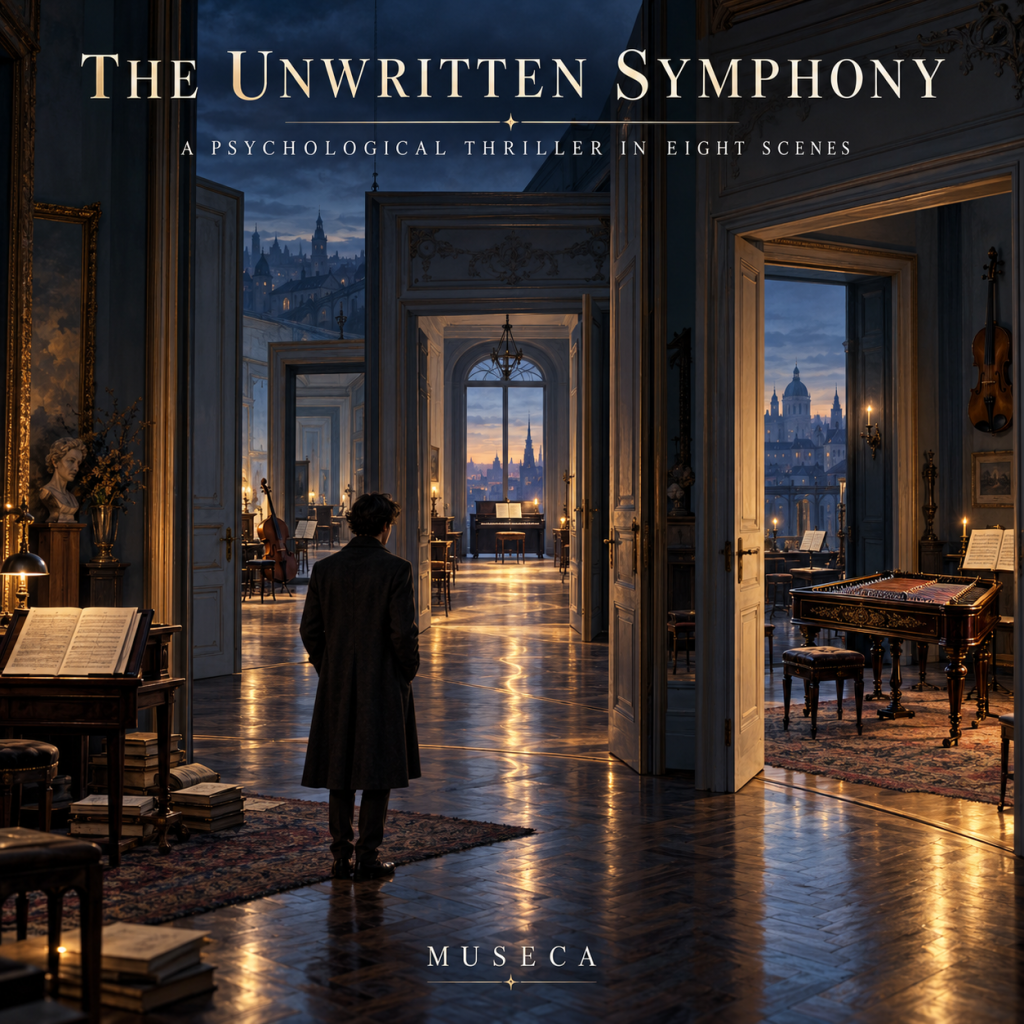
The Unwritten Symphony is an album in eight tracks, one for each scene of the novella, sharing its titles. It opens in the rehearsal hall of The Missing Measure and ends in the orchestra of The Transcendence Symphony; between them it follows Leon Arlen through the city — the uneven tune of The Child at the Piano, the polished cadence of The First Compromise, the full orchestra of The Conductor’s Promise, the silence of the café in The Man Without a Title, and the door that waits at the end of The Door Without a Score. The seven-note figure runs through all of it. So does the gap after the seventh.
The album can be heard on its own, in order, as a single arc. It can also be played alongside the book, one track per chapter, before or after each scene is read. Either way it ends the same place the novella does: with a note that arrives late, and quietly, and leaves open the question of who played it.
Read the Full Novella
The album leaves room for listeners to imagine the spaces between its scenes. The companion novella tells the composer’s journey in full prose, from the life he has built to the decision awaiting him at the edge of the unfamiliar city. Download the novella as a PDF to follow the complete story. It reveals the album’s ending.
Liner Notes
The Missing Measure A rehearsal hall, an orchestra playing a passage exactly as it was written, and a composer at the back of the room who can no longer remember deciding it should sound that way. In the percussion, seven measured strikes where an eighth would complete the pattern. He did not write the eighth, and he cannot remember leaving it out. That night, at a crossing, something taps the car window seven times. The album begins where the count stops.
The City of Unfinished Music Leon wakes under an awning in a city where every piece of music breaks off before its end. Pianos stop before the fourth note. A notebook in his pocket already carries a warning in his own hand. In a long room he finds a single manuscript page headed Transcendence Symphony, plays it, and says the words that will cost him — and in the silence after the seventh strike, for the first time, something reaches him from the other side.
The Child at the Piano The smallest room in the city and the only honest music in it: a boy with one finger on each hand, playing a tune that rises, falls by an interval no one would choose, and stops. Which is the right ending? — I don’t know yet. For a few minutes Leon sits on the bench and plays the wrong note on purpose, and learns from a child that you can like a thing before it is done. Then the strikes come, and the boy looks up as if a name has been called in another room.
The First Compromise A young man at a piano smooths the child’s tune into something an audience would applaud. He is not wrong, and that is the trouble. Leon claims a second page, and the price is the sound of his sister’s voice — and when a woman calls to him through the silence after the seventh strike, he no longer knows who she is. The listener does. This is where the album turns.
The Conductor’s Promise The full hall. A conductor who can preserve the child’s hesitation when he chooses to, and who chooses not to. Here the city’s symphony is heard whole for the first time, and it is extraordinary, and it is being assembled out of what Leon has given up. The house isn’t gone. Her voice isn’t gone. Listen. The measure, he is told, has to end eventually. The strikes are closer together now.
The Man Without a Title No music at all, at first. A café at the edge of a square, a man with a face you forget as soon as you look away, and a list in Leon’s own handwriting of everything he was prepared to lose and in what order. The quietest track on the album holds the one plain sentence the book allows itself: The one calling you doesn’t know your work.
The Door Without a Score A small performance room, the pages of the symphony laid in an arc on the floor, one space in the arc still empty, and behind the piano a door with no light beneath it. The conductor brings the final page. What is inside it is the most beautiful thing Leon has ever heard, and the most dangerous. The last of the seven strikes, and the longest silence on the album.
The Transcendence Symphony Someone is speaking his name. The final track is the only finished piece of music in the story — the symphony Leon writes afterward, with a cimbalom for the seven-note figure and an orchestra that has learned to wait. It is not the music he heard in the city. He could not say whether the city gave him any music at all. It ends with a note that arrives late, and quietly, and no one is sure who played it.
Playlist
The Missing MeasureMuseca3:14
The City of Unfinished MusicMuseca3:10
The Child at the PianoMuseca4:24
The First CompromiseMuseca3:28
The Conductor’s PromiseMuseca3:14
The Man Without a TitleMuseca3:40
The Door Without a ScoreMuseca3:30
The Transcendence SymphonyMuseca3:34
Continue exploring
Beyond the unfinished score
Follow the cimbalom into another chamber setting, stay with an imagined nocturnal journey, or explore the musical craft of psychological shadow.
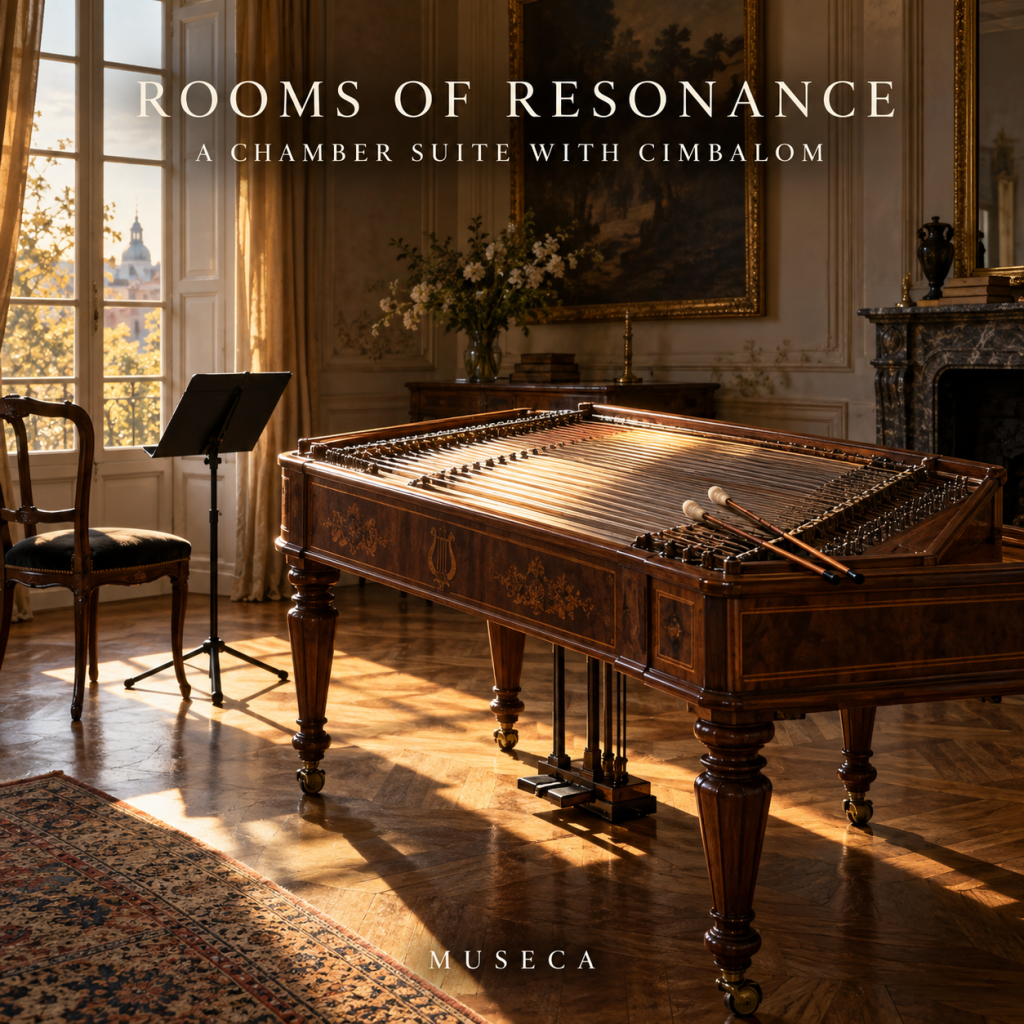
Let the Hungarian concert cimbalom lead eight chamber movements focused on resonance, gesture, and changing instrumental relationships. The instrument steps from the drama into a more open musical study.
A cello and piano travel through imagined roads, distant lights, and uncertain crossings. Continue the experience of music as a landscape whose destination remains open to the listener.
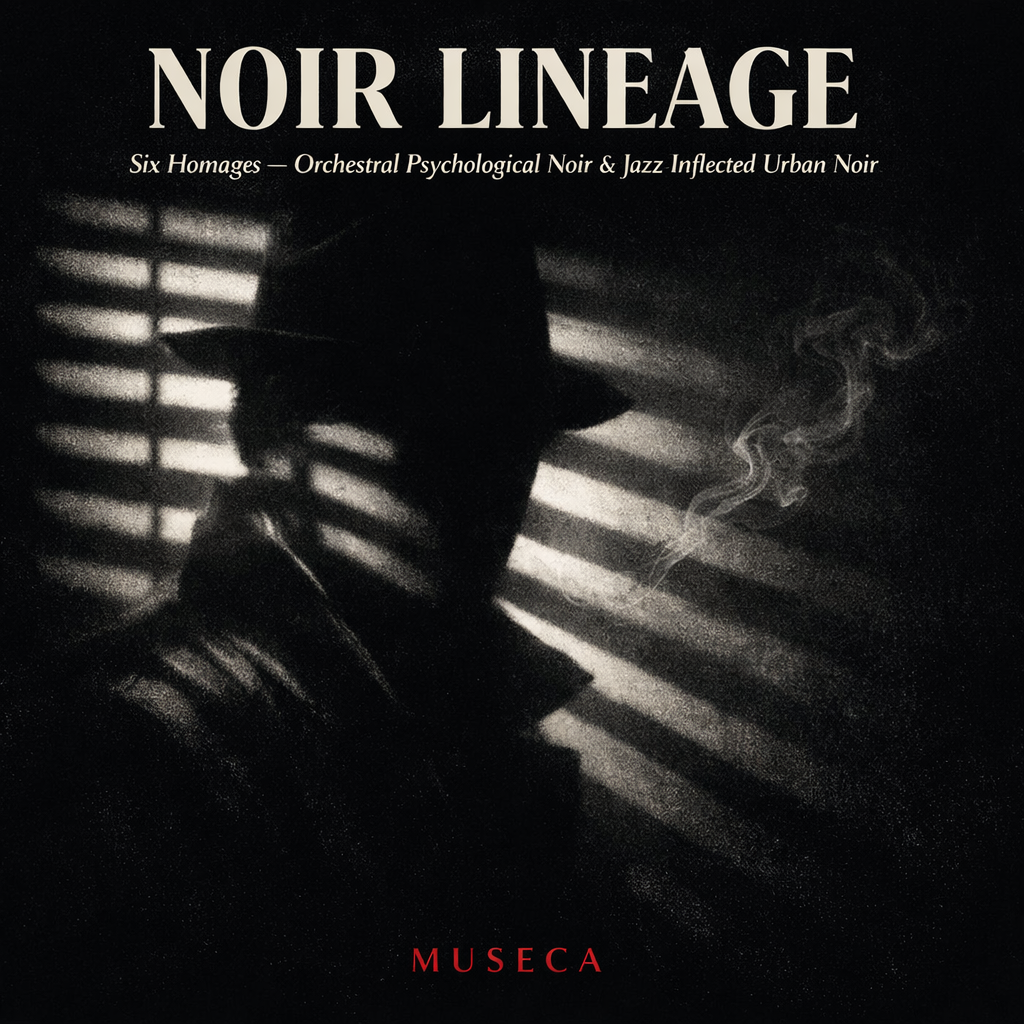
Discover an homage to film noir’s orchestral and jazz vocabulary. Harmonic ambiguity, shadowed timbres, and recurring figures offer another way to hear psychology become musical form.