
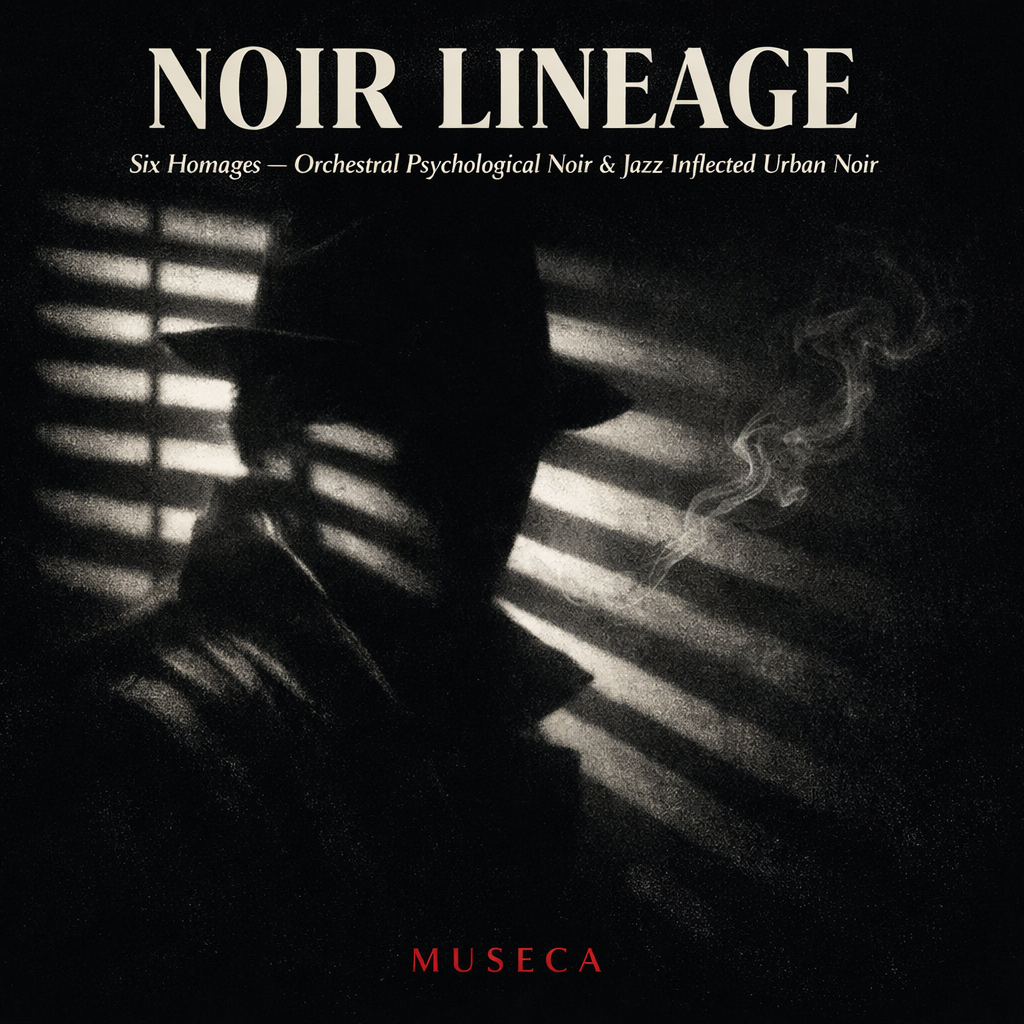
Noir Lineage is a homage to the musical language of film noir—music written not to reassure, but to implicate. In classic noir, harmony rarely rests, melody rarely tells the whole truth, and orchestration functions like lighting: it hides as much as it reveals. Where much Golden Age film scoring aims for clarity—heroism, romance, victory—noir scoring specializes in psychological ambiguity: chromatic inner voices that suggest double motives, pedal tones that feel like inevitability, and timbres (muted brass, low winds, veiled strings) that sound like shadow itself.
The album draws directly from the pioneering composers who defined noir’s vocabulary in the studio era and then expanded it through jazz. Miklós Rózsa established a foundational orchestral noir grammar—propulsive ostinati, hard-edged motifs, and harmonic pressure that makes “fate” feel mechanical and unstoppable. Franz Waxman refined a complementary strain: glamorous surfaces animated by decay, where lush orchestration and elegant gestures conceal corrosion in the harmony. David Raksin proved that noir could be intensely lyrical without becoming sentimental—his haunted themes treat romance as fixation, memory, and unresolved guilt. Bernard Herrmann, serving here as the album’s psychological climax, transformed suspense into architecture: obsessive cells, harmonic blocks, and unrelenting accumulation that deny catharsis. Noir’s urban bloodstream then enters through jazz—Duke Ellington’s scoring brings moral complexity into swing and blues color, letting the city itself testify in voicings, riffs, and late-night bite. Finally, John Lewis and the Modern Jazz Quartet offer the perfect noir epilogue: cool, chamber-jazz restraint—precise, modern, and fatal in its understatement.
I constructed Noir Lineage as a single narrative descent using a deliberate ordering that mirrors noir’s emotional mechanics. It begins with Rózsa—the “engine noir” of inevitability—then moves into Waxman, where glamour rots in real time. Raksin follows with obsession, giving the album its human wound: a melody that feels like a name you cannot stop hearing. Herrmann then closes the orchestral cycle as the trap tightens—paranoia as a structure with no exits. From there, the album pivots into the street-level world of jazz: Ellington supplies urban morality and nocturnal tension, and John Lewis/MJQ leaves us in the cool aftertaste of consequence—neon reflection on black glass, the case technically closed, the truth still unresolved.
Liner Notes
“The Policy of Fate (Rózsa)” opens the album with noir’s most unforgiving truth: the sense that consequence has already started moving before the protagonist understands the rules. A relentless low-register pulse drives forward like an engine that will not stall, while a compact doom motif returns with increasing insistence. Muted brass and shadowed winds do not announce danger so much as confirm it—each recurrence tightening the narrative, each chromatic turn suggesting that the clean way out was never available.
“Velvet Corruption (Waxman)” shifts from propulsion to seduction—glamour as a surface treatment applied to moral rot. The orchestral palette turns luminous and expensive, but the harmony carries hairline fractures: waltz and tango ghosts drift through the texture as if the room itself remembers too much. Strings bloom, harp glints, and then the floor subtly tilts; cadences evade certainty, and what initially feels like elegance gradually reveals itself as a controlled collapse.
“Her Name in Smoke (Raksin)” is the album’s obsession theme: romantic, memorable, and quietly compromised. A lyrical line floats above veiled strings, but it is never allowed to become comforting; inner voices move chromatically, leaning into dissonance like a confession that cannot be completed. The melody behaves like evidence—reappearing in altered light, reframed and re-voiced until it becomes less a love theme than a fixation, equal parts longing and indictment.
“Corridors Without Exit (Herrmann)” is paranoia made structural. A small cell repeats, not as accompaniment but as architecture—walls closing in through incremental pressure and tightening orchestration. Pedal tones hold the ground while harmonic blocks shift overhead, denying resolution and eroding any sense of stable center. The build is purposeful and unromantic: noir at its most clinical, where dread is not a moment but a design, and the climax arrives without release—only the certainty that the corridor continues.
“Testimony at 2 A.M. (Ellington)” pivots the album from studio-orchestra psychology to street-level ethics. The city speaks in jazz voicings: piano-led motion, muted trumpet sting, tenor sax smoke, upright bass gravity, and brushed percussion that suggests wheels on wet pavement. Blues color appears not as comfort but as truth-telling—music that can swing and still feel dangerous, as though every chord extension is another detail the witness hesitates to reveal.
Version 1
Version 2
“Cold Neon Aftermath (John Lewis / MJQ)” closes with restraint that cuts deeper than drama. Chamber-jazz precision replaces orchestral mass: sparse counterpoint, cool harmony, and a minimal pulse that refuses sentimentality. The feeling is not defeat but inevitability—an epilogue that doesn’t explain, only clarifies the temperature of the world. The final sonorities linger like neon reflected on black glass: clean, quiet, and fatal.
Playlist
- Track 1 — The Policy of Fate (Rózsa) Museca 2:26
- Track 2 — Velvet Corruption (Waxman) Museca 2:36
- Track 3 — Her Name in Smoke (Raksin) Museca 3:23
- Track 4 — Corridors Without Exit (Herrmann) Museca 2:35
- Track 5 — Testimony at 2 A.M. (Ellington) (Version 1) Museca 3:39
- Track 5 — Testimony at 2 A.M. (Ellington) (Version 2) Museca 3:30
- Track 6 — Cold Neon Aftermath (John Lewis / MJQ) Museca 3:56