
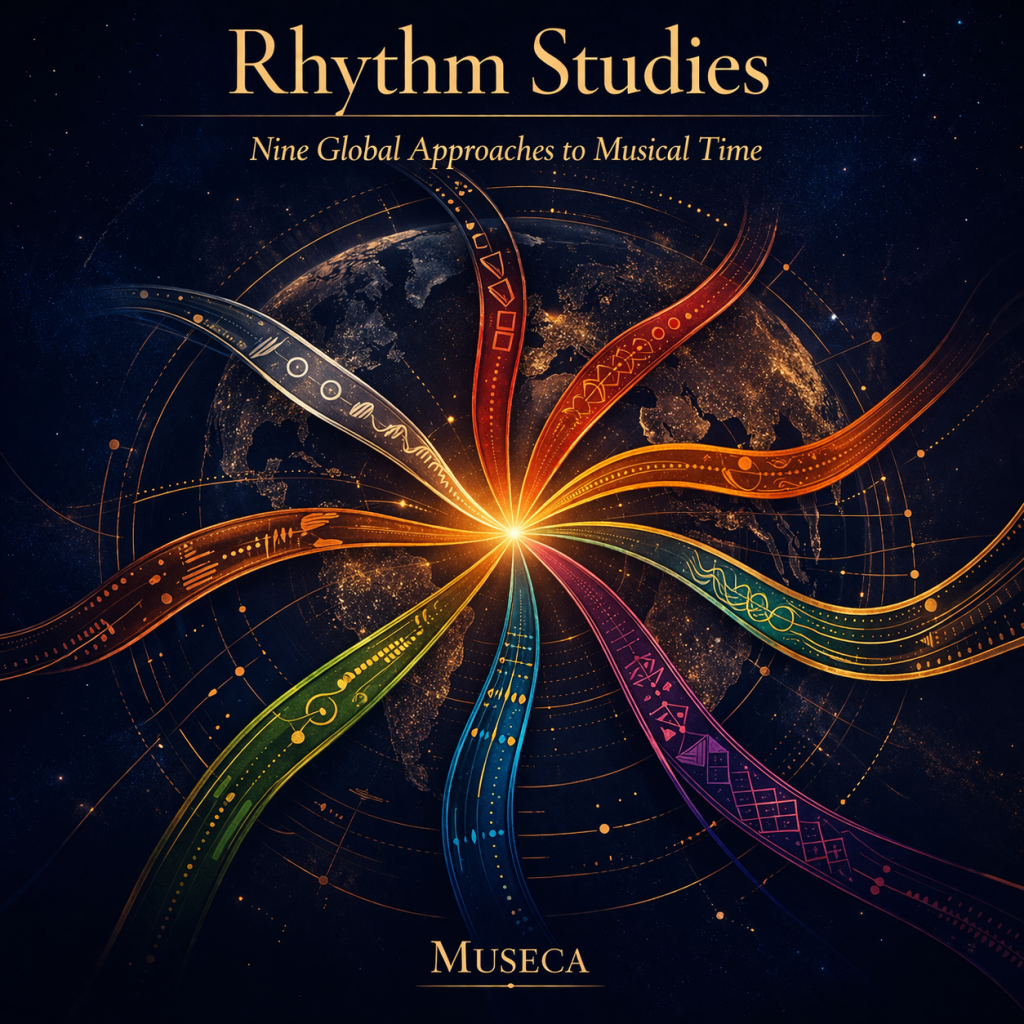
Rhythm Studies
Rhythm is one of the oldest and most universal forces in music. Before melody was shaped into song and before harmony was codified into systems, rhythm gave sound its motion, pulse, breath, and life. It has always been the element most closely tied to the body: to dance, ritual, labor, procession, celebration, memory, devotion, and communal identity. Across the world, different cultures developed distinct rhythmic languages—some grounded in cycles, some in groove, some in asymmetry, some in interlocking layers, and some in the subtle shaping of time itself.
Rhythm Studies is a Museca project devoted to exploring nine major rhythmic worlds through focused musical study and original composition. Each branch of the project examines not just a surface style, but a deeper rhythmic logic: how pulse is organized, how accents are felt, how cycles resolve, how layers interact, and how time becomes expressive. These studies are designed both as artistic tributes and as practical investigations into the architecture of rhythm.
From this page, you may enter nine separate album worlds, each dedicated to a particular rhythmic tradition or rhythmic principle. Together, they form a broader atlas of global time-feeling: a journey through groove, pattern, ceremony, propulsion, suspension, interlock, and flow.
Visitors to this project may also download the companion textbook A Comprehensive Study of Musical Rhythm, a Museca volume that presents rhythm as a global field of study and explores rhythmic systems, theory, and practice across traditions.
The Nine Rhythm Studies
- African Rhythm Studies
A study of layered pulse, bell timelines, call-and-response design, interlocking percussion, and the foundational logic of cross-rhythm and communal groove.
- South Asian Rhythm Studies
A study of tala, subdivision, mathematical phrasing, cyclic return, rhythmic recitation, and the extraordinary structural imagination of Indian rhythmic thought.
- Afro-Diasporic Rhythm Studies
A study of the transformation and expansion of African rhythmic inheritance across the diaspora, including syncopation, groove lineage, dance impulse, and clave-based thinking.
- Middle Eastern Rhythm Studies
A study of cyclical rhythmic modes, accent hierarchies, flowing ornamented pulse, and the expressive balance between strength, rest, and patterned return.
- Flamenco Compás Studies
A study of compás as a living rhythmic framework: tension, propulsion, accent displacement, handclap logic, and the dramatic force of cyclical flamenco time.
- Indonesian Rhythm Studies
A study of colotomic cycles, interlocking parts, ensemble shimmer, gong architecture, and the layered unfolding of musical time in Indonesian traditions.
- East Asian Rhythm Studies
A study of gesture, ceremony, restraint, attack, breath, and the many ways rhythm can function not only as groove, but as drama, space, and presence.
- Balkan Rhythm Studies
A study of additive meter, asymmetrical groupings, dance-driven irregularity, and the natural vitality of rhythms built from unequal pulses.
- Polyrhythmic Studies
A study of simultaneous rhythmic layers, competing subdivisions, structural friction, and the multidimensional possibilities that arise when multiple time-feelings coexist.
A Companion Textbook
To accompany this project, Museca also offers the downloadable textbook A Comprehensive Study of Musical Rhythm: A Global Exploration of Rhythmic Systems, Theory, and Practice. This volume expands the larger vision behind the Rhythm Studies project by examining rhythmic foundations, syncopation, polyrhythm, cross-rhythm, global rhythmic traditions, and practical applications for composition, improvisation, and performance.
Whether you begin with the textbook or with the albums themselves, the goal is the same: to hear rhythm more deeply, feel it more fully, and understand how profoundly different cultures have shaped musical time.
Enter the Studies
Choose one of the nine rhythm studies below to explore its dedicated album, musical language, and rhythmic world.
If this rhythmic project resonates with you, you may also enjoy:
Related Listening
- World Traditions — for the music that lives natively in the rhythmic worlds these studies explore: maqam, raga, gamelan, Afro-house, flamenco, Balkan dance, klezmer, and beyond
- Spiritual & Metaphysical — for the AfroDivine series (AfroDivine I & II, You Are the Path, You Are the Dream) where Afro-diasporic rhythmic logic becomes ceremonial and devotional language
- Ballet & Dance — for body-based rhythmic thinking, where the structures studied here become the language of physical movement
- Chill & Ambient — for the groove-as-foundation albums where rhythm carries entire compositions over slow-pulse and asymmetric-meter architectures
- Phrygian Parlour — for the modal traditions (flamenco, klezmer Freygish, Persian Dastgah Shoor, raga) that braid Phrygian color with the rhythmic systems studied here
Companion Reading
- Comprehensive Study of Musical Rhythm — the textbook this entire project is the listening companion to. Examines rhythmic foundations, syncopation, polyrhythm, cross-rhythm, and global rhythmic traditions, with practical applications for composition, improvisation, and performance
- AfroDivine — Definition and Production Guide — the monograph defining the Afro-house / neo-soul / sacred-cinematic idiom that extends Afro-diasporic rhythmic logic into Museca’s coined musical tradition
- The Spiral and the Circle — Composing with Numbers — particularly the Euclidean rhythm, prime-number asymmetry, and golden-ratio chapters, which extend the structural-rhythm thinking of the South Asian and Polyrhythmic studies into compositional method
- The Study of Tension and Release in Music — for rhythmic tension as one of the nine major expressive forces, and for the role of accent, displacement, and silence in shaping musical motion