
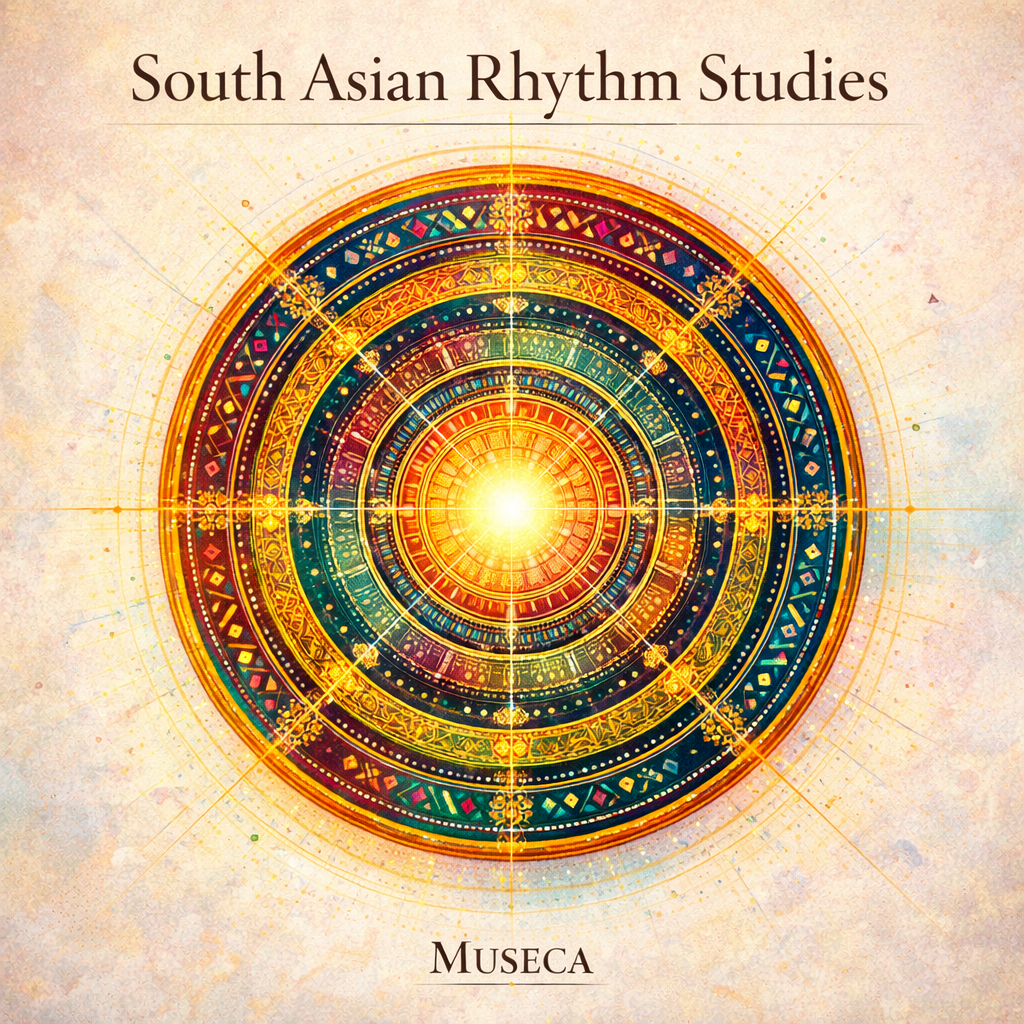
South Asian rhythm offers one of the most sophisticated and intellectually beautiful conceptions of musical time anywhere in the world. Rather than treating meter as a fixed container, Indian rhythmic systems often unfold through tala: codified cycles with internal divisions, points of emphasis, and patterns of return. Within this framework, rhythm becomes not only a matter of pulse, but of design, memory, recitation, proportion, and transformation. The result is a musical language in which mathematics and expressivity are not opposites, but partners.
This page explores that world through studies inspired by tala, subdivision, rhythmic recitation, cyclic return, and the extraordinary structural imagination of Indian music. Some works emphasize clarity of cycle, others the energy of repetition or the intricacy of internal patterning, but all are rooted in the idea that rhythm can be both rigorously organized and deeply alive. These pieces are offered as tributes to a rhythmic tradition of immense refinement, discipline, and creative possibility.
Liner Notes
This album is a journey through one of the most sophisticated rhythmic traditions in the world. Across India, Pakistan, and Bangladesh, rhythm is not merely a framework for music—it is a living, breathing cycle, a returning force that shapes melody, emotion, and communal experience. Each track on this album explores a distinct rhythmic idea, moving from classical tāla structures to folk traditions, spoken rhythm, and modern hybrid forms. Together, they form a unified study of cyclic time, additive motion, and rhythmic consciousness.
“Teentāl Invocation (16-Cycle Mandala)” opens the album with the foundational symmetry of the 16-beat cycle. This is the ground upon which much of North Indian classical music stands—a balanced, spacious framework where every phrase orbits the central gravitational point of sam. The music unfolds slowly, allowing the listener to feel the cycle not as a count, but as a returning breath.
“Jhaptāl Tenfold” introduces asymmetry. With its 2+3+2+3 structure, the 10-beat cycle creates a subtle instability that is nevertheless deeply coherent. The shifting groupings produce a gentle forward lean, inviting the listener to feel rhythm as an additive architecture rather than a fixed grid.
“Rūpak Seven (Light Step)” offers a different kind of asymmetry—one that begins in emptiness. Starting on a khāli, the cycle feels weightless at first, then gradually finds its footing. The result is a lyrical, almost playful motion, demonstrating how odd meters can remain graceful and expressive.
“Dadra Light Six” moves into the intimate world of semi-classical song. The 3+3 cycle is simple, but profoundly effective, carrying the emotional weight of ghazal and film music. Its gentle sway allows melody and feeling to come forward, showing how rhythm can support tenderness rather than complexity.
“Keherwa Pulse (8-Beat Folk Cycle)” brings the listener into the communal sphere. This is the rhythm of gatherings, celebrations, and shared voices. The 8-beat cycle is universal in its accessibility, and here it becomes a vehicle for joy, clapping, and collective motion—bridging classical structure with popular expression.
“Miśra Chapu: Seven Over Four” marks the first major hybrid. A South Indian 7-beat hand cycle is layered over a steady 4/4 pulse, creating a shifting relationship between two rhythmic worlds. The result is hypnotic: a pattern that never quite aligns in the same way twice, yet remains grounded enough for dance.
“Khanda Chapu: Five-Pulse Dance” sharpens the focus on additive rhythm. The 2+3 structure drives the music forward with a distinct, energetic pulse. This track reveals the power of five—not as an oddity, but as a natural, compelling groove when properly articulated.
“Sankīrna Spiral (9-Pulse Cycle)” expands the cycle further. The 2+2+2+3 grouping creates a spiraling sensation, where the listener is drawn into a longer arc of motion. The orchestral textures emphasize the evolving nature of the cycle, demonstrating how rhythm can shape large-scale musical form.
“Konnakol Matrix” strips everything back to the essence of rhythm itself: the voice. Using the syllabic language of South Indian konnakol, this track presents rhythm as pure articulation—spoken, layered, and recombined. It is both a study and a demonstration of how complex rhythmic ideas can be internalized and expressed without instruments.
“Qawwali Heartbeat (Dadra / Keherwa Fusion)” shifts into the ecstatic. Rooted in Sufi devotional practice, the music builds through repetition, clapping, and collective energy. The alternation between 6-beat and 8-beat feels reflects the dynamic flow of Qawwali performance, where rhythm intensifies the spiritual experience.
“Baul Traveler (Bengali Folk Cycle)” returns to simplicity, but with a different intention. The gentle sway of Bengali folk rhythm supports a wandering, introspective voice. Here, rhythm is a companion to the journey—steady, unassuming, and deeply human.
“Tihai of the Subcontinent” brings all elements together in a final convergence. Built on the 16-beat cycle, the music culminates in repeated cadential patterns—tihais and their expanded form, the chakradhar. These rhythmic resolutions, repeated three times to land precisely on the downbeat, serve as a unifying gesture. The many cycles, subdivisions, and traditions explored throughout the album resolve into a single, powerful return.
South Asian Rhythmic Studies — 12-Track Overview
| Track | Tāla / Meter | Subdivision Structure | Region / Tradition | Pedagogical Focus |
|---|---|---|---|---|
| 1. Teentāl Invocation | Teentāl – 16 beats | 4+4+4+4 | Hindustani (North India) | Foundational 16-beat cycle; grounding in symmetrical tāla architecture |
| 2. Jhaptāl Tenfold | Jhaptāl – 10 beats | 2+3+2+3 | Hindustani | Asymmetrical 10-beat phrasing; additive rhythm organization |
| 3. Rūpak Seven (Light Step) | Rūpak – 7 beats | 3+2+2 (khāli start) | Hindustani | Understanding 7-beat phrasing; using odd cycles for lyrical, light textures |
| 4. Dadra Light Six | Dadra – 6 beats | 3+3 | Hindustani / Semi-classical / Ghazal | Romantic 6/8 feel; soft cyclic sway used in ghazal/film idioms |
| 5. Keherwa Pulse | Keherwa – 8 beats | 4+4 | North Indian / Pakistani / Bangladeshi Folk | Folk-pop cycle; clapping patterns and communal rhythmic feel |
| 6. Miśra Chapu: Seven Over Four | Miśra Chapu – 7 beats | 3+2+2 | Carnatic (South India) + Afro House | Cross-rhythm: 7-beat hand cycle over a 4/4 electronic pulse |
| 7. Khanda Chapu: Five-Pulse Dance | Khanda Chapu – 5 beats | 2+3 | Carnatic | Additive rhythm in 5; energetic 2+3 phrasing for dance contexts |
| 8. Sankīrna Spiral (9-Pulse Cycle) | Sankīrna Chapu – 9 beats | 2+2+2+3 | Carnatic | Spiral-type 9-beat cycle; asymmetry and long-form phrasing |
| 9. Konnakol Matrix | Spoken subdivisions | 2, 3, 4, 5, 7, 9 | Carnatic vocal rhythm | Mastering vocal rhythmic syllables; combining subdivision families |
| 10. Qawwali Heartbeat | Keherwa (8) + Dadra (6) | 4+4 and 3+3 | Pakistan / North India (Sufi) | Qawwali rhythmic build; dholak, clapping, communal escalation |
| 11. Baul Traveler | Folk 6/8 / soft 8-beat | 3+3 or 4+4 (folk sway) | Bengal (Bangladesh & West Bengal) | Mystic-folk cyclicity; simple rhythmic storytelling; traveling rhythm |
| 12. Tihai of the Subcontinent | Teentāl + Tihai structures | 16-beat cycle + 3× phrases | Pan–South Asian (Hindustani + Carnatic fusion) | Cadential formulas (tihai, chakradhar); finale-level rhythmic convergence |
Playlist
- Track 1 – “Teentāl Invocation (16-Cycle Mandala)” Museca 3:58
- Track 2 – “Jhaptāl Tenfold” Museca 3:56
- Track 3 – “Rūpak Seven (Light Step)” Museca 3:32
- Track 4 – “Dadra Light Six” (Instrumental) Museca 3:45
- Track 5 – “Keherwa Pulse (8-Beat Folk Cycle)” Museca 1:54
- Track 6 — Miśra Chapu: Seven Over Four Museca 3:00
- Track 7 – “Khanda Chapu: Five-Pulse Dance” Museca 1:30
- Track 8 — Sankīrna Spiral (9-Pulse Cycle) Museca 2:23
- Track 9 — Konnakol Matrix Museca 1:37
- Track 10 — Qawwali Heartbeat (Dadra / Keherwa Fusion) Museca 2:35
- Track 11 — Baul Traveler (Bengali Folk Cycle) Museca 2:40
- Track 12 — Tihai of the Subcontinent Museca 2:16