
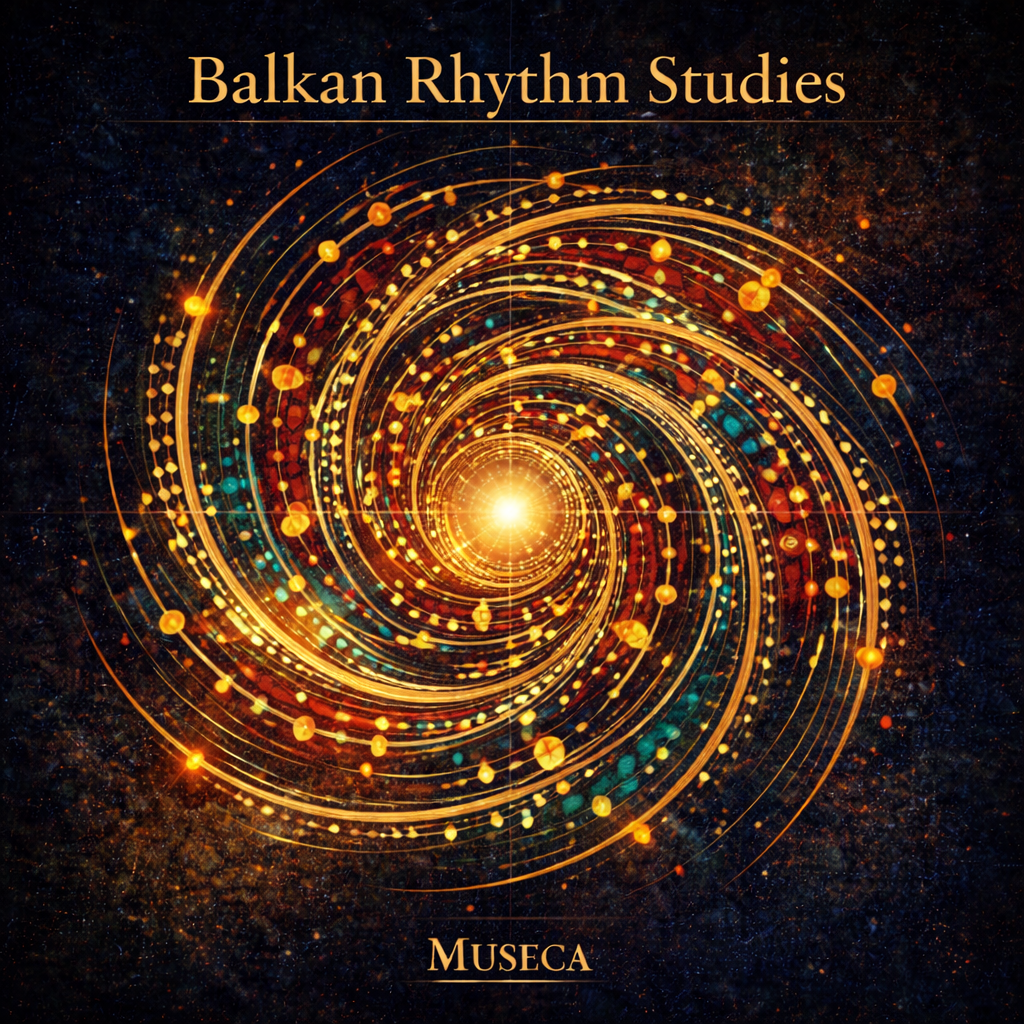
Balkan rhythm is one of the most exhilarating examples of how unequal pulses can generate natural, irresistible motion. Built from additive meters and asymmetrical groupings, these rhythmic traditions turn patterns of twos and threes into dance, vitality, and forward drive. What may seem irregular on paper becomes, in performance, vividly physical and perfectly coherent. Balkan rhythm reminds us that meter need not be even to feel grounded; imbalance itself can become a source of energy and grace.
This page explores that rhythmic world through studies shaped by additive design, asymmetrical pulse, and dance-driven irregularity. Some pieces emphasize the lilt of uneven groupings, others the brightness and urgency of moving through constantly rebalanced accents. All are grounded in the idea that asymmetry is not a complication, but a rhythmic life-force. These works pay tribute to the brilliance, momentum, and natural musicality of Balkan time.
Liner Notes
Balkan Pulse: Asymmetrical Meter Studies
This collection explores a fundamental reorientation of rhythmic perception. In much of Western music, symmetry governs expectation; pulse is divided evenly, and balance is assumed. Here, that assumption is set aside. The music unfolds through additive meters, where rhythm is constructed from uneven groupings that feel organic, physical, and deeply human. What initially appears irregular reveals itself, over time, as a more nuanced and expressive form of order.
Rachenitsa Drive (7/8 = 2+2+3)
The opening track establishes the core language of the album. The 2+2+3 grouping creates a forward-leaning momentum—two short steps followed by a longer release. This asymmetry produces propulsion without rigidity, evoking traditional dance forms where movement is guided by feel rather than count. The energy is immediate, grounded, and celebratory, serving as both introduction and invitation.
Macedonian Twist (7/8 = 3+2+2)
Reordering the same seven pulses shifts the entire psychological center of the rhythm. The longer opening group creates a sense of suspension before the shorter steps resolve the phrase. The result is more elastic, less driving, and subtly more introspective. This track demonstrates how additive rhythm is not merely structural—it reshapes emotional perception.
Karsilama Circuit (9/8 = 2+2+2+3)
Expanding into nine pulses introduces greater fluidity. The repetition of three short groupings followed by a longer phrase creates a looping sensation, almost cyclical in nature. The rhythm begins to feel less like a sequence and more like a current, carrying the listener through a continuous, evolving motion.
Thrace Spiral (9/8 = 2+3+2+2)
A reconfiguration of nine alters the trajectory. The longer second grouping introduces a pivot point, around which the rhythm appears to turn. This creates a spiraling sensation—less linear, more rotational. The track emphasizes motion that curves rather than advances, drawing the listener inward.
Daichovo Mirage (11/8 = 2+2+3+2+2)
With eleven pulses, the structure becomes more intricate, yet paradoxically more immersive. The central group of three acts as an anchor within the longer cycle, creating a moment of expansion before the rhythm contracts again. The listener is no longer counting but adapting, allowing the pulse to reorganize perception in real time.
Dunav Hyperstep (11/8 Modern)
This track extends the 11/8 framework into a contemporary context. The rhythm is sharpened, streamlined, and intensified, highlighting its compatibility with modern production aesthetics. The asymmetry remains intact, but its presentation is more aggressive, more precise, and more aligned with electronic momentum.
Romanian 13 (13/8 = 2+2+2+3+2+2)
Thirteen pulses create an extended arc, a longer breath of rhythm that resists immediate comprehension. The structure unfolds gradually, revealing internal balance through repetition. What first feels unpredictable becomes coherent, demonstrating how familiarity transforms complexity into fluency.
Carpathian Run (13/8 Fast Dance)
At increased tempo, the 13/8 cycle becomes exhilarating. The longer sequence compresses into a rapid, flowing motion, where the subdivisions blur into a continuous surge of energy. The track captures the sensation of momentum without interruption—a sustained forward motion that feels both urgent and controlled.
Odd-Grid Ensemble (Mixed 7/8 → 9/8 → 11/8)
This piece explores transition itself. By moving between meters, it reveals the underlying relationships that connect them. The shifts are not abrupt but evolutionary, suggesting that these rhythms are variations of a broader system rather than isolated forms. The listener experiences rhythm as a continuum.
Balkan House Engine (7/8 over 4/4)
Here, asymmetry is layered over familiarity. A steady 4/4 foundation anchors the listener while a 7/8 pattern moves above it, creating tension between stability and displacement. This dual structure bridges traditional rhythmic concepts with modern dance frameworks, demonstrating their compatibility and potential for fusion.
Gypsy-Jazz 9-Step
This track introduces melodic agility into the asymmetrical framework. The 9/8 pulse supports fluid phrasing and expressive ornamentation, allowing the rhythm to feel playful rather than forceful. It highlights the adaptability of additive meters across stylistic boundaries.
Asymmetrical Horizon (Epic Finale)
The closing piece gathers the album’s ideas into a broader, cinematic form. The irregular becomes expansive, no longer confined to pattern but extended into atmosphere and scale. What began as a study concludes as a landscape—one where asymmetry is not an exception, but the governing principle.
Balkan Pulse: Asymmetrical Meter Studies — 12-Track Overview
| Track | Meter | Subdivision Structure | Style / Mode | Pedagogical Focus |
|---|---|---|---|---|
| 1. Rachenitsa Drive | 7/8 | 2+2+3 | Balkan Folk / Festival Energy | Foundational additive rhythm; feeling asymmetry as forward propulsion rather than irregularity |
| 2. Macedonian Twist | 7/8 | 3+2+2 | Macedonian Dance / Fluid Groove | Re-grouping pulse; shifting rhythmic gravity while maintaining total meter |
| 3. Karsilama Circuit | 9/8 | 2+2+2+3 | Thracian / Greek Dance Hybrid | Extending additive cycles; building cyclical rhythmic flow across longer groupings |
| 4. Thrace Spiral | 9/8 | 2+3+2+2 | Spiral Dance / Cinematic Motion | Rotational phrasing; perceiving rhythm as circular motion instead of linear time |
| 5. Daichovo Mirage | 11/8 | 2+2+3+2+2 | Bulgarian / Mystical Folk | Intermediate asymmetry; stabilizing longer irregular cycles through internal anchors |
| 6. Dunav Hyperstep | 11/8 | Modernized 11-beat grouping | Progressive Electronic / Hybrid Groove | Applying asymmetry in modern production; precision timing and electronic layering |
| 7. Romanian 13 | 13/8 | 2+2+2+3+2+2 | Romanian Dance Tradition | Advanced additive phrasing; maintaining coherence across extended rhythmic cycles |
| 8. Carpathian Run | 13/8 | Fast asymmetrical grouping | High-Energy Folk Dance | Speed and flow; internalizing asymmetry at high tempo without counting |
| 9. Odd-Grid Ensemble | Mixed (7/8 → 9/8 → 11/8) | Evolving additive systems | Cinematic / Structural Study | Metric modulation; transitioning between asymmetrical systems fluidly |
| 10. Balkan House Engine | 7/8 over 4/4 | Polymetric overlay | Afro House / Electronic Fusion | Layering asymmetry over stable grids; hybrid groove construction |
| 11. Gypsy-Jazz 9-Step | 9/8 | Flexible phrasing within 9 | Gypsy Jazz / Acoustic Fusion | Melodic phrasing in odd meter; integrating asymmetry into improvisation |
| 12. Asymmetrical Horizon | Mixed / Expansive | Layered and evolving groupings | Cinematic Finale / Epic Form | Synthesis of all additive systems; large-scale rhythmic architecture |
Playlist
- Track 1 – Rachenitsa Drive (7/8 = 2+2+3) Museca 3:48
- Track 2 - Macedonian Twist Museca 2:47
- Track 3 - Karsilama Circuit Museca 2:23
- Track 4 - Thrace Spiral Museca 2:55
- Track 5 - Daichovo Mirage Museca 3:03
- Track 6 - Dunav Hyperstep Museca 3:07
- Track 7 - Romanian 13 Museca 2:51
- Track 8 - Carpathian Run Museca 3:11
- Track 9 - Odd-Grid Ensemble Museca 3:19
- Track 10 - Balkan House Engine Museca 3:47
- Track 11 - Gypsy-Jazz 9-Step Museca 2:47
- Track 12 - Asymmetrical Horizon Museca 3:28