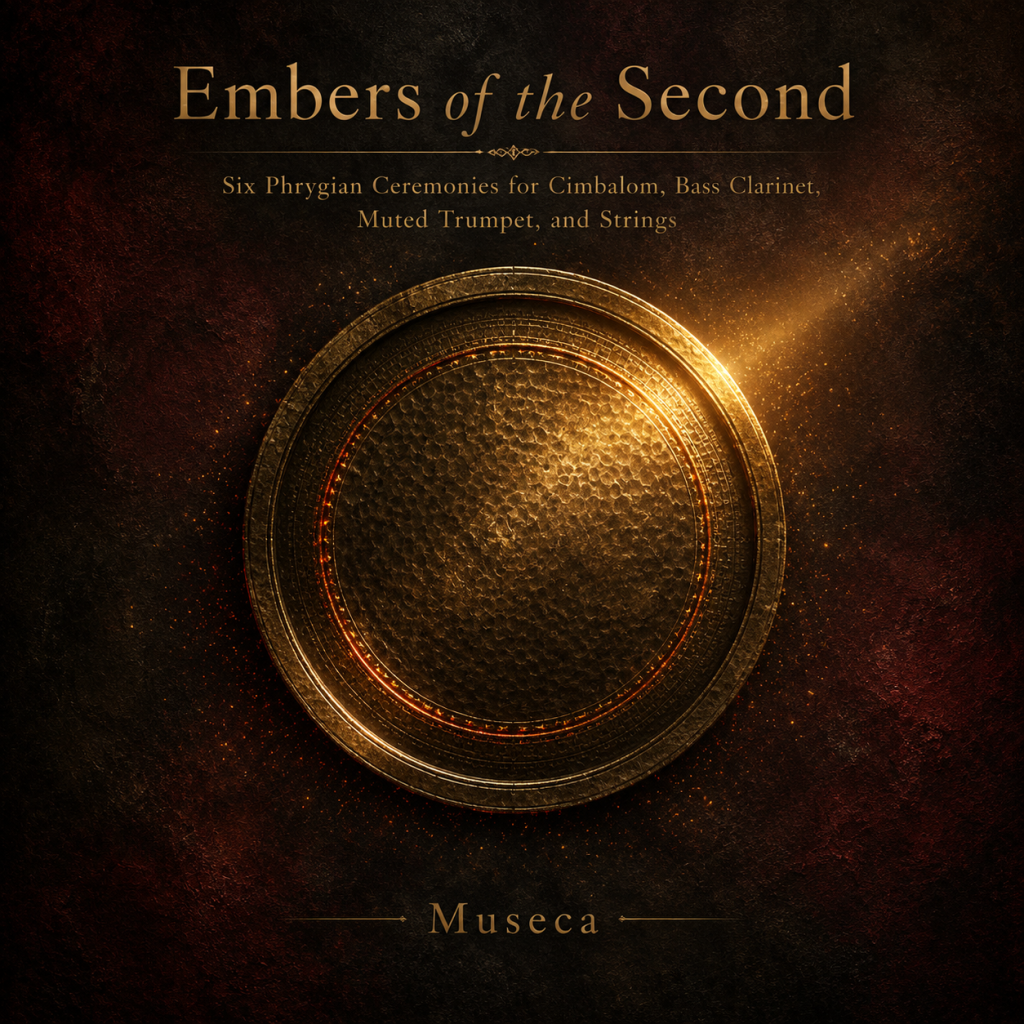
Embers of the Second explores the Phrygian mode through an ensemble whose colors seem made for ritual tension: cimbalom, bass clarinet, muted trumpet, and strings. Where other modal languages may seek brightness, breadth, or release, Phrygian begins with pressure. Its defining flat second leans immediately against the tonic, creating a field of dark proximity—close, heated, and alert. Yet unlike Locrian, Phrygian retains the perfect fifth, and with it a stronger structural spine. The result is not collapse, but controlled severity: a musical world in which tension burns inside form.
This album is built around that distinction. The cimbalom gives the mode a hammered metallic glow, turning harmonic friction into something tactile, ember-like, and ceremonial. The bass clarinet provides the dark center of gravity, moving through chant-like lines, low invocations, and processional phrases that seem to rise from stone rather than air. The muted trumpet enters as a veiled herald, formal and distant, sounding not as triumph but as signal—an old authority heard through dusk, corridor, or memory. Around them, the strings create the atmosphere in which the mode lives: austere, smoldering, suspended, and at times almost liturgical in restraint.
The six tracks of Embers of the Second do not treat Phrygian as exotic color or borrowed atmosphere. They inhabit it as a complete expressive world: one of dark ceremony, processional elegance, nocturnal heat, and disciplined fire. This is music that stands under pressure without yielding to disorder. If Ashes of the Fifth listened to the beauty of fracture, Embers of the Second listens to the beauty of tension held in dignity.
Liner Notes
Embers of the Second
The opening track establishes the album’s governing identity at once: Phrygian not as ornament or borrowed color, but as a complete ceremonial language. The flat second presses immediately against the tonic, creating a sense of heat held very close to the center. The cimbalom introduces that pressure in metallic glints and ember-like resonance, while the bass clarinet gives the mode its grave interior weight. The muted trumpet appears as a veiled public signal, distant but authoritative, and the strings widen the air around the ensemble without softening its severity. The result is an opening that feels less like an arrival than an ignition: a formal space slowly beginning to burn.
Bronze Procession
Here the music takes on motion, but not in the sense of journey or narrative progress. Instead, it moves as ritual moves: measured, repetitive, solemn, and symbolically charged. The cimbalom becomes the track’s defining surface, its repeated strokes suggesting hammered metal, ritual bronze, or ceremonial ornament catching firelight. Beneath and through that surface, the bass clarinet carries the Phrygian mode with dark steadiness, while muted trumpet phrases punctuate the texture like calls heard across a public square at dusk. The strings do not so much accompany as sustain the ceremonial weather of the piece, giving the procession its gravity, dignity, and latent tension.
Trumpet at the Inner Gate
This track is built on distance and guardedness. The muted trumpet is treated not as a brilliant solo voice, but as a herald heard from behind stone, curtain, or threshold. Its role is architectural as much as musical: it marks space, boundary, and withheld access. Against that distance, the bass clarinet remains closer and more inward, grounding the Phrygian center with an almost chant-like authority. The cimbalom, lighter and more selective here, functions like metallic ornament or coded signal, while the strings suspend the entire scene in a state of ceremonial expectancy. The piece suggests not entry, but approach—the tense dignity of standing just outside a chamber whose meaning is still concealed.
The Burning Threshold
The fourth movement is the most forceful and publicly charged track on the album. Here the restrained fire of the opening pieces is allowed to rise into greater intensity, though never into chaos. The cimbalom becomes sharper and more rhythmically declarative, the strings take on greater agitation through tremolo and tight modal pressure, and the muted trumpet sounds less distant—still veiled, but more commanding. The bass clarinet remains the central spine, preventing the music from dissolving into theatrical excess. What gives the track its power is not volume or speed, but the sensation of controlled danger: the feeling that one is crossing into a zone of consequence where ceremony and threat have become inseparable.
Nocturne of Black Sand
After the public intensity of the preceding track, this movement withdraws into an inward night music. The Phrygian mode remains fully present, but its tension is transformed into smoldering intimacy. The bass clarinet sings more softly here, with a dark tenderness that reveals the mode’s capacity for inward lament as well as ritual strength. The cimbalom becomes sparse and resonant, offering isolated metallic afterglows rather than active pulse, and the muted trumpet appears only in restrained fragments, as though memory itself were sounding from a distance. The strings thin into harmonics and soft suspensions, creating an atmosphere that feels both desert-like and interior—heat retained in silence, pressure preserved beneath stillness.
Crown of Ember
The closing track gathers the album’s ceremonial materials and gives them their final form. The title suggests not hollow authority, as in the Locrian companion, but authority still burning from within. The bass clarinet establishes a grave and stable center, while the flat second remains present as a disciplined source of friction rather than rupture. The muted trumpet returns with greater formal presence, lending the music a darkly processional grandeur, and the strings widen the ensemble into something nearly liturgical in scope. Around and through this texture, the cimbalom provides the final metallic glow, not as fracture but as radiant residue. The album ends without conventional resolution, yet with unmistakable strength: a Phrygian enthronement in which fire has not been extinguished, only brought under form.
Playlist
- Track 1 - Embers of the Second Museca 3:05
- Track 2 - Bronze Procession Museca 3:34
- Track 3 - Trumpet at the Inner Gate Museca 3:13
- Track 4 - The Burning Threshold Museca 3:22
- Track 5 - Nocturne of Black Sand Museca 3:26
- Track 6 - Crown of Ember Museca 3:05