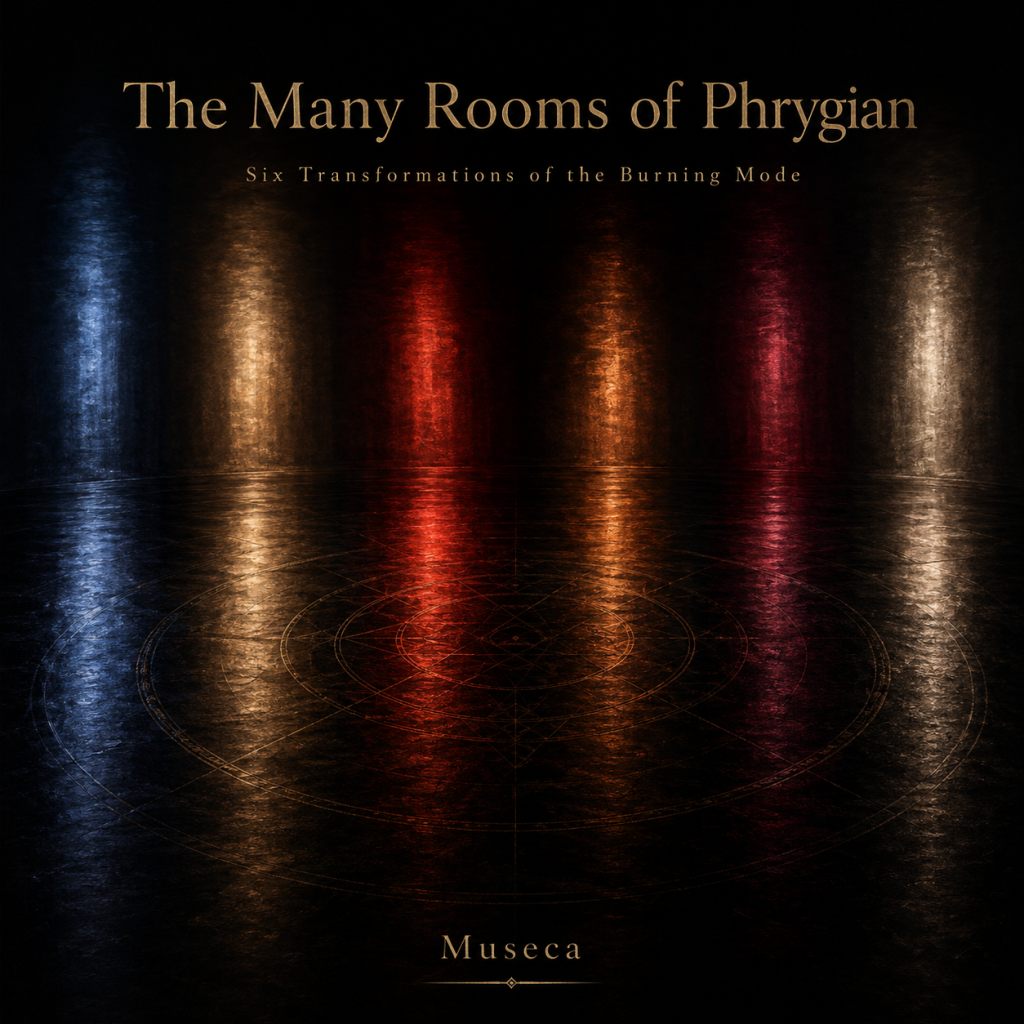
The Many Rooms of Phrygian continues the architectural idea of its Locrian companion, but under a different element. If Locrian reveals one hidden wound moving through six worlds, Phrygian reveals one hidden fire. The same six chambers remain—chamber noir jazz, sacred ambient minimalism, ritual groove, flamenco-shadow writing, expressionist cabaret, and chamber folk—but the modal force that inhabits them has changed. The unstable fracture of Locrian gives way to a darker kind of authority: a stronger root, a retained fifth, and the immediate pressure of the flat second burning against the tonic.
Across these six tracks, Phrygian proves itself not merely dark, but ceremonially alive. In one room it becomes bronze-lit midnight poise; in another, vigil without dawn. In one, it moves through the body as trance and procession; in another, it speaks through the stage lamp, the mask, and the inward monologue. By the final track, it sounds less like a scale than like an old heat surviving inside many historical forms.
The album remains unified by a common musical ethic. Each piece preserves a nocturnal, restrained, and intelligent atmosphere. Cadential closure is avoided in favor of pedals, drones, modal ostinati, and sustained pressure from the flat second. The bass clarinet again serves as a hidden connective thread, joining city, chapel, ritual floor, stage, and village fire. The result is not a genre sampler, but a single modal intelligence moving through six different worlds—one mode, six rooms, one enduring ember.
Liner Notes
Velvet Under the Brass Moon
The album opens in a city of controlled shadows. Here Phrygian enters chamber noir jazz not as instability, but as poise under pressure. The bass clarinet moves through the mode like a private intelligence, while muted trumpet, vibraphone, brushed drums, piano, and cello create a bronze-lit atmosphere of midnight elegance. The flat second is present from the outset, not as a wound in the structure, but as the source of its danger and allure. The result is less insomnia than vigilance: urban music that seems to know more than it says.
Vigil with No Morning Bell
The second room withdraws from the city into a sacred interior, but not one of comfort. Phrygian’s darker authority makes sacred minimalism feel less like unresolved prayer and more like sustained vigil. Drone, bass flute, sparse piano, and suspended upper textures create the impression of incense, shadow, and still devotion without release. The absence of a “morning bell” in the title suggests exactly this: a watch that continues through darkness, held in form, without external answer. The track is devotional, but its devotion is severe rather than consoling.
The Body Carries the Fire
The third movement turns from interior stillness to embodied pulse. Here Phrygian proves it can live inside groove without losing dignity. Deep bass, hand percussion, restrained electronic atmosphere, and modal repetition allow the track to become trance-like, but the trance is rooted rather than dissolving. The fire of the title is not spectacle; it is inner heat carried by the body through cycle, repetition, and breath. The flat second continues to press against the tonic, yet the groove accepts that pressure as something inhabitable. What emerges is a ritual space in which rhythmic confidence and harmonic darkness do not cancel each other, but deepen one another.
Veil of Ember and String
This track may be the most organically at home in Phrygian, since flamenco’s natural terrain already lies nearby. Yet the piece is not pastiche. Instead, it distills a shadowed flamenco spirit into a chamber language of guitar, cajón, palmas, bass clarinet, and viola. The guitar articulates severe modal shapes and rhythmic compás, while the bass clarinet darkens the edges and the viola sustains an inward flame. The title is exact: a veil, because the intensity remains partly hidden; ember, because the heat is real but contained; string, because every gesture is tethered to an austere musical line. The result is elegant, subterranean, and ceremonially alive.
Monologue Beneath the Red Lamp
The fifth room belongs to stage light, voice, and mask. In this expressionist cabaret setting, Phrygian becomes theatrical without ever becoming flamboyant. Piano frames the space with angular control, bass clarinet shadows the voice, and viola adds nervous inner heat. The red lamp of the title suggests both revelation and distortion: a light in which confession becomes performance and performance becomes confession. Compared with the Locrian companion, the persona here is less fractured and more commanding, but the psychological tension remains acute. The track inhabits a rare expressive territory: intimate theater with modal gravity, where wit, severity, and vulnerability stand together beneath a single dark glow.
Village by the Last Hearth
The album closes not in the city or on the stage, but in an older communal space. Phrygian enters chamber folk as if it had always belonged there—in drone, frame drum, fiddle or nyckelharpa, plucked strings, and the recurring shadow of bass clarinet. The “last hearth” suggests a fire still alive at the edge of night, and that image defines the track’s meaning. This is not cheerful folk dance, but dusk ritual: ancestral memory held together by warmth, repetition, and modal gravity. The closing effect is deeply apt. After passing through jazz, vigil, groove, heat, and cabaret, Phrygian arrives where it sounds oldest and most inevitable: by the fire, at the threshold, still burning.
Playlist
- Track 1 - Velvet Under the Brass Moon Museca 3:55
- Track 2 - Vigil with No Morning Bell Museca 3:54
- Track 3 - The Body Carries the Fire Museca 4:02
- Track 4 - Veil of Ember and String Museca 3:10
- Track 5 - Monologue Beneath the Red Lamp Museca 1:59
- Track 6 - Village by the Last Hearth Museca 4:13