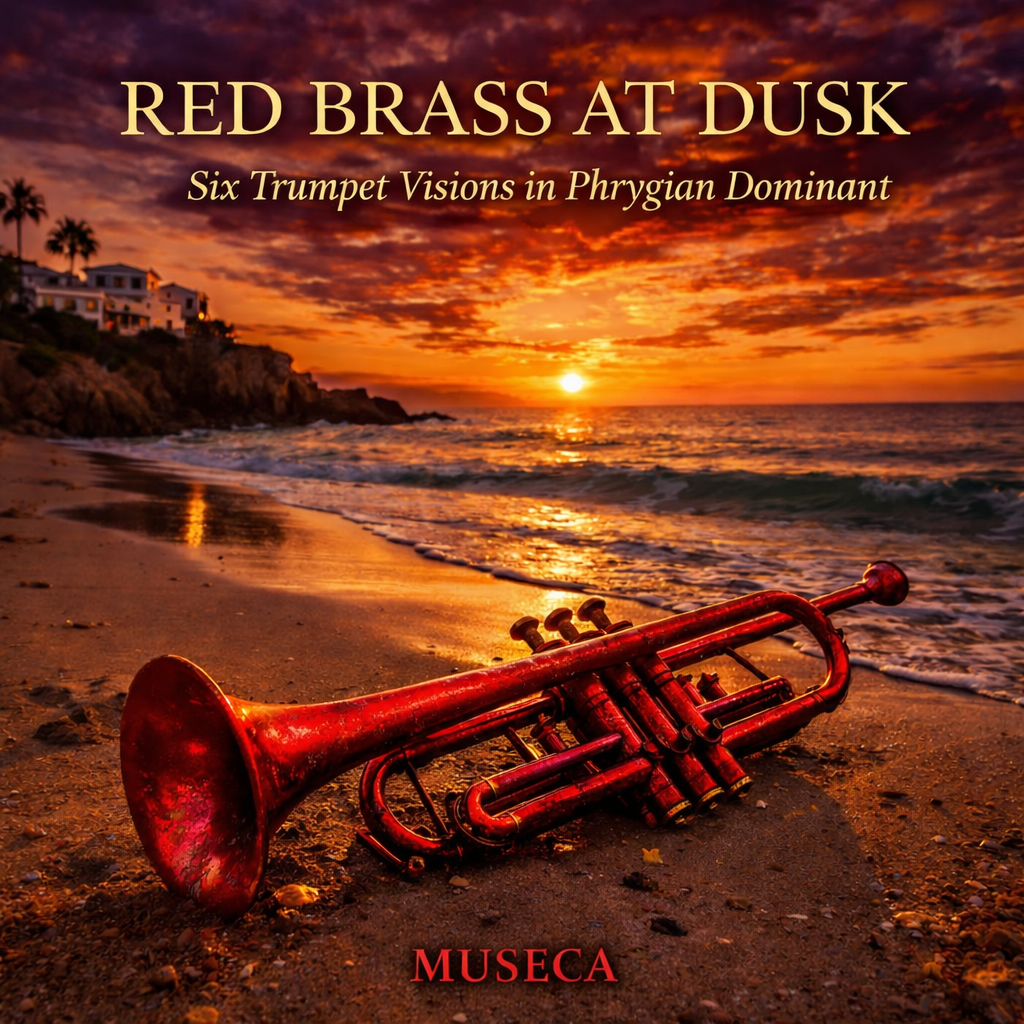
Red Brass at Dusk is built around a single governing color: the Phrygian dominant mode. Everything in the album grows out of that sound world—its heat, its gravity, its tension, and its ceremonial beauty. The result is a cycle of six instrumental pieces centered on the solo trumpet, but supported by a carefully chosen ensemble that gives the album its Spanish, ritual, and cinematic character. These are not meant as light genre sketches or decorative mood pieces. They are six connected visions shaped by one modal language and one atmosphere: fire held in shadow.
The choice of Phrygian dominant is what gives the album its unmistakable identity. This mode combines brilliance and darkness in a way few scales can. Its lowered second creates immediate tension and a sense of danger, while its major third allows the music to retain strength, clarity, and ceremonial authority. Because of that combination, the mode can sound ancient, noble, smoldering, and intense all at once. It carries a strong association with Spanish and flamenco-adjacent color, but in this album it is used not as cliché or imitation, but as a structural and emotional foundation. The mode becomes the album’s architecture: the source of its melodic turns, its harmonic pressure, its ritual pacing, and its dusk-lit emotional field.
The trumpet was chosen as the central voice because it can inhabit this mode with extraordinary force. In Red Brass at Dusk, the trumpet is not treated merely as a bright brass instrument or a vehicle for virtuosity. It is the album’s principal speaker: at times declarative, at times wounded, at times ceremonial, at times elevated and radiant. The trumpet can cut through the darkness of the mode with sharp clarity, but it can also sing within it, giving shape to long lines that feel both passionate and restrained. In this setting, it becomes a voice of fire, procession, and memory.
Around the trumpet, the album uses a recurring ensemble of flamenco guitar, frame drum, darbuka, bass drone, dark ambient pads, deep percussion, and occasional ambient guitar textures. Each instrument serves a clear purpose. The flamenco guitar gives the music its tactile grain and its Iberian contour, supplying both rhythmic edge and harmonic atmosphere. The frame drum and darbuka provide the pulse of ritual—sometimes processional, sometimes barely breathing, sometimes intensifying the music’s ceremonial momentum. The bass drone anchors the modal world, creating the sense that the pieces rise out of something ancient and unbroken beneath them. The dark pads widen the music into cinematic space, allowing the album to move beyond chamber intimacy into something more expansive and visionary. On later tracks, deep percussion and ambient guitar broaden the horizon even further, adding scale without breaking the album’s essential inwardness.
Together, these instruments create a sound world that is both Spanish and cinematic, ritual and modern, intimate and expansive. The guitar and hand percussion keep the music rooted in heat, earth, and gesture; the pads, drone, and ambient layers lift it toward atmosphere and distance. This balance is central to the album’s design. Red Brass at Dusk does not belong wholly to flamenco, film score, chamber music, or world fusion. It draws strength from all of those territories while remaining anchored in its own modal identity.
Across the six tracks, Phrygian dominant is heard in different states: smoldering, processional, shadowed, panoramic, veiled, and crowned. The opening tracks establish the ritual fire and tension of the mode. The middle of the album deepens into procession and widening cinematic space. The final pieces turn inward and then upward, allowing the trumpet to carry the music toward a final red-gold radiance. In that sense, the album is not simply six separate pieces, but a continuous arc through one vivid tonal landscape.
Red Brass at Dusk is therefore best understood as a unified modal journey: six trumpet-centered visions shaped by the intensity of Phrygian dominant and illuminated by a carefully chosen ensemble of guitar, percussion, drone, and shadowed cinematic space. It is music of threshold, ember, horizon, and flame—serious in tone, darkly noble in spirit, and held throughout in the red light of evening.
Liner Notes
Trumpet of the Burning Step
The album opens by declaring its governing language at once: Phrygian dominant in full view. The trumpet enters not as a lyric wanderer, but as a ceremonial force—heated, bold, and sharply outlined against flamenco guitar, frame drum, darbuka, bass drone, and dark pads. This is the ignition point of the record, where the listener first steps into the red-lit architecture of the album. The mood is fiery, noble, and tense, establishing the trumpet as the central voice of ritual and ascent.
Ashes Under the Arch
The second track turns inward. The same Phrygian dominant world remains intact, but its energy is more shadowed and reflective. The trumpet is less declarative here, moving through darker phrasing and a more veiled emotional field. Flamenco guitar and hand percussion remain present, though more restrained, while the drone and ambient pads give the piece a haunted dusk-lit stillness. If the opening track is the first flame, this one is the ember chamber just beyond it.
Flame Processional
This piece introduces stronger ceremonial motion. The trumpet leads with firmer, more forward-moving phrases, while guitar and percussion create the sensation of ritual movement rather than private meditation. The Phrygian dominant mode becomes processional here—still intense, still shadowed, but more public in bearing and more structurally insistent. The track carries the album from inward heat into collective momentum, as though the red world has now begun to walk.
Red Horizon in Brass
Here the album widens. The Spanish and ritual core remains, but the emotional field opens into cinematic breadth. The trumpet rises into broader lines, no longer confined to enclosed firelight, but sounding across a more panoramic space. Deep percussion and ambient layers expand the horizon while flamenco guitar and modal tension keep the piece rooted in the album’s identity. This is the point where the record begins to look outward as well as inward: not merely flame, but flame against distance.
The Ember Veil
After the widening of the previous track, the album withdraws into its most intimate and nocturnal state. The trumpet becomes softer, more haunted, and more inwardly expressive, moving through Phrygian dominant as though through smoke and memory. The ensemble is thinned, allowing silence, resonance, and shadow to matter more. The result is one of the most suspended moments on the album: a veiled nocturne in which the fire is still present, but half-hidden behind ash, dusk, and breath.
Crown of Saffron Fire
The closing piece gathers the album’s elements into their fullest form. The trumpet carries the broadest and most exalted melody of the cycle, while flamenco guitar, darbuka, frame drum, bass drone, dark pads, and deep percussion combine into a final red-gold architecture. The mode retains its tension and ceremonial force, but now it is lifted into something more radiant and complete. The ending is not festive, nor triumphal in a conventional sense. It feels instead like revelation: the final elevation of fire into light, and the completion of the album’s journey at dusk.
Playlist
- Track 1 - Trumpet of the Burning Step Museca 4:40
- Track 2 - Ashes Under the Arch Museca 5:14
- Track 3 - Flame Processional Museca 4:15
- Track 4 - Red Horizon in Brass Museca 5:57
- Track 5 - The Ember Veil Museca 5:12
- Track 6 - Crown of Saffron Fire Museca 4:56