
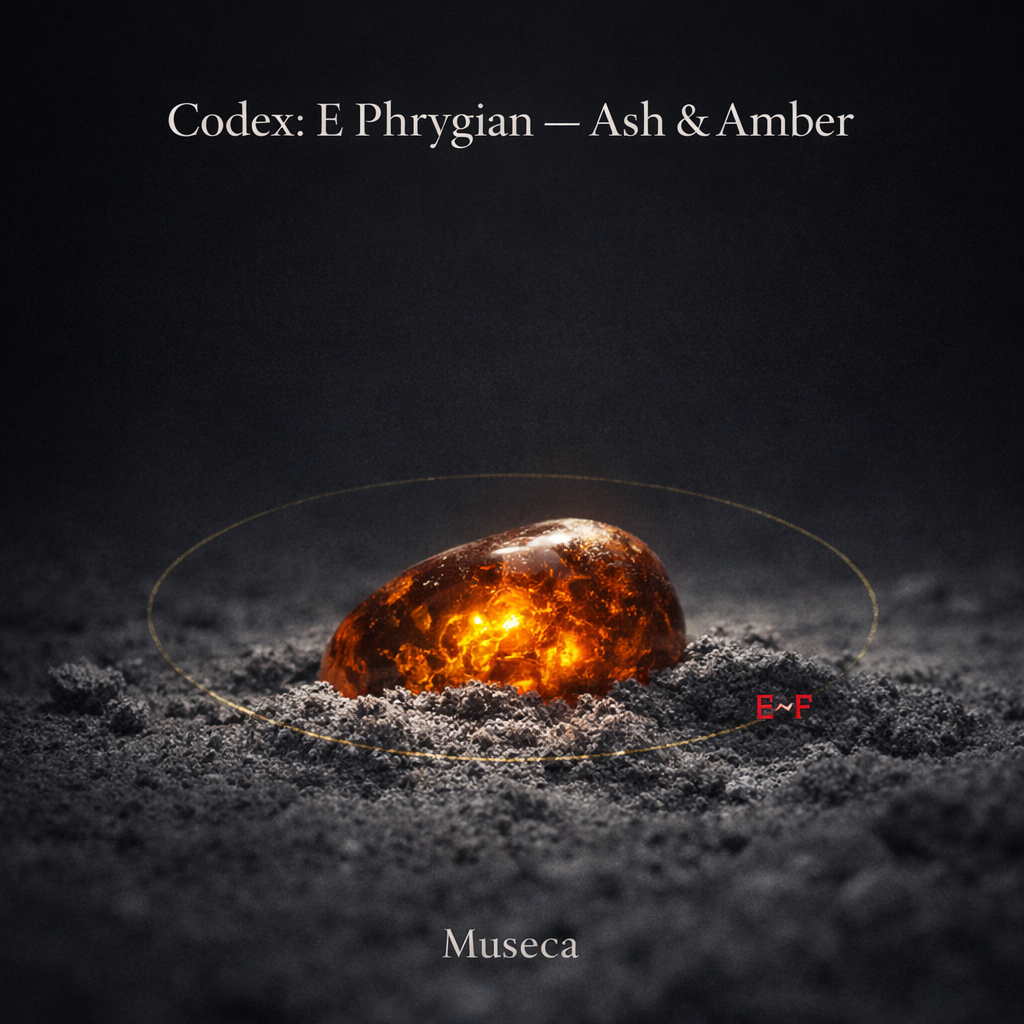
Codex: E Phrygian — Ash & Amber is a study in a single gravitational fact: in E Phrygian, the music lives one half-step above its home. The mode is built like the natural minor scale, but with one decisive alteration—its second degree is flattened. In practical terms, E Phrygian is E–F–G–A–B–C–D, and that F (the ♭2) is the signature. It is the “nearby threat” tone: close enough to touch the tonic, close enough to bruise it, and close enough to define the emotional weather of the entire record.
That is the purpose of this codex: to treat E Phrygian not as a color, but as a rule of physics. In a major key, resolution tends to feel like arrival. In E Phrygian, arrival is never entirely safe. The tonic remains present, even dominant—but it is constantly shadowed by the semitone above it. This produces a particular cinematic posture: tension that does not need volume to be intense; danger that can whisper; intimacy that can still feel armed. It is also why Phrygian has long been associated with Iberian and flamenco-inflected gestures: the mode’s gravity naturally favors guitar-centric harmonies, austere drones, processional movement, and cante-like lament—all without leaving the core identity of the scale.
Across these tracks, E Phrygian is used in three roles. First, as pursuit—a propulsion engine where the ♭2 functions like a siren adjacent to the tonic. Second, as threshold—a gate-ritual sensation where drones and bells turn the mode into architecture. Third, as human consequence—romance, processional dignity, and lament, where the same interval that implies threat also implies tenderness that cannot relax. The album title reflects that duality: Ash for the grit, aftermath, and shadow; Amber for the preserved glow inside the darkness—the way E Phrygian can hold heat without becoming bright.
This is not background music and it is not spectacle. It is a codex: a controlled environment designed to let one mode reveal its full emotional range. If you listen for only one thing, listen for the relationship between E and F—the home tone and its nearest neighbor. Everything in Ash & Amber is built to make that single half-step feel inevitable.
Liner Notes
Ash & Amber Overture (E Phrygian)
The album opens by establishing E as an uncompromising center—then immediately placing its closest shadow beside it: F (♭2). This overture is the codex thesis in sound: grit without theatrics, heat without flame. The tension is not created by loudness; it is created by proximity, as if the music’s “home” is permanently one breath away from abrasion.
E Phrygian (Pursuit/Terror)
Here E Phrygian becomes a kinetic engine. Rhythmic insistence and tight motifs push forward while the ♭2 remains an ever-present warning—close enough to feel like a hand on the back of your neck. The terror is measured rather than frantic: a controlled chase, an inevitable closing distance.
Ashen Gate (E Phrygian — Flamenco/Cinematic)
Flamenco influence appears as posture, not spectacle—dry attack, implied palmas, guitar-centric gravity—then expands into a cinematic field of space and shadow. This track behaves like a threshold: it invites you forward while refusing to offer clean resolution. The “gate” is in the harmony itself—an entrance that never fully opens.
Indigo Gate (E Phrygian Re-record)
The ritual hinge of the album. Drones, bell-tones, and long reverberant decay turn the mode into architecture—cool, nocturnal, and ceremonial. Re-recorded in E, it locks the codex into a single tonal identity while preserving the sense of crossing into a darker chamber where time slows and every interval feels deliberate.
E Phrygian Romance (Soleá hint)
Romance in E Phrygian is not sweetness; it is intimacy under pressure. The soleá hint reads as restraint and dignity—an emotional discipline—rather than a dance-floor gesture. The half-step tension becomes personal, like closeness that cannot relax, tenderness edged with grit.
E Phrygian Processional
A slow ceremonial walk through ash. Low percussion and muted harmonic turns create a dignified weight, as if the music is carrying something fragile and consequential. The power is in pacing: the track advances like an oath, refusing triumph, choosing inevitability instead.
E Phrygian Lament (Cello lead)
The human center of the record. The cello sings as a voice would—phrases that feel remembered rather than performed—supported by sparse accompaniment that keeps the grief honest. The ♭2 is felt as a wince: immediate, close, and quietly devastating, with no need for dramatic climax.
Rosette Ember (Codex Seal Interlude)
A final artifact—close-mic detail, amber drone, near-silence—designed to linger rather than conclude. It functions as the codex seal: the preserved glow inside the ash, the last controlled heat after the gate has closed. The ending does not resolve; it remains, like an afterimage.
Playlist
- Museca Core (E Phrygian) Museca 3:28
- E Phrygian — Pursuit/Terror Museca 5:33
- “Ashen Gate” (E Phrygian • flamenco-cinematic) Museca 4:12
- Indigo Gate Museca 3:57
- E Phrygian Romance (Soleá hint) Museca 4:25
- E Phrygian Processional Museca 3:20
- E Phrygian Lament (Cello lead) Museca 3:47
- Rosette Ember (Codex Seal Interlude) Museca 2:46