
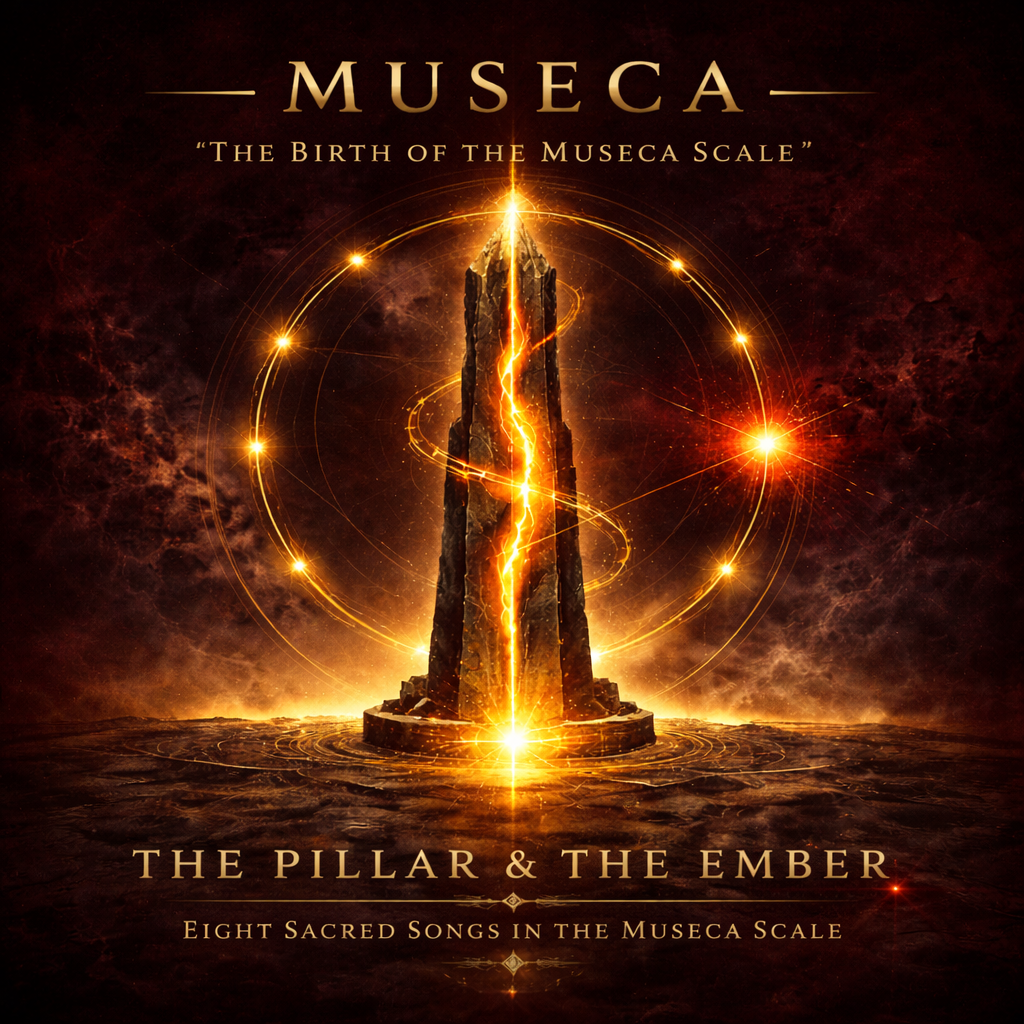
The Pillar and the Ember: Eight Sacred Songs in the Museca Scale is built upon an original modal language called the Museca Scale, a personal scale system designed to unite dark stability with controlled danger. Its foundation is Museca Core, an E-centered heptatonic mode: E–F–G–A–B–C–D. In practical terms, this is an E Phrygian world, with the lowered second degree (F) providing the scale’s defining gravitational pull toward the tonic E. That half-step relationship gives the language its ancient, solemn, inward quality. It is singable, coherent, and emotionally grounded. To this Core form is added a second tier, Museca Prime, which introduces one additional note: B♭. The Prime collection becomes E–F–G–A–B♭–B–C–D. This added B♭ functions as the scale’s signature “ember tone,” a dark inflection placed directly beside the structural fifth, B natural. The resulting friction between B♭ and B creates the distinctive Museca spark: a brief flash of instability within an otherwise stable tonal home.
The scale is not only a collection of notes, but a behavioral system. In the Museca language, B natural serves as a pillar tone—structural, resting, and stabilizing—while B♭ is directional, expressive, and never fully at rest. The most important cadential motion is F to E minor, the Phrygian descent that gives the music its sense of inevitability and return. A second characteristic gesture is D–F–Em, a signature stamp that deepens the feeling of ritual arrival. More rarely, the album uses B♭ to Em as a marked dramatic cadence, allowing the “ember” note to resolve into the home chord with tension still glowing around it. In this way, the Museca Scale was designed to combine Phrygian gravity, Locrian-like danger, and tonic stability into one authored sound world.
This album uses that system deliberately across all eight tracks. The opening pieces are rooted primarily in Museca Core, introducing the listener to the home language: dark, breath-like, solemn, and intimate. As the album progresses, the Prime form gradually emerges, first as a subtle coloration and then as a stronger expressive force. By the middle of the cycle, the added B♭ becomes an emotional turning point, giving the music a darker inner flare without breaking its tonal center. The final tracks do not abandon that tension; instead, they absorb it. The album returns to the Core, but changed by what the Prime has revealed. Structurally, the record is a study in how a personal scale can function not as an abstract theory, but as the governing grammar of a complete song cycle.
Stylistically, the Museca Scale is carried here through a fusion of sacred downtempo, neo-classical melody, cinematic atmosphere, and Café del Mar–influenced groove. The scale’s breath and gravity are voiced through duduk, warm bass, piano, low strings, ambient pads, hand percussion, soft electronic pulse, and occasional muted trumpet as accent color. The goal was not to create a purely ritualistic album, nor a conventional chillout record, but something in between: music that moves with the body while remaining inward, ancient, and contemplative. The groove gives the Museca language bloodstream; the scale gives the groove identity.
The emotional arc of the album follows a clear inner journey: arrival, orientation, pulse, threshold, awakening, trial, integration, and return. It begins with the naming of a center, passes through remembrance and hidden fire, crosses into sacred tension, confronts the darker note within, and finally returns home with a deepened sense of self. The lyrics are not narrative in a literal sense. They form a symbolic spiritual vocabulary built from recurring images—pillar, ember, lantern, stone, ash, breath, fire, threshold—all of which mirror the behavior of the scale itself. The pillar represents structure, center, and the sustaining fifth. The ember represents the hidden spark, the dangerous beauty of the added tone, the soul’s inner fire. The lantern is consciousness carried through darkness. Stone is memory, endurance, and the ancient body of experience. Ash is what remains after ordeal: not ruin, but transformation.
Taken together, these songs suggest that the deepest trials of the soul do not destroy its center; they reveal it. The lyrics move through fear, concealment, awakening, and purification toward a final reconciliation in which what once seemed opposed—light and dark, stability and danger, pillar and ember—belongs to one living whole. That is the meaning of this album, and it is also the meaning of the Museca Scale itself: a music in which home is never naive, fire is never merely destructive, and return is only real after one has passed through the flame.
Liner Notes
Invocation in E
The album opens by consecrating the tonal world of the Museca Scale before the groove fully arrives. This piece leans almost entirely on Museca Core—the E-centered collection E–F–G–A–B–C–D—so the listener first hears the scale as breath, gravity, and atmosphere. The lowered second, F, is especially important here, since its pull toward E establishes the Phrygian identity that underlies the whole record. The sparse text and wordless vocal lines make the track feel less like a conventional song and more like an invocation of the scale itself: the pillar is named, the ember is foreshadowed, and the home key is spiritually prepared.
Lyrics
[Wordless Vocalise]
Ah—eia—ah
Eia—ah—eia
Ah—eia—ah
[Invocation – soft lead voice, intimate and sacred]
Call the tone
Call the flame
Name the home
E without name
[Interlude – duduk, piano, ambient pad; a faint pulse begins]
[Chant – very soft downtempo pulse, light hand percussion]
From stone to breath
From breath to fire
From dark to tone
From tone to choir
[Wordless Rise – fuller choir, still restrained]
Ah—eia—ah
Eia—ah—eia
Ah—ah—eia
[Final Invocation – solemn, centered]
Hold the pillar
Keep the ember
Guard the center
Still remember
Phrygian Lantern
This is the first full statement of the album’s emotional language, and it presents the Museca Scale in its most lyrical form. The song is rooted primarily in Museca Core, allowing the melody to remain singable, dark, and intimate while the Café del Mar–influenced pulse gives it movement. The characteristic gravity of F resolving toward E shapes the emotional contour of the song, and the harmony circles around the Core’s stable modal colors rather than immediately introducing the more dangerous Prime inflection. In this way, the track acts as the listener’s first real entrance into Museca as a song language: inward, solemn, but gently in motion.
Lyrics
[Verse 1]
I kept a lantern in the fold of night
A little ember veiled from open sight
The sea of dark moved slowly through the stone
But in that hush I knew I was not alone
[Pre-Chorus – light lift, keep it intimate]
If all I carry is a faithful flame
Why does the silence tremble at my name
Why does the doorway breathe beneath the air
As if a hidden fire is waiting there
[Chorus – flowing, memorable, downtempo glide]
Phrygian lantern, burn low, burn true
Guide me through the dark I’m walking through
Hold the pillar, keep the ember near
Make a home for breath inside my fear
Phrygian lantern, small and clear
Shine where only listening hearts can hear
Till the night releases what it knows
And the buried tone of mercy glows
[Verse 2 – add soft groove and strings]
Ashes were sleeping in the broken seam
Like old prayers drifting through a dream
The wind moved softly through the hidden frame
And every shadow seemed to speak my name
[Pre-Chorus – slightly fuller]
If all I carry is this thread of fire
Why does it draw me farther, higher
Why does the ruin bend without a sound
As if a lost beginning can be found
[Chorus – fuller, still smooth and restrained]
Phrygian lantern, burn low, burn true
Guide me through the dark I’m walking through
Hold the pillar, keep the ember near
Make a home for breath inside my fear
Phrygian lantern, small and clear
Shine where only listening hearts can hear
Till the night releases what it knows
And the buried tone of mercy glows
[Bridge – half-time feel, airy duduk answer]
I do not ask the dark to disappear
Only to open what is hidden here
I do not ask for morning without cost
Only the path that leads me through the lost
[Final Chorus – warm, luminous, wider vocal]
Phrygian lantern, burn low, burn true
Guide me through the dark I’m walking through
Hold the pillar, keep the ember near
Make a home for breath inside my fear
Phrygian lantern, small and clear
Shine where only listening hearts can hear
Till the night releases what it knows
And the buried tone of mercy glows
Stone Hymn
Here the album proves that the Museca Scale can support not only lament and reverie, but also groove. “Stone Hymn” still draws mainly from Museca Core, yet it places that material inside a stronger rhythmic frame of bass pulse, hand percussion, and chant-like repetition. The scale’s darker tones give the song its ceremonial depth, while the recurring emphasis on E, F, and G keeps the melody grounded in the Core’s ancient modal identity. This is one of the clearest demonstrations that Museca is not merely a theoretical system—it can sustain body, repetition, and communal-feeling motion without losing its seriousness.
Lyrics
[Verse 1]
Stone remembers what the mouth forgets
Names once carried in the dust of breath
Footsteps turning in the ancient floor
Hands of fire passing through the door
[Pre-Chorus – lift gently, choir pad rising]
What was buried was not gone
What was silent still lives on
In the arch, in the seam, in the bone
Every loss has left its tone
[Chorus – chant-like, flowing groove, memorable]
Stone hymn, carry me
Through the weight of memory
Keep the pillar, guard the flame
Call the lost ones back by name
Stone hymn, under night
Hold the ember out of sight
Till the dark gives back its word
And the oldest tone is heard
[Verse 2 – fuller groove, more percussion shimmer]
Ash kept falling where the candles stood
Time covered over all it thought it could
Still the walls beneath the weathered air
Held a vow as if the vow were prayer
[Pre-Chorus – stronger, still smooth]
What was broken learned to sing
From the dust a hidden ring
In the arch, in the seam, in the bone
Every wound has kept its tone
[Chorus – wider, with soft backing choir]
Stone hymn, carry me
Through the weight of memory
Keep the pillar, guard the flame
Call the lost ones back by name
Stone hymn, under night
Hold the ember out of sight
Till the dark gives back its word
And the oldest tone is heard
[Bridge – half-time, atmospheric, duduk and piano breathe]
From stone to breath
From breath to fire
From fire to tone
We rise, we rise
[Instrumental Break – duduk lead over bass groove, frame drum, and ambient strings]
[Final Chorus – strongest, sacred but grooving]
Stone hymn, carry me
Through the weight of memory
Keep the pillar, guard the flame
Call the lost ones back by name
Stone hymn, under night
Hold the ember out of sight
Till the dark gives back its word
And the oldest tone is heard
Threshold Ember
This piece is the crossing point between the album’s Core world and its deeper, more marked language. The track begins in the atmosphere of Museca Core, but gradually hints at Museca Prime, the expanded form that adds B♭ beside the structural B natural. Because the text is sparse and ritual-like, the musical shift does most of the expressive work: the groove glides forward, the duduk carries the breath of the old world, and the muted trumpet introduces a bronze accent that suggests the coming change. This is the threshold where the listener begins to feel that the scale contains not only home, but also a hidden flame.
Lyrics
[Ritual Lines – soft, intimate, almost whispered]
At the threshold
Keep the ember
[Interlude – duduk lead, muted trumpet answers in short distant phrases]
[Ritual Lines – low, reverent]
Do not turn
Cross in fire
[Instrumental Rise – piano motif, deeper bass, subtle Prime color, muted trumpet accent]
[Ritual Lines – breath-like delivery]
Hold the pillar
Name the flame
[Instrumental Break – duduk and muted trumpet in dialogue over steady downtempo glide]
[Final Ritual Lines – calm, centered]
Cross the silence
Enter whole
Ember Between Stones
At the center of the album, the full Museca language begins to reveal itself. This song balances Core and Prime more openly, so the listener hears not only the E Phrygian foundation, but also the first substantial emotional effect of the added B♭, the album’s ember tone. The track does not let that note dominate; instead, it appears as a deepening coloration inside an otherwise stable tonal world. That is central to the philosophy of the Museca Scale: danger is present, but it does not erase home. The lyrics about hidden fire beneath stone mirror this exact musical design—the spark is buried, but living.
Lyrics
[Verse 1]
There is an ember sleeping in the stone
A quiet fire beneath the weight alone
No eye can see it in the fading light
But still it breathes its small red truth at night
[Pre-Chorus – lift slightly, deeper pads and strings]
Every wall I touch begins to glow
Every wound I hid begins to show
Something buried under dust and time
Is waking now and teaching me to climb
[Chorus – flowing, memorable, central groove]
Ember between stones
Fire beneath old bones
I was not empty, only underground
Waiting for one lost sound
Ember between stones
Heat in the broken tones
Under the weight of all I could not say
The living spark stayed
[Verse 2 – fuller groove, duduk in short answering phrases]
I walked the corridors of silent names
I wore their sorrow like a crown of flames
Then through the cracks beneath the weathered arch
A secret rhythm answered from the dark
[Pre-Chorus – stronger, subtle Prime tension]
Every breath becomes a hidden bell
Every fear becomes a waking spell
Something ancient turning in the seam
Leans through the dust and rises into me
[Chorus – wider vocal, more low strings]
Ember between stones
Fire beneath old bones
I was not empty, only underground
Waiting for one lost sound
Ember between stones
Heat in the broken tones
Under the weight of all I could not say
The living spark stayed
[Bridge – half-time, atmospheric, introduce a brief shadow color]
A darker note moved close beside the flame
It touched the heart and called it by its name
Not to unmake the ground beneath my feet
But turn the hidden fire into heat
[Instrumental Break – duduk lead over bass groove, piano, strings, and soft percussion]
[Final Chorus – fullest, luminous but grounded]
Ember between stones
Fire beneath old bones
I was not empty, only underground
Waiting for one lost sound
Ember between stones
Heat in the broken tones
Under the weight of all I could not say
The living spark stayed
Shadow Fifth
This is the album’s great point of tension and the clearest display of Museca Prime. Here the relationship between B♭ and B natural becomes the central dramatic force, giving the song its feeling of sacred danger and inner instability. The groove is darker and more propulsive, the muted trumpet adds sharp accent color, and the harmony allows the Prime inflection to come forward with far greater intensity than on the earlier tracks. Yet even here, the piece still resolves toward the E-centered home. That is what makes the song powerful rather than chaotic: the shadowed fifth is allowed to burn, but not to take the throne.
Lyrics
[Verse 1]
I came to the edge where the old notes turn
Where the pillar holds and the dark notes burn
There in the breath between wound and flame
Something unnamed was calling my name
[Pre-Chorus – rising tension, restrained but urgent]
One step nearer, the silence split
A hidden ember at the center lit
Not to undo the ground below
But wake the fire I feared to know
[Chorus – strongest groove so far, dark and memorable]
Shadow fifth
Call me to the edge and back again
Shadow fifth
Touch the wound and make it sing again
Between the fall and the return
Between the fear and what I learn
There is a fire behind the stone
Shadow fifth, lead me home
[Verse 2 – fuller percussion, muted trumpet accent phrases]
I felt the old walls move inside my chest
A darker grace refusing me my rest
Not to destroy the name I knew
But burn it clean and make it true
[Pre-Chorus – wider, more intense]
One note broken from the living wall
One low spark answering the call
It brushed the heart, then turned to light
A blade of heat inside the night
[Chorus – bigger, with low choir support]
Shadow fifth
Call me to the edge and back again
Shadow fifth
Touch the wound and make it sing again
Between the fall and the return
Between the fear and what I learn
There is a fire behind the stone
Shadow fifth, lead me home
[Bridge – half-time, atmospheric, duduk and muted trumpet in dialogue]
I do not bow to ruin
I do not flee the flame
I take the darker ember
And rise without a name
[Instrumental Break – strongest groove, duduk lead, muted trumpet accents, bass and percussion driving]
[Final Chorus – fullest, cinematic, charged but controlled]
Shadow fifth
Call me to the edge and back again
Shadow fifth
Touch the wound and make it sing again
Between the fall and the return
Between the fear and what I learn
There is a fire behind the stone
Shadow fifth, lead me home
Ashes of the Pillar Tone
After the climax, this track becomes a song of integration. It continues to draw on both Core and Prime, but the sharper tensions of the previous track are now absorbed into a more reflective, illuminated language. The Museca Scale here sounds less like a conflict and more like a hard-won understanding. The pillar tone remains present as a stabilizing force, while traces of the ember still flicker beneath the surface. The dialogue between duduk and muted trumpet helps embody that balance: breath and bronze, grief and structure, shadow and form. Musically and lyrically, this is the song in which the scale begins to understand itself.
Lyrics
[Verse 1]
Ashes lay quiet where the fire had been
Soft on the stone, soft on the skin
Nothing was lost, only changed in the flame
What could not remain was never my name
[Pre-Chorus – gentle lift, low strings and ambient choir]
After the burning, after the light
After the blade at the heart of the night
Something within me, solemn and slow
Learned what the ember was trying to show
[Chorus – flowing, reflective, steady groove]
Ashes of the pillar tone
You did not leave me here alone
You kept the center through the fire
You held the shape of my desire
Ashes of the pillar tone
Teach the broken heart its home
Till what was dark and what was bright
Rest in one undivided light
[Verse 2 – fuller bass and percussion shimmer]
I heard the silence answer in the wall
Not with a shout, but a merciful call
The darker note that once had cut so deep
Now moved like memory through my sleep
[Pre-Chorus – a little wider]
After the falling, after the test
After the wound had opened my chest
Something beneath me, ancient and true
Stayed through the fire and carried me through
[Chorus – broader, with soft backing choir]
Ashes of the pillar tone
You did not leave me here alone
You kept the center through the fire
You held the shape of my desire
Ashes of the pillar tone
Teach the broken heart its home
Till what was dark and what was bright
Rest in one undivided light
[Bridge – half-time, airy, duduk and muted trumpet in dialogue]
What the flame took
What the flame gave
What I called ending
Was a deeper way
[Instrumental Break – duduk lead, muted trumpet replies, warm bass and soft beat continue]
[Final Chorus – fullest, glowing but restrained]
Ashes of the pillar tone
You did not leave me here alone
You kept the center through the fire
You held the shape of my desire
Ashes of the pillar tone
Teach the broken heart its home
Till what was dark and what was bright
Rest in one undivided light
Lantern After Fire
The album closes by returning to the world of Museca Core, but not in the same innocence with which it began. The final track is mostly grounded again in the Core’s singable Phrygian language, with its characteristic F-to-E gravity, yet it carries the memory of Prime within it. The ember is no longer a threatening intrusion; it has become part of the soul’s inner knowledge. That is why the song feels calm without feeling simple. The Museca Scale comes home, but home has been transformed. The final effect is one of quiet reconciliation: the pillar still stands, the ember still glows, and both now belong to one returning light.
Lyrics
[Verse 1]
I carried the lantern back through the flame
Not as I entered, not with the same name
Ash on my hands, but the center still clear
A quieter fire was living here
[Pre-Chorus – gentle lift, strings open slowly]
What I had feared became a door
What I had lost became much more
Not by erasing the night I knew
But by letting its ember pass through
[Chorus – flowing, warm, resolved]
Lantern after fire
Glow in the breathing wire
Hold the pillar, keep me near
Make a home within the clear
Lantern after fire
Calm of a deep desire
Till the ash and flame agree
And the hidden tone is me
[Verse 2 – slightly fuller groove, duduk answers softly]
The walls were changed by the passing heat
The dark no longer felt complete
Somewhere between the wound and the light
Mercy had entered the heart of the night
[Pre-Chorus – a little wider, still intimate]
What once was shadow learned to rest
What once was broken crossed my chest
Not as a burden too hard to bear
But as a sign that the fire was there
[Chorus – fuller, luminous, still restrained]
Lantern after fire
Glow in the breathing wire
Hold the pillar, keep me near
Make a home within the clear
Lantern after fire
Calm of a deep desire
Till the ash and flame agree
And the hidden tone is me
[Bridge – half-time, airy, nearly whispered]
I do not return unchanged
I return more still
Not emptied of the night
But gentled by its will
[Instrumental Break – duduk over warm bass, piano, and soft beat, no heavy lift]
[Final Chorus – most open and peaceful]
Lantern after fire
Glow in the breathing wire
Hold the pillar, keep me near
Make a home within the clear
Lantern after fire
Calm of a deep desire
Till the ash and flame agree
And the hidden tone is me
Playlist
- Track 1 - Invocation in E Museca 2:23
- Track 2 - Phrygian Lantern Museca 5:00
- Track 3 - Stone Hymn Museca 5:00
- Track 4 - Threshold Ember Museca 3:18
- Track 5 - Ember Between Stones Museca 5:36
- Track 6 - Shadow Fifth Museca 5:20
- Track 7 - Ashes of the Pillar Tone Museca 5:35
- Track 8 - Lantern After Fire Museca 6:15