
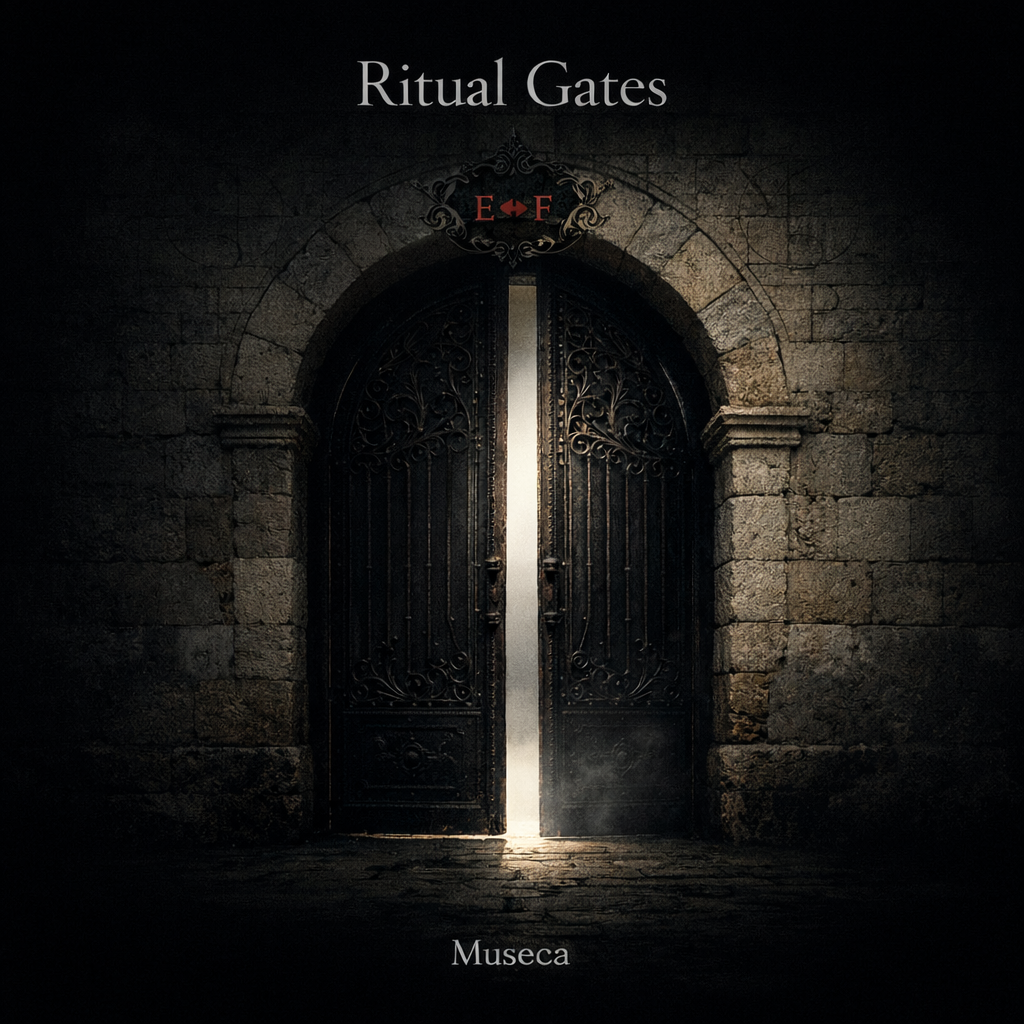
Ritual Gates is an album built on a single idea: a gate is not a place you arrive—it is a place you pass through. Every track is designed to feel like an enacted threshold: signals, ostinati, bells, drones, and restrained percussion forming a continuous rite rather than a collection of songs. The sequencing and production are intentionally “architectural,” with long reverberant tails and planned crossfades so the album behaves like one unbroken corridor of sound.
At the center of that corridor is E Phrygian, a mode defined by the most intimate kind of tension in Western harmony: the half-step above the tonic. In E Phrygian, the scale is E–F–G–A–B–C–D, and the defining interval is the relationship between E and F (♭2)—a neighboring tone so close it feels like pressure rather than distance. That single semitone is the mode’s signature. It creates a psychological posture that is uniquely suited to ritual music: the tonic is present and grounded, but never fully at ease. You are “home,” yet the doorway is always open, and something is always just on the other side.
That is the purpose of using E Phrygian here, and why it matters. In many modes, tension and release behave like travel: you depart, you wander, you return. E Phrygian does not romanticize departure. Its tension is local, immediate, and persistent—perfect for trance structures where repetition must remain alive without relying on big harmonic changes. The recurring ♭2 provides a constant, controlled friction that keeps the listener alert inside the loop, which is precisely what ritual and signal-based music requires. It also explains Phrygian’s historical power across traditions: it can evoke austerity, ancient solemnity, and Iberian grit, but it can also feel like sacred minimalism when treated as a sustained field rather than a dramatic gesture.
Across Ritual Gates, E Phrygian becomes a practical tool—not a theory lesson. Bells mark thresholds. Pulses act as wards. Drones become stonework. Radio-grain textures suggest transmissions from beyond the arch. The goal is not to “resolve” the mode, but to inhabit it—to let the E–F relationship function as a ritual law: a constant adjacency that shapes every breath of the mix. What you hear is the importance of E Phrygian made audible: a tonal center that holds its ground while admitting the presence of the unknown, turning repetition into ceremony and sound into passage.
Liner Notes
Phrygian (De-emphasize the 5th)
A ritual groove built on deliberate omission. By softening the pull of the fifth, the track shifts Phrygian from “progression” into “presence”—less like harmony traveling somewhere, more like a circle being drawn again and again. The result is trance by constraint: E is anchored, F (♭2) stays close, and the tension becomes a steady pressure rather than an event.
Desert Threshold (Phrygian signal)
A distant transmission carried on dry air. Pulses and sparse motifs behave like a coded message—repeating, patient, and slightly degraded at the edges—while the E–F semitone friction reads as the signal’s static. This is the album’s first clear threshold: you can feel the gate before you see it.
Phrygian Ostinato Gate
Here the gate is mechanical—an ostinato that functions like a locking mechanism. Repetition is not decoration; it is architecture. The mode’s identity stays intact by refusing to “resolve” into comfort: E remains the floor, and the nearby F keeps the floor from ever feeling safe. The groove suggests motion, but the harmony insists on ritual.
Indigo Gate (E Phrygian Ritual)
The hinge of the album: cool, nocturnal, and ceremonial. Bells and resonant metal tones create a sense of vaulted space, while the tonic drone holds E as a fixed point of gravity. The re-recording in E aligns the entire album’s tonic ecosystem, so this “indigo chamber” feels like a true interior room rather than a detour.
Threshold Bells (E Phrygian)
Bells do what drums cannot: they sanctify time. Their repeating pattern turns the semitone tension into an incantation—E as the spoken vow, F as the whispered warning. The low drum is a measured heartbeat under stone, designed to leave long tails and let the next track emerge as a continuation, not a cut.
Dust Signal (E Phrygian)
The most explicitly “transmission” track: radio-grain textures, coded pulses, and distant metallic hits that feel like a broadcast coming through sand. The E–F relationship becomes the channel’s friction, a sonic haze that keeps the repetition alive. Minimalism here is not emptiness; it is focus—what remains after everything nonessential is stripped away.
Gate of Ash (E Phrygian)
Breath drones and frame drum cycles create the album’s most tactile ritual. The sound is close to the body—air, skin, wood, and quiet impacts—yet it lives inside a large, reverberant room. F hovers as a warning tone, never allowed to become “pretty,” so the piece feels like ceremony performed under oath.
Stone Arch Drone (Exit Seal) (E Phrygian)
A near-beatless closing seal built for crossfade. Sub swell, stone ambience, and distant resonances hold E like a final architectural column while the faint implication of F keeps the door from fully shutting in the mind. It does not conclude; it remains—an afterimage of the gate, a quiet reminder that passage changes the listener even after the music ends.
Playlist
- Phrygian (de-emphasize the 5th) — Ritual Groove Museca 4:25
- Desert Threshold (Phrygian Signal) Museca 3:29
- Phrygian Ostinato Gate (Instrumental) Museca 3:13
- Indigo Gate Museca 3:06
- Threshold Bells (E Phrygian) Museca 4:36
- Dust Signal (E Phrygian) Museca 3:28
- Gate of Ash (E Phrygian) Museca 3:49
- Stone Arch Drone (Exit Seal) (E Phrygian) Museca 3:40