Imitation · Canon · Polyphony
Counterpoint Studies — Vol. I
Independent melodic lines build harmony through motion, from a two-voice duet to multilayered contrapuntal architecture.

Museca · Curated Listening Collection No. 11
Hear a compositional principle become music
How does a composer turn an abstract idea into something we can feel? These twenty-four original Museca recordings invite the listener inside the musical workshop: independent melodies become counterpoint; a repeated figure becomes structure; competing rhythmic layers reshape time; instrumental color gives an idea a new character; tension changes our sense of gravity; and modes alter the light around a tonal center. Six listening modules turn musical principles into audible experience—no advanced theory required.

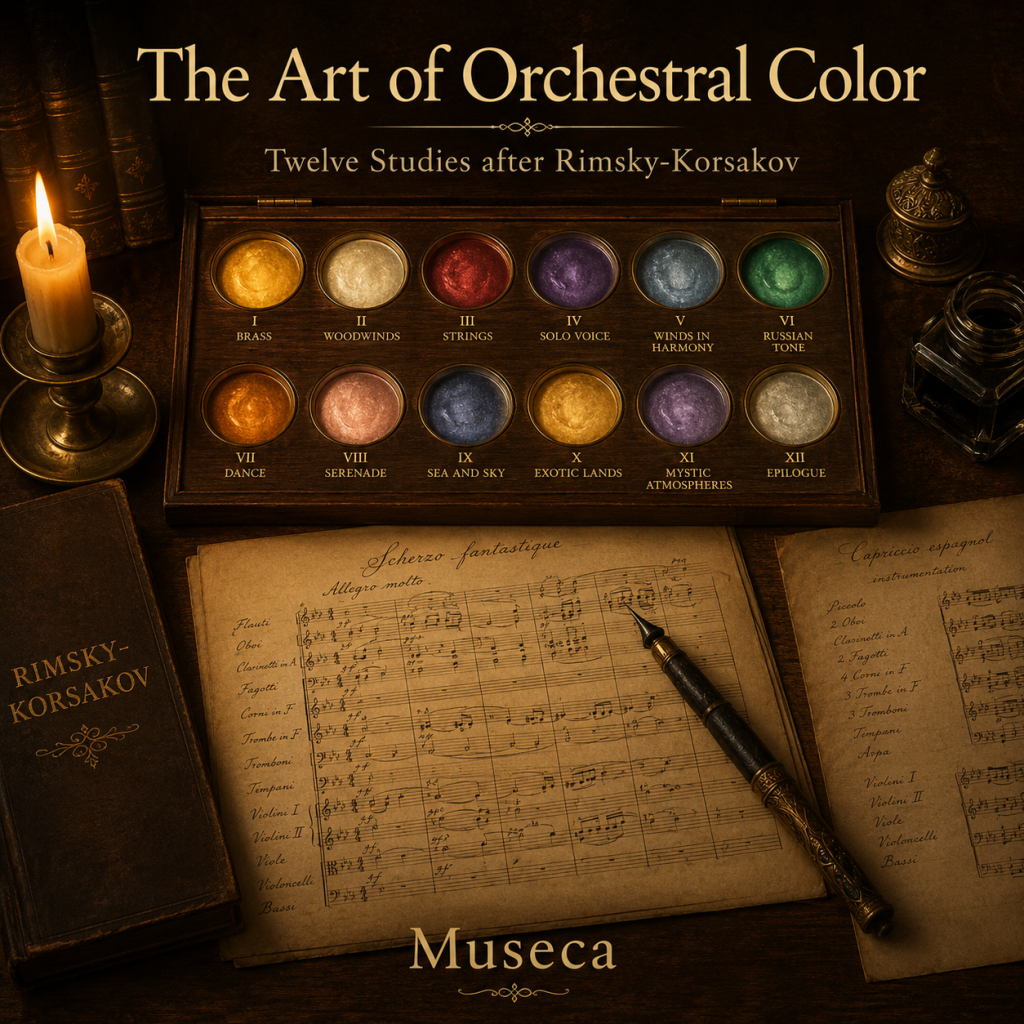
The most useful music theory is not simply understood. It is heard.
The learning path
Each module introduces a principle in plain language, then offers four contrasting recordings with a focused listening prompt. You need not master the vocabulary before listening. Use the examples to discover what the technique does.
For a continuous journey, play all twenty-four tracks in order and hear how the study evolves from musical lines to tonal environments. For a practical lesson, choose one module, read its two-sentence concept and listening exercise, then replay its four examples. Count, compare, or simply describe what changes in your own words. When a technique is more subtle than its title suggests, the listening prompt is an invitation to investigate—not a claim that every detail must be audible in the same way.
The complete audio sequence
Twenty-four existing Museca recordings, arranged into six short practical studies. Begin with “Dance of Two Strings” and follow the path from independent melodic lines toward modal color.
All recordings are original Museca compositions. The Cue player uses existing source-album audio files without duplicate uploads. In the WordPress editor, the Cue shortcode may appear as text; it renders as an audio player in the webpage preview and public page.
The lessons
Every track has a concise listening note, followed by a link to the original album. The techniques are offered as perceptual exercises rather than prerequisites or tests.
Module 01 · Tracks 01–04
Two lines can become one musical thought
Counterpoint is the art of giving two or more melodies meaningful independence. Instead of one tune supported by chords, different lines move together and create harmony through their interaction.
Follow only one voice for ten seconds. Then shift to another. On a second listening, hear both as parts of the same musical conversation.
Follow one string line for a few moments, then switch attention to the other. Can you hear two melodies instead of melody plus accompaniment?
Listen for an idea appearing again in a later voice. In a canon, the second line enters after the first has already begun.
Focus on the spaces between replies. Hear how the lines may answer one another while retaining their own melodic direction.
At greater density, try to identify an individual strand, then hear the overall texture when all strands are considered together.
Module 02 · Tracks 05–08
A pattern stays; the meaning changes
An ostinato is a recurring rhythmic or melodic figure. Its repetition can establish a stable foundation while surrounding harmony, register, texture, and accents develop.
Identify the shortest repeated pattern you can hear. Track it through one full phrase, then ask which musical details change above or around it.
Find the repeating rhythmic cell and keep it in mind. What changes around the pattern while it stays familiar?
Follow the recurring ground beneath the expressive surface. Notice how a steady foundation can support changing emotion.
Listen for repeated figures creating a feeling of insistence. How do the accents alter your sense of forward motion?
Notice tiny changes against repeated material. Repetition can make small differences sound unusually important.
Module 03 · Tracks 09–12
One pulse, several ways to feel time
Rhythmic displacement moves an accent or figure away from an expected position. Polyrhythm involves contrasting rhythmic divisions occurring together. They are distinct techniques, but both can change where the listener feels the beat.
Tap a steady pulse. While it continues, notice accents or subdivisions that pull your attention elsewhere. Try following a second rhythmic grouping without losing the first.
Try counting three equally spaced pulses while attending to a competing two-part pattern. Let one grouping anchor the other.
Notice the expressive friction between four-part and three-part divisions of time. You can hear the contrast without counting every note.
Listen for rhythmic layers that seem to phrase independently. Does your sense of the main beat change as attention moves between them?
Use the title’s 5:4 relationship as a listening challenge: notice how unequal groupings can create a shifting accent landscape.
Module 04 · Tracks 13–16
The same phrase can mean something new in another voice
Orchestration is the art of assigning musical roles and material to instruments. Timbre—the particular quality of a sound—can transform the expressive effect of a melody, harmony, or rhythm.
Ignore pitch for a few moments. Attend instead to attack, resonance, register, and the way instrumental colors blend or separate.
Focus on how each note begins—sharp, soft, struck, or breathed. The start of a sound can become part of its musical identity.
Listen for the moment when contrasting instrumental colors seem to merge into a single composite tone.
Compare bowed-string resonance with the rounded tone of the horn. What remains distinctive when the voices share a phrase?
Follow a musical idea as different instrumental colors take it over. Orchestration can change a phrase without changing its basic identity.
Module 05 · Tracks 17–20
The ear can feel a question before hearing an answer
Harmonic tension arises through relationships among pitches and chords, including dissonance, unexpected intervals, unstable centers, and delayed resolution. Tension is not necessarily unpleasant; it can give music direction and emotional depth.
Notice when a harmony feels settled and when it seems to demand continuation. Can repetition make the pulse predictable while the pitches remain unstable?
Listen beneath the most prominent melody. Can you sense how inner voices and harmonic spacing contribute to tension or release?
Hear how harmonic-minor color can make tonal gravity feel more pointed and unusual. Listen for a pull that is not simply major or minor brightness.
A repeating pattern can stabilize the rhythm while an unstable modal center keeps the harmony unsettled. Listen for that contrast.
Locrian lacks a stable perfect fifth above its tonic. Hear how this can resist the sense of rest associated with more familiar tonal centers.
Module 06 · Tracks 21–24
Change the scale and the emotional landscape changes
A mode is a particular organization of scale degrees around a tonal center. By hearing contrasting modal environments one after another, we can compare how different intervals affect brightness, weight, and expectation.
Treat these four tracks as a comparative laboratory rather than a single melody transformed in real time. Listen across Ionian, Dorian, Phrygian, and Lydian and describe each in your own words.
Begin the comparison with the familiar major-mode sound. Notice how its tonal center can feel open and comparatively settled.
Compare this with Ionian: what changes when a minor-colored mode retains a relatively bright sixth degree?
The lowered second degree brings a close semitone above the tonic. Listen for a darker, more compressed feeling of gravity.
The raised fourth creates a distinctive brightness. Compare the feeling of this final tonal landscape with the opening Ionian study.
The recordings in their original settings
Six study families are represented here, including both volumes of Counterpoint Studies. Each album is a complete musical exploration in its own right; the laboratory rearranges existing recordings to make contrasts especially accessible.
Imitation · Canon · Polyphony
Independent melodic lines build harmony through motion, from a two-voice duet to multilayered contrapuntal architecture.
Lyrical counterpoint · Chamber dialogue
Counterpoint in a more intimate, expressive setting: transparent dialogue, intersecting phrases, and voices that retain individuality.
Repetition · Ground bass · Minimalism
The repeating musical figure as an engine of rhythm, structure, variation, and developing emotional meaning.
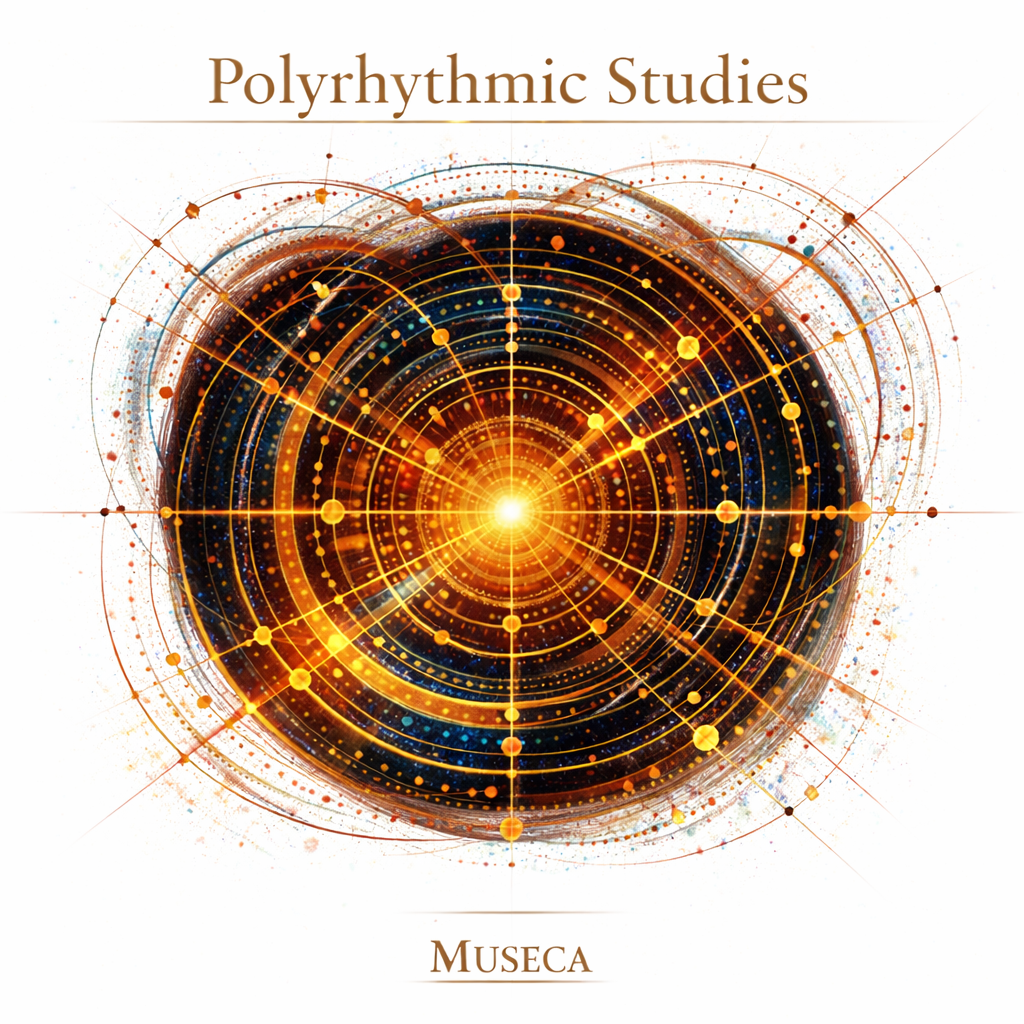
Cross-rhythm · Pulse · Multiple subdivisions
Studies of different rhythmic divisions and accent patterns operating at the same time—from 3:2 to 5:4.
Tone color · Attack · Instrumental blend
Eight studies in the qualities that make instruments distinct, including attack, overtone color, register, resonance, and blending.
Orchestration · Instrumental roles · Transparency
A collection exploring how an orchestra distributes melody, blends contrasting voices, and uses texture with purpose.
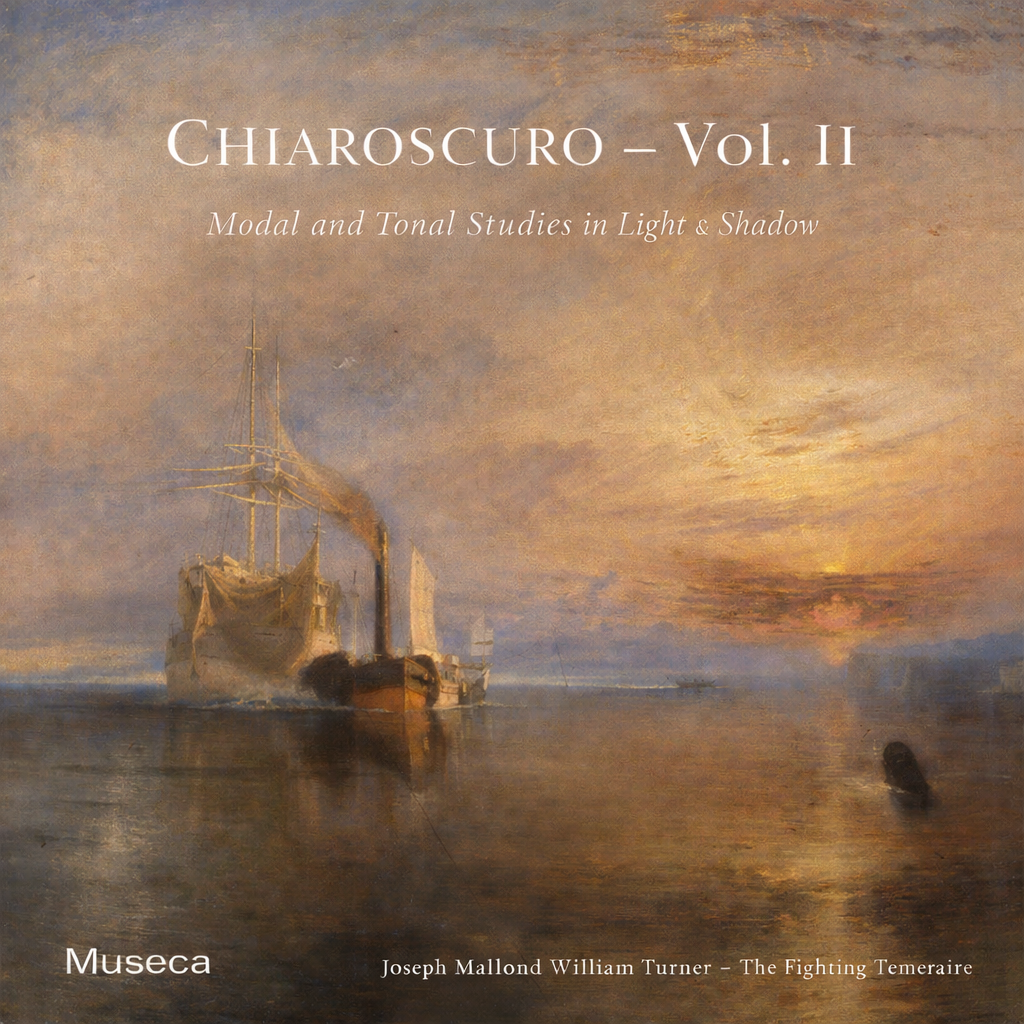
Modal identity · Harmonic light and shadow
A series of tonal landscapes where modes shape brightness, uncertainty, gravity, and expressive color.
Companion reading · Museca Library
The Music Library offers deeper references for the techniques heard here. The playlist is the practical entry point; the books offer terminology, background, and additional compositional context.
Polyrhythm, pulse, meter, syncopation, and rhythm across musical traditions
Explore this bookInstrumental range, timbre, combination, and orchestration
Explore this bookSeven diatonic modes understood as an ordered spectrum of musical brightness
Explore this bookThe connection between sonic color, harmony, emotional atmosphere, and composition
Explore this book