
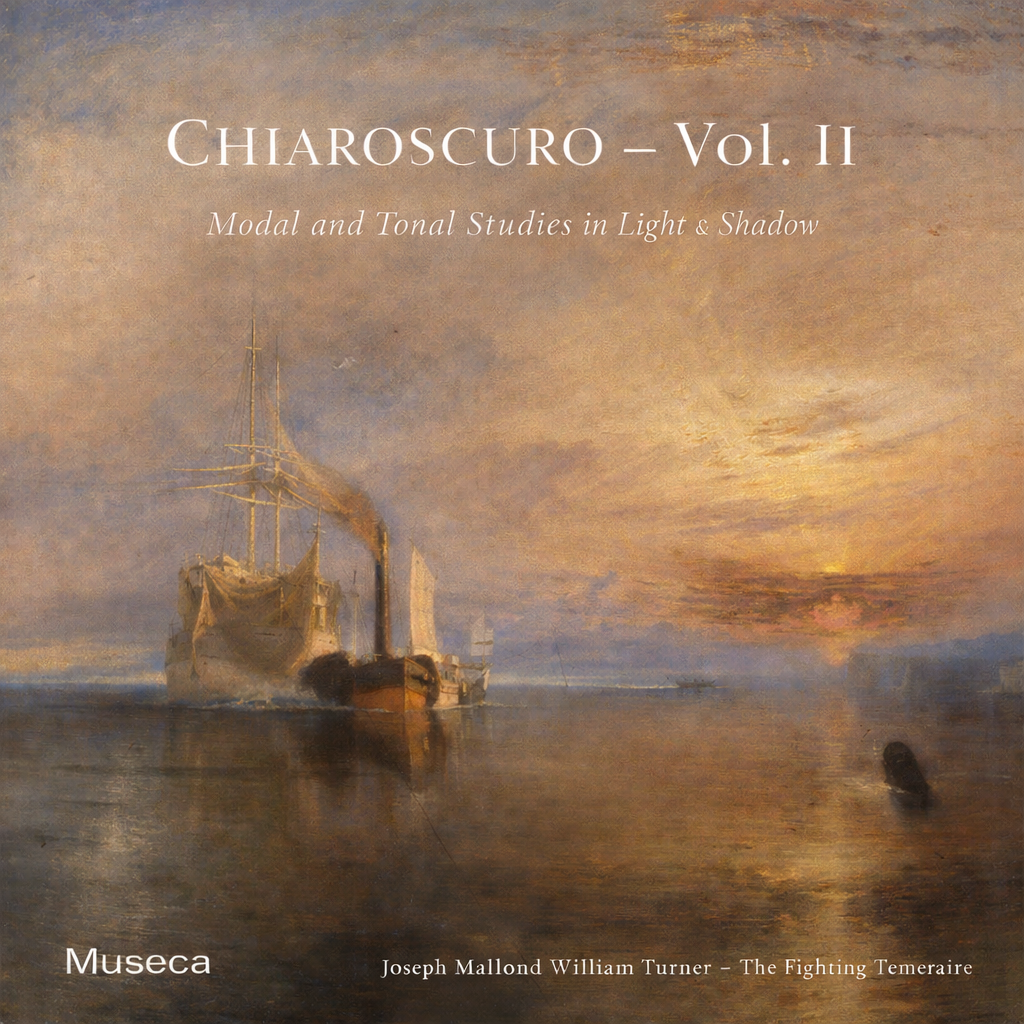
CHIAROSCURO — Vol. II
Modal and Tonal Studies in Light & Shadow
If Vol. I explored chiaroscuro as event—sharp contrasts, harmonic collisions, moments where light strikes darkness—Vol. II moves into a different territory. Here, chiaroscuro becomes environment rather than gesture. Light and shadow no longer oppose one another in sudden flashes; they coexist, intermingle, and gradually transform.
In the visual arts, this shift mirrors the movement from Caravaggio to Turner. Where Caravaggio isolates figures with dramatic illumination against black voids, Turner dissolves form into atmosphere. Light is no longer a spotlight—it is weather, memory, and time itself. Darkness is not absence, but depth.
This album adopts that philosophy in sound.
From Harmony to Tonality
While Vol. I is built on chord progressions and harmonic contrast, Vol. II is grounded in modes and tonal fields. Each piece is a sustained exploration of a single tonal world—Ionian, Dorian, Phrygian, and beyond—allowing light and shadow to emerge from within the scale itself, rather than from abrupt harmonic opposition.
Here, chiaroscuro is expressed through:
modal color
intervallic gravity
tonal ambiguity
brightness versus weight
openness versus constraint
Instead of asking “What happens when light collides with darkness?”, these studies ask:
“What kind of light does this tonal world naturally produce?”
Light as Character, Not Contrast
Each track functions as a sonic landscape rather than a narrative moment. Ionian opens wide, luminous, and untroubled. Phrygian smolders beneath the surface. Locrian fractures stability entirely. Some modes glow softly; others flicker, distort, or darken without ever fully extinguishing light.
Chiaroscuro here is gradual, immersive, and psychological. Shadow may arrive not as tension, but as inevitability. Light may feel artificial, adaptive, or broken. In some pieces, tonal gravity replaces harmonic resolution; in others, silence and diffusion act as shadow.
A Companion, Not a Sequel
CHIAROSCURO — Vol. II is not a continuation of Vol. I so much as its atmospheric counterpart. Where the first volume demonstrates the mechanics of contrast, the second invites the listener to inhabit tonal space—to stand inside the fog, the glow, the unresolved horizon.
Together, the two volumes form a single system:
Vol. I: Harmonic chiaroscuro — light and shadow as structure
Vol. II: Tonal chiaroscuro — light and shadow as climate
This album is an invitation to listen slowly, to perceive brightness and darkness not as opposites, but as coexisting forces within the same field of sound.
Light does not always arrive suddenly.
Sometimes, it simply emerges.
Liner Notes
Ionian — Open Light
This study establishes the baseline against which all other tonal worlds are perceived. Built entirely within the Ionian mode, the harmony avoids chromaticism, modal tension, or destabilizing intervals. Wide spacing, gentle voice-leading, and restrained motion allow light to exist without resistance. Chiaroscuro here is minimal by design: illumination without shadow, a tonal “daylight” that defines normalcy before contrast appears.
Dorian — Silver Light
Dorian introduces shadow gently, not through darkness but through gravity. Though minor in color, the raised sixth injects a subtle lift that prevents collapse into melancholy. The harmony balances weight and clarity, allowing minor tonality to glow with a cool, reflective sheen. Chiaroscuro emerges internally, as light embedded within darkness rather than opposed to it.
Phrygian — Veiled Fire
Phrygian marks the first true tension of the album. The flattened second is treated not as a passing color, but as a constant pressure shaping every harmonic decision. Motion remains restrained, but the tonal field smolders beneath the surface. Light is present, yet filtered—intense but contained. This is chiaroscuro as latent heat: shadow charged with energy.
Lydian — Radiant Instability
Lydian reverses expectations by making brightness itself unstable. The raised fourth introduces a fracture within an otherwise major environment, creating a sense of floating illumination without ground. Harmony shimmers and hovers, resisting firm resolution. Chiaroscuro here is not darkness intruding on light, but light destabilizing itself through excess.
Mixolydian — Fading Light
Mixolydian softens authority rather than removing it outright. The lowered seventh weakens the pull of resolution, allowing brightness to linger without conclusion. Harmony feels familiar yet worn, as though daylight is thinning. Chiaroscuro appears as erosion: light remains, but certainty fades.
Aeolian — Settled Shadow
Aeolian presents darkness as a resting state rather than a crisis. Natural minor harmony is allowed to settle without drama, tension, or corrective brightness. Motion is minimal and grounded, emphasizing acceptance over struggle. Chiaroscuro becomes static here—shadow as home, not threat.
Locrian — Broken Light
Locrian removes tonal ground altogether. The flattened fifth undermines stability, preventing the ear from locating a true center. Harmony circles itself, suspended and unresolved. Any trace of light feels fractured and incomplete. Chiaroscuro here is permanent imbalance: illumination without foundation.
Harmonic Minor — Artificial Light
Harmonic minor reintroduces brightness by force. The raised seventh cuts sharply through the minor field, creating a vertical pull toward resolution that feels imposed rather than natural. The resulting light is precise, tense, and exotic. Chiaroscuro is explicit: shadow pierced by an artificial spotlight.
Melodic Minor — Adaptive Light
Melodic minor allows brightness to adjust rather than dominate. Ascending motion lifts through raised sixth and seventh degrees, while descending lines return naturally to darkness. Light appears contextually, then withdraws. Chiaroscuro here is conditional—responsive rather than absolute.
Phrygian Dominant — Gilded Shadow
Phrygian Dominant wraps darkness in ornament. The major third glows richly against the Phrygian framework, producing a sense of luxury without comfort. Harmony is dignified, heavy, and exotic. Light decorates shadow but never replaces it. Chiaroscuro becomes ceremonial rather than dramatic.
Whole Tone — Diffuse Light
The whole tone scale dissolves contrast almost entirely. With no tonal hierarchy or gravitational center, harmony floats in evenly distributed brightness. Without shadow, depth disappears. Chiaroscuro is inverted here: light everywhere, meaning nowhere. The absence of darkness becomes its own form of unease.
Negative Key — Black Field
The album closes by withdrawing sound itself. Tonality is implied rather than stated, emerging briefly from silence before receding again. Harmony does not resolve; it vanishes. Silence functions as the deepest shadow, framing absence as presence. Chiaroscuro reaches its final state: light extinguished not by force, but by disappearance.
Playlist
- Ionian — Open Light Museca 2:55
- Dorian — Silver Light Museca 3:31
- Phrygian — Veiled Fire Museca 3:34
- Lydian — Radiant Instability Museca 3:00
- Mixolydian — Fading Light Museca 3:44
- Aeolian — Settled Shadow Museca 2:43
- Locrian — Broken Light Museca 3:45
- Harmonic Minor — Artificial Light Museca 2:57
- Melodic Minor — Adaptive Light Museca 2:43
- Phrygian Dominant — Gilded Shadow Museca 3:00
- Whole Tone — Diffuse Light Museca 1:56
- Negative Key — Black Field Museca 1:55