
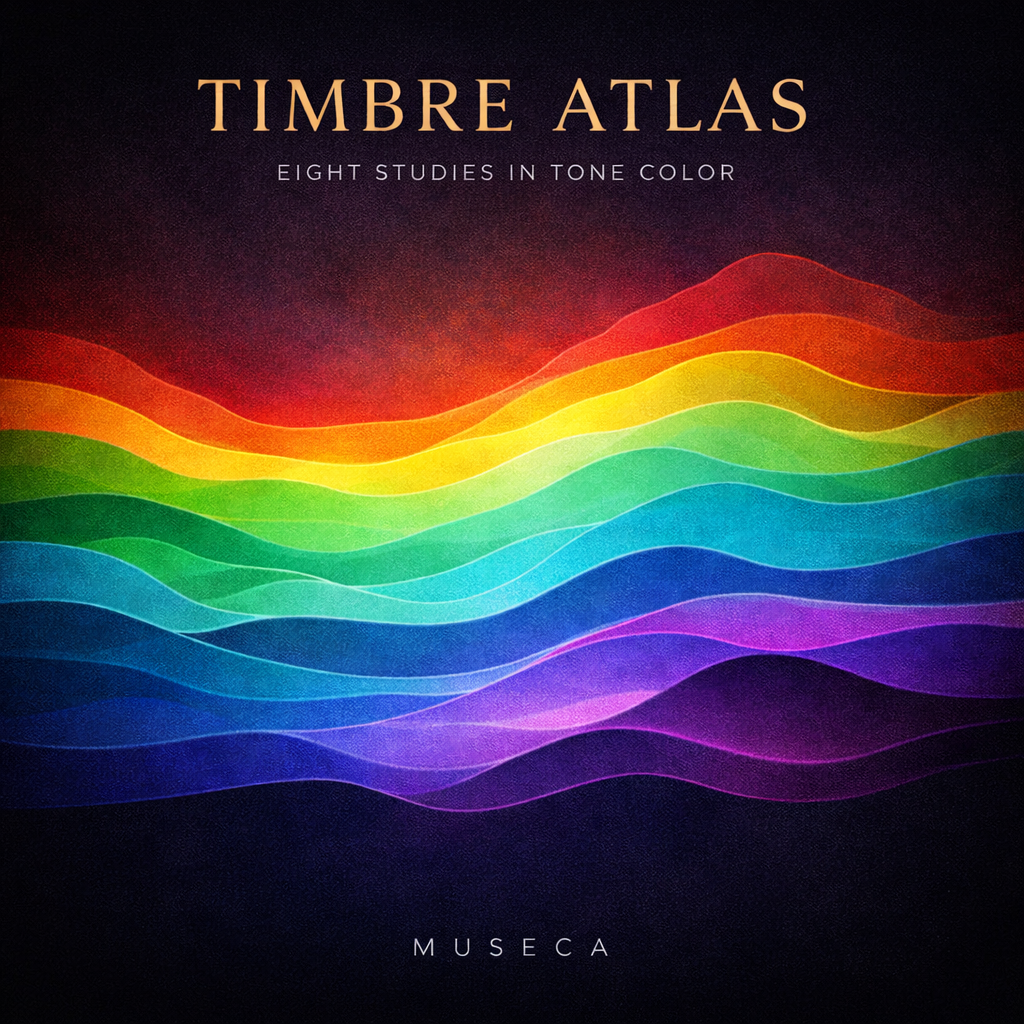
Timbre Atlas — Eight Studies in Tone Color
In music, tone color—more formally called timbre—is the quality that makes two sounds feel different even when they play the same pitch at the same volume. A flute and a violin can both play the same A, yet one sounds airy and luminous while the other sounds bowed, vivid, and human. That difference is timbre. It is shaped by the overtone spectrum (which upper partials are present), the envelope (how the sound attacks, sustains, and decays), the balance of tone versus noise (breath, bow, reed, distortion), and the resonance of the instrument and the space around it. Timbre is the “material” of sound—the wood, metal, silk, smoke, glass, and light.
Most albums treat timbre as a vehicle for melody and harmony. Timbre Atlas reverses that hierarchy. Here, timbre is the subject. Each track is a focused study that isolates one major dimension of tone color—overtone structure, attack, blending, register, noise, resonance, and modern studio transformation—so the listener can hear timbre not as decoration, but as meaning.
The album is constructed with a deliberate set of constraints designed to make timbre unmistakable. A single recurring motif appears throughout all eight pieces, sometimes stated plainly, sometimes embedded across layers, so the ear always has a familiar shape to recognize. Beneath that motif lies a stable harmonic “floor”: a constant pedal center and a restrained, slow-moving harmonic loop that keeps attention on color rather than chord changes. Finally, the album maintains a cohesive sense of “place” through a consistent spatial signature—one unified acoustic world—so that contrast is created by timbre design rather than by changing rooms.
The result is a kind of musical exhibition. You will hear the same identity dressed in different bodies: sound built from partials, melody carved from transients, chords that glow through resonance, and textures that hover at the boundary between pitch and breath. As the eight studies unfold, tone color becomes a narrative force—capable of tenderness, gravity, shimmer, tension, and release without needing words. By the final track, the album gathers its discoveries into a single composite voice: an atlas not of geography, but of how sound feels.
Liner Notes
The Fingerprint
This opening study treats timbre as a set of living harmonics. A steady center holds the ear in place while the sound gradually “reveals itself” from within—first as shadow, then as contour, then as radiance. What changes is not the theme, but the material it is made of: partials brighten, soften, and thin until the melody feels less like notes and more like a spectrum coming into focus. The result is a slow unveiling of the sound’s identity—its fingerprint.
Attack Is Melody
Here, the beginning of each sound becomes the main event. Short articulations—plucked, tapped, clicked, and struck—carry the motif as if rhythm itself were speaking in pitches. The music is deliberately dry and close, letting the ear perceive tiny differences between wood, string, breath, and transient design. As the palette shifts, the same gesture takes on new personalities: agile, brittle, warm, or razor-clean. In this study, timbre is the choreography of impact.
Velvet Blend
This piece explores one of the oldest orchestration secrets: two instruments can become a third when they share a line. Instead of doubling for volume, the music doubles for shade—silvery unions, smoky unions, golden unions—each with its own emotional temperature. The motif returns in different pairings like a face seen under changing light: identical features, altered meaning. The hybrid space between acoustic ensemble and subtle electronic glue is intentional, designed to make “blend” feel like a crafted substance—velvet, not vapor.
Register Paint
Register is a form of tone color, even when harmony and melody remain constant. This track treats the orchestra as a vertical canvas, moving the same motif through low gravity, midrange intimacy, and high, fragile brightness. Nothing is “improved” by EQ; the transformation comes from where the sound lives. As the line climbs, the emotional viewpoint shifts with it—earthbound to suspended—until the final minutes feel less like a cadence and more like altitude.
Air and Water
This study lives on the border where pitch becomes texture. Breath, bow, and granular haze blur the line between tone and noise, allowing the motif to appear as a memory rather than a statement. At times the melody is present only as tuned air—suggested more than declared—then slowly regains definition as if surfacing. The sound world is intentionally dark and fluid, emphasizing that timbre is not only what is heard, but what is implied.
Metal, Glass, Light
Resonance is treated here as harmony’s true carrier. Vibraphone, celesta, harp, and restrained bells do not merely “decorate” the chords; their decays become the chords. The motif is articulated in luminous fragments that continue speaking after the hands have lifted away. This track is built around the musical meaning of sustain—the halo that remains when the strike is finished—and the way a room can sing along with an instrument.
Studio Alchemy
In a modern studio, timbre is orchestrated as much by the signal chain as by the instrument. This track makes that fact audible: the same piano phrase returns again and again, but each time it inhabits a different body—warmer, narrower, brighter, wider, more intimate, more distant—without changing the underlying musical identity. The consistent “room” keeps the listener oriented while processing becomes the plot. It is a demonstration of color grading for sound: not a new melody, but a new material.
Eight Colors in One Mirror
The finale gathers the album’s discoveries into a single composite voice. Earlier timbral worlds return as brief reflections—partials, attacks, blends, register shifts, resonance halos, and processed shadows—then fuse into one integrated language. The motif is heard simultaneously through multiple dimensions: as transient, as overtone, as resonance, as space. Rather than ending with a grand statement, the music resolves into a kind of remembering: the room holds the final color as the sound recedes, leaving the atlas open.
Playlist
- The Fingerprint Museca 4:21
- Attack Is Melody Museca 1:19
- Velvet Blend Museca 3:00
- Register Paint Museca 4:47
- Air and Water Museca 3:24
- Metal, Glass, Light Museca 3:17
- Studio Alchemy Museca 2:11
- Eight Colors in One Mirror Museca 4:00