
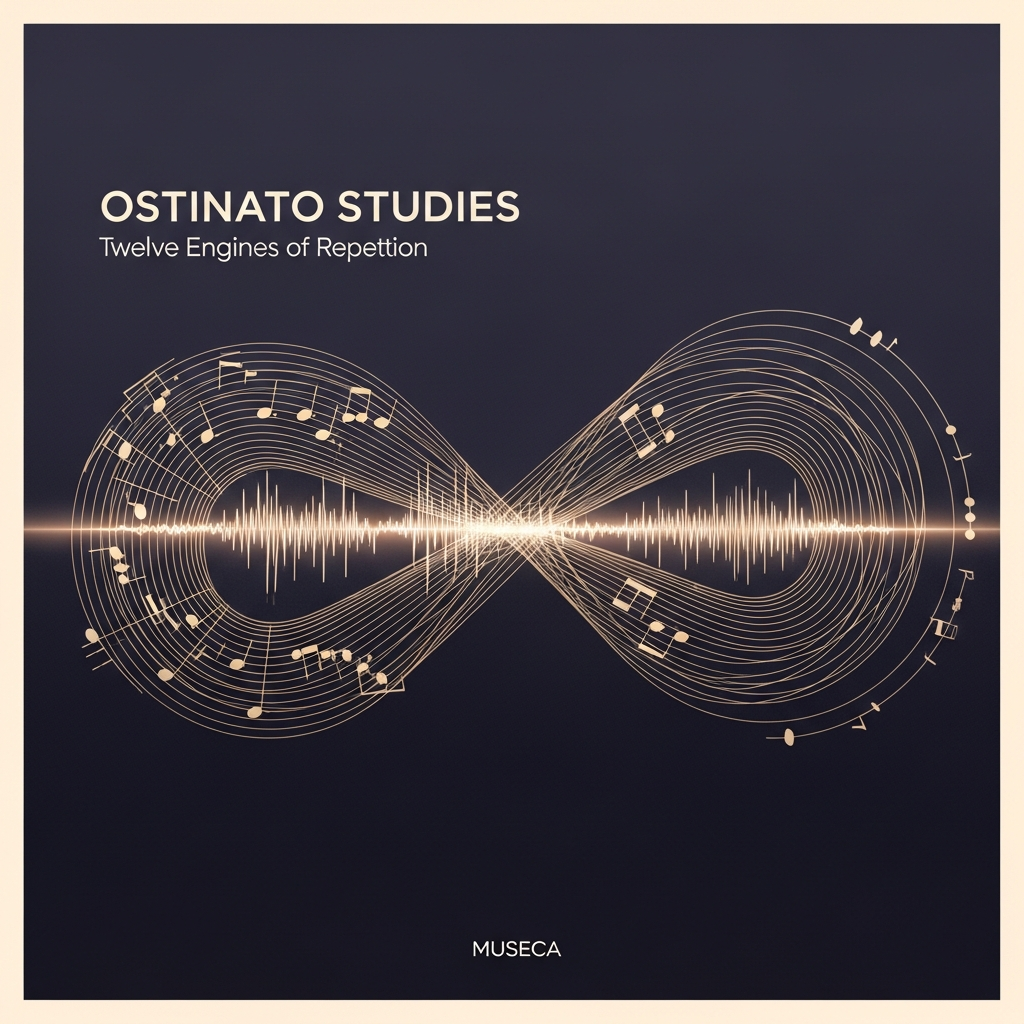
Ostinato Studies is a focused exploration of one of music’s most enduring forces: repetition.
Across cultures, centuries, and styles, the ostinato has served as music’s quiet engine—steady, insistent, and transformative. Whether expressed as a drum cycle, a ground bass, a repeating melody, or a slowly evolving texture, the ostinato anchors time while inviting change.
This album traces the historical and expressive life of the ostinato through twelve concise studies. It begins with ancient and folk traditions, where repetition is inseparable from ritual and movement, then moves through Baroque ground bass forms, Romantic expansions, twentieth-century rhythmic engines, and contemporary cinematic and minimalist approaches. Each piece is built around a single, clearly defined repeating idea, allowing the listener to hear how variation, color, and emotion emerge not by abandoning the pattern, but by living within it.
Rather than presenting ostinato as a compositional trick, Ostinato Studies treats it as a philosophy of time. The repetition is not static; it breathes, accumulates meaning, and reveals structure through persistence. What changes is not the pattern itself, but our perception of it.
Taken together, these studies form both an album and a listening guide—an invitation to hear how the same fundamental idea can generate vastly different musical worlds.
Liner Notes
Circle of Steps
This opening study returns the ostinato to its oldest home: the body. A single hand-drum cell repeats with calm insistence, while small percussive layers interlock around it like footsteps joining a circle. The music evolves by accumulation—shakers, skin drums, and subtle accents entering like new dancers—yet the core pattern never yields. The result is ritual rather than “song,” a reminder that ostinato began as timekeeping, trance, and communal motion.
Baroque Footing
Here the ostinato steps into the concert hall without losing its pulse. Low strings and timpani provide a repeating rhythmic foundation—crisp, poised, and symmetrical—while light Baroque textures bloom above: continuo, upper strings, and courtly counterlines. The study demonstrates an essential principle: when the ground is stable, harmony can change gracefully overhead. This is repetition refined into architecture—formal, elegant, and unshakeable.
Pulse Machine 120
The modern world inherits the same device and simply electrifies it. A 120-bpm groove—kick, hat, clap—becomes the ostinato itself, a grid that never breaks. Everything else is ornament: bass pressure, synth pulses, filter builds, and dynamic waves. The piece is deliberately “engineered,” showing how contemporary production treats repetition as structure, energy, and identity. It is the club equivalent of the ancient circle: a shared pulse, updated.
Ground of Lament
A classic ground bass lament: the archetype of harmonic ostinato in Western art music. A repeating descending bass line cycles with quiet inevitability, while suspensions, sighing figures, and mournful harmonies unfold above it. The emotional power comes from the contradiction—an unchanging foundation beneath intensifying expression. The listener hears grief not as an event but as a loop: persistent, dignified, and inexhaustible.
Romantic Chaconne Dream
The same ground-bass principle expands into a wider emotional horizon. The repeating foundation remains, but Romantic harmony blooms with warmth, chromatic color, and large dynamic arcs. Strings swell, winds glow, and the texture breathes in long phrases—like a dream that keeps returning to the same memory, each time with deeper resonance. This study illustrates the evolution of the Baroque chaconne into a lush orchestral language where repetition supports surging lyricism.
Four-Chord City
This study reframes the ground bass as the everyday engine of modern songwriting: the chord loop. A single four-chord progression repeats with deliberate constancy, while rhythm section, keys, and guitar evolve through voicing changes, small hooks, and production shifts. The interest lies in surface transformation—tone, density, groove, and dynamic contour—over a harmonic “street grid” that never changes. It is the pop counterpart to the passacaglia: simple, practical, and endlessly generative.
Canon Street
A repeating foundation becomes a canvas for imitation. Over a steady ground progression, a short melodic fragment enters in successive voices, creating a gentle canon that feels both inevitable and fresh. The effect is architectural yet playful: repetition that multiplies rather than merely persists. This track highlights a special ostinato phenomenon—when a loop is not just repeated, but handed off, passed through the ensemble like a shared thought.
Rite Fragment Engine
The ostinato turns feral. A jagged melodic cell repeats with hard accents and irregular stress, creating a ritualistic engine that feels less like dance and more like propulsion—primitive, tense, and insistent. Orchestral colors flash and collide: winds snap, brass punctuates, percussion strikes. The harmony is allowed to roughen at the edges, emphasizing the early 20th-century discovery that repetition can generate shock, not comfort. This study is ostinato as force.
Cinematic Hook Line
A modern scoring principle distilled: a two-bar arpeggiated hook that persists while the world changes around it. The repeating figure acts as emotional heartbeat, allowing harmony, orchestration, and dynamics to tell a story without abandoning the pattern. Strings and pads widen the horizon; subtle percussion adds motion; the cue builds through layering rather than thematic reinvention. It demonstrates why ostinato is a cornerstone of contemporary narrative music: it sustains continuity while intensifying meaning.
Phrygian Ostinato Gate
The album enters modal territory, where repetition becomes atmosphere. A low, persistent Phrygian ostinato—dark, close, and incense-like—anchors the piece while textures gradually accumulate above it. The mode’s half-step gravity gives the loop a haunted magnetism: it pulls inward rather than resolving outward. This study is a “threshold” piece—less about melody than about the sensation of crossing into a space defined by one repeating shape.
Locrian Ostinato Veil
A colder mirror to the previous track, built in Locrian’s unstable world. The ostinato remains simple and continuous, but the tritone tension makes the ground feel fragile—as if it might collapse beneath the harmony. Pads and sparse percussion move like fog; the loop is a quiet threat rather than a comfort. This study demonstrates how the same compositional method can yield a radically different emotional result when the modal center is inherently unsettled.
Minimal Drift
The final study reduces ostinato to its most meditative essence: a gentle repeating pattern set in a field of slow harmonic drift. Changes are microscopic—phasing, echo, subtle rebalancing of overtones—so that time itself becomes the subject. The loop is not a “hook” here; it is a horizon line, constant as perception shifts. The album closes by returning ostinato to its deepest function: not repetition as insistence, but repetition as stillness that moves.
Playlist
- Track 1 – “Circle of Steps” Museca 2:45
- Track 2 – “Baroque Footing” Museca 1:38
- Track 3 – “Pulse Machine 120” Museca 4:35
- Track 4 – “Ground of Lament” Museca 1:19
- Track 5 – “Romantic Chaconne Dream” Museca 3:18
- Track 6 - Four-Chord City Museca 1:29
- Track 7 - Canon Street Museca 2:37
- Track 8 - Rite Fragment Engine Museca 1:40
- Track 9 - Cinematic Hook Line Museca 2:15
- Track 10 - Phrygian Ostinato Gate (Instrumental) Museca 3:13
- Track 11 – Locrian Ostinato Veil (Instrumental) Museca 2:27
- Track 12 - Minimal Drift Museca 3:27