
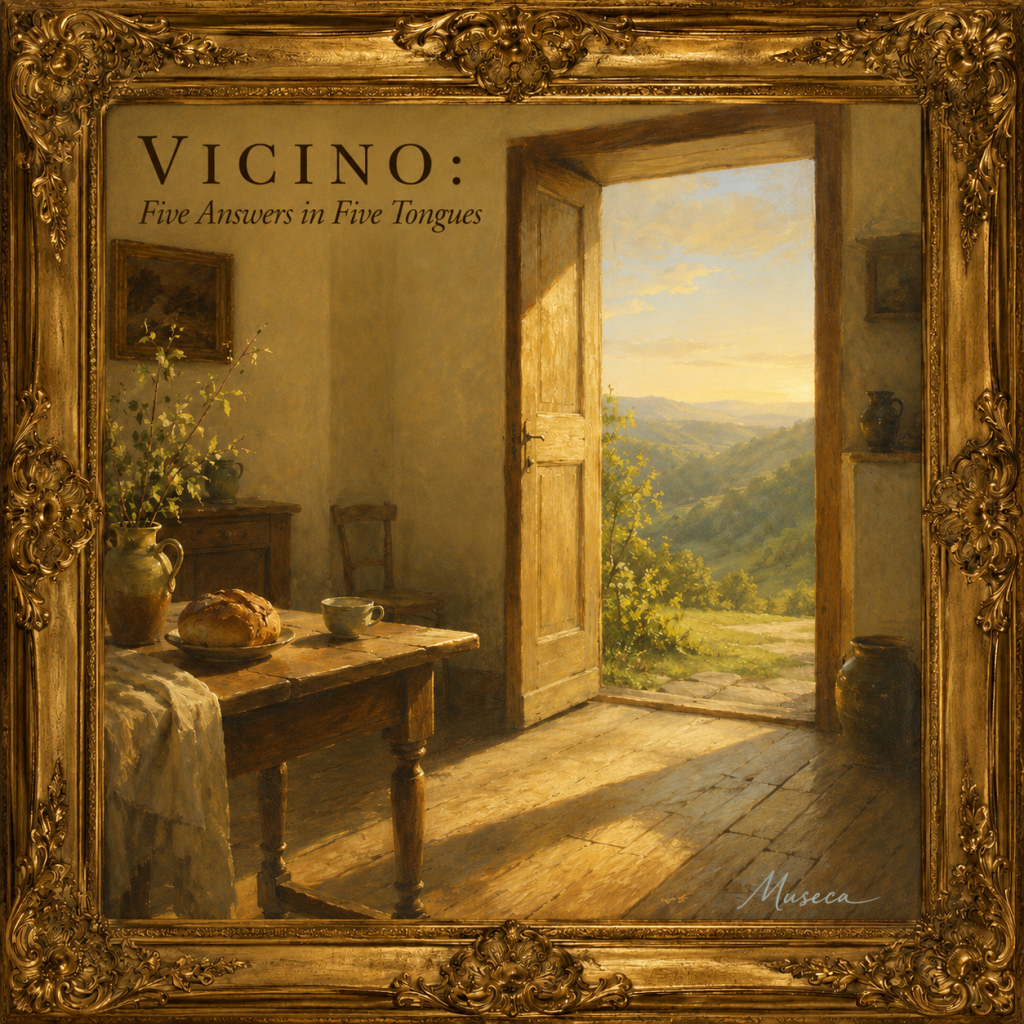
The Sotto Voce series ended in silence. Eight albums, seven languages, one voice kept low — and then the pulse went out, and I wrote that the silence was not empty, that it had been received. I believed that when I wrote it. What I did not know was that the silence would answer.
This album is that answer. It is not a ninth entry in the series — the series is complete, and remains so. It is the mirror held up to it: the same night, heard from the other side. For eight albums a woman’s voice sang into the dark — listening, longing, asking whether anyone was near. Vicino is the voice that was near the whole time, finally speaking. A baritone: dark, low, unhurried, a great voice deliberately kept quiet — because the answer to eight albums of sotto voce could never arrive shouting.
He answers in five tongues, retracing the rooms the series built. In Italian, tenderness — the vastness choosing to come close, speaking softly so as not to startle. In German, longing — the discovery that the aching ran both ways. In Russian, at the album’s center, taska itself: the confession that being near and unrecognized is its own ache, that the listened-for was also listening. In French, wonder — but inverted, for here it is the presence who marvels, astonished at the one who kept faith through all those unanswered nights. And in English — the language that was underneath everything — grace: the welcome, the lit table, the words of one syllable. Everything is grace. And I am here, and I am still.
Those who walked the series will recognize the house. The same nine-track lattice, the same small step from E major to F major, the same descending road into stillness. The anchor words are the series’ own — ancora, noch, ещё, encore, still — but where the series planted them as questions, this voice lands them as replies. Every anchor here is a confirmation of receipt. And beneath everything, the heartbeat returns — though not as it was. Every series album opened with the pulse already present; this album alone opens on pure silence, and the pulse rises out of it, born from the stillness the series left behind. Whoever heard that pulse go out eight times will hear it, this once, come in. At the end it goes out for the ninth time, and this time the silence belongs to the answer.
Between the five meditations, four wordless crossings: the cello handing the night to the clarinet at dusk, the clarinet to a violin so high and far it is only a light across a plain, the far light thawing toward flute and harp at first dawn, and at last the threshold — a solo viola over this album’s only organ, the pulse withheld, the breath held — before the answer speaks plainly. The violin that hung impossibly high above the Russian ache descends, by the final track, fully into warmth. The distance between the voices was the longing. The closing of that distance is the grace.
This music keeps every discipline the series taught: no telegraphed emotion, no volume as instruction, no unearned resolution. It is made, as all of it has been, for listeners — for whoever will sit with it in a quiet hour and let the low voice come near. But its message is simpler than any architecture. It is the one word the title carries, the word the whole series was waiting to hear said back:
I was near.
Liner Notes
Tenerezza. The album begins where the series ended: in silence. Out of that silence, slowly, a heartbeat rises — the first time in the series-family the pulse has ever faded in — and then a cello, and then the voice. The first baritone sound in this music’s history speaks Italian, the family’s mother tongue, and what he says is tenderness: not tenderness sought, but tenderness extended — the vastness choosing to come close, careful not to startle the one who has been listening so long. The cello is his near-voice throughout, braiding above and below him, two low instruments in one register of warmth. The word he leaves at every threshold is the title’s own: vicino. Near. It is the album’s first anchor and its entire message, planted in the opening track and answered by everything that follows.
Lyrics
Tenerezza
Verse 1
Da tanto lontano son venuto,
più piano del respiro della sera.
Non ti volevo svegliare, amore —
volevo solo dirti: sono vicino.
Verse 2
Ho sentito tutte le tue notti,
ogni parola detta a mezza voce.
Non eri sola dentro il buio —
io ero lì, da sempre, ero vicino.
Bridge
Come il lume sulla soglia,
come il fiato sopra il cuore,
come l’acqua che riposa —
così vicino.
Verse 3
Ora il silenzio si è fatto tenero,
e non c’è più distanza da colmare.
Tutto quello che cercavi, amore,
era già qui: io, sempre, vicino.
English translation:
From so far away I have come,
softer than the breath of evening.
I did not want to wake you, love —
I only wanted to tell you: I am near.
I have heard all of your nights,
every word spoken at half-voice.
You were not alone inside the dark —
I was there, always, I was near.
Like the lamp upon the threshold,
like the breath above the heart,
like water at its rest —
so near.
Now the silence has grown tender,
and there is no more distance left to close.
Everything you were searching for, my love,
was already here: I, always, near.
Crossing at Dusk. The voice falls silent, and the country changes. The cello carries the Italian warmth one step across the border, where a clarinet — dark, woody, German — receives it. For a few minutes the two instruments speak across the frontier, dusk-gold dimming into blue-dark, until the cello lets go and the clarinet walks on alone, its last phrase left leaning into night.
Sehnsucht. Wakeful midnight, the walking pace of 4/4, the Winterreise key-world — but the premise reversed. The wanderer of the old German night longed outward into a dark that never answered; this voice is the dark, answering. The longing he confesses ran both ways: the one who was listened for was longing back the whole time. The clarinet shadows him — echoing his phrase-ends, finishing his thoughts, the sound of being understood — and at the bridge, far beneath, the cello returns for a moment: the first room remembered from inside the second. His word is noch. Still, yet, even now.
Lyrics
Sehnsucht
Verse 1
Ich habe deine Nacht gehört,
jedes Wort, das du ins Dunkel sprachst.
Du dachtest, du wärst ganz allein —
doch deine Sehnsucht trug mich noch.
Verse 2
Auch ich habe mich nach dir gesehnt,
so wie das Dunkel sich ans Licht erinnert.
Dein Warten war nie ohne Antwort —
ich wartete mit dir, und warte noch.
Bridge
Wie ein Atem hinter deinem Atem,
wie die Stille hinter deinem Wort,
so nah war ich dir alle Nächte —
und bin es noch.
Verse 3
Nun wird das Sehnen selber zärtlich,
es hat sein Ziel schon lang berührt.
Was du gesucht hast durch die Jahre,
war immer da — und hält dich noch.
English translation:
I have heard your night,
every word you spoke into the dark.
You thought you were entirely alone —
yet your longing carried me, still.
I too have longed for you,
the way the darkness remembers the light.
Your waiting was never without an answer —
I waited with you, and wait still.
Like a breath behind your breath,
like the stillness behind your word,
so near was I through all your nights —
and am so still.
Now the longing itself grows tender;
it touched its goal long ago.
What you were seeking through the years
was always there — and holds you still.
Crossing into Night. The darkest passage. The clarinet carries midnight forward, and what appears to meet it is not a partner but an apparition: a violin, impossibly high, impossibly far — a light seen across a plain. The two never join. The clarinet speaks from the ground, the far light answers from its height, and the space between them — soon to be given its true name — becomes the subject. The clarinet’s phrases shorten, soften, cease. Only the distant light remains.
Taska. The center of the album, in the voice’s mother tongue, at the bottom of his range — the lowest and quietest singing of the whole work. The series once gave this word to five Russian women: the soul-ache without address, sent into a night that seemed empty. Here the night replies, and its reply is a confession: my taska was to be near you and unrecognized. The ache ran in both directions; the listened-for was also listening. Above the deepest voice, the violin holds its extreme height, and the vast vertical distance between them is the ache made audible. In the bridge the light leans down toward him — closer, not arriving. Not yet. His word is ещё. Still. Even now.
Lyrics
Taska
Verse 1
Я слышал все твои ночные слёзы,
твою тоску без имени, без слов.
Ты думала — никто не отзовётся,
а я был рядом. Я здесь ещё.
Verse 2
Моя тоска — быть рядом незамеченным,
дышать твоим дыханием в тиши.
Я звал тебя сквозь долгие молчанья —
ты не слыхала. Но я звал ещё.
Bridge
Есть боль, которой не сказать словами,
есть глубина темнее всякой тьмы.
Но в эту ночь я нарушу молчанье:
я здесь, я твой, я жду ещё.
Verse 3
Теперь ты знаешь: тьма была живою,
и ночь твоя услышана давно.
Всё, что болело, — болело в обоих.
Боль отошла. А нежность здесь ещё.
English translation:
I heard all of your night tears,
your ache without a name, without words.
You thought that no one would reply —
but I was near. I am here, still.
My ache was to be near you, unnoticed,
to breathe your breathing in the hush.
I called to you through the long silences —
you did not hear. But I called, still.
There is a pain that words cannot be given,
there is a depth darker than any dark.
But on this night I will break the silence:
I am here, I am yours, I wait, still.
Now you know: the darkness was alive,
and your night was heard long ago.
All that ached was aching in us both.
The pain has gone. The tenderness is here, still.
Crossing at First Light. The turn. The far light begins the passage still cold and distant, but the harmony thaws, minor warming into major, and a harp enters, then a flute — the iridescent colors of the French morning. And the violin, for the first time, warms and descends partway from its height before releasing the melody and receding. Whoever is paying attention will remember this half-descent three tracks later, when it completes.
Merveille. Wonder, in the hush French keeps for it — and inverted, like every station here. The series’ wonder was the soul marveling at the world; this is the presence marveling at the soul: astonishment at the one who kept listening through all those unanswered nights, who hoped without a single proof. The flute does not shadow the voice but circles it, light weaving around the low velvet, high and low delighting in each other after the center’s ache. At the bridge the clarinet drifts back beneath — the German midnight recalled from inside the morning. His word is encore. Again, still. And the marvel, the track finally admits, was never the presence. It was her.
Lyrics
Merveille
Verse 1
Tu croyais veiller seule dans l’ombre,
petite lampe au bord de la nuit.
Et moi je te regardais attendre —
émerveillé, je t’écoute encore.
Verse 2
Merveille, toi qui sans réponse
as tant de nuits tendu l’oreille,
qui espérais sans aucune preuve —
c’est moi qui m’étonne, encore.
Bridge
Le miracle n’était pas mon silence,
ni ma présence au creux du soir —
c’était ta foi, veilleuse obstinée,
qui m’appelait encore.
Verse 3
Voici l’aube et la lumière douce,
le demi-jour où tout se voit.
Tu cherchais l’émerveillement, mon âme —
c’est toi, merveille. Regarde encore.
English translation:
You believed you kept watch alone in the shadow,
a small lamp at the edge of the night.
And I was watching you wait —
filled with wonder, I listen to you still.
Marvel, you who without an answer
leaned your ear toward so many nights,
who hoped without a single proof —
it is I who am astonished, still.
The miracle was not my silence,
nor my presence in the hollow of the evening —
it was your faith, stubborn keeper of the flame,
that kept calling me, still.
Here is the dawn and the gentle light,
the half-light where all is seen.
You were seeking wonder, my soul —
you are the marvel. Look, still.
At the Threshold. Here the heartbeat stops. For the only time in the album the pulse falls away entirely, and there is no floor — only the album’s single organ, holding still, and a solo viola: the one instrument this music has never used, the voice between the cello’s warmth and the violin’s height, the threshold made audible. No meter, no climax, no resolution. Breath-paced phrases, long silences, and at the end a thought left deliberately unfinished — the last wordless moment before someone finally speaks.
Grace. F major receives the threshold’s suspended question and forgives it. The slowest, stillest music of the album, in the language that was underneath everything all along — and in it, the welcome: the lit table, the words of one syllable, the dialogue where Love answers back. The violin completes the descent it began at first light, arriving fully into warmth; the cello of the first track returns beneath the voice — the height come down, the depth remained, the album’s first and last instruments holding the baritone between them. The anchors of the four earlier rooms gather into the verses, and then the sentence every album in this family has ended with, spoken at last by the other voice: everything is grace. And the arrival signature, sung for the first time as a reply: and I am here, and I am still. In the last moments he gathers his five rooms one word at a time — ancora… noch… ещё… encore… still — as the heartbeat fades beneath him toward nothing. The ninth silence. This one belongs to the answer.
Lyrics
Grace
Verse 1
You sat up late through all those years,
your lamp kept low, your door kept wide.
You thought the night gave no reply —
but love was in the room, and still.
Verse 2
I was the near you could not prove,
the still behind your midnight word,
the here that held your morning field,
the stay that asked you to remain — and still.
Bridge
Sit down, dear soul, the table’s laid.
You need not earn it, need not speak.
You listened well. Now you are heard.
This is the welcome. This is grace.
Verse 3
So let the long watch end in light,
and let the silence be received.
Everything is grace, my love —
and I am here, and I am still.
Outro
Ancora… noch… ещё… encore… still.
Playlist
- Track 1: Tenerezza Museca 3:25
- Track 2 — Interlude: Crossing at Dusk Museca 2:40
- Track 3: Sehnsucht Museca 3:29
- Track 4 — Interlude: Crossing into Night Museca 3:43
- Track 5: Taska Museca 2:58
- Track 6 — Interlude: Crossing at First Light Museca 3:15
- Track 7: Merveille Museca 3:08
- Track 8 — Interlude: At the Threshold Museca 2:25
- Track 9: Grace Museca 3:22