
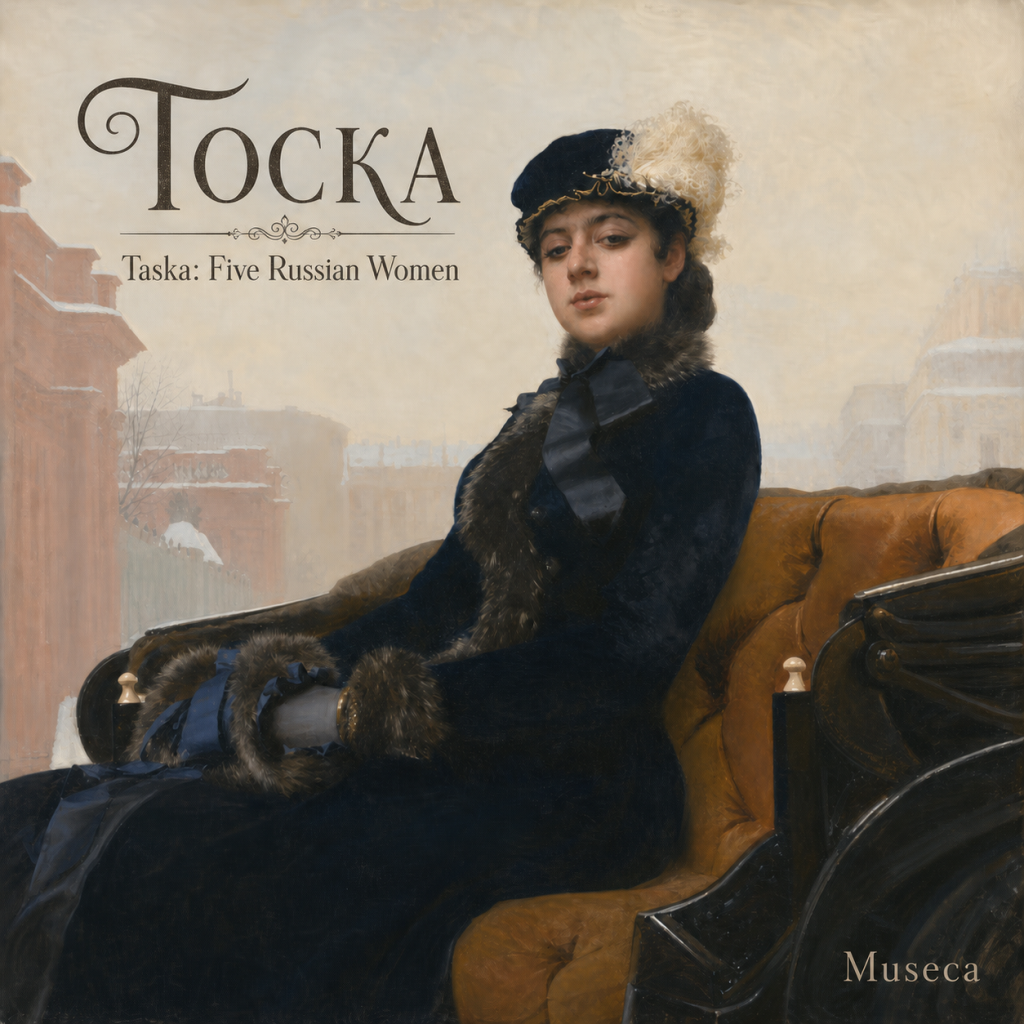
INTRODUCTION
There is a Russian word for which no English word will serve. Taska (тоска). Vladimir Nabokov, who was rarely defeated by a translation problem, set down his pen against this one and wrote that no single word in English carries it. The lexicon offers longing, melancholy, nostalgia, yearning, ache — and each of them tells a fragment of the truth, and each of them tells a lie of omission. Taska is not any of these. Taska is the soul-state in which all of them live at once.
It is the ache that arrives without a cause and refuses to leave when the cause is removed. It is the sweetness of remembering something that was never quite as sweet as you remember it. It is the strange fullness that comes when grief and beauty cannot be told apart any longer. Taska is what the Russian soul has called the weight of being alive in a country that has known too much winter, too much history, too much love. It is the color of a particular kind of silence after a particular kind of song.
This album is named for that word.
I did not set out to write an album about taska. I set out, after finishing a previous album in five languages, to write a follow-up in Russian alone. The Russian track on the multilingual album had emerged with a quality I had not expected — a depth of feeling that seemed to come from somewhere older than the song itself, from a tradition I had only borrowed for one track and not yet learned to inhabit. When that track was finished and the album was sent into the world, I found myself unwilling to leave the Russian aesthetic behind. I wanted to live there longer. I wanted to find out what else that voice had to say.
What it had to say, I learned, was women.
Russia has produced extraordinary literary heroines, and they live in the cultural memory of every educated Russian as personally as members of the family. A Russian schoolchild knows Tatiana Larina the way an English schoolchild knows Juliet — but more so, because Pushkin’s Eugene Onegin is read by every generation, set as opera by Tchaikovsky, performed and reperformed across two centuries. Natasha Rostova at the moonlit window of Otradnoye is one of the most beloved scenes in all of Russian fiction. Sonia Marmeladova reading the raising of Lazarus to Raskolnikov by a single candle is one of the most spiritually charged moments in any literature. Anna Karenina at the Obiralovka station is one of literature’s most devastating endings. Lara Antipova, walking out of the frame of Pasternak’s Doctor Zhivago into the silence of the Soviet camps, is one of the most haunting disappearances ever written.
These five women carry the taska of the Russian soul. Each of them aches in her own way. Tatiana aches with the first ache of love — the young heart that has just confessed itself and now sits at the dawn after the letter has been sent. Natasha aches with the bright ache of awakening — the young heart that has just discovered it can fly. Sonia aches with the sacred ache of a love that gives itself entirely. Anna aches with the ache that does not transmute — the ache that finds no faith, no peace, no consolation, and falls. Lara aches with the late ache — the ache of having lived through everything and learned, somehow, to carry it.
Five women. Five forms of taska. One album.
The architecture of the work is shaped by an emotional arc rather than a chronological one. The five women are not presented in the order their authors wrote them. They are presented in the order their souls live. We open with Tatiana’s longing because longing is the door through which everyone enters love. We rise into Natasha’s awakening because awakening is what longing becomes when it is given air. We descend into Sonia’s faith because faith is what awakening becomes when it is asked to bear suffering. We fall into Anna’s catastrophe because catastrophe is what suffering sometimes becomes when faith is not given. We close with Lara’s acceptance because acceptance is what survives all of it — the wisdom of the soul that has lived through the whole arc and can now stand in the snow remembering everything without being broken by it. The journey of the album is the journey of a single Russian female soul moving through every weather of taska it can know.
Between the women’s portraits sit three Russian landscapes. Belyye Nochi — White Nights — is the suspended luminescence of Petersburg in summer, the city of Peter the Great holding its breath in the hour before sunrise. Tserkov’ v Snegu — Church in Snow — is the wooden Orthodox sanctuary in winter twilight, the deepest sacred soul of rural Russia seen from across a snowfield. Reka Pered Ledokhodom — River Before the Ice Breaks — is the moment in early spring when the surface of a Russian river is still frozen but the water beneath has begun to move, and the whole landscape holds itself in the latent pressure before catastrophic transformation. These three interludes are the world the women inhabit. They are also the album’s three Russias: imperial-secular, rural-sacred, and the dangerous in-between of nature about to break.
Musically, the album is built on the architecture of the previous Russian track that began this entire journey. That track, Smireniye — Surrender — established the aesthetic vocabulary: Russian Late Romantic identity references (Tchaikovsky and Rachmaninoff above all, with the Vespers and the Vocalise as the central anchor points) layered onto a Café del Mar deep-night chillout production frame, with Schwartz’s Aria 3 and the Enigma-Delerium ambient lineage providing the contemporary atmospheric language. The vocal identity is anchored on Hibla Gerzmava and the early career of Anna Netrebko, with secondary references that vary across the women — Galina Vishnevskaya for sacred-historical gravity, Anna German for warm-domestic intimacy.
What carries through every track is the taska color in the soprano line — the long sustained Vocalise vowels, the slight darkening of the middle voice, the open Russian vowels stretched and savored. What varies across the tracks is everything else. Each woman gets her own signature instrumental color, present in her track and present nowhere else on the album. Tatiana speaks through the cor anglais — the lyrical melancholy wood-voice that Tchaikovsky himself reserved for moments of solitary longing. Natasha rises with the solo flute — the Russian classical bird-flute lineage of Firebird and Rimsky-Korsakov. Sonia kneels with the solo cello — the deepest soul-voice instrument, the one Russian sacred music has used for spiritual weight across centuries. Anna fragments through the solo low oboe paired with contrabassoon — Tchaikovsky’s Pathétique-finale combination for unbearable grief. And Lara, finally, claims the solo French horn — held back through every other vocal track on the album, kept in reserve for the closer, sounding at last in the Tchaikovsky 5th Symphony second movement register that has been the album’s spiritual touchstone from its first note.
The climax architecture also varies. No two tracks bloom alike. Tatiana’s climax is intimate duet — soprano and cor anglais together at her most vulnerable moment. Natasha’s is upward ascent — voice and flute soaring into the night. Sonia’s is triple bloom — soprano with cello, then mixed Russian Orthodox choir rising in sacred embrace, then foreground bells of zvon at the peak. Anna’s is breakdown — every album element fails simultaneously, a single tam-tam strike, the pulse breaks, silence enters, and a whispered phrase emerges from the silence after. Lara’s is slow descending bloom — the album’s softest peak, the wisdom of acceptance rendered as gentle elegiac landing rather than triumphant finale. Five women, five climaxes, five entirely different shapes of musical culmination. The architecture itself is the characterization.
Across the eight tracks, certain images recur as quiet threads. The candle. The river. The phrase Время идёт — time flows on — closing the codas of Tatiana, Natasha, and Sonia, broken by Anna’s catastrophic ending, and finally restored by Lara, who sings Снег идёт. Время идёт. — Snow falls. Time flows on. — as the album’s last breath. The album’s deepest structural decision is that time does not stop because one woman fell. The river keeps flowing. The snow keeps falling. The other women carry on. Taska itself becomes the album’s witness that life continues — and the elegiac restoration of that thread at the end is the album’s quiet affirmation.
A word, finally, on what this album is and is not.
It is not a celebration of Russian suffering. The Russian literary tradition has been called the literature of suffering often enough, and it is true that suffering is in these books, in these women, in this music. But the deeper truth is that the Russian tradition is the literature of bearing. Of carrying what cannot be set down. Of finding in the carrying itself a kind of strange grace. Tatiana does not stop loving Onegin even when she has been given to another. Sonia does not stop reading scripture even in the hovel. Lara does not stop remembering even after history has tried to erase her. The women of this album are not victims of taska. They are its keepers. They hold the soul-ache of the Russian heart and they live with it, and the music asks the listener to do the same — not to be entertained by their suffering, but to sit beside them in the candlelight and listen to what they carry.
It is also not a museum piece. These women lived in books written between 1833 and 1957. They wear their century on their dresses and in their letters. But the taska they carry is not historical. It is a soul-state available to any human being in any century who has loved and lost and remembered. The album reaches across the centuries to say something the women themselves would say if they could speak to the listener directly: this ache is yours too. You know it. You have carried something like it. We are the same.
If the album does its work, it will leave the listener, by the time the snow finishes falling at the end of Lara’s track, with a particular kind of quiet inside. Not consolation exactly. Not resolution. The album is too honest to claim those. Something stranger and gentler — the peace of having been seen. The peace of knowing that the ache one has carried alone has also been carried, in some form, by these five women, and by the writers who loved them enough to put them on the page, and by the country that gave the soul-ache its name.
That is what taska is for. To carry what cannot be set down — and, in the carrying, to discover that the soul is large enough.
The album is theirs. It is also yours.
Введение на русском языке
В русском языке есть слово, которое не передаётся ни одним английским словом. Тоска. Владимир Набоков, которого редко побеждала переводческая задача, отложил перо перед этим словом и написал, что ни одно английское слово не вмещает его. Словарь предлагает longing, melancholy, nostalgia, yearning, ache — и каждое из них передаёт лишь крупицу истины, и каждое из них умалчивает остальное. Тоска — это не любое из них. Тоска — это душевное состояние, в котором они живут все одновременно.
Это боль, которая приходит без причины и не уходит, когда причина устранена. Это сладость воспоминания о чём-то, что никогда не было таким сладким, каким ты его помнишь. Это странная полнота, которая наступает, когда горе и красоту уже невозможно отличить друг от друга. Тоска — это то, что русская душа назвала тяжестью бытия в стране, которая знала слишком много зимы, слишком много истории, слишком много любви. Это цвет особой тишины после особой песни.
Этот альбом назван этим словом.
Я не собирался писать альбом о тоске. После завершения предыдущего альбома на пяти языках я хотел написать продолжение только на русском. Русская песня в том многоязычном альбоме раскрылась с глубиной чувства, которой я не ожидал — глубиной, которая, казалось, исходила откуда-то старше самой песни, из традиции, которую я заимствовал лишь для одной композиции и ещё не научился обживать. Когда та песня была готова и альбом ушёл в мир, я обнаружил, что не желаю покидать русскую эстетику. Я хотел пожить в ней дольше. Я хотел узнать, что ещё этот голос может сказать.
А сказал он мне, как я узнал, — женщин.
Россия породила удивительных литературных героинь, и они живут в культурной памяти каждого образованного русского так же лично, как члены семьи. Русский школьник знает Татьяну Ларину так, как английский школьник знает Джульетту, — но даже сильнее, потому что «Евгений Онегин» Пушкина читается каждым поколением, поставлен Чайковским как опера, исполнен и переисполнен на протяжении двух столетий. Наташа Ростова у лунного окна в Отрадном — одна из самых любимых сцен во всей русской литературе. Соня Мармеладова, читающая Раскольникову о воскрешении Лазаря при свете единственной свечи, — один из самых духовно насыщенных моментов в любой литературе. Анна Каренина на станции Обираловка — одна из самых сокрушительных развязок в литературе вообще. Лариса Антипова, выходящая из рамок «Доктора Живаго» Пастернака в безмолвие советских лагерей, — одно из самых мучительных исчезновений, когда-либо написанных.
Эти пять женщин несут в себе тоску русской души. Каждая из них тоскует по-своему. Татьяна тоскует первой тоской любви — юное сердце, которое только что призналось себе и теперь сидит на заре после отправленного письма. Наташа тоскует светлой тоской пробуждения — юное сердце, которое только что обнаружило, что может летать. Соня тоскует святой тоской любви, отдающей себя без остатка. Анна тоскует тоской, которая не преображается, — тоской, не находящей ни веры, ни мира, ни утешения, и падает. Лариса тоскует поздней тоской — тоской человека, который пережил всё и научился, как-то, это нести.
Пять женщин. Пять форм тоски. Один альбом.
Архитектура работы выстроена эмоциональной дугой, а не хронологической. Пять женщин представлены не в том порядке, в котором их написали авторы. Они представлены в том порядке, в котором живут их души. Мы открываем альбом томлением Татьяны, потому что томление — это дверь, через которую все входят в любовь. Мы поднимаемся в пробуждение Наташи, потому что пробуждение — это то, чем становится томление, когда ему дают воздух. Мы спускаемся к вере Сони, потому что вера — это то, чем становится пробуждение, когда от него требуется нести страдание. Мы падаем в катастрофу Анны, потому что катастрофа — это то, чем иногда становится страдание, когда вера не дарована. Мы закрываем альбом принятием Ларисы, потому что принятие — это то, что переживает всё это, мудрость души, прошедшей всю дугу и теперь способной стоять в снегу, помня всё, и не быть этим сломленной. Путь альбома — это путь одной русской женской души, проходящей через всякую погоду тоски, какую она может знать.
Между женскими портретами располагаются три русских пейзажа. Белые ночи — это подвешенная светоносность Петербурга летом, город Петра Великого, затаивший дыхание в час перед восходом. Церковь в снегу — это деревянный православный храм в зимние сумерки, глубочайшая священная душа сельской России, увиденная через снежное поле. Река перед ледоходом — это миг ранней весны, когда поверхность русской реки ещё скована льдом, но вода под ней уже начала двигаться, и весь пейзаж держится в скрытом напряжении перед катастрофическим преображением. Эти три интерлюдии — мир, в котором живут женщины. Они также — три России альбома: имперско-светская, сельско-сакральная и опасная промежуточная природа, готовая вот-вот сломаться.
Музыкально альбом построен на архитектуре предыдущей русской песни, с которой и начался весь этот путь. Та песня, Смирение, утвердила эстетический словарь: русские позднеромантические референсы (Чайковский и Рахманинов прежде всего, со «Всенощным бдением» и «Вокализом» как центральными опорными точками), наложенные на продакшн-рамку чилаута Café del Mar глубокой ночи, при этом Шварц с Aria 3 и линия Enigma–Delerium предоставляют современный атмосферный язык. Вокальная идентичность опирается на Хиблу Герзмаву и раннюю Анну Нетребко, с второстепенными референсами, которые варьируются от женщины к женщине: Галина Вишневская — для сакрально-исторической весомости, Анна Герман — для тёплой домашней интимности.
Что проходит сквозь каждую песню — это цвет тоски в линии сопрано: длинные выдержанные гласные вокализа, лёгкое затемнение среднего регистра, открытые русские гласные, растянутые и смакуемые. Что варьируется от песни к песне — это всё остальное. У каждой женщины свой отличительный инструментальный цвет, присутствующий в её песне и нигде больше на альбоме. Татьяна говорит через английский рожок — лирический меланхолический деревянный голос, который сам Чайковский приберегал для моментов одинокого томления. Наташа возносится с соло флейты — линия русской классической птичьей флейты «Жар-птицы» и Римского-Корсакова. Соня преклоняется с соло виолончели — самым глубоким душевным голосом, инструментом, который русская духовная музыка веками использовала для духовной весомости. Анна распадается через соло низкого гобоя в паре с контрафаготом — комбинация финала «Патетической» Чайковского для невыносимой скорби. И Лариса наконец принимает соло валторны — удерживавшейся вдали от каждой другой вокальной песни альбома, сохранённой для финала, звучащей наконец в регистре второй части Пятой симфонии Чайковского, который был духовным компасом альбома с самой первой ноты.
Кульминационная архитектура тоже варьируется. Ни две песни не расцветают одинаково. Кульминация Татьяны — это интимный дуэт: сопрано и английский рожок вместе в самый её уязвимый момент. Кульминация Наташи — это восходящее вознесение: голос и флейта парят в ночь. Кульминация Сони — это тройное цветение: сопрано с виолончелью, затем смешанный русский православный хор, поднимающийся в священных объятиях, затем колокольный звон на переднем плане в самой вершине. Кульминация Анны — это распад: каждый элемент альбома отказывает одновременно, единственный удар тамтама, пульс ломается, входит тишина, и шёпотная фраза появляется из тишины потом. Кульминация Ларисы — это медленное нисходящее цветение: самая мягкая вершина альбома, мудрость принятия, переданная как тихое элегическое приземление, а не как триумфальный финал. Пять женщин, пять кульминаций, пять совершенно разных форм музыкального завершения. Сама архитектура — это характеристика.
Через все восемь песен определённые образы возвращаются как тихие нити. Свеча. Река. Фраза Время идёт, закрывающая коды Татьяны, Наташи и Сони, разорванная катастрофическим финалом Анны и наконец восстановленная Ларисой, поющей Снег идёт. Время идёт. — как последний вздох альбома. Глубочайшее структурное решение альбома в том, что время не останавливается оттого, что одна женщина пала. Река продолжает течь. Снег продолжает падать. Другие женщины продолжают жить. Сама тоска становится свидетелем альбома, что жизнь продолжается, — и элегическое восстановление этой нити в конце есть тихое утверждение альбома.
И, наконец, слово о том, чем этот альбом является и чем не является.
Он не является прославлением русского страдания. Русскую литературную традицию достаточно часто называли литературой страдания, и правда, что страдание есть в этих книгах, в этих женщинах, в этой музыке. Но более глубокая истина в том, что русская традиция — это литература несения. Несения того, чего нельзя сложить с плеч. Обретения в самом несении некоей странной благодати. Татьяна не перестаёт любить Онегина, даже когда отдана другому. Соня не перестаёт читать Писание даже в этой каморке. Лариса не перестаёт помнить, даже после того, как история попыталась её стереть. Женщины этого альбома — не жертвы тоски. Они — её хранительницы. Они держат душевную боль русского сердца и живут с ней, и музыка просит слушателя сделать то же самое — не наслаждаться их страданием, а сидеть рядом с ними при свете свечи и слушать, что они несут.
Он также не является музейным экспонатом. Эти женщины жили в книгах, написанных между 1833 и 1957 годами. Они носят свой век на платьях и в письмах. Но тоска, которую они несут, — не историческая. Это душевное состояние, доступное любому человеку в любом веке, который любил, терял и помнил. Альбом протягивает руку через столетия, чтобы сказать то, что сами женщины сказали бы, если бы могли заговорить со слушателем напрямую: эта боль и твоя тоже. Ты её знаешь. Ты несла что-то подобное. Мы — одно.
Если альбом исполнит свою работу, он оставит слушателю, к моменту, когда прекращается снег в конце песни Ларисы, особую тишину внутри. Не утешение, строго говоря. Не разрешение. Альбом слишком честен, чтобы притязать на это. Нечто более странное и более нежное — мир от того, что тебя увидели. Мир от знания, что боль, которую ты несла в одиночку, несли в какой-то форме и эти пять женщин, и писатели, которые любили их достаточно, чтобы записать на странице, и страна, давшая этой душевной боли её имя.
Вот для чего нужна тоска. Чтобы нести то, чего нельзя сложить с плеч, — и, в самом несении, обнаружить, что душа достаточно велика.
Альбом — их. И твой тоже.
Liner Notes
Заря (Dawn) — Tatiana Larina
The album opens at the threshold of love. Tatiana Larina sits alone in her bedroom after the sleepless night, watching a pale gray Russian summer dawn rise through the open window. The letter is gone — the servant has carried it away — and somewhere on the road her entire confessed soul is in transit toward Eugene Onegin’s hands. She has done the most consequential thing of her young life. She has nothing left to do but wait.
The track does not depict the writing of the letter. Tchaikovsky’s beloved aria has owned that scene for a hundred and fifty years. The track inhabits the hour after, when Tatiana’s heart moves in waves between two tides — fear of what he will do with what she has given him, hope that he will read and understand. The two currents resolve at the climax into a Pushkin-anchored surrender: Я твоя. I am yours. The Russian listener will recognize the line. It is the surrender at the heart of the famous letter, returning to her in the dawn aftermath as the truest thing she ever wrote.
Early Anna Netrebko anchors the vocal stack — her early Tchaikovsky Tatiana sits in Russian musical memory — with Anna German’s warm-domestic intimacy as secondary color. Tatiana’s signature instrument is the solo cor anglais, the lyrical melancholy wood-voice Tchaikovsky reserved for moments of solitary longing. It accompanies her through the verse, and at the climax it rises to meet her vocal voice in unaccompanied duet — the album’s most intimate peak, the soul finding its own instrumental shadow in the moment of fullest feeling.
The track lands on the album’s first appearance of a phrase that will run through every vocal track to come: Время идёт. Time flows on.
Lyrics (Russian/English)
Заря (Dawn) — Tatiana Larina
Original Russian
Свеча погасла. Тает ночь. Туман над садом, бледный свет. Письмо в дороге — далеко. Что скажет мне… он?
Заря встаёт над тишиной. Роса на травах — серебро. Он прочитает. Он поймёт. Ответит мне… он.
Я твоя… Я твоя… В этот час, в этом свете — я твоя. Ах… ах… я твоя-ааа… Навсегда — я твоя.
Утро пришло. Время идёт. Сердце ждёт.
English Translation
The candle is out. Night is melting. Mist over the garden, pale light. The letter is on its way — far away. What will… he say to me?
Dawn rises over the silence. Dew on the grasses — silver. He will read. He will understand. He will… answer me.
I am yours… I am yours… In this hour, in this light — I am yours. Ah… ah… I am yours… Forever — I am yours.
Morning has come. Time flows on. The heart waits.
Белые Ночи (White Nights) — Interlude
The first instrumental landscape. The listener stands on the granite embankment of the Neva at three in the morning during the Petersburg white nights, when the sun has slipped just below the horizon but the sky is still a luminous gold-and-silver, and across the water the spire of the Peter and Paul Fortress is beginning to catch the first eastward light. The bridges are raised. The city sleeps. The air is utterly still.
The architecture is three slow waves of gathering light. The first wave: glockenspiel and tubular bells — imperial Petersburg’s light-glints catching on the river. The second: high lonely violin in upper register as the spire ignites. The third: solo French horn rises with a single long ascending line as light fully reaches the spire and floods the river. A distant wordless choral pad floats above — the white-night sky itself singing softly. The river beneath runs in sustained low strings; the harp adds silver shimmer.
This is the album’s first Russia: imperial, secular, architectural, water-bound, suspended in time.
Луна (Moon) — Natasha Rostova
The album rises into its lyrical apex. Natasha Rostova at the open window of Otradnoye, the country estate where Tolstoy placed the most beloved scene in War and Peace — the moonlit night that has lived in Russian cultural memory for a hundred and fifty years. The garden lies silver under the moon. The cool spring air drifts through. Somewhere in her young chest a feeling has woken that she does not yet have a name for. I want to fly!
This is the album’s brightest taska. The ache is not loss or surrender or faith forged in suffering — it is the ache of a young soul that has just discovered it has wings. The Russian word taska contains its joyful-longing register as well as its dark one, and Natasha inhabits the bright form: the ache of not yet and almost and wanting, without any wound underneath.
Hibla Gerzmava in her brighter higher register anchors the vocal stack, with early Anna Netrebko as secondary. Natasha’s signature instrument is the solo flute, the Russian classical bird-flute lineage of Firebird and Rimsky-Korsakov — Natasha’s wing-voice, the part of her that wants to lift off the ground. At the climax, soprano and flute soar together while harp arpeggios cascade like moonlit dew shaken from leaves and string tremolo shimmers at the very top. Nothing comes from below to meet her. The climax is pure ascent.
The verses anchor on луна — moon. The climax extends into Vocalise on лечу — I fly — Tolstoy’s conditional wish transformed in the music’s climactic moment into the indicative present. The wish becomes the act. The track lands on Окно открыто. Время идёт. Сад поёт. The window is open. Time flows on. The garden sings.
Lyrics (Russian/English)
Original Russian
Не спится мне. Окно раскрыто.
Прохладен воздух. Тих сад.
Серебром на травах — свет.
В небе бледная… луна.
В груди — крыло. Не знаю чьё.
Дышу — и сердце ввысь.
Что-то зовёт меня туда,
куда ведёт… луна.
Лечу… лечу…
В этой ночи, в этом свете — я лечу.
Ах… ах… лечу-ууу…
В небо, в небо — я лечу.
Окно открыто. Время идёт.
Сад поёт.
English Translation
I cannot sleep. The window is open.
The air is cool. The garden is quiet.
Silver on the grasses — light.
In the sky, the pale… moon.
In my breast — a wing. I don’t know whose.
I breathe — and the heart upward.
Something calls me there,
where leads… the moon.
I fly… I fly…
In this night, in this light — I fly.
Ah… ah… I fly…
To the sky, to the sky — I fly.
The window is open. Time flows on.
The garden sings.
Церковь в Снегу (Church in Snow) — Interlude
The second instrumental landscape, and the second of the album’s three Russias. The listener stands in the snow outside an archetypal wooden Orthodox village church in winter twilight. Snow falls steadily. Through small windows the interior glows with oil lamps and candles. From across the snowfield, distant Orthodox bells call for vespers. The listener has not yet crossed the threshold.
Where the previous interlude was imperial-Petersburg-secular, this is rural-Orthodox-sacred. Together the two interludes establish the album’s two Russias. The wooden village church predates imperial cathedrals — it is the deepest cultural heart of Russian Orthodoxy.
The architecture is bell-anchored: three distant Orthodox bell-events across the interlude, growing into a zvon pattern. The bells are kept distant — heard from outside, never foregrounded. The album’s bell-arc is just beginning. The signature instrument is the solo viola — the album’s threshold-voice, neither violin nor cello, neither bright nor deep. The viola carries the snow itself, soft and gray and falling. A very distant wordless bass-baritone hum runs through the whole track, like the village hum of monks chanting vespers heard through walls and snow.
The interlude ends as it began, in distant bells fading and viola softening into snow. The listener has stood at the threshold long enough. Now the door opens.
Свеча (Candle) — Sonia Marmeladova
The structural and spiritual center of the album. Sonia Marmeladova’s tiny rented room. A single candle burns on the chest of drawers. The yellowed New Testament given to her by the murdered Lizaveta lies open on the table. Raskolnikov has come to her hovel to demand she read aloud the Gospel of John, chapter eleven — the raising of Lazarus. Sonia is trembling, exalted, terrified. She has nothing in this world except her body, which she has sold to feed her family, and her faith, which she has somehow not surrendered. She begins to read. Lazarus, come forth. Dostoevsky said he wrote the scene in tears.
The track does not dramatize the reading itself. To put scripture into Sonia’s mouth in song would tip the work toward narrative recitation, and Sonia is too sacred to instrumentalize. The track inhabits her inner state in the moment: the strange peace of a soul that has nothing left to lose because it has already given everything; the yurodivy — the holy fool — quality of love that asks no return; taska transmuted, through faith, into something past grief.
Hibla Gerzmava in her darkest most expressive middle register anchors the vocal stack, with Galina Vishnevskaya as secondary color — the great Russian sacred-historical soprano whose voice carries the weight of having witnessed what the twentieth century did to Russia. Sonia’s signature instrument is the solo cello — the deepest soul-voice instrument, the kneeling voice. It opens the track and accompanies her through the verse.
The climax is the album’s most architecturally rich peak — triple bloom. The soprano and cello sing first. Then the mixed Russian Orthodox choir blooms underneath in ascending sacred embrace — sopranos and altos and basses and baritones together, wordless. Then the foreground zvon enters at the very peak: the full polyrhythmic Russian Orthodox bell pattern, present and unmistakable. A sustained organ pad anchors underneath. The album’s bell-arc reaches its summit here.
The choice of mixed choir is essential — Sonia’s faith includes everyone, lifts everyone, makes no exclusions. The climax word is Воскресни — rise, resurrect — the Russian liturgical imperative that lives at the heart of every Russian Orthodox Easter. And at the peak, the soprano sings the actual phrase from Sonia’s reading: Лазарь, гряди вон — Lazarus, come forth — in Church Slavonic. The Russian Orthodox listener will recognize it instantly. The whole novel’s spiritual axis rests on those three words. The album’s sacred center rests on them too.
The track lands: Свеча горит. Время идёт. Душа поёт. The candle burns. Time flows on. The soul sings. The candle is still alight when the music ends. It will go out on the next vocal track.
Lyrics (Russian/English)
Original Russian
Свеча горит. Дрожит рука. В холодной комнате — тепло. Я держу святое слово — в этом слове… свет.
Я читаю — и душа моя горит, как этот воск. Всё, что было, всё отдам — лишь бы был… свет.
Воскресни… воскресни… В этом свете, в этой ночи — воскресни. Ах… ах… воскресни-иии… Лазарь, гряди вон — воскресни.
Свеча горит. Время идёт. Душа поёт.
English Translation
The candle burns. The hand trembles. In the cold room — warmth. I hold the holy word — in this word… light.
I read — and my soul burns, like this wax. All that was, all I will give — so long as there is… light.
Rise… rise… In this light, in this night — rise. Ah… ah… rise… Lazarus, come forth — rise.
The candle burns. Time flows on. The soul sings.
Река Перед Ледоходом (River Before the Ice Breaks) — Interlude
The album’s third instrumental landscape, and its only true tension-building moment. The listener stands at the edge of a wide Russian river in early spring twilight, at the moment before the ice breaks. The surface is still frozen, but hairline cracks run through it. Beneath, the water is moving. Pressure is building. The river will break tonight or tomorrow or in three days, and when it does, the ice will groan, crack like cannon fire, tear itself apart in great floes that grind downstream.
This interlude does not establish a place. It establishes a condition — latency, foreshadowing. Sonia’s track ended in sacred peace; Anna’s will explode in agitato fall. The bridge between them is held breath. The whole album holds its breath here.
The signature instrument is the solo bass clarinet — Stravinsky’s Rite of Spring opening register, the cracking ice itself, low note creeping upward in micro-intervals. Tremolo strings vibrate in middle register as the ice surface under pressure. Sustained very low strings hold the deep cold water beneath. Harp drops single low notes like the muffled creak of ice shifting. For the first time on the album, tam-tam appears — but only as a rolled tremor, never struck, the shadow of the strike that will arrive in the next track.
The interlude does not resolve. It ends on suspended dissonance — the held breath itself — and pours unresolved into Anna’s track. The river does not break here. The river breaks in Anna’s track.
Поезд (Train) — Anna Karenina
The album falls. Anna Karenina at the Obiralovka station on the outskirts of Moscow, the afternoon she walks the empty platform watching the freight train approach. Vronsky has not come. The carriage she has stepped down from is empty. Her last hope has dissolved. Tolstoy renders the closing pages of her consciousness in some of the most devastating prose ever written — fragmented thoughts, half-rendered images, the mind unraveling in real time. The novel’s last clear sentence describes the candle by which she had been reading the book of her life flaring up brightly, sputtering, and going out forever.
This is the album’s only catastrophic taska. The form that does not transmute. The form that finds no faith, no peace, no consolation, and falls. The album would be dishonest without her — a meditation on Russian beauty that did not pass through Russian truth.
The track does not depict the act itself. The track inhabits Anna’s consciousness in the moments before — the broken thought-patterns, the rising despair, the strange exalted clarity that comes when a soul has decided. The lyrics fragment as the track proceeds, mirroring Tolstoy’s prose. The track’s shape is the shape of her unraveling.
Galina Vishnevskaya now ascends to primary, with Hibla Gerzmava as secondary darker color. Vishnevskaya’s voice carried the weight of a woman who had witnessed what the twentieth century did to Russia — aged, lived, worn by what she has been through. Anna’s signature instrument is the solo low oboe paired with contrabassoon — Tchaikovsky’s Pathétique-finale combination for unbearable grief, the broken-mind voice. Tremolo strings widen. Agitato low strings rise in fast repeated figures — the album’s only rhythmic urgency. A distant railway rumble runs through the lower frequencies, handled with restraint, suggesting the approaching train without rendering it.
The tempo destabilizes. The chillout pulse intensifies and then fails at the climax — the album’s heartbeat, which has held the work together for six tracks, breaks down for the first time. The soprano sings broken Vocalise rather than sustained ascent. A single foreground tam-tam strike lands at the peak. Sudden silence — two beats, the moment of impact rendered as silence rather than noise. Then, emerging from the silence, a single whispered phrase, not sung but spoken in barely-audible breath: И свеча погасла. And the candle went out. Tolstoy’s final-sentence image, in the album’s only spoken text. The candle Sonia kept burning has been extinguished here.
The track is named Поезд — Train — departing from the album’s celestial-poetic title pattern. Where the other titles name lights, Anna’s names a machine. The pattern-break is itself a statement.
The album’s Время идёт time-thread is broken here. Time does not flow on at Anna’s ending. Time stops. The next track will have to restore it.
Lyrics (Russian/English)
Original Russian
Перрон. Дождь. Пустой вагон. Его здесь нет. Его здесь нет. Дым над рельсами — серый дым. Везде, везде… тьма.
Сын. Муж. Любовь. Стыд. Ложь. Свеча… свеча… горит, горит… Кто я? Зачем? Куда? Только… тьма.
И всё… и всё… В этом дыме, в этом шуме — и всё. Ах… ах… и всё-ооо… Всё. Всё. Всё.
…И свеча погасла.
English Translation
The platform. Rain. Empty carriage. He is not here. He is not here. Smoke above the rails — gray smoke. Everywhere, everywhere… darkness.
Son. Husband. Love. Shame. Lie. The candle… the candle… burns, burns… Who am I? For what? Where? Only… darkness.
And everything… and everything… In this smoke, in this noise — and everything. Ah… ah… and everything… Everything. Everything. Everything.
…And the candle went out.
Снег (Snow) — Lara Antipova
The album’s final breath. Lara Antipova in Moscow in the late 1920s, after Yuri Zhivago has died of a heart attack on a tram. She has come from somewhere — from the Urals, from one of the lives history has scattered her across — believing he was still alive, and she has found his body lying at the wake. Pasternak gives her, in Doctor Zhivago‘s epilogue, a few pages of fragmented memory standing by his coffin, and then she walks out of the novel’s frame, arrested by an unnamed agent in an unnamed year, vanishing without trace into one of the women’s camps in the north.
The track inhabits her late consciousness — the woman who has lived through the Revolution, the loss, the love, the separation, and now stands in the Moscow snow remembering Varykino. Memory and present tense weave together. The snow falling now in Moscow is the same snow that fell at Varykino. Time has folded.
This is the album’s deepest taska. Not Anna’s catastrophic ache, not Sonia’s transmuted sacred ache — Lara’s is the wisdom of having carried it all. There is grief; there is also a strange peace — the peace of a soul that has nothing left to lose because everything that could be lost has been. The album’s most important line is also Lara’s: И не больно мне. And it does not hurt me.
Hibla Gerzmava returns in her warmest matured middle register, with Anna German as secondary. The Anna German return is the album’s most deliberate cross-album resonance — her warm-domestic voice opened the album as Tatiana’s secondary, and her return here as Lara’s secondary closes the album with the same warm intimate color it began in. Two ends of one woman’s life wearing the same warm voice. Lara is, in a sense, Tatiana having lived.
Lara’s signature instrument is the solo French horn — held back through every vocal track for this moment. The horn has been the album’s spiritual touchstone since the work first emerged from Smireniye; the Tchaikovsky 5th Symphony second movement has been the reference north star from the beginning. The horn opens the track alone in middle register, accompanies her through the verse, and rises to meet her at the climax in tender duet. The album’s whole instrumental architecture has been pointing toward this moment.
The climax is slow descending bloom — the album’s softest peak. The soprano sings in long sustained Vocalise, restored from Anna’s fragmentation. The horn rises to meet her. The high lonely violin joins as third voice. Underneath, the Russian Orthodox male choir descends in gentle counter-architecture — Smireniye’s signature use in its softest form, memory of choir, half-heard, holding her quietly from the past. The architectural lesson is that the album’s deepest emotional moment is its quietest.
The verses anchor on снег — snow — the image that connects Moscow now to Varykino then. The climax extends into Vocalise on помню — I remember — the verb that defines Lara’s late consciousness.
And in the coda, the album’s deepest structural decision lands. Снег идёт. Время идёт. Snow falls. Time flows on. Lara sings the line twice. The album’s Время идёт time-thread, which Anna’s catastrophic ending broke, is restored here. Time does not stop because one woman fell. The river keeps flowing. The snow keeps falling. The other women carry on. Lara, the woman who survived, is the album’s witness that life continues — and her quiet closing of the Время идёт thread is the album’s deepest affirmation.
The track is named Снег — Snow — restoring the album’s celestial-natural title pattern after Anna’s Поезд break. Snow joins dawn, moon, and candle as the album’s four light-and-element words. The pattern restored after Anna’s pattern-break; the album’s surface composes itself again. Taska becomes wisdom rather than wound.
The album closes without fanfare. The French horn fades. The low strings settle. The snow continues to fall. The music ends quietly into silence, leaving the listener with what Lara has been the witness for — not consolation exactly, not resolution, but the peace of having lived through. The peace of carrying what cannot be set down and discovering, in the carrying, that the soul is large enough.
Lyrics (Russian/English)
Original Russian
Москва. Январь. Идёт снег. Я помню всё — и не больно мне. Был дом. Была любовь. Был свет. Падает… снег.
Был лес. Была зима. Был ты. Огонь горел. Не помню — где. Волки выли. Падал снег. Вечный, белый… снег.
Помню… помню… В этом снеге, в этом свете — помню. Ах… ах… помню-ууу… Всё, что было — помню.
Снег идёт. Время идёт. Снег идёт. Время идёт.
English Translation
Moscow. January. Snow is falling. I remember everything — and it does not hurt me. There was a home. There was love. There was light. Falling… snow.
There was a forest. There was winter. There was you. The fire burned. I don’t remember — where. The wolves howled. Snow was falling. Eternal, white… snow.
I remember… I remember… In this snow, in this light — I remember. Ah… ah… I remember… All that was — I remember.
Snow falls. Time flows on. Snow falls. Time flows on.
Playlist
- TRACK 1: TATIANA — "Заря" / "Zarya" / "Dawn" Museca 5:20
- TRACK 2: Belyye Nochi Museca 3:05
- TRACK 3 NATASHA — ЛУНА (Moon) Museca 3:59
- Track 4: Tserkov' v Snegu Museca 2:35
- Track 5: Sonia Marmeladova — Faith Museca 4:45
- Track 6: Reka Pered Ledokhodom — Interlude III Museca 2:28
- Track 7: Anna Karenina — Fall Museca 4:19
- Track 8: Lara Antipova — Acceptance Museca 4:44