
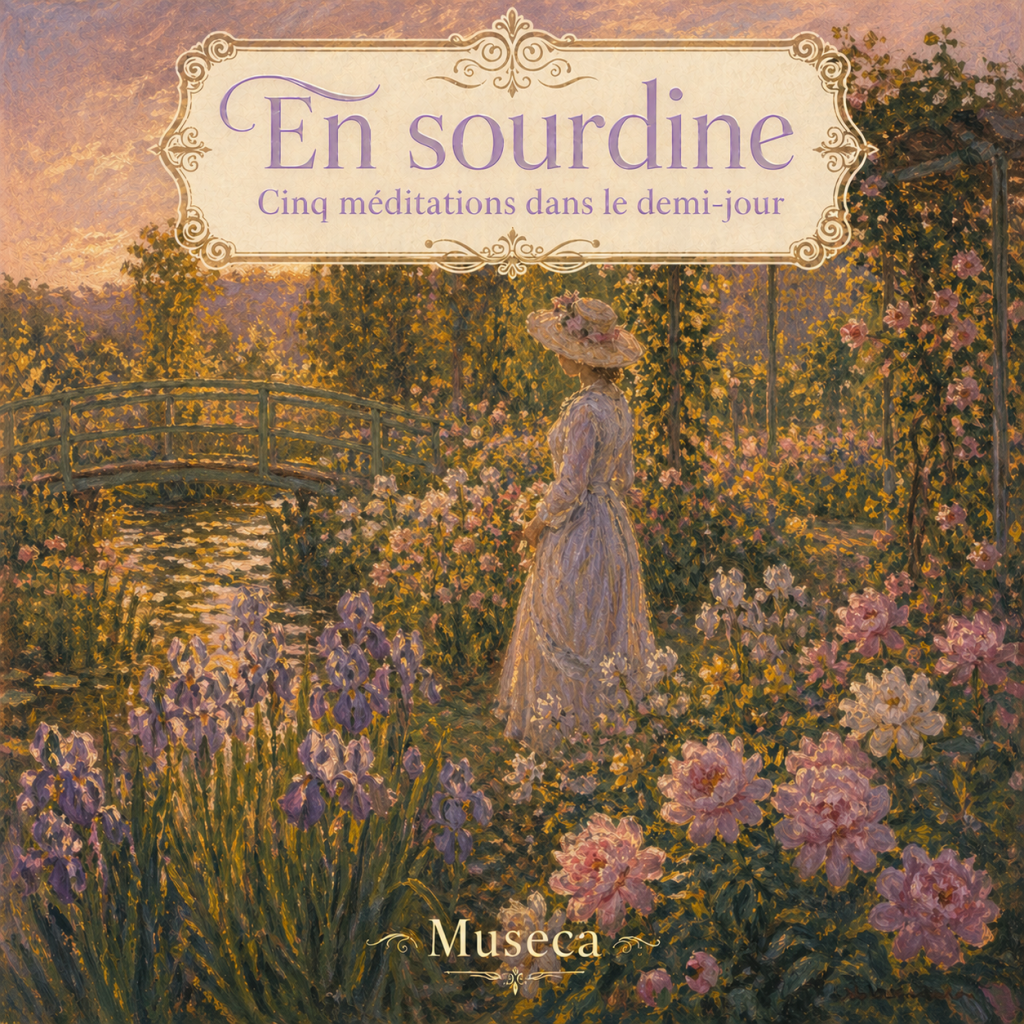
Album Introduction
This album is the second in a series I am composing in a style I call Sotto Voce — sacred-sensual classical crossover with sustained dynamic restraint, in the lineage of Paul Schwartz’s Aria trilogy, Emma Shapplin’s Carmine Meo, the Café del Mar deep-listening tradition, Enigma, and Delerium. The Sotto Voce style synthesizes five distinct musical traditions that have rarely been held together in a single album: classical French art-song (Fauré, Debussy, Hahn, Duparc, Franck, Ravel), Café del Mar chillout production, Enigma and Delerium’s classical-crossover electronic art music, the late-90s and early-2000s wave of crossover-classical artists who used classical voices over electronic production, and the secular sacred minimalism tradition of Arvo Pärt, Henryk Górecki, and John Tavener.
What distinguishes Sotto Voce from each of these adjacent traditions is the specific aesthetic discipline applied to their combination: sotto voce vocal restraint throughout, classical orchestral palette rather than synthetic textures, careful avoidance of operatic spinto delivery in favor of the deepest mélodie tradition’s contained dignity, and a commitment to lyrical economy over rhetorical display.
The originating album in the series was multilingual, meditating on five universal emotional territories across five different languages — Italian, French, Russian, German, and English. En sourdine is the first single-language extension in the series, devoted entirely to the French language and its specific deep emotional territories. The album takes its name from Verlaine’s poem En sourdine (“In Muted Tones”) from his collection Fêtes galantes, set famously by Fauré, Debussy, and Hahn. The phrase en sourdine names a quality — playing or speaking with mute applied, with restraint, in held attention — that defines the entire album’s aesthetic posture. The subtitle Cinq méditations dans le demi-jour (Five Meditations in the Half-Light) names the album’s structure: five vocal meditations on five distinctly French emotional territories, separated by four instrumental interludes, all unfolding across a single French day from morning to deep night.
The album is constructed as an unbroken arc across one French day.
Track 1 opens at le matin clair (the clear morning) with La tendresse — the long-love-tenderness of two people who have been together for many years, rendered in the kitchen-domestic interior at first light.
Track 2 is the late morning Prélude: La fenêtre ouverte — an instrumental opening of the album outward into French sensibility, harp and flute carrying Ravel and Debussy’s late-morning luminosity.
Track 3 arrives at midi (noon) with L’extase douce — gentle ecstasy at a small fountain in a courtyard, the noon’s wonder-arrival rendered in solo oboe and soprano.
Track 4 enters the afternoon’s first deepening with Interlude: Ombres longues (Long Shadows) — solo cello in Fauré-Debussy hybrid register, the afternoon’s lengthening shadows enacted through harmonic deepening.
Track 5 reaches la tombée du jour (the falling of the day, late afternoon) with La nostalgie — place-bound longing in the deepest French chanson tradition, the album’s structural midpoint, with the noon’s oboe voice surfacing within the afternoon’s longing at the climactic moment.
Track 6 enters twilight with Interlude: Entre chien et loup (Between Dog and Wolf — the deeply French phrase for the moment when the day’s certainty yields to evening’s ambiguity) — solo English horn carrying Franck-Debussy hybrid threshold weight.
Track 7 arrives at l’heure bleue (the blue hour) with La mélancolie douce — sweet melancholy, the album’s emotional center, the bittersweet awareness of beauty passing in the present moment, with the morning’s clarinet voice surfacing within the evening’s velvet melancholy.
Track 8 reaches au seuil de la nuit (the threshold of night) with Interlude: Au seuil de la nuit — solo viola over sustained organ pad in Fauré-Pärt hybrid register, the album’s secular sacred turn.
Track 9 closes at la nuit profonde (the deep night) with La grâce — Bernanos-tradition recognition that tout est grâce (everything is grace), the day held whole in the deep night’s stillness, with the twilight’s English horn voice surfacing within the closing’s recognition.
The album’s architecture is precise across multiple dimensions. The tempo bell curve descends mathematically from morning to deep night — Track 1 at 72 BPM, peaking at Track 3’s 78 BPM at noon, then descending through 74, 72, 70, 66, 62, and finally 60 BPM at the closing. The harmonic arc moves through eight modal homes, each growing out of the previous track’s harmonic seeds — E major, E Lydian, A major with A Lydian climax, F-sharp Aeolian, B minor with Dorian inflections, B Aeolian drifting to F-sharp Phrygian, D-flat major drifting to B-flat minor, B-flat Aeolian, and finally F major in the Fauré Requiem In paradisum pastoral key tradition. An instrumental memory pattern develops across the album’s second half: in each of Tracks 5, 6, 7, and 9, a voice from earlier in the day returns briefly at a structural moment — the noon’s oboe surfacing in the afternoon’s longing, the afternoon’s cello surfacing in the twilight’s darkening, the morning’s clarinet surfacing in the evening’s melancholy, and the twilight’s English horn surfacing in the deep night’s recognition. The album becomes a structure of instrumental memory across the day. Anchor words mark the vocal tracks’ emotional centers — Encore (still, again), Voici (here, behold), Reste (remains), Encore returning instrumentally, and Grâce completing the album’s three-register recognition (the quality, the philosophical weight in Tout est grâce, the gratitude in Merci).
The album is intended for sustained listening rather than for shuffle play. Each track is calibrated to its position in the day’s arc, with cross-track continuity gestures (sub-bass and rhythmic pulse continuing at lower volume across track boundaries, organ pad bridging Tracks 8 and 9, instrumental returns at climactic moments) that work only when the album is heard in sequence. The full album runs approximately 35 to 40 minutes — the duration of a contemplative listening session, of a long evening’s quiet attention, of a single sustained meditation across the imagined French day.
Liner Notes
La tendresse, au matin clair
I wanted to begin the album in the deepest French emotional territory I know — la tendresse, the long-love-tenderness of two people who have been together for many years and who now exist in each other’s gravitational field with the simplicity of long habit. The scene is a kitchen-domestic interior at first light. The beloved is nearby — making coffee, reading a paper, moving through the morning with the speaker. The morning’s tenderness is rendered through small specific images: the warmth of bread on the table, the kettle’s steam in cool air, hands that have known each other for decades. The lyric uses the speaker’s first-person voice addressing the beloved as tu, the deepest grammar of French love-song. The anchor word Encore (still, again) lands at the song’s first arrival — still loving, still present, still given to one another after all these years.
Solo clarinet in chalumeau register carries the warm wooden domestic voice of the morning. The harmony is E major with parallel chord motion, the album’s brightest opening key. The Sotto Voce style’s first full statement: classical soprano in mélodie tradition delivery over Café del Mar production with parallel-ninth Debussy harmony. The album opens by establishing what its center will be — that small specific tenderness exists, that long love is real, that the morning holds these things as they are.
Lyrics (French/English)
[Intro]
[Verse 1]
La lumière sur le mur,
The light on the wall,
le matin, doucement.
the morning, gently.
Tu es là, près de la fenêtre,
You are there, near the window,
les volets grands ouverts.
the shutters wide open.
Tu verses le café,
You pour the coffee,
ta main que je connais.
your hand that I know.
Je te regarde sans rien dire —
I watch you without saying anything —
tu es là.
you are there.
[Anchor]
Encore.
Still.
[Interlude]
[Verse 2]
Tes mains sur le bol blanc,
Your hands on the white bowl,
le pain, l’odeur du café.
the bread, the smell of coffee.
Une cloche au loin sonne —
A bell rings in the distance —
le monde s’éveille tout bas.
the world wakes softly.
Combien de matins ainsi,
How many mornings like this,
combien d’années tenues.
how many years held.
Et pourtant, ce matin clair,
And yet, this clear morning,
je te vois.
I see you.
[Anchor / Climax]
Encore.
Still.
[Coda]
Le soleil sur ta main,
The sunlight on your hand,
le matin sur la table.
the morning on the table.
Je reste là, sans rien dire.
I stay there, saying nothing.
Tu es.
You are.
Prélude: La fenêtre ouverte
The album’s first instrumental interlude opens the morning outward. The window of the album is unlatched. Harp and flute carry Ravel-and-Debussy’s late-morning luminosity into the listener’s attention. The track’s structural function is opening — the morning has arrived, the day’s full possibility is now visible through the open window, the air from outside enters the interior space. The harp’s parallel chord drift handles the harmonic language; the flute’s clear singing line carries the melodic identity in E Lydian (the morning’s E major now opening into Lydian brightness through the raised fourth A-sharp). I wanted the interlude to function as breath between Track 1’s tenderness and Track 3’s noon — the moment when the day’s full unfolding becomes available, before the noon’s wonder fully arrives.
L’extase douce, à midi
The album’s noon, set at a small fountain in a stone courtyard. L’extase douce — gentle ecstasy — is wonder arriving as gift, the moment when the speaker’s attention is held by something specific in the world (here, the water in the fountain, the sun on stone, the air at midday) and the held attention itself becomes a form of communion. The lyric is the speaker’s solitary observation, with brief apostrophe to the fountain at the climactic moment. The anchor word Voici (here, behold) lands at the song’s recognition moment — the simple French word that names what is in front of the speaker as given, as witnessed, as seen.
Solo oboe in luminous bright register carries the noon’s specific instrumental voice. The harmony is A major with A Lydian climax — the album’s brightest moment, the day at its full radiance. The climactic moment uses A Lydian’s raised fourth as harmonic brightening rather than as drift. The harp returns the album’s signature foundation. The Sotto Voce style here inhabits its most luminous register — the noon’s wonder rendered without operatic display, without dramatic resolution, just held attention to what is present.
Lyrics (French/English)
[Intro]
[Verse 1]
Le soleil tombe sur la pierre.
The sun falls on the stone.
L’eau dans la fontaine bouge.
The water in the fountain moves.
L’air est lourd, l’air est chaud.
The air is heavy, the air is warm.
Je suis seule dans la cour.
I am alone in the courtyard.
Une feuille tourne dans l’eau.
A leaf turns in the water.
Le bruit de la fontaine, sans fin.
The sound of the fountain, without end.
Je m’arrête, je regarde.
I stop, I look.
Tout est là, sans rien demander.
Everything is here, asking nothing.
[Anchor]
Voici.
Here.
[Interlude]
[Verse 2]
La pierre garde la chaleur.
The stone holds the warmth.
L’eau garde le ciel.
The water holds the sky.
L’instant garde son silence.
The moment holds its silence.
Et moi, je tiens cet instant.
And I, I hold this moment.
Toi, fontaine, toi, midi.
You, fountain, you, noon.
Tu donnes sans demander.
You give without asking.
Le monde s’ouvre par la grâce du midi.
The world opens through the grace of noon.
[Anchor / Climax]
Voici.
Here.
[Coda]
L’eau, la pierre, le silence.
The water, the stone, the silence.
Voici.
Here.
Interlude: Ombres longues
The afternoon’s first deepening. The shadows are now lengthening across the day’s stone surfaces. Ombres longues — long shadows — names the moment when the noon’s full radiance begins yielding to the afternoon’s coming depth. Solo cello in Fauré-Debussy hybrid register: Fauré’s Élégie tradition restrained legato (deeply French middle-low cello voice) over Debussy-tinted harmonic atmosphere (parallel chord motion, modal ambiguity). The bass clarinet enters briefly at the structural pivot for woody darkening. The harmony is F-sharp Aeolian — picking up Track 3’s added F-sharp from the noon’s Lydian climax and making it the new modal home, the album’s first descent into modal-minor territory.
I wanted this interlude to enact the afternoon’s first deepening as a continuous compositional gesture rather than as a sudden shift. The cello’s lyrical phrases unfold patiently; the strings drift between atmospheric wash and architectural support; the harp continues. The track is the album’s first crossing — from the morning’s brightness into the afternoon’s coming depth.
La nostalgie, à la tombée du jour
The album’s structural midpoint and its most distinctly French chanson-tradition track. La nostalgie — place-bound longing across distance and time — is the deepest territory of Aznavour, Brel, Piaf, Barbara. The scene is rendered with extreme sensory specificity: a stone wall opposite, an old grapevine climbing the wall, the evening angélus bell, distant wood smoke, the late-afternoon golden light. The place is unnamed but rendered with the precision that French chanson tradition requires — universal in geography, specific in detail. The lyric primarily uses present-tense observation (the speaker holds the place in memory as if she is there now), with a single decisive shift to past tense at the climactic moment when the past surfaces grammatically: Je me souviens, encore (I remember, still).
Solo cello carries the afternoon-into-evening voice in Fauré-tradition restrained legato. At the climactic moment, the solo oboe returns from Track 3 for a single luminous phrase — the noon’s wonder voice surfacing within the afternoon’s longing. The harmonic shift from B minor to B Dorian at this moment, combined with the oboe’s return, marks the album’s first cross-track instrumental memory gesture. The lyric uses the anchor word Reste (remains, abides) — Aznavour’s iconic word from Que reste-t-il de nos amours. The album begins here to gather itself across its hours: the noon’s voice now lives within the afternoon’s longing.
Lyrics (French/English)
[Intro]
[Verse 1]
À la tombée du jour,
At the falling of the day,
le mur, la pierre claire.
the wall, the pale stone.
La vigne sur le mur,
The grapevine on the wall,
l’ombre, doucement.
the shadow, gently.
Je vois ce que je vois,
I see what I see,
ce que j’ai toujours vu.
what I have always seen.
Le soleil sur la pierre,
The sun on the stone,
la cour, ici.
the courtyard, here.
[Anchor]
Reste.
Remains.
[Interlude]
[Verse 2]
L’angélus, au lointain,
The angelus, in the distance,
la fumée d’une cheminée.
the smoke of a chimney.
Le soir doré, partout,
The golden evening, everywhere,
le silence, après.
the silence, after.
Toi, le mur que je tiens,
You, the wall I hold,
toi, la cour qui demeure.
you, the courtyard that abides.
Toi, le bruit de la cloche
You, the sound of the bell
dans le soir qui descend.
in the evening descending.
[Settling Moment]
Aaah…
[Climax]
Je me souviens, encore.
I remember, still.
Reste.
Remains.
[Coda]
Le mur, le soir, encore.
The wall, the evening, still.
La cloche, au lointain.
The bell, in the distance.
Loin, je reste.
Far away, I remain.
Reste.
Remains.
Interlude: Entre chien et loup
The deeply French expression for twilight — literally “between dog and wolf,” the moment of deepening dusk when one cannot tell familiar shapes from strange ones, when the day’s certainty yields to evening’s ambiguity. Solo English horn in Franck-Debussy hybrid register: Franck’s Symphony slow movement singing-aching lyrical tradition over Debussy’s harmonic atmosphere. The harmonic motion drifts gently from B Aeolian toward F-sharp Phrygian and back — the modal drift physically embodying the threshold quality, the harmony itself enacting the dog-or-wolf indistinction.
The solo cello returns briefly at the structural pivot — the afternoon-deepening voice from Track 4 surfacing within the twilight’s darkening. The album’s instrumental memory pattern continues. The English horn — the orchestra’s twilight voice, the instrument that has carried twilight scenes in Western music for two centuries — arrives into the album for the first time and inhabits its proper hour.
La mélancolie douce, à l’heure bleue
The album’s emotional center. La mélancolie douce — sweet melancholy — is the bittersweet awareness of beauty passing in the present moment, the deepest French emotional register. The hour is l’heure bleue — the blue hour, the period of approximately twenty to thirty minutes after sunset and before full night when the sky becomes deeply saturated blue and the air seems to hold this blue. The scene is a small private interior: a sitting room or study, the lamp not yet lit, a chair, a small table with a book or glass, the speaker still and alone. Verlaine’s En sourdine tradition directly — the album’s title-poem arrives at its emotional center.
Solo cello continues as the album’s afternoon-into-evening voice. At the climactic moment, the solo clarinet returns from Track 1 — the morning’s tenderness surfacing within the evening’s melancholy. The harmonic motion drifts between D-flat major (Debussy’s Clair de lune velvet evening key) and B-flat minor (its relative minor), the bittersweet quality enacted through harmonic motion rather than through fixed state. At the climactic moment, the harmony arrives at fullest D-flat major while the soprano holds the deepest two-line moment of the album: Toi, l’heure bleue, tu es ici. / Tout est ici, tout passe. (You, the blue hour, you are here. / Everything is here, everything passes.) The bittersweet truth in eleven syllables across two lines. The anchor word Encore sung once at the end of the first verse, its second arrival rendered as the clarinet’s instrumental return at the climax — the morning’s voice and the morning’s word arriving together at the album’s deepest moment.
I wrote this track holding Verlaine’s poem En sourdine close. The lyric inhabits the poem’s emotional grammar — the speaker present to the half-light hour with full awareness of its passing, the hour itself addressed as tu across the climactic section, the recognition that the hour is real and ending held without weeping. The deepest French handling of bittersweet awareness: that mélancolie douce contains joy within itself, that the awareness of beauty passing is itself a form of joy.
Lyrics (French/English)
[Intro]
[Verse 1]
L’heure bleue entre dans la chambre.
The blue hour enters the room.
La lampe attend, encore éteinte.
The lamp waits, still unlit.
Le silence remplit l’air.
The silence fills the air.
Je ne bouge pas.
I do not move.
Le bleu se pose sur le bois,
The blue settles on the wood,
sur le verre, sur ma main.
on the glass, on my hand.
Tout devient cette couleur,
Everything becomes this color,
tout devient cette heure.
everything becomes this hour.
[Anchor]
Encore.
Still.
[Interlude]
[Verse 2]
Je tiens un verre vide.
I hold an empty glass.
Je n’ai rien à dire.
I have nothing to say.
Le bleu sur les murs s’efface
The blue on the walls fades
sans que je le voie partir.
without me seeing it leave.
Une étoile, peut-être, là-haut.
A star, perhaps, up there.
Le ciel respire à peine.
The sky barely breathes.
Je suis dans cette heure
I am in this hour
comme un souffle dans un verre.
like a breath in a glass.
[Settling Moment]
Aaah…
[Climax]
Toi, l’heure bleue, tu es ici.
You, the blue hour, you are here.
Tout est ici, tout passe.
Everything is here, everything passes.
[Brief Re-Settling]
Mmm…
[Coda]
L’heure passe, doucement.
The hour passes, gently.
Le bleu reste, encore.
The blue remains, still.
Je le tiens, je le laisse.
I hold it, I let it go.
Et c’est si beau.
And it is so beautiful.
Interlude: Au seuil de la nuit
The album’s secular sacred turn. Au seuil de la nuit — at the threshold of night — names the moment when the blue hour has fully passed and the world has crossed into deep night. Solo viola in Fauré-Pärt hybrid register: Fauré’s late chamber music’s contained aching dignity (the Élégie tradition’s middle voice, the singing-aching middle string voice that no other instrument achieves) over Pärt’s tradition sustained organ pad atmosphere. The organ enters the album for the first time, deliberately reserved across the seven prior tracks for this exact moment. The instrument arrives as the air of a sacred space rather than the instrument played in that space — sustained, modal, ambient, never articulated.
The track inhabits a held threshold rather than a transition. Three of the album’s continuity elements depart at this single point: the harp falls silent, the rhythmic pulse fades out, the divisi string wash thins to a single sustained cello note. The day’s continuous infrastructure yields to the night’s held atmosphere. The harmonic home is B-flat Aeolian — Track 7’s drift target settling into Track 8’s hold, the same five-flats key signature but with different modal center and tonal handling. I wanted this interlude to function as the album’s consecration of the night — the moment when the secular sensibility briefly opens into something close to sacred attention without becoming religious.
La grâce, dans la nuit profonde
The album closes with the recognition that the day that has just passed has been gift. La grâce — grace — in the secular sacred register: not the theological gift of religious tradition, but the Bernanos-tradition awareness from Journal d’un curé de campagne, where the dying priest’s final words “Tout est grâce” (everything is grace) compress the entire philosophy of secular sacred recognition into three syllables. The scene is the same small private interior from Track 7 — the same room that held the speaker at the blue hour — now at the deep night. The lamp that was unlit at the blue hour is now lit, casting warm soft light across the room. The same chair, same table, same window. The room has held the speaker through the day’s hours and now holds her at the recognition.
The harmonic home is F major — the pastoral key, the Fauré Requiem In paradisum closing tradition, the deepest French handling of contemplative resolution. The harmonic motion from Track 8 to Track 9 is gentle: F was Track 8’s fifth degree; F becomes Track 9’s tonic. The same harmonic field re-emphasized around F. The dominant becomes the closing home rather than resolving back to the tonic — a paradoxical resolution that is genuinely contemplative, the album landing in a key that contains its prior territory within itself rather than returning to it.
The lyric renders specific small sensory details from the day’s hours surfacing as memory in the present-moment deep night: la chaleur de ta main, ce matin (the warmth of your hand, this morning — Track 1’s territory), le soleil sur la pierre, à midi (the sun on the stone, at midday — Track 3’s territory), le silence après l’angélus (the silence after the angelus — Track 5’s territory), la première étoile (the first star — the threshold between Track 7’s blue hour and the deep night). The day is gathered through specific sensory anchors rather than through explicit structural acknowledgment.
The anchor word architecture closes the album in three registers. Grâce sung at the first anchor — the simplest naming, the album’s title word becoming the song’s first arrival. Tout est grâce at the climactic moment — the Bernanos-tradition philosophical articulation, three words containing the entire recognition, with the solo English horn returning from Track 6 weaving underneath in F major’s pastoral warmth (the twilight’s threshold voice surfacing within the closing’s emergence-from-depth). Merci embedded in the closing line — the simplest possible thanks, the everyday French word for gratitude as the album’s final sound. Three structural moments holding the three registers of grâce: the quality, the philosophical weight, the gratitude.
The album’s complete instrumental memory pattern resolves with the English horn return. Tracks 5, 6, 7, and 9 each contain within themselves a brief return of an earlier voice from the day. The closing track remembers the album’s threshold into depth (Track 6’s twilight) at the moment of its emergence from depth into recognition. The album closes not on philosophical declaration but on the simplest possible word: Merci.
Lyrics (French/English)
[Intro]
[Verse 1]
La lampe est allumée.
The lamp is lit.
La nuit est dans la chambre.
The night is in the room.
Tout est calme, ici.
Everything is calm, here.
Je suis assise, je respire.
I am sitting, I am breathing.
La chaleur de ta main, ce matin.
The warmth of your hand, this morning.
Le soleil sur la pierre, à midi.
The sun on the stone, at midday.
Le silence après l’angélus.
The silence after the angelus.
Tout cela, tout cela.
All of this, all of this.
[Anchor]
Grâce.
Grace.
[Interlude]
[Verse 2]
La première étoile, à la fenêtre.
The first star, at the window.
Le ciel ouvert, immense.
The sky open, immense.
Ma main près de la lampe.
My hand near the lamp.
Mon souffle dans la nuit.
My breath in the night.
Tout cela m’a été donné.
All of this has been given to me.
Sans que je le sache, sans que je demande.
Without my knowing, without my asking.
Le jour, la lumière, ta main.
The day, the light, your hand.
Le silence, à présent.
The silence, at present.
[Settling Moment]
Aaah…
[Climax]
Tout est grâce.
Everything is grace.
Tout cela.
All of this.
[Brief Re-Settling]
Mmm…
[Coda]
La nuit est calme.
The night is calm.
La lampe est ici.
The lamp is here.
Tout cela m’a été donné.
All of this has been given to me.
Merci.
Thank you.
Playlist
- Track 1: La tendresse, au matin clair Museca 3:20
- Track 2: Prélude: La fenêtre ouverte Museca 3:49
- Track 3: L'extase douce, à midi Museca 3:30
- Track 4: Interlude: Ombres longues Museca 3:59
- Track 5: La nostalgie, à la tombée du jour Museca 4:14
- Track 6: Interlude: Entre chien et loup Museca 3:35
- Track 7: La mélancolie douce, à l'heure bleue Museca 4:45
- Track 8: Interlude: Au seuil de la nuit Museca 3:50
- Track 9: La grâce, dans la nuit profonde Museca 4:43