
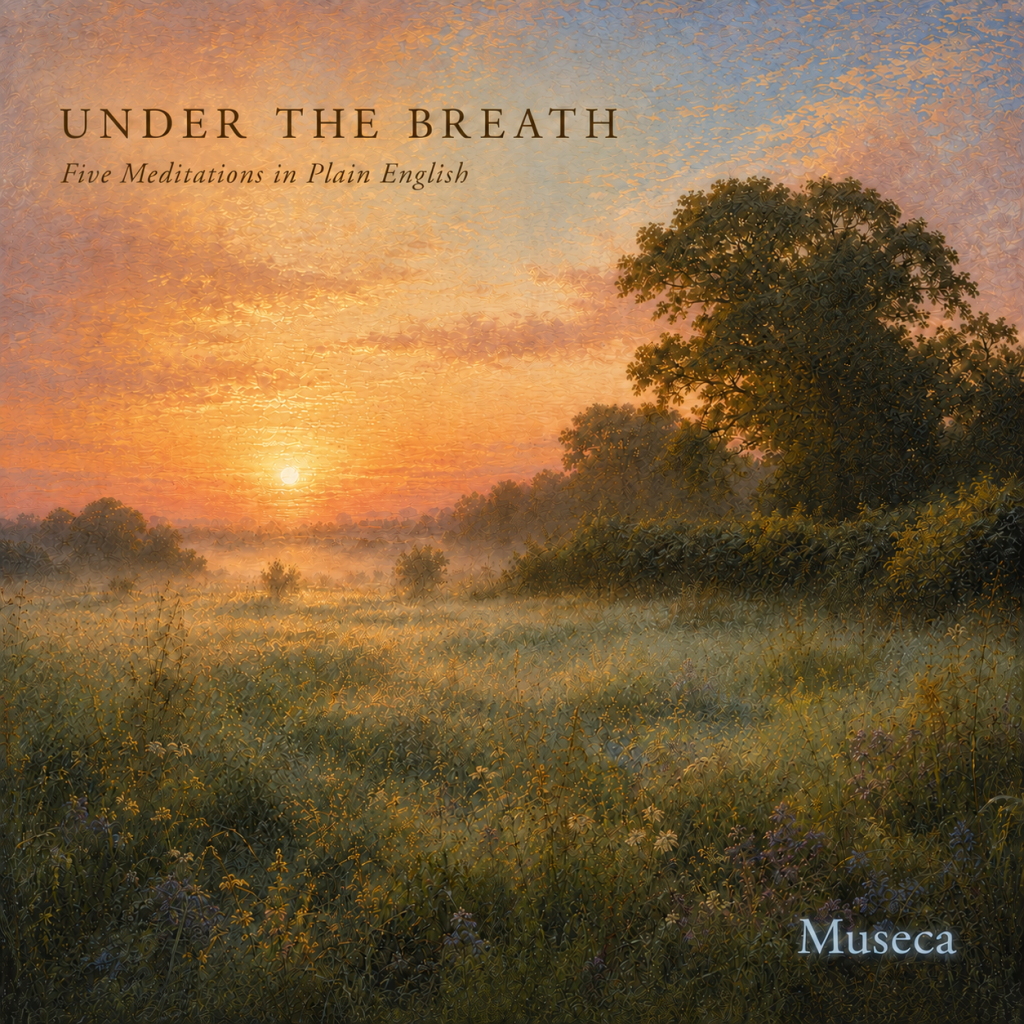
For seven albums I have written in borrowed tongues — Italian, French, Spanish, Russian, German, Japanese, and before all of them the five-voiced album that gave the series its name. Each language lent the music something English could not: tenerezza‘s bodily warmth, taska‘s soul-ache without address, the held propriety of Halblaut, the turning seasons of utsuroi. English was always there, but always in the margins — the language of the translations printed beneath the lyrics, the language I thought in while writing everything else. The one voice in the room that never sang.
This album is that voice’s turn. And because English is the language the series was always half-spoken in, the title does what none of the earlier titles could: it translates the series’ own name. Sotto voce means, in plain English, under the breath. After seven albums of saying it in other languages, the name finally says itself.
The tradition this album stands in is the one English contemplative writing does better than any other: the metaphysical. George Herbert is the presiding voice — the plain-speech intensity of a poet who could put the largest possible weight on the smallest possible words, who wrote about the soul and the divine in the vocabulary of a room, a table, a welcome. Henry Vaughan lends the album its night-and-light register, the luminous dark of a man who saw eternity the other night like a great ring of pure and endless light and told us so in a sentence a child could follow. Gerard Manley Hopkins supplies one morning of his particular astonishment. The lyrics are original — nothing here is a setting — but they are steeped in that tradition’s cadence: short clauses, monosyllabic landings, philosophical weight carried in plain English without rhetorical lift. Hence the subtitle. In plain English is both a description and a discipline.
The album moves through the hours of a single English day and night, but the hours are imagery, not itinerary. The real journey is interior — the metaphysical arc of a soul moving from tenderness to grace — and the English places along the way are where that journey becomes visible. It begins in a dim room at first light, where something waits and is near. Morning unfolds and the music walks out through it. Then a wakeful midnight in the same room, the world asleep, the soul awake and seeking. The hour before light. A dawn field where the world’s particulars arrive one by one and the soul discovers it is not watching the morning but standing inside it. A dusk of strings turning homeward. A lamplit evening interior where a table has been laid and a door left open. A threshold. And then the deep of night, where everything the day gave is given back, and given a name.
Five words carry the album, one for each sung meditation: near, still, here, stay, grace. They arrive at the ends of things — the last word of a verse, half-spoken — and each returns transformed before the end. Listeners of the earlier albums will recognize the method; listeners of this one need no preparation, because for the first time in the series the anchor words require no translation. When the final track gathers all four of its predecessors into a single verse — the nearness waiting in the room, the still that kept the dark, the here of the morning field, the stay that sat the soul down — the album’s whole architecture surfaces in four lines, in words of one syllable.
The instruments keep the English contemplative tradition’s company. A solo violin opens the album in the pastoral register of Vaughan Williams — contained, tender, nothing soaring — and it is the violin that returns to close it, the voice that began the journey ending it. Between them: a clarinet that appears twice, once in Finzi’s morning warmth and once, darkened, in Howells’s elegiac hour before light — the same voice in two weathers, for those who listen across tracks. A French horn carries the midnight longing in the register Britten found for it. A cor anglais brings the morning field its wonder and returns, tracks later, at the moment of recognition — because wonder remembered is very close to gratitude. Two string choirs, one near and one far, answer each other at dusk in the old antiphonal manner of the Tallis Fantasia. A cello holds the lamplit evening with the gravest warmth English music owns. And a viola — saved, unheard, through the entire album — speaks only at the threshold, alone over the album’s only organ, in the stillness where Tavener and Pärt keep house.
Beneath everything, a pulse. From the first seconds of the first track, a sub-bass heartbeat holds the floor of the album, crossing every track boundary without pause — until the threshold, where for the first time it falls silent, and the listener feels the floor withdrawn. It returns with the final track, because grace restores the ground that was always there. And in the album’s last minute it does something it has never done in this album: it slows, and fades, and goes out entirely. The last sound of the album is the pulse dying into silence. Listeners who know the earlier albums know what that silence means. It is how every album in this series ends. This time, it is how the series ends.
Because this is the last one. The series that began as five meditations in five tongues closes here, in the tongue that was underneath all of them. The closing phrase that has ended every album — tout est grâce, tutto è grazia, todo es gracia, each language finding its own way to Bernanos’s last sentence — arrives at last in the language I first read it in: everything is grace. And the small refrain that has closed each album in its native words closes this one in mine: and I, here, still. In the final track’s quietest moment, that little word still is allowed, once, to remember its brothers and sisters — ancora, encore, aún, noch — the series’ languages sounding together for the only time, under the breath, before English takes the last word.
I have said, from the beginning, that this music is made for listeners — for the kind of attention that notices a violin returning after half an hour, a word planted two tracks before it blooms, a pulse that was always there revealed only by its absence. This album asks that attention one more time, and rewards it, I hope, one last time. Nothing here is loud. Nothing here resolves before it has been earned. The music keeps its voice low so that you will lean in — and what you lean into, if the album does its work, is the discovery the soul makes across these nine tracks: that what it was listening for was near the whole time.
Everything is grace. And I, here, still.
Liner Notes
Tenderness, at First Light
The album opens in a dim room before the day has found it. Nothing has happened yet: the glass is grey, the chair unmoved, the breath slow. And yet something waits, and it is near. A solo violin — contained, tender, the voice that will return to close the album — carries the first light over the heartbeat pulse that will hold the floor of everything to come. The word near arrives at the end of each verse, each time carrying a little more weight, until a voice that may not be a voice says it back: I was not gone. I have been near. The someone-near is never named. It could be the beloved, the dawn, the soul’s own deeper presence. The song is careful not to decide, and asks you not to either.
Lyrics
Verse 1
The day has not yet found the room.
The glass is grey. The breath comes slow.
No hand has moved the chair from where it stood.
Yet something waits, and it is near.
Verse 2
I do not know who breathes beside me now —
the dawn, the love, my own soft waking breath.
A little light has entered without sound.
What once was far is learning to be near.
Verse 3
You need not rise, the hush said in the room.
You need not earn the morning at your door.
I was the breath you thought had gone from you.
I was not gone. I have been near.
Outro
So let the day come softly as it will.
Let pale light rest where fear had lain.
The soul sits down inside its own first peace,
and says no more than this: near.
Interlude: Morning Unfolding
The violin hands the morning to a clarinet, and the album walks outdoors. This is the warmest, most easeful music on the album — a lyrical clarinet in conversation with strings, harp turning gently underneath, morning opening outward from the window to the door to the garden. Nothing here is troubled. Remember the clarinet’s voice, though: you will meet it again, changed, in a darker hour.
Longing, at Wakeful Midnight
The same room as the opening track, at the opposite hour. The world is asleep; the soul is not. A French horn carries the night register — restrained, sustained, the loneliest of the album’s voices — while the singer keeps vigil at the window with the album’s second word: still. Still I wait. Still I seek. In the instrumental bridge, listen for a memory: the opening track’s violin returns for a few measures, tenderness echoing briefly into the longing’s night, before it recedes and the horn is left alone. The night’s answer, when it comes, is not a rescue but a recognition: you are still here. That is enough.
Lyrics
Verse 1
The night has come. The world has gone to sleep.
I am awake. The window holds the dark.
The clock has slowed to where the slow hours keep.
And still I wait. I do not know for what.
Verse 2
Somewhere a light is shining I cannot see.
Somewhere a hand is holding what I let fall.
The night is wide. The night is full of me.
And still I seek. The dark is not the all.
Verse 3
I thought my longing was a kind of lack.
I thought the dark was where the held-thing breaks.
And then the night — or what the night could say —
said: you are still here. That is enough.
Outro
The night holds on. The morning will not come
for hours yet. I do not need the day.
The dark has shown me what the light would hide.
The waiting is the way. And still — I am.
Interlude: The Hour Before Light
The clarinet returns — the same voice that unfolded the morning, now heard in the darkest hour of the night, slow and elegiac in the manner of Howells. The same instrument in two weathers: this is the album speaking its method quietly, for those who listen across tracks. Through the interlude the harmony begins, almost imperceptibly, to admit the possibility of light, and the music ends leaning forward, unresolved, toward the dawn.
Wonder, in the Morning Field
The soul steps out of the night into an open field, and the album reaches its brightest ground. A cor anglais sings the pastoral morning; the harmony shimmers with a raised, luminous inflection; the world’s particulars arrive one by one — the dew, the leaf, the waking wren. The word here is here: not the wonder of exclamation but the quiet astonishment that the world is present at all, and that the one perceiving it is inside it rather than watching. For one track, the album’s interior arc opens its window all the way.
Lyrics
Verse 1
I step out of the night into the field.
The grass is grey, then green, then lit with dew.
The sky is turning pale above the hill.
I have not asked for this. And it is here.
Verse 2
I count the small things morning gives the lane:
the thread of dew, the leaf, the waking wren.
None of them knows the wonder it is in.
And none of them is elsewhere. All is here.
Verse 3
And something in me rises like the light —
not thought, not prayer, but seeing given wings.
The world keeps happening, fresh from its first day.
I am not watching it. I am in it, here.
Outro
The sun is up. The field goes on with day.
The wren has work. The thread has dried to air.
I hold one morning no one else will hold,
and all I know to say of it is: here.
Interlude: Turning Homeward
For the first time, no soloist. Two string choirs — one near and close, one distant and half-lost in air — answer each other in the old English antiphonal manner, the day declining as the music turns back toward the interior. Even the harp falls silent here. The interlude does not end so much as hold its last phrase open, unresolved: the resolution it withholds belongs to the next song, and to what waits there.
Recognition, at the Lit Table
The evening interior: a lamp, a laid table, a door found standing open. This is the album’s heart, and the oldest scene in English contemplative poetry — the soul drawing back, feeling unworthy of the welcome, and the welcome refusing the objection. A solo cello carries the track with the gravest warmth on the album, and in the bridge the morning field’s cor anglais returns to braid with it: wonder remembered at the moment of recognition. The word is stay, spoken three times to the soul before the soul, in the quietest moment of the song, finally says it back. Listen, too, for one small word passing almost unnoticed in the third verse. It is planted here on purpose. It blooms two tracks later.
Lyrics
Verse 1
The day is done. I come back to the room.
The lamp is lit. The table has been laid.
I did not knock. The door was standing open.
And something waited there, and it said: stay.
Verse 2
But I drew back. My hands are marked with day.
I have not earned the bread, nor kept the hour.
Whatever set this table knows my name —
and knowing it, has still one word: stay.
Verse 3
You bring the day; I never asked for more.
You need not wash the morning from your hands.
This is not wages. This is only grace.
The bread is yours. The evening’s word is: stay.
Outro
So I sit down. The lamp burns low and kind.
The room is full of what I cannot name.
It asked no promise, and it kept its own.
I am not going anywhere. I stay.
Interlude: At the Threshold
Everything the album has stood on falls away. The pulse that has held the floor since the first seconds of the first track goes silent; the harp is gone; the production hush is total. What remains is the album’s only organ, utterly still, and a viola — kept unheard through the entire album for this moment — speaking slow, plain phrases into the silence. Nothing builds. Nothing rises. The track refuses, on principle, to go anywhere: it is the held breath before the last door, and its stillness is not emptiness but attention. The darkness it holds is the very key from which the final track’s light will be made.
Grace, in the Deep of Night
The pulse returns, the violin returns — the voice that opened the album closing it — and the cello of the lit table stays underneath, recognition carrying into grace. The night gives its account: nearness waiting in the room, the still that kept the dark, the here of the morning field, the stay that sat the soul down — the album’s four words gathered into four lines, and given, at last, their one name. In the final refrain, at the quietest moment of the album, the little word still is allowed once to remember the languages that came before it, under the breath, before English takes the last word. And then the album does what it has been preparing from its first seconds: the heartbeat pulse, present beneath every track, slows, and fades, and goes out. The last sound is silence arriving. Everything is grace. And I, here, still.
Lyrics
Verse 1
The lamp is out. The house is dark and kind.
The day I held is given back to night.
I kept no part of it, and lost no part.
What holds me now, I have one word for: grace.
Verse 2
It was the nearness waiting in the room.
It was the still that kept me through the dark.
It was the here that met me in the field,
the stay that sat me down. All of it grace.
Verse 3
And if the night should ask me what I learned,
I will say: nothing came that was not given,
and nothing given did not come this near.
Everything — everything is grace.
Outro
And I, here, still.
Still — ancora — encore — aún — noch — still.
The night is deep. The morning will come round.
I am not waiting now. I have been received.
And all I have to give the dark is thanks.
Playlist
- Track 1 — "Tenderness, at First Light" Museca 4:14
- Track 2 — "Interlude: Morning Unfolding" Museca 3:58
- Track 3 — "Longing, at Wakeful Midnight" Museca 4:07
- Track 4 — "Interlude: The Hour Before Light Museca 3:35
- Track 5 — "Wonder, in the Morning Field" Museca 3:24
- Track 6 — "Interlude: Turning Homeward" Museca 3:45
- Track 7 — "Recognition, at the Lit Table" Museca 3:33
- Track 8 — "Interlude: At the Threshold" Museca 3:05
- Track 9 — "Grace, in the Deep of Night" Museca 3:59