
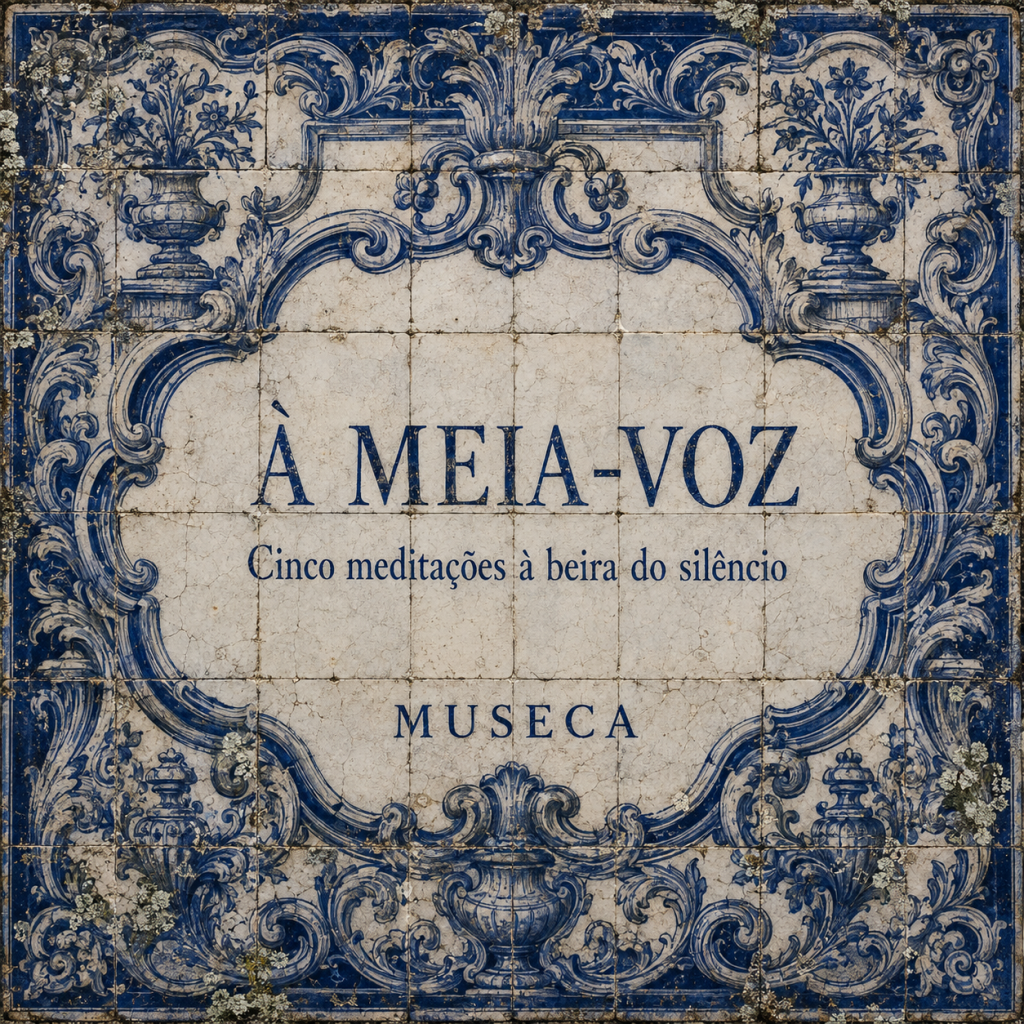
À meia-voz
Cinco meditações à beira do silêncio
There is a Portuguese idiom for singing under the breath: à meia-voz — at half-voice. It sits alongside sotto voce, en sourdine, halblaut, voz callada. This album is the tenth in the Sotto Voce series and its first in Portuguese, and it was written for the register the phrase describes — a voice pitched low enough not to wake anyone in the house.
Portugal has one of the world’s great traditions of quiet singing, and one of its great loud ones. Fado can fill a room; it can also be sung to nobody, in a kitchen, late. This album takes fado’s harmonic language, its guitarra, and its central word — saudade — and asks them to stay at the volume of the second thing. The other half of the album’s voice comes from across the Atlantic, from the bossa nova principle that the microphone can be trusted and the singer need not push. The result is Lisbon architecture with a whispered delivery: the fado of a house at three in the morning.
Five meditations trace an interior movement: Perto — nearness, before anything is said. Saudade — the longing that is a weight rather than a wound. Sossego — the stillness of someone who has stopped asking. Demora — the plea for the afternoon to last a little longer. Graça — grace, and gratitude, which in Portuguese are the same word twice.
Between them, four instrumental interludes mark the passage of a single night into morning: Madrugada, the small hours; Maré, the tide that keeps almost arriving; Penumbra, the dimmest point; Véspera, the eve. The guitarra portuguesa is heard alone in the first of these and returns only at moments when a memory is being kept.
The album observes the series’ architecture. Nine tracks alternating voice and instrument. E major at the opening, F major at the close. A single sustained low tone runs continuously beneath all nine pieces and fades to silence only in the last coda. Nothing rises above mezzo-piano except four lines in the whole record. Figures introduced early return late, changed: the tide resolves, the cello’s first phrase comes back slowed and lowered, and the word ainda — still, yet — moves from longing in the second track to presence in the ninth.
The series ends every album in the same place, in whatever language it is speaking. Here it is Tudo é graça — everything is grace — and then, quietly, e eu aqui, ainda: and I, here, still.
Sung in European Portuguese. Best heard at low volume, late, with the lights off.
Liner Notes
Perto — Meditação I
The album opens where the series always opens: on nearness, before anything has been asked for. A cello plays alone, out of time, and the voice enters at the volume of someone who does not want to wake the house. Não te chamo — I am not calling you. The anchor word is perto, near, sung plain, and the refrain says what the whole album will keep saying in different ways: that no further word is required. E major, the series’ permanent opening key. The cello phrase heard in the first fifteen seconds returns twice more before the record ends, each time lower and slower.
Portuguese Lyrics
Verso I
Não te chamo. Estás
do lado onde a luz não chegou.
Sei — como a maré
sabe da pedra antes de a tocar.
Verso II
Falo baixo, para não te acordar
do lado do sono em que me ouves.
O mar deixa o sal na parede da casa;
eu deixo o meu nome à porta.
Refrão
Perto.
Não é preciso mais palavra.
Perto — e o quarto respira.
Verso III
Nada acontece. É isso que acontece:
a manhã que tarda, a mão que não pede.
Guardo-te como se guarda a água
na concha das mãos, sem fechar.
Refrão
Perto.
Não é preciso mais palavra.
Perto — e o quarto respira.
English translation
Verse I
I am not calling you. You are
on the side the light has not reached.
I know — the way the tide
knows the stone before it touches it.
Verse II
I speak quietly, so as not to wake you
on the side of sleep where you hear me.
The sea leaves its salt on the wall of the house;
I leave my name at the door.
Refrain
Near.
No further word is needed.
Near — and the room breathes.
Verse III
Nothing happens. That is what happens:
the morning that is slow to come, the hand that asks for nothing.
I hold you the way water is held
in the cup of the hands, without closing them.
Refrain
Near.
No further word is needed.
Near — and the room breathes.
Madrugada — Interlúdio I
The small hours. The guitarra portuguesa alone, tremolo, over the sustained low tone — the album’s first sight of the instrument that will carry its memory. The figure played here is not developed; it is simply stated, so that it can be recognized later. E minor: the same tonic as the opening meditation, darkened as night comes on.
Saudade — Meditação II
The word needs no translation and resists it. This meditation refuses to treat it as grief. What it describes is a chair left facing the sea that nobody sits in and nobody moves — the deliberate keeping of an absence, which is a form of hospitality. A minor, fado’s home key. At the final refrain the harmony lifts briefly toward C major, the consolation the tradition always allows itself, and the guitarra enters for the first time inside a song, playing the Madrugada figure beneath the voice. The still-word ainda appears here for the first time, in its longing sense. It will come back.
Portuguese Lyrics
Verso I
Há uma cadeira voltada para o mar
que ninguém ocupa e ninguém tira.
Deixei-a assim. É o meu modo
de dizer que ainda espero.
Verso II
O que tenho de ti é o que falta:
o lugar da mão na mesa,
o silêncio depois do teu nome,
a porta que não fecho.
Refrão
Saudade.
Não é dor — é o peso da luz
num quarto de onde saíste.
Verso III
A maré volta sem que a chamem.
Eu não sei voltar assim.
Estou à janela como quem aprende
uma palavra que já sabia.
Refrão
Saudade.
Não é dor — é o peso da luz
num quarto de onde saíste.
E ainda assim — a cadeira, o mar.
English translation
Verse I
There is a chair turned toward the sea
that no one sits in and no one moves.
I left it that way. It is my way
of saying that I am still waiting.
Verse II
What I have of you is what is missing:
the place of your hand on the table,
the silence after your name,
the door I do not close.
Refrain
Saudade.
It is not pain — it is the weight of the light
in a room you have left.
Verse III
The tide comes back without being called.
I do not know how to come back like that.
I stand at the window like someone learning
a word she already knew.
Refrain
Saudade.
It is not pain — it is the weight of the light
in a room you have left.
And even so — the chair, the sea.
Maré — Interlúdio II
Cello and nylon guitar in 6/8, the album’s only departure from four. A phrase rises, reaches, and falls back without resolving; it does this many times. The tide is the album’s model of patience — something that keeps returning without ever quite arriving. The harmony drifts downward. This figure is left unfinished on purpose.
Sossego — Meditação III
Pessoa’s word, and the album’s lowest point. Not sadness: the stillness of someone who has stopped asking, which is a different thing and harder to reach. Deixei de perguntar. Não por cansaço — I stopped asking. Not from tiredness. There is a glass of water on the table and the water is quiet, and the singer says she is learning from it. D minor. The quietest track on the record, with no ornament anywhere. The cello is silent until the last refrain, where it enters with one phrase: the cello’s opening line from Perto, slowed and dropped, returning as memory rather than statement.
Portuguese Lyrics
Verso I
Deixei de perguntar.
Não por cansaço — por ter chegado
ao lugar onde as perguntas
se sentam e não pedem nada.
Verso II
A casa fecha os olhos sem dormir.
Há um copo de água na mesa
e a água está quieta.
Aprendo com ela.
Refrão
Sossego.
Não é o fim de nada.
É o que sobra quando a espera se cala.
Verso III
Já não ouço o mar — está lá.
Já não te chamo — estás.
As coisas têm o seu lugar
e eu tenho o meu, à sombra.
Refrão
Sossego.
Não é o fim de nada.
É o que sobra quando a espera se cala.
E a luz não precisa de mim para entrar.
English translation
Verse I
I have stopped asking.
Not out of weariness — from having arrived
at the place where the questions
sit down and ask for nothing.
Verse II
The house closes its eyes without sleeping.
There is a glass of water on the table
and the water is still.
I am learning from it.
Refrain
Quiet.
It is not the end of anything.
It is what remains when the waiting falls silent.
Verse III
I no longer hear the sea — it is there.
I no longer call you — you are here.
Things have their place
and I have mine, in the shade.
Refrain
Quiet.
It is not the end of anything.
It is what remains when the waiting falls silent.
And the light does not need me in order to enter.
Penumbra — Interlúdio III
Almost nothing. Single piano notes with long silences between them, high cello harmonics barely present, the low tone underneath. No chord is ever completed. This is the dimmest place in the album, and it is placed immediately after the stillness rather than before it, because the deepest quiet is what follows acceptance, not what precedes it.
Demora — Meditação IV
The first warmth since the opening. The cor anglais, silent for six tracks, begins this one alone — held back so long precisely so that its entrance is felt as an arrival. The plea is small and exact: not come back, but let the afternoon not end yet, let the light linger on the wall. The anchor word is fica — stay. Fica o tempo de um copo de água: stay for as long as a glass of water takes. B-flat major. The last line concedes what the whole song has been circling: that the time being asked for is the time needed to learn how to let go.
Portuguese Lyrics
Verso I
Não te peço que voltes.
Peço menos: que a tarde
não acabe já,
que a luz se demore na parede.
Verso II
Há coisas que se dizem devagar
para durarem mais.
Digo o teu nome assim,
com todas as sílabas abertas.
Refrão
Fica.
Não para sempre — só agora.
Fica o tempo de um copo de água.
Verso III
O sol desce a rua sem pressa,
como quem sabe que volta.
Eu não sei. Por isso
seguro a tarde com as duas mãos.
Refrão
Fica.
Não para sempre — só agora.
Fica o tempo de um copo de água,
o tempo de eu aprender a deixar-te ir.
English translation
Verse I
I am not asking you to come back.
I am asking less: that the afternoon
not end yet,
that the light linger on the wall.
Verse II
There are things that are said slowly
so that they last longer.
I say your name that way,
with all its syllables open.
Refrain
Stay.
Not forever — only now.
Stay the length of a glass of water.
Verse III
The sun goes down the street unhurried,
like someone who knows he will return.
I do not know that. And so
I hold the afternoon with both hands.
Refrain
Stay.
Not forever — only now.
Stay the length of a glass of water,
the time it takes me to learn to let you go.
Véspera — Interlúdio IV
The eve. Guitarra and cello together for the first time, the album’s fullest texture, which is still only three instruments. The rising figure from Maré returns and this time completes itself, resolving into F major — the key the final meditation opens in. The record hands the tonic across the seam and waits there.
Graça — Meditação V
The cello opens alone again, as in the first track, now in F. The cor anglais returns from Demora. The meditation counts what was received rather than what was lost, and it rests on a fact the Romance languages hold quietly: in Portuguese, graça is grace, and obrigada is thank you, and the two ideas were never separated. Gratitude is grace recognized.
At the climax the harmony lifts plagally toward B-flat for the series’ permanent closing sentence — Tudo é graça, everything is grace, what came and what did not come, what stayed and what was slow to leave. Then the voice drops back to F, back to mezzo-piano, and sings the line the series has sung in six other languages: E eu aqui, ainda. And I, here, still. The word that meant longing in the second track means presence in the ninth.
A faint guitarra tremolo sounds once in the coda, the figure from the small hours returning at the end of the night. The sustained low tone, which has run unbroken beneath all nine pieces, fades here for the first and only time, into silence.
Portuguese Lyrics
Verso I
Não pedi a manhã e ela veio.
Não mereci a água e bebi.
A mão que me trouxe até aqui
não era a minha.
Verso II
Contei o que perdi durante anos.
Hoje conto de outro modo:
a cadeira, o mar, a tarde que ficou,
o silêncio que me deixaram.
Refrão
Graça.
A palavra é a mesma de obrigada.
Não foi engano — foi assim que se aprendeu a agradecer.
Verso III
Tudo o que passou, passou por dentro de mim
e deixou a casa mais larga.
Já não separo o que veio do que doeu.
Está tudo na mesma mesa.
Refrão
Tudo é graça.
O que veio e o que não veio.
O que ficou e o que se demorou a partir.
Tudo é graça.
Final
E eu aqui, ainda.
English translation
Verse I
I did not ask for the morning and it came.
I did not deserve the water and I drank.
The hand that brought me here
was not my own.
Verse II
For years I counted what I had lost.
Today I count differently:
the chair, the sea, the afternoon that stayed,
the silence they left me.
Refrain
Grace.
The word is the same as thank you.
It was no mistake — this is how we learned to give thanks.
Verse III
Everything that passed, passed through me
and left the house more spacious.
I no longer separate what came from what hurt.
It is all on the same table.
Refrain
Everything is grace.
What came and what did not come.
What stayed and what was slow to leave.
Everything is grace.
Final line
And I, here, still.
Playlist
- Track 1 — Perto (Meditação I) Museca 2:43
- Track 2 — Madrugada (Interlúdio I) Museca 3:13
- Track 3 — Saudade (Meditação II) Museca 2:20
- Track 4 — Maré (Interlúdio II) Museca 2:29
- Track 5 — Sossego (Meditação III) Museca 2:30
- Track 6 — Penumbra (Interlúdio III) Museca 2:08
- Track 7 — Demora (Meditação IV) Museca 2:13
- Track 8 — Véspera (Interlúdio IV) Museca 2:25
- Track 9 — Graça (Meditação V) Museca 2:37