Let the rhythmic cell return
Ostinato Studies
Ostinato Studies explores what can grow from a persistent pattern. Compare a repeated musical foundation with the Hidden Name’s fixed encoded identity.
Explore album ↗
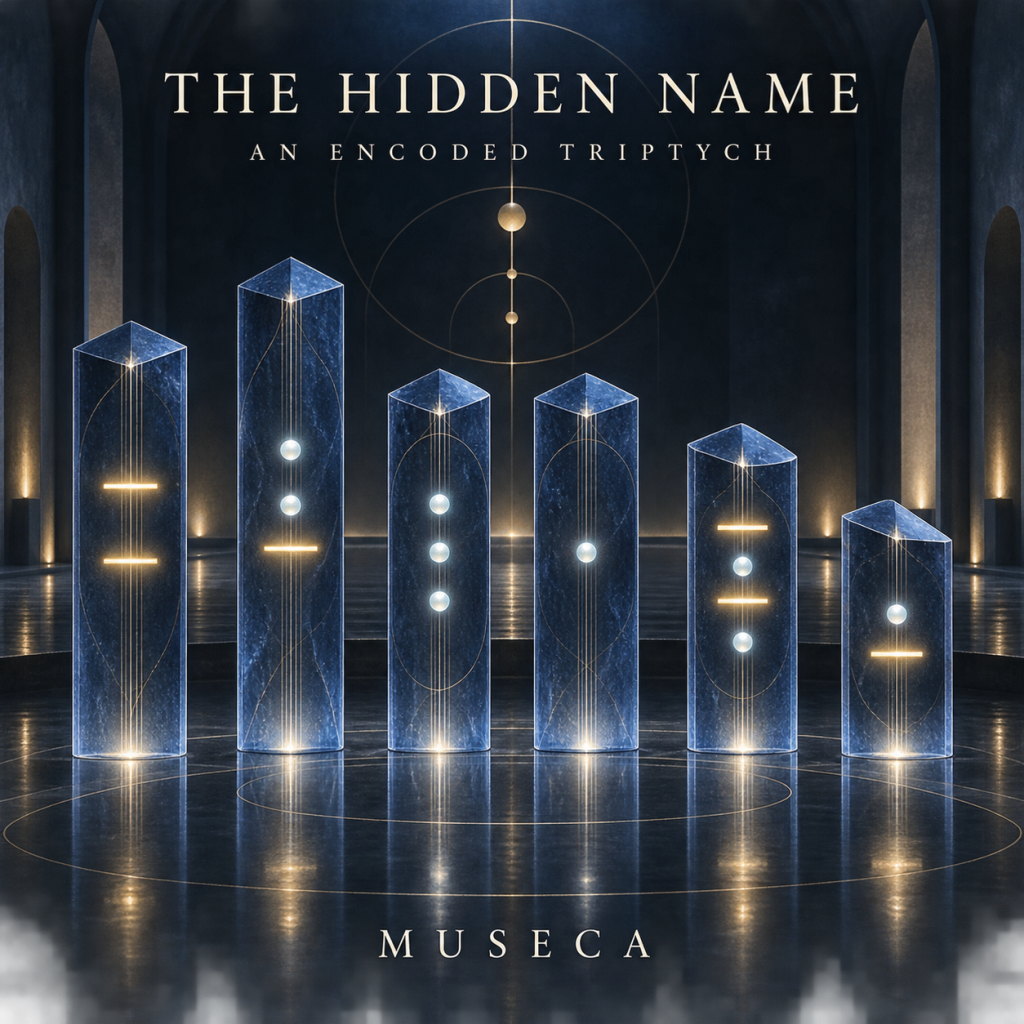
An Encoded Triptych
A persistent story about Lalo Schifrin’s theme for Mission: Impossible proposes that its celebrated five-beat rhythm began with the Morse code for the initials M.I.: two dashes followed by two dots. The explanation is elegant and the rhythmic relationship fits, although the surviving historical record does not establish with certainty that Schifrin consciously used Morse code when he created the theme. It therefore belongs somewhere between musical analysis and creative folklore—an unverified story, but a compelling idea.
That idea became the point of departure for The Hidden Name. What if a name were treated not merely as a title, but as the concealed musical substance of an entire composition? The name MUSECA was first translated into its fixed International Morse spelling. A compositional grammar was then placed around it: dots became eighth notes, dashes became quarter notes, and every letter received a recurring pitch value.
The resulting sequence—A, B, G, G, E, C—became the melodic identity of the name. The lengths of its Morse characters created three metric fields: M–U forms eight eighth-note units and therefore 4/4; S–E forms four and therefore 2/4; C–A forms nine and therefore 9/8. Rhythm, pitch and meter thus arise from a single encoded source.
The album unfolds as a triptych. Signal — An Encoded Prelude allows the code to gather out of silence. The Hidden Name — A MUSECA Encoded Composition presents and develops the identity in its fullest form. Resonance — An Encoded Epilogue leaves behind its afterimage: the name is no longer announced but remembered. Across the three works, an abstract sequence of dots and dashes becomes pulse, phrase, harmony, texture and memory.
The listener does not need to decode the system in order to enter the music. The code is its hidden architecture, not its subject. It operates beneath the audible surface in the same way that a name can remain unspoken while still shaping an identity. For readers who wish to examine that architecture, the technical and historical appendix following the liner notes explains the system in detail.
The Hidden Name — An Encoded Triptych is constructed from a single musical premise: the name MUSECA can function as both message and compositional material.
In International Morse code, the name becomes:
M = – –
U = · · –
S = · · ·
E = ·
C = – · – ·
A = · –
The rhythmic translation is exact. Every dot becomes an eighth note, and every dash becomes a quarter note. The complete name therefore contains twenty-one eighth-note units, equivalent to ten and one-half quarter-note beats.
The code naturally divides into three metrical groups. M–U occupies eight eighth-note units and fits into 4/4. S–E occupies four eighth-note units and fits into 2/4. C–A occupies nine eighth-note units and requires 9/8. The recurring sequence of 4/4, 2/4, and 9/8 is consequently not an imposed rhythmic effect. It arises directly from the proportions of the encoded name.
The letters also receive fixed pitches:
M = A, U = B, S = G, E = G, C = E, A = C
This produces the six-note monogram A–B–G–G–E–C. Repeated notes within a letter retain their assigned pitch while their durations distinguish dots from dashes. In its purest form, the cipher can therefore be heard as a sequence of repeated tones whose lengths spell the name. Elsewhere, the same pitch collection becomes melody, harmony, counterpoint, pedal resonance, and instrumental color.
The opening piece presents the code as something approaching from beyond the audible field. The music begins at a very slow tempo, with isolated fragments separated by silence. A sustained A suggests the first dash of M; a brief B introduces the dot-character of U; repeated Gs anticipate S; and isolated E and C gestures allow the final letters to gather gradually. At this stage, the listener hears signs without yet hearing the complete name.
The first full transmission states the cipher without harmony. M–U fills a measure of 4/4, S–E occupies 2/4, and C–A completes the statement in 9/8. The right hand carries the pitches A–B–G–G–E–C while the left hand remains silent. This is the album’s clearest demonstration of the underlying mechanism: the pitch identifies the letter, and the rhythm communicates its Morse pattern.
Once the transmission has sounded, the piano responds from below. The complete code passes into the bass register while quiet upper harmonies listen above it. The relationship between signal and resonance is thereby established: the code is not merely stated but answered by the instrument’s surrounding register.
A distant version follows one octave higher. Its rhythm remains exact, but the change of register makes it sound less physical and more remote. The name is still present, yet it now behaves like a signal reflected across a great distance.
In the reflected passage, the original pitches are redirected into a new contour while the Morse durations remain unchanged. This is an important structural distinction. The code can survive alteration of register, harmony, and melodic shape because its rhythmic identity remains intact. The listener may no longer hear a literal spelling, but the underlying proportions continue to govern the phrase.
The central interference intensifies the texture by adding a fifth above each coded tone. Dots and dashes become two-note sonorities, and the bass introduces crossing waves of motion. The cipher is surrounded by greater harmonic activity, although it is never erased.
At the point of recognition, the exact code returns in octaves. This is the fullest and strongest statement in the prelude. What began as isolated signs has become unmistakable. The dynamic level broadens, the register expands, and the hidden name is finally heard as a complete musical identity.
The recognition does not lead to a conventional conclusion. Instead, the letters separate again. A dash, a dot, three repeated dots, and the remaining fragments emerge individually against sustained pedal tones. The final transmission returns at the edge of audibility, one octave lower than the first. Its concluding harmony is allowed to disappear rather than resolve, leaving the signal suspended in resonance.
The central work expands the encoded material from solo piano into a piano quintet and develops it through five connected stages.
The Code begins with the canonical statement in its most literal form. The piano spells MUSECA as A–B–G–G–E–C, using the 4/4–2/4–9/8 pattern created by the Morse durations. The strings initially withhold their commentary. After the statement is complete, they enter as sustained harmonic resonance, transforming the six isolated pitches into a chamber sonority.
The code is then repeated one octave lower. This second statement has greater weight and a more interior character. The music subsequently begins to dissolve: individual notes from the monogram separate from their original rhythmic order, and the section slows through 5/4 toward a quiet, sustained harmony. The literal message has been delivered; everything that follows grows from its residue.
In The Name Becomes Music, the cipher ceases to behave like a transmission and begins to behave like lyrical material. The cello carries a cantabile line derived from the pitch monogram, while the violins and viola initially sustain distant, sul-tasto harmonics. The piano supplies spacious harmonic fields drawn from the same notes.
The prevailing 4/4 meter gives this section a more continuous flow, but 3/4 and 5/4 measures disturb any sense of square periodicity. These expansions and contractions preserve the asymmetry inherited from the code. As the tempo rises gently, the letters are no longer heard as isolated units; they are connected into longer melodic sentences. The name has moved from signification into song.
Refractions places the material primarily in 9/8, the meter associated with the final letters C–A. The longer compound pulse allows fragments of the monogram to overlap and circulate between the instruments. Short cells enter canonically, as though the same encoded light were being seen through different surfaces.
A sudden 7/8 measure produces a brief fracture in the pattern. The disturbance is not arbitrary: it represents the code broken into unequal fragments and recombined before the original flow can settle. The texture gradually gathers again, then withdraws through 6/8 into a suspended ending. Sul-tasto strings and quiet harmonics keep the refractions distant and translucent.
In Convergence, the separated strands begin drawing together. The piano presents compact forms of A–B–G–G–E–C while the string voices enter successively, each carrying related portions of the same pitch field. A 5/4 expansion presses the music forward without forcing it into a conventional climax.
The movement accelerates as the entries become more closely aligned. At the central 9/8 convergence, the piano and all four strings state the monogram together in octave alignment. The name is no longer passed from voice to voice; it becomes one unified field of sound. The release that follows slows deliberately and remains harmonically unresolved, preparing the final revelation.
The Name Revealed begins by restoring the exact Morse statement. Once again, M–U occupies 4/4, S–E occupies 2/4, and C–A occupies 9/8. This return is not simply a repetition of the opening. The surrounding strings now retain the memory of everything the code has generated.
The coded name then unfolds as melody, first quietly and later with increasing warmth. Rhythmic values derived from the monogram are distributed among the five instruments until they arrive together in a broad statement of A–B–G–G–E–C. At this moment, code, melody, and harmony become indistinguishable.
The revelation is followed by gratitude rather than triumph. The dynamics recede, the tempo falls, and the music passes through a final veil into a peaceful sustained sonority. The name has been revealed not by announcing it more loudly, but by allowing every part of the ensemble to remember it.
The final piece begins inside the resonance left by the central work. Piano and strings enter at an extremely slow tempo with sustained tones drawn from the monogram’s harmonic field. The name is initially present only as memory.
The first echo restores the exact code in the piano. The familiar 4/4–2/4–9/8 sequence returns, but held string tones soften its edges. The piano preserves the distinction between dots and dashes, while the quartet turns those articulated signs into continuous breath. Code and resonance now coexist.
The remembrance section releases the pitches from their literal Morse order. A–B–G–G–E–C becomes a lyrical harmonic field, with the piano shaping short melodic figures and the quartet holding or answering them. The identity of the name remains audible through pitch, even when its exact rhythmic spelling is absent.
In the reflections, individual pieces of the code circulate between the five players. The piano presents isolated dashes and dots while the strings answer from different registers. These fragments cross one another without forming an immediate complete statement. The name is being recalled from several directions at once.
The constellation forms the epilogue’s warmest and broadest passage. Chords built from the monogram expand across the ensemble until the separate notes appear to belong to one resonant body. Even at its strongest dynamic, the music remains transparent; the purpose is illumination rather than spectacle.
The name then returns within the ensemble as a final exact statement. The piano presents the code in octaves, Violin I carries it at a higher register, and the remaining strings sustain its harmonic foundation. This is the last moment in the album when MUSECA is spelled completely through both pitch and rhythm.
Afterward, the code begins to release itself. Individual letters separate and drift outward: A, B, repeated Gs, E, and C emerge as isolated remnants surrounded by sustained strings. The distinction between message and overtone gradually disappears.
In the final resonance, there is no further complete statement. Only the harmonic trace remains. The last sonority gathers the principal tones of the monogram into a suspended field, enriched by an additional D that prevents the harmony from closing too neatly. The ensemble holds the sound until it belongs as much to the room as to the instruments.
The album therefore travels from signal, through recognition, to resonance. The Morse code begins as an exact external message, becomes the internal structure of a chamber composition, and finally survives as musical memory. By the end, the name no longer needs to be repeated. It remains present in the resonance it has created.
Technical and Historical Appendix
Musical cryptograms, Morse rhythm and the compositional architecture of The Hidden Name
Composers have long placed identities, words and private references inside musical works. A sequence made from letters and translated into pitches is commonly called a musical cryptogram or musical monogram. Such a device does not merely conceal information. Once sounded, it can become a theme: something capable of repetition, development, inversion, transposition, harmonization and dramatic transformation.
The most celebrated example is the B–A–C–H motif. German note naming calls B-flat “B” and B-natural “H,” so Bach’s surname becomes the pitches B-flat–A–C–B-natural. Johann Sebastian Bach introduced this signature into the final, unfinished contrapunctus of The Art of Fugue. Later composers, including Schumann, Liszt, Reger, Busoni and Webern, treated the same four notes as an emblem of Bach and as material for new compositions.
Dmitri Shostakovich created another famous signature from the German rendering of his initials: D–S–C–H. Because “Es” denotes E-flat and “H” denotes B-natural, the monogram sounds as D–E-flat–C–B-natural. It recurs throughout some of his most personal works. These examples establish an important precedent for The Hidden Name: a composer’s identity can supply genuine musical material rather than merely a title placed above it.
Morse code assigns each letter a standardized sequence of short and long signals. The pattern for a letter does not change according to the word in which it appears. M is always two dashes; S is always three dots; A is always dot–dash. This stable spelling makes Morse particularly suitable for a repeatable compositional procedure.
In literal radiotelegraphic timing, a dash lasts three dot units. Spaces also have prescribed lengths. A composer is free to preserve those proportions or to adapt them. The essential identity of a letter resides in the ordered contrast between its short and long events.
Lalo Schifrin’s 1966 theme for Mission: Impossible is famously built upon a five-beat pulse. A widely repeated explanation begins with the Morse code for the initials M.I.:
If each dot is interpreted as one beat and each dash as one and a half beats, the sequence produces 1½ + 1½ + 1 + 1 = 5 beats. The musical result fits the theme’s meter strikingly well. Yet two qualifications matter. First, this 1:1½ conversion is not literal Morse timing, in which a dash is three times a dot. Second, no decisive statement from Schifrin has been found confirming that M.I. supplied the original compositional method. In accounts of the theme’s creation, Schifrin spoke of being asked for something exciting and emblematic to accompany a burning fuse, but he did not establish the Morse derivation.
The story should therefore be presented as musical folklore or retrospective analysis—not as proven history. Its importance for this album lies elsewhere: it poses a fertile compositional question. If two initials can plausibly suggest a meter, can a complete name generate an entire musical architecture?
Morse has appeared in music in several distinct ways. Some works translate a code into rhythm; others sound an actual coded transmission; still others use it as a private clue. These procedures are related, but they are not identical.
| Composer or work | Use of Morse | Relationship to The Hidden Name |
|---|---|---|
| Barrington Pheloung, Inspector Morse | The principal theme encodes MORSE rhythmically; episode scores sometimes concealed names or clues. | A close precedent for deriving thematic rhythm from a name. |
| Rush, “YYZ” | The opening rhythm was inspired by the Morse identifier transmitted by Toronto Pearson airport. | A fixed public code becomes a recognizable rhythmic signature. |
| Kraftwerk, “Radioactivity” | An audible Morse transmission spells the title. | Morse appears as sound and message rather than as a complete pitch-and-meter system. |
| Lalo Schifrin, Mission: Impossible | The M.I. explanation fits the 5/4 rhythm but remains historically unverified. | The conceptual spark for asking what a more systematic treatment could produce. |
The MUSECA method joins these traditions but expands their reach. Morse is not merely quoted as an effect or used for one opening rhythm. It supplies the durational identity of every letter, while an accompanying pitch monogram provides melodic identity. The combined material then shapes meter, phrase, harmony and large-scale form.
The first stage contains no musical invention: MUSECA is simply spelled in International Morse code. Because the code is standardized, anyone encoding the same six letters obtains the same result.
For this album, the short and long signals were converted into ordinary musical values according to a deliberately compact 1:2 relationship:
This is not an unavoidable or universal translation. A composer could instead choose sixteenth notes and dotted eighth notes to preserve Morse’s literal 1:3 duration ratio, or choose other values entirely. The eighth/quarter rule was selected because it retains the essential distinction between short and long, remains clear to performers, keeps each letter compact enough to function as a motive, and produces musically useful metric groups. It is an artistic decision, but not a casual one.
| Letter | Morse | Musical rhythm | Eighth-note units |
|---|---|---|---|
| M | –– | quarter + quarter | 4 |
| U | ··– | eighth + eighth + quarter | 4 |
| S | ··· | eighth + eighth + eighth | 3 |
| E | · | eighth | 1 |
| C | –·–· | quarter + eighth + quarter + eighth | 6 |
| A | ·– | eighth + quarter | 3 |
The six letters were paired into three cells. Their combined durations naturally produce three different measures:
| Letter pair | Calculation | Metric result | Musical character |
|---|---|---|---|
| M + U | 4 + 4 = 8 eighth-note units | 4/4 | Balanced declaration |
| S + E | 3 + 1 = 4 eighth-note units | 2/4 | Compressed continuation |
| C + A | 6 + 3 = 9 eighth-note units | 9/8 | Asymmetrical expansion and arrival |
The complete word therefore occupies twenty-one eighth-note units. More importantly, it contains its own metric progression: stability, compression and expansion. The changing meters are not placed over the name after the fact; they are consequences of its encoded durations.
Morse determines only the order of short and long events. It does not determine pitch. A separate melodic rule was therefore created for the six letters:
Unlike B–A–C–H, this mapping does not arise from a pre-existing national system of note names. It is a newly authored monogram. The pitches were selected to form a coherent contour: an opening rise from A to B, a return to G, a repeated G that creates a central axis, and a final descent through E to C. The collection A–B–C–E–G belongs comfortably to the tonal world shared by C major and A minor, allowing the name to sound recognizable while remaining harmonically open.
S and E share G, but they do not become identical. Their Morse rhythms are different: S occupies three eighth notes, while E is a single eighth note. Each letter’s identity therefore comes from the union of pitch and rhythm, not from pitch alone. Other pitches could certainly have been chosen; they would have generated a different composition. What makes this a system is not that the mapping is inevitable, but that it is declared, repeatable and consistently used.
| Letter | Morse rhythm | Pitch | Combined musical identity |
|---|---|---|---|
| M | quarter–quarter | A | A sustained in two long impulses |
| U | eighth–eighth–quarter | B | B gathering from two short events into one long event |
| S | three eighths | G | G articulated as a compact triple signal |
| E | one eighth | G | G reduced to a single point |
| C | quarter–eighth–quarter–eighth | E | E alternating long and short impulses |
| A | eighth–quarter | C | C moving from short impulse to sustained arrival |
A code becomes music only when it begins to behave expressively. In The Hidden Name, the canonical sequence functions as a generative source rather than a pattern mechanically repeated without change.
Development remains essential. Octave displacement, registral transfer, harmonic support, contrapuntal imitation, augmentation, diminution and changes of dynamics can transform the surface while preserving the encoded identity beneath it. The system therefore establishes limits without eliminating imagination.
The solo piano prelude treats the code as an event arriving from silence. Fragments appear before the complete identity is fully understood. Changes of tempo and register suggest transmission, distance and response. The piece establishes the alphabet of the album: short and long values, the emerging pitch monogram and the first recognition of MUSECA as sound.
The central work expands the code into a piano-and-string environment. Here the name becomes more than a signal. Its rhythms generate measures; its pitches enter chords, sustained sonorities and melodic exchanges; and its components pass between instrumental voices. The code is stated, interpreted and allowed to become musical discourse. What began as information becomes identity.
The epilogue does not need to prove the code again. It treats the earlier material as memory: slower, more spacious and increasingly absorbed into resonance. Recognizable intervals and rhythmic traces remain, but the name recedes from declaration into afterimage. The triptych ends not with the erasure of the identity, but with its continuation beyond direct statement.
| Layer | Status | Meaning |
|---|---|---|
| Morse spelling | Externally fixed | MUSECA always produces the same ordered dots and dashes. |
| Dot/dash note values | Authored rule | The eighth/quarter relationship was chosen for this album and applied consistently. |
| Letter/pitch mapping | Authored rule | A–B–G–G–E–C is the canonical MUSECA monogram for this work. |
| Letter pairing | Formal decision | M–U, S–E and C–A expose the embedded 4/4, 2/4 and 9/8 fields. |
| Tempo, register, harmony and orchestration | Expressive freedom | These elements interpret and develop the identity without changing its source. |
Calling the musical rules “arbitrary” would be incomplete. They are not dictated by Morse code, but neither are they random. They were selected for recognizable contrast, performability, tonal coherence and formal usefulness. This is how many compositional systems operate: an artist chooses a set of constraints and then discovers what those constraints make possible.
The Hidden Name belongs to an old artistic lineage in which composers conceal names and messages inside musical structures. Its materials also reflect a modern history in which Morse code has been heard as rhythm, quotation, clue and technological sound. The album’s distinctive step is to combine those traditions into a single integrated procedure.
The code does not compose the music by itself. It establishes a field of possibility. The compositional act lies in choosing the translation, hearing the expressive implications of the resulting material, and carrying that material through melody, harmony, meter, instrumentation and form. MUSECA begins as six letters, becomes a transmitted pattern, acquires a voice, and finally persists as resonance. The hidden name is both the subject of the work and the mechanism by which the work comes into being.