
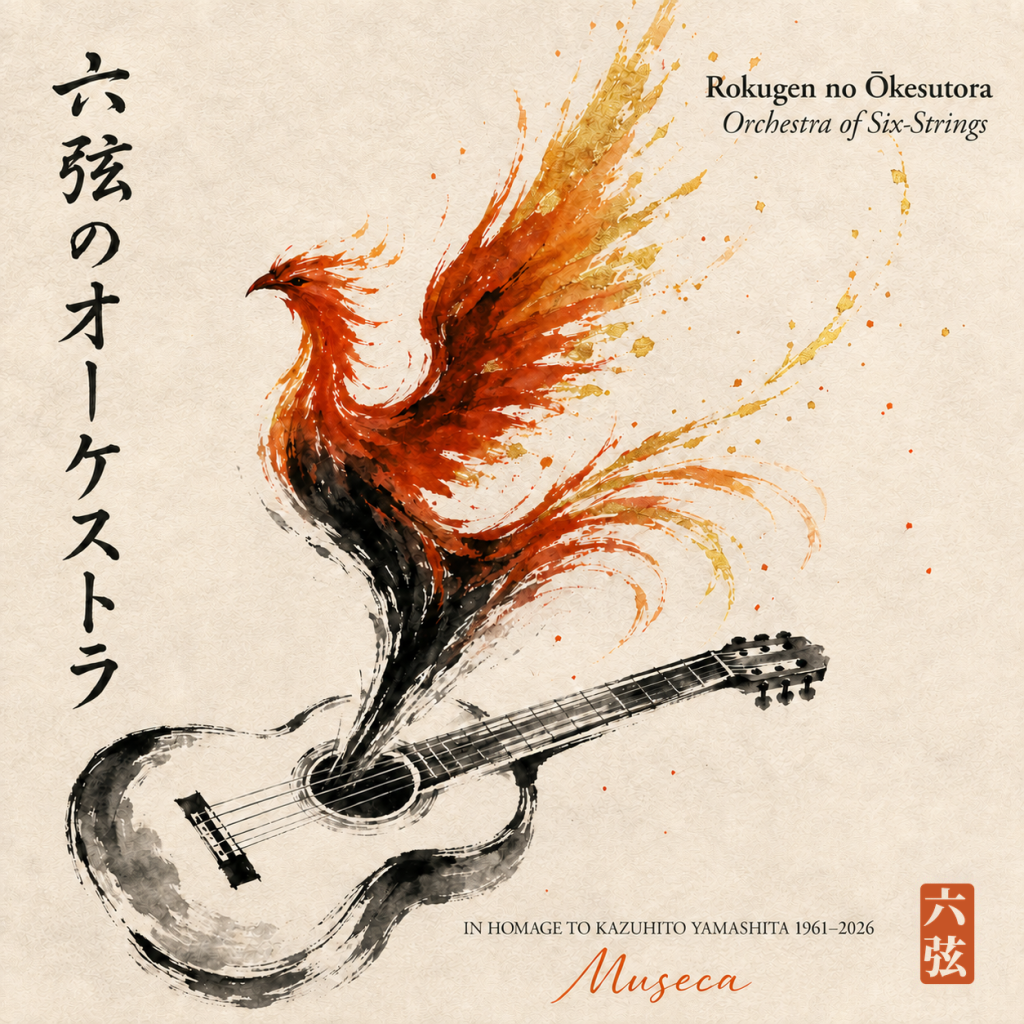
六弦のオーケストラ
Rokugen no Ōkesutora — Orchestra of Six Strings
In Homage to Kazuhito Yamashita (1961–2026)
There is a sentence I have not been able to put down since January. When Kazuhito Yamashita died on the 24th of that month, at sixty-four, one obituary remembered him as the guitarist who needed no orchestra for symphonic work. Everything I wanted to say about him — everything this album tries to say — is already inside that sentence. One man. One guitar. Six strings asked to do the work of a hundred players, and somehow, impossibly, doing it.
The career reads like a legend because it was one. He was born in Nagasaki in 1961 and began the guitar at eight with his father, Toru Yamashita, a guitar teacher — the first of this album’s images, and to me still the most moving: every impossible thing he later did was already contained in those first lessons. At eleven he won the Kyushu Guitar Competition. At sixteen, in a single year — 1977 — he won three of the most important international competitions in the guitar world: the Ramírez in Spain, the Alessandria in Italy, and the Paris Radio France Competition, the youngest winner ever recorded. What followed was a life spent in the great halls — the Musikverein in Vienna, Lincoln Center, Chicago’s Orchestra Hall, the St. Petersburg Philharmonia — and an outpouring of recorded work almost beyond belief: fifty-two albums by the age of thirty-two, eighty-three in all.
But it was what he asked of the guitar that made him singular. In 1980, at nineteen, he released his own transcription of Mussorgsky’s Pictures at an Exhibition for solo guitar, and the guitar world has never entirely recovered. Then came Stravinsky’s Firebird, Rimsky-Korsakov’s Scheherazade, Dvořák’s New World Symphony — full orchestral scores wrestled onto a single wooden box with six strings, in arrangements so difficult that some declared them unplayable even as he was playing them. To watch him perform these was to watch a man refuse a boundary the rest of the world had agreed was permanent. He was called controversial for it. He was also called a miracle. Both were right, and the second mattered more.
The fireworks were only half the man. The other half was devotion of an almost monastic kind: the complete solo guitar works of Fernando Sor across sixteen discs; Bach’s unaccompanied violin, cello, flute, and lute works — five albums’ worth — in his own transcriptions; the world-premiere recordings of Castelnuovo-Tedesco’s 24 Caprichos de Goya and Platero y yo; more than sixty premieres of new works; a National Arts Festival Grand Prize for resurrecting the forgotten dawn of Japanese guitar music, 1923–1948. He partnered with James Galway, with Larry Coryell, with the Tokyo Quartet. And in 2004 he founded a guitar quintet with his own children — a family ensemble in an older tradition, music as something a household makes together, the way it began for him in Nagasaki.
At the center of his life was a composer. His wife, Keiko Fujiie — twice winner of the Otaka Prize — wrote a lifetime of music for him, and her titles alone form a map of their shared world: Bodrum Sea. To Far-off Land. Now the Horizon Comes Into View. Dialogue with the Night. Sweet Tenderness. The Blue Flower. Much of the most important guitar music of the past four decades exists because one composer loved one guitarist, and he spent his career giving her music to the world. Any honest homage to him must bow to that partnership, and this album’s two central tracks live entirely inside it.
The album itself is a life told in seven movements, for solo guitar alone. That last constraint is the whole tribute: no orchestra appears anywhere on this record, because he needed none. Dawn in Nagasaki begins where he began — a father’s simple melody placed in small hands, learned haltingly, then fluently, then with one brief flash of what those hands would become. Three Crowns is sixteen years old and fearless, three competition stages in a single blazing year. Pictures and Firebird stand together as the impossible years — the guitar swelling into galleries and firebirds, one instrument insisting it can hold a hundred. Then the album turns inward. Dialogue with the Night and Sweet Tenderness are the Fujiie heart of the record: night music and love music, the sound of a marriage conducted in premieres. And Six Strings, Still Sounding is the farewell — the opening melody returning one last time, a single distant shakuhachi marking the departure, and the strings continuing past the edge of hearing, because a resonance like his does not stop. We do not stop it.
He needed no orchestra. He had one all along — it had six strings, and for fifty-six years it sounded like the whole world.
This album is dedicated, with gratitude and wonder, to the memory of Kazuhito Yamashita, and to Keiko Fujiie and the Yamashita family, who made the music with him.
This album is an independent homage, offered in gratitude. It was made without affiliation to the Yamashita family, and it asks nothing of them — only that it might stand, briefly, in the long shadow of what he built. If these seven tracks do their work, they will point away from themselves.
The truest way to honor them is to leave them for the real thing: his recordings and performances live on at his official website, kazuhitoyamashita.com, and on his official YouTube channel, youtube.com/@YAMASHITAKazuhitoOfficial, where many of the videos were edited by his own hand.
And the music of composer Keiko Fujiie — whose works were central to his repertoire across decades of collaboration, and who continues to compose today — can be explored at keiko-fujiie.com.
Everything this album reaches for, he already played. Go listen.
— Museca
六弦のオーケストラ — Liner Notes
Dawn in Nagasaki
長崎の夜明け — Nagasaki no Yoake
Nagasaki, 1969. A guitar teacher named Toru Yamashita places an instrument in the hands of his eight-year-old son. Everything that follows — the competitions, the impossible transcriptions, the eighty-three albums — is already here, folded inside a first lesson. The melody in this piece is deliberately simple: stepwise, narrow, built on the guitar’s open strings, the kind of tune a father writes for small hands. It is played three times, the way a child learns — hesitantly, then fluently, then with a sudden two-bar flash of brilliance that vanishes as quickly as it came, like a boy’s hands briefly revealing what they will become. Listen to this melody carefully. It is the seed of everything on this album. It will surface again where you least expect it, and at the very end it will come home.
Three Crowns
三つの王冠 — Mittsu no Ōkan
In 1977, a sixteen-year-old from Nagasaki walks onto three competition stages in a single year — the Ramírez in Spain, the Alessandria in Italy, the Radio France in Paris — and leaves each one as the youngest winner ever recorded. This is the sound of that year: bright, fearless, almost laughing, a young virtuoso discovering that the impossible passages come easily and the world is suddenly very large. The music moves in three episodes, one for each crown, each faster and more brilliant than the last, separated by brief traveling interludes — a boy on trains and airplanes, guitar case in hand. Those small interludes are worth your attention: inside their passing figures hide the first faint outlines of music that will not fully arrive until two tracks from now. At sixteen, everything he would later dare was already gathering.
Pictures
展覧会の絵 — Tenrankai no E
In 1980, at nineteen, he released his own transcription of Mussorgsky’s Pictures at an Exhibition — a full orchestral canvas hung on six strings — and the guitar world split into those who called it impossible and those who had just heard him do it. This track walks the gallery as he did: a promenading figure strides between tableaux, and each picture blooms out of the guitar in a different color — bells, brass, a music box, a great gate. The thesis of his whole career is audible in the form itself: the promenade does not remain a visitor. Somewhere in the middle of the piece it stops walking past the pictures and steps inside one, and viewer and viewed become a single music. That was his gift. He did not play transcriptions of orchestras. He entered them.
Version 1
Version 2
Firebird
火の鳥 — Hi no Tori
They called it reckless. Stravinsky’s Firebird on a solo guitar — the shimmer, the violence, the impossible dance — struck some critics as a beautiful mistake, virtuosity spent against a wall that would not move. This track takes the criticism seriously and answers it. The music is built as a struggle that does not hide its strain: tremolos pushed to the edge of breaking, the low strings hammering the dance while the treble screams the bird aloft, moments where the texture nearly collapses under what it is being asked to carry — and does not. Because that was the point. The strain was the meaning. Watching him play this music, audiences were not witnessing ease; they were witnessing refusal — one man declining a boundary the rest of the world had agreed was permanent. The fire in this piece is not decoration. It is the cost, burning in the open.
Dialogue with the Night
夜との対話 — Yoru to no Taiwa
At the center of his life was a composer. Keiko Fujiie wrote a lifetime of music for him — sea music, horizon music, night music — and this track lives entirely inside that world, taking its name from one of hers. It is the album’s turn inward: after the blaze of the Firebird, darkness falls in a single unprepared step, and the guitar begins to speak in two voices — a low phrase asking, a high phrase answering, the night’s side of a conversation whose other side we never hear. The dialogue does not resolve. Question and answer circle each other, drawing closer without ever agreeing, the way two artists who share a life can spend decades in a single unfinished conversation and want it no other way. Of everything on this album, this is the track I wrote most carefully, because it stands for something I can only witness from outside: a marriage conducted in premieres.
Sweet Tenderness
甘やかなやさしさ — Amayaka na Yasashisa
The other side of the night is this: morning in a house full of guitars. Named for another Fujiie work, this is the album’s happiest music — a lilting, sunlit dance, the sound of the family quintet he founded with his own children, music restored to what it was in Nagasaki at the beginning: something a household makes together. The melody passes from register to register like an instrument handed around a room, each voice taking its turn — the daughters, the son, the father listening. And listen closely to the middle of the dance, where the texture thins for a moment: woven inside it, disguised in the new rhythm, is the father’s melody from Dawn in Nagasaki — the tune Toru gave to Kazuhito, now given again. Some inheritances are passed down so gently that the children dance on them without knowing.
Six Strings, Still Sounding
六弦は鳴りやまず — Rokugen wa Nariyamazu
The guitarist stops; the guitar does not. This farewell brings back the first lesson one last time — the simple melody from Dawn in Nagasaki, played now by the old master, harmonized with everything a lifetime taught him, while brief memories drift through and dissolve: an ember of the Firebird, a grave phrase where bass and treble answer each other in the manner of the Bach he served for decades, one warm turn of tenderness. Then the music thins to a single line and speaks the album’s harmonic signature plainly, three times, like last words: E leaning to F, and returning home. And at the very end, for the only time on this album, a distant shakuhachi rises to meet the guitar — the breath-voice of Japan, arriving at the threshold to carry the melody the rest of the way. The guitar’s final note is struck once, softly, and allowed to ring to its full natural decay. The instrument stops. We do not stop it. Six strings, still sounding.
In memory of Kazuhito Yamashita (1961–2026), and with gratitude to Keiko Fujiie and the Yamashita family.
Playlist
- Track 1 - Dawn in Nagasaki (Nagasaki no Yoake) Museca 2:43
- Track 2 - Three Crowns (Mittsu no Ōkan) Museca 3:19
- Track 3 - Pictures (Tenrankai) Version 1 Museca 3:20
- Track 3 - Pictures (Tenrankai) Version 2 Museca 2:48
- Track 4 - Firebird (Hi no Tori) Museca 2:49
- Track 5 - Dialogue with the Night (Yoru to no Katarai) Museca 2:45
- Track 6 - Sweet Tenderness (Amai Yasashisa) Museca 2:28
- Track 7 - Six Strings, Still Sounding (Rokugen wa, Mada Hibiku) Museca 2:59