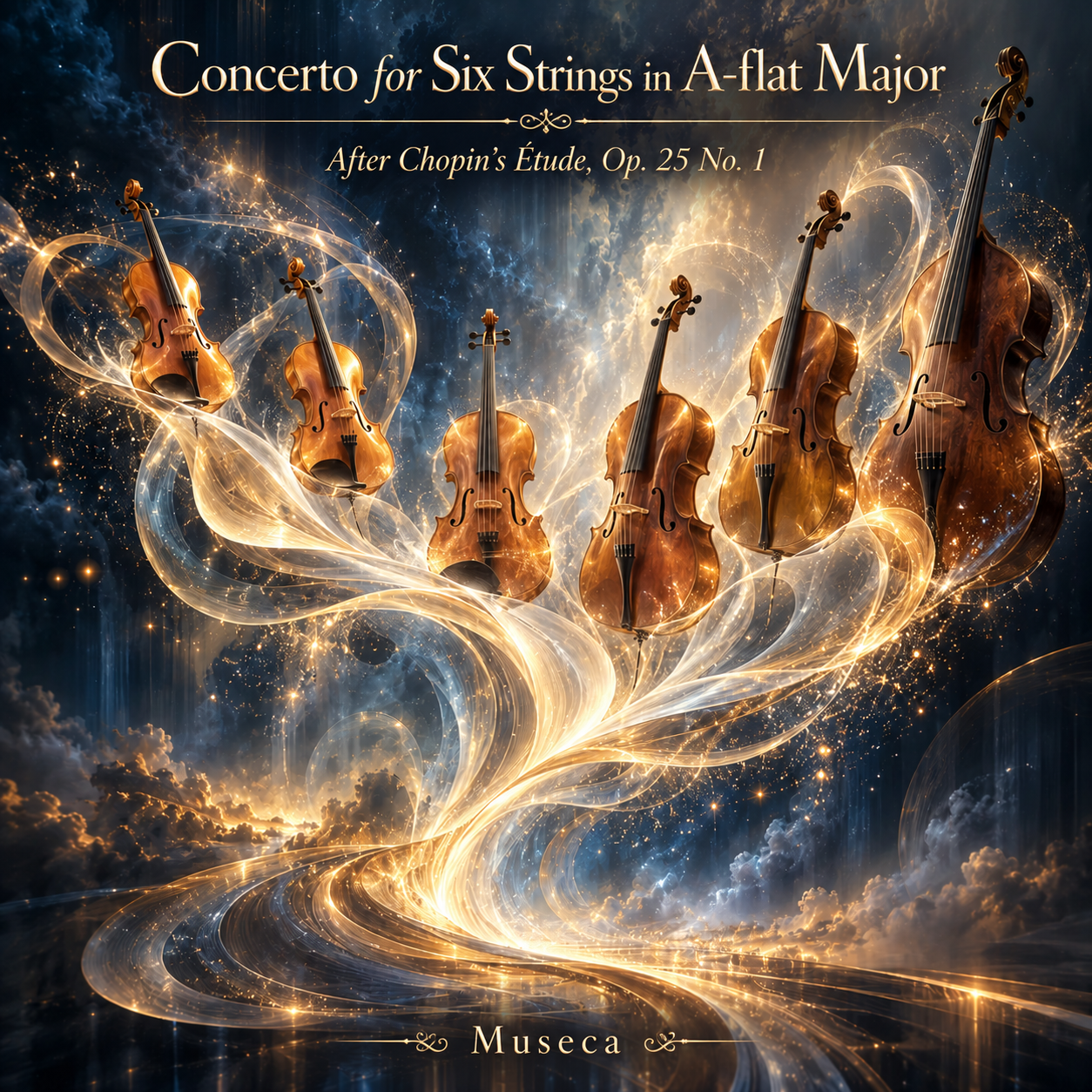
Concerto for Six Strings in A-flat Major began as an experiment in transformation. Its point of departure was Frédéric Chopin’s Étude in A-flat Major, Op. 25 No. 1, a work whose flowing arpeggiation, harmonic motion, and constantly shifting inner voices suggested a latent orchestral life beneath the piano surface.
The first movement grew from an attempt to reimagine that étude for a six-player string ensemble: two violins, viola, two cellos, and contrabass. Rather than treating the piano writing as a sequence of notes to be mechanically reassigned, the orchestration was conceived functionally. The piano’s melodic contour, bass foundation, broken-chord motion, repeated-note energy, resonance, and internal counterpoint were redistributed across the strings so that the ensemble could behave as a single extended instrument.
From that first transformation, an entirely new work began to emerge. The recurring intervallic character, especially the gravitational relationship between A-flat and E-flat, became the genetic material for three newly conceived companion movements. The concerto gradually expanded into a four-movement cycle, moving from the flowing brilliance of the opening movement through an introspective Adagio, a graceful Romantic waltz, and finally a buoyant rondo finale.
The result is not an attempt to complete or imitate Chopin, nor a reconstruction in historical style. It is a contemporary chamber concerto born from close listening: a work that begins with Chopin’s musical DNA and allows it to evolve into a new sequence of lyrical, contrapuntal, and dance-like forms.
The opening movement is the origin of the entire concerto. Conceived from Chopin’s Étude in A-flat Major, Op. 25 No. 1, it translates the continuous piano texture into six bowed voices without sacrificing the work’s sense of flow.
The violins carry the brightness and thematic memory of the upper register, while the viola preserves the dense middle space that gives the étude much of its harmonic character. The two cellos reshape the broken harmony and lower-register motion, and the contrabass provides structural gravity rather than constant weight. Repeated-note figures, arpeggiated motion, and registral shifts are passed antiphonally through the ensemble, allowing the strings to recreate the piano’s internal mechanics by orchestral means.
The movement retains the central A-flat field while passing through brightening, chromatic intensification, dominant expansion, and eventual modal ambiguity. What begins as an orchestration gradually becomes something more independent: the first statement of the concerto’s own language.
Adagio — Nocturne in F minor
The second movement turns inward.
Where the first movement transforms the A-flat–E-flat relationship into motion, the Adagio stretches that same intervallic world into a language of distance, memory, and suspension. Set in F minor, the movement exposes lyrical possibilities that were largely hidden inside the activity of the opening Allegro.
The texture begins low and sparsely, allowing the cello to emerge as a principal voice before the upper strings enter. Violin and cello gradually enter into dialogue, while viola and inner strings sustain suspensions and slowly unfolding harmonic color. Rapid broken-chord motion from the first movement is transformed into overlapping, spacious arpeggiation.
Rather than building toward a dramatic climax, the movement deepens through counterpoint and harmonic shadow. It closes without full emotional resolution, leaving its final sonority suspended and preparing the listener for the return of movement.
Valse moderato — D-flat Major
The third movement introduces dance into the concerto’s architecture.
Set in D-flat major, the Valse moderato transforms the concerto’s characteristic fourth-and-fifth relationships into a flowing three-beat gesture. Its mood is graceful rather than theatrical, drawing more from the elegance of Romantic string writing than from the grandeur of the ballroom.
Violin I carries the principal waltz melody, while Violin II and viola provide light offbeat motion and harmonic lift. Cello I often acts as a lyrical partner rather than merely a bass instrument, and the lower strings keep the dance buoyant by avoiding excessive weight.
A darker central section moves through related minor colors, allowing the cello and viola to become more expressive before the principal material returns with richer counterpoint. The movement closes lightly, almost as if the dance were receding rather than stopping, creating space for the finale.
Allegro vivace — Rondo in A-flat
The finale gathers the concerto’s earlier ideas and turns them toward resolution.
Its principal ritornello grows once again from the A-flat–E-flat relationship, but now the interval becomes a clear, buoyant theme in lively 6/8. The result combines Baroque-like contrapuntal propulsion with Romantic harmonic color and the chamber intimacy established throughout the work.
The movement moves through a series of contrasting episodes. One recalls the lyrical character of the Adagio in compressed, quicker motion; another revisits the chromatic tension and sequential drive of the first movement; a brief passage even suggests the elegant motion of the preceding waltz without abandoning the compound meter.
As the final ritornello returns, all six players participate more fully, not through thick doubling but through increasingly active counterpoint. The concerto concludes with the fundamental E-flat-to-A-flat resolving gesture passed upward through the ensemble, from contrabass to Violin I.
What began in the first movement as ambiguity and motion finally arrives at clarity.
Playlist
I. Allegro — Aeolian HarpMuseca3:26
II. Adagio — Nocturne in F minorMuseca3:50
III. Valse moderato — D-flat MajorMuseca3:14
IV. Allegro vivace — Rondo in A-flatMuseca3:39
Video Album
Continue exploring
Where the musical idea travels
Return to the Romantic piano, widen the Polish musical lineage, or explore transformation through another chamber ensemble.
Hear original solo-piano works in conversation with Chopin’s expressive world. Nocturnes, études, waltzes, and other forms provide another perspective on the source language behind this concerto.
Move from Chopin’s influence into a broader study of Polish musical identity, including mazurka and polonaise traditions, harmonic color, and orchestral experiment.
Let the Hungarian concert cimbalom lead an ensemble of strings, piano, and bass clarinet. Eight connected movements offer another exploration of gesture, resonance, and musical transformation.