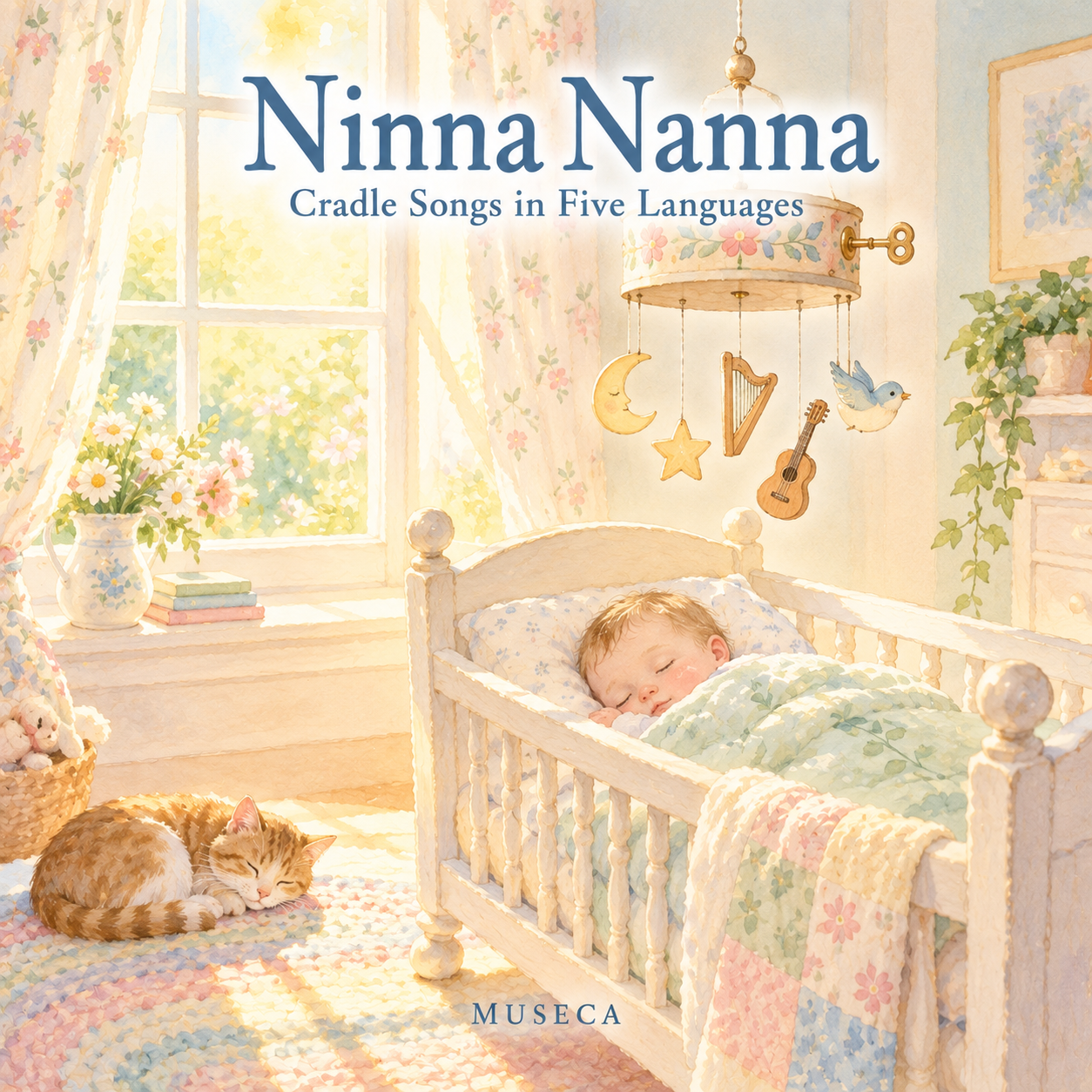
The one form that has to be quiet. For three albums now I have been writing music that is not allowed to get loud. The Sotto Voce series began as a discipline — a ceiling on volume, a refusal of the swell, the climax, the string pad that tells you what to feel — and the discipline turned out to be a way of listening. But in Maun and Sukūn the quiet was something I imposed. A meditation could have been loud; a Sufi poem could have been sung at full voice; I chose otherwise. The lullaby is different. The lullaby is the one kind of song in the world where the quiet is not a choice but the whole point. Nothing can get loud, or the child wakes. Every decision this series has been built on — the low register, the single instrument, the withheld colour, the pulse you feel rather than hear — is, in a cradle song, simply what the form requires. Ninna Nanna is the album where the method and the material finally wanted the same thing.
One night, one child. These are not five lullabies from five countries. They are one night in one house: a child put down at dusk, drowsing, resisting, going under, and finally gone, and the person beside the cradle singing the whole way. The house happens to hold five cradle songs in five languages, which is only to say that it is a house where people came from somewhere. The nine pieces are the stations of that night — five sung, four played between them while the singer changes instruments — and everything that happens in the music is driven by the child. The tempo slows because the child is slowing. The keys step downward, one floor at a time, because the night is deepening. The rocking of the first songs stops when the singer’s hand goes still. And the last song is sung to a child who is already asleep.
Five languages. The album opens in Italian, whose ninna nanna gives the record its title and its native sway — the gentle six-eight rock that every cradle in Europe seems to share. The child is still awake here, still watching, and the song does what the first lullaby of a night does: it closes the house, one thing at a time. Welsh follows, and the Welsh word for lullaby, suo gân, means simply “lull-song” — the drowsing song, the one you sing when the eyes keep opening to check that you are still there. The third is Yiddish, and it is the centre of the night, because the Yiddish cradle song is the one tradition that tells the child the truth: that the world is wide and not always kind, that the road goes on past the door, and that the child should sleep anyway. The fourth is Japanese, a komoriuta in the sleep-song manner rather than the nursemaid’s lament, sung at the threshold with the moon on the floor; it is the song in which the words stop before the melody does, because by then there is no one awake to hear them. And the last is Hawaiian, sung over the sleeping child in the hour before dawn — the song the child never hears, which is the only song of the night that is really for the singer.
One voice. All five languages are sung by the same woman, in the same half-voice, from the first station to the last. She never raises it. The Italian has a little daylight left in it; the Yiddish sits lower and wearier; the Japanese is barely more than speech; the Hawaiian is at peace. I wanted one person in the room all night, not a cast.
Five instruments, one at a time. Each song has a single instrument beside the voice, and the four interludes are the handoffs between them — the singer setting one down and picking up the next. A nylon-string guitar for the Italian. A Welsh harp for the Welsh, in its warm middle register, never the glittering one. A muted violin for the Yiddish, playing almost nothing: long low notes and a few spoken phrases between the verses. A koto for the Japanese, plucked plainly, its notes left to ring into silences that grow longer each time. And for the Hawaiian, a slack-key guitar in an open tuning — the same family of instrument that opened the night, retuned for the end of it. Underneath all of this, from the first bar of the first song to the last minutes of the last, runs a single low pulse, felt more than heard: the heartbeat of the room, and the one thing on the album that never stops until it does.
The music box. There is one more instrument, and it is withheld for eight tracks. When the child finally sleeps — between the Japanese song and the Hawaiian one — the singer does what parents have always done at that moment: winds the music box over the cradle and sits back, and for the first time all night lets something other than her own hands and throat make the sound. The box plays the very first melody of the album, the Italian refrain, to a child who can no longer hear it. It plays at the one tempo it has. A music box cannot slow down or soften, and that rigidity, after an hour of a voice that has done nothing but soften, is the tenderest thing on the record. In the final minutes of the last song the box returns, plays the refrain once more, and runs down — the notes spacing further and further apart as the mechanism gives out — while the pulse beneath it fades, until there is one last note and then only the room.
The way down. The keys descend across the night — E to C to A to F-sharp, and at last, as the music box takes over, the half-step settle into F — and the tempo falls with them, from the Italian rock to the Hawaiian drift. The three middle handoffs each turn on one held note: the floor lowers under it, and the note that was the roof of one key becomes the floor of the next. The darkening into the Yiddish song happens the same way — a single raised note leaning in — and the same note, two tracks later, becomes the stable centre of the Japanese one. These are small things, and they are meant to be. A casual listener will hear a quiet record that gets quieter. A listener who follows the thread will hear a night with a shape.
For whom. I made this for the same listener all my music is for: the one who wants a restful surface and is welcome to stay there, and the one who wants to follow the architecture underneath. But it is also, plainly, a record to put on in a room where a child is going to sleep, and for that reason it lives in two places on this site — among the Sotto Voce albums, and among the Music for Children. Both are true. A lullaby is a piece of music for a listener who is leaving, and I have never found a better description of what I am trying to do.
Dusk, and the child is still awake and watching, so the first song does what the first song of any night does: it closes the house one thing at a time — the shutter, the lamp, the cat on the step, the bread in its basket — and comes back each time to the oldest refrain in the language, ninna nanna, ninna oh. The verses shorten as they go. The guitar rocks in six-eight under everything, and the refrain it carries is the melody the whole night will return to, though no one knows that yet.
Lyrics
Verse 1
Chiudo piano la persiana,
spengo il lume in fondo alla scala,
il gatto dorme sul gradino,
il pane è chiuso nel cestino,
e il cielo sopra si fa blu.
Refrain
Ninna nanna, ninna oh,
fa la nanna, amore mio,
che la sera è già passata
e la casa s'è addormentata.
Verse 2
Tace la strada, tace il cane,
la luna è salita sul tetto,
tieni il mio dito nella mano,
io resto qui, vicino al letto.
Refrain
Ninna nanna, ninna oh,
fa la nanna, amore mio,
che la sera è già passata
e la casa s'è addormentata.
Verse 3
Si chiudono gli occhi, piano piano,
la notte è buona, non temere,
io sono qui, e canto ancora.
Refrain
Ninna nanna, ninna oh,
fa la nanna, amore mio,
che la sera è già passata
e la casa s'è addormentata.
Refrain (hummed)
Mm…
In English
I close the shutter softly, I put out the lamp at the foot of the stairs, the cat is asleep on the step, the bread is shut in its basket, and the sky above turns blue. — Ninna nanna, ninna oh, go to sleep, my love, for the evening has already passed and the house has fallen asleep. — The street is silent, the dog is silent, the moon has climbed onto the roof; you hold my finger in your hand; I stay here, beside the bed. — The eyes are closing, slowly, slowly; the night is good, don’t be afraid; I am here, and I am still singing.
Nos
Instrumental. Welsh for night. Guitar and harp.
The singer sets one instrument down and picks up the next while the window goes dark. The guitar plays the Italian refrain once more with the voice gone; the harp enters on a single held note, the floor lowers beneath it, and the same tune is heard again in a lower key. The guitar thins and leaves. From here the harp is the house’s instrument.
Suo Gân
Welsh. Harp and voice.
The Welsh word for lullaby means “lull-song,” and this is the drowsing song — the fire sinking, the wind over the hill, the small eyes opening and closing and opening once more to check. The verses stay the same length but the lull grows: once after the first verse, twice after the second, three times after the third, the last time hummed, until the words have been replaced by the thing they were for. The harp stays in its warm middle register the whole way; the two-bar rocking figure under the voice is the one that will come back at the end of the night.
Lyrics
Verse 1
Mae'r tân yn suddo'n araf, araf,
mae'r gwynt yn mynd dros ben y bryn,
mae'r drws ar gau, a'r lamp yn isel,
a'r nos yn llenwi'r tŷ fel llyn.
Refrain
Huna, blentyn, huna, huna,
huna'n dawel ar fy nghôl.
Verse 2
Fy nwylo sydd ar y tannau,
a'r tannau'n canu'n isel, isel,
dy lygaid bach yn agor, cau,
yn agor — a dw i'n dal yma.
Refrain (twice)
Huna, blentyn, huna, huna,
huna'n dawel ar fy nghôl.
Verse 3
Mae'r amrannau'n drwm, yn drwm,
a'r sêr yn dawel uwch y to,
does dim i'w ofni yn y tŷ —
dim ond y delyn, a dim ond fi.
Refrain (three times, the last hummed)
Huna, blentyn, huna, huna,
huna'n dawel ar fy nghôl.
In English
The fire sinks slowly, slowly; the wind goes over the top of the hill; the door is shut and the lamp is low, and the night fills the house like a lake. — Sleep, child, sleep, sleep; sleep quietly on my lap. — My hands are on the strings, and the strings sing low, low; your little eyes open, close, open — and I am still here. — The eyelids are heavy, heavy, and the stars are quiet above the roof; there is nothing to fear in the house — only the harp, and only me.
Vig
Instrumental. Yiddish for cradle. Harp and muted violin.
Three things change here and none of them at once. The floor lowers again under a held note; the violin enters on it and bends two notes of the scale — one up, one down — so the key darkens from minor into something older; and the cradle’s rock becomes a walk, the same slow pulse regrouped into three. The harp hears the lean and withdraws. Someone has stood up and is pacing.
Shlof
Yiddish. Muted violin and voice.
The centre of the night, and the one cradle tradition that tells the child the truth. Each verse ends with a question the child would ask if awake — what does the wind want, where does the road go, who will you be — and the refrain is the only answer the singer has: shlof, mayn kind, sleep, my child. The last question is her own. The violin plays almost nothing, a few low spoken phrases between the verses, and the song ends on a single held note, unresolved, because that is where she is.
Lyrics
Verse 1
דער ווינט ציט בײַם פֿענצטער, דער ווינט איז קאַלט,
ער קומט פֿון ווײַט, און ער איז אַלט,
ער קלאַפּט אין שויב, ער וויל צו דיר —
וואָס וויל דער ווינט פֿון דיר און מיר?

Der vint tsit baym fentster, der vint iz kalt,
er kumt fun vayt, un er iz alt,
er klapt in shoyb, er vil tsu dir —
vos vil der vint fun dir un mir?
עס ליגט אַ לאַנגער וועג אַהער,
מיר אַלע זײַנען פֿון ערגעץ הער,
אַ וועג אָן סוף, אַ שטילער וועג —
וווּ פֿירט ער הין, דער שטילער וועג?

Es ligt a langer veg aher,
mir ale zaynen fun ergets her,
a veg on sof, a shtiler veg —
vu firt er hin, der shtiler veg?
דו וועסט אַ מאָל פֿרעגן, ווען דו ביסט גרויס,
ווי די וועלט זעט אויס, און ווי זי איז,
איך וועל דיר זאָגן: זי איז ווײַט —
און ווער וועסטו זײַן אין איר, מיט דער צײַט?

Du vest amol fregn, ven du bist groys,
vi di velt zet oys, un vi zi iz,
ikh vel dir zogn: zi iz vayt —
un ver vestu zayn in ir, mit der tsayt?
איך גיי אַרום, איך גיי און גיי,
די נאַכט איז לאַנג, און איך בין מיד,
איך האַלט דיך אויף די הענט און זינג —
נאָר ווער וועט זינגען מיר דאָס ליד?

Ikh gey arum, ikh gey un gey,
di nakht iz lang, un ikh bin mid,
ikh halt dikh oyf di hent un zing —
nor ver vet zingen mir dos lid?
The wind pulls at the window, the wind is cold; it comes from far away, and it is old; it knocks on the pane, it wants to reach you — what does the wind want from you and me? — Sleep, my child, my crown, my beautiful one; sleep now, child, fall asleep. — A long road lies this way; we are all from somewhere; a road without end, a quiet road — where does it lead, the quiet road? — One day you will ask, when you are grown, what the world looks like and how it is; I will tell you: it is wide — and who will you be in it, with time? — I walk around, I walk and walk; the night is long, and I am tired; I hold you in my arms and sing — but who will sing the song for me?
Tsuki
Instrumental. Japanese for moon. Muted violin and koto.
The walk stops. The violin sinks to the note that leaned the night into darkness two songs ago, and the floor lowers beneath it until that same note is the steady centre of a new key — the one thing that tilted the night becomes the thing that holds it. The koto enters below, draws its scale downward once, and the violin dies away rather than stopping. Then the koto alone, in short phrases with silences between them that grow longer each time, until there is no meter left, only the pulse.
Nenneko
Japanese. Koto and voice.
The threshold. The moon is on the floor, the breath beside the singer has slowed, her hands are no longer moving, and this is the last song sung to a child who can hear it. The verses shorten — four lines, three, two — and in the last one the words stop in the middle of a line and the melody goes on in a hum, because by then there is no one awake to sing words to. The hum thins to a single note and is gone. The koto plucks once. The pulse continues alone.
Lyrics
Verse 1
つきの ひかりが ゆかに おちて
ちいさな いきが ゆきかえる
わたしの ては もう うごかない
いえは しずかに ねむってる

Tsuki no hikari ga yuka ni ochite,
chiisana iki ga yukikaeru,
watashi no te wa mou ugokanai,
ie wa shizuka ni nemutteru.
The moonlight falls on the floor; a small breath goes and returns; my hands no longer move; the house is quietly sleeping. — Sleep now, sleep now, sleep now; sleep now, sleep now. — Outside the window there is no wind; the dog and the cat are asleep; the ones awake are the moon and me. — You don’t need the song any more, do you — and still I sing…
Pō
Instrumental. Hawaiian for night — and the first darkness, before anything was made. Koto and music box.
The child is asleep, and for the first time all night the singer lets something other than her own hands make the sound: she winds the box over the cradle and sits back. It takes the koto’s last note, settles a half-step lower into the key the album has been descending toward since the first bar, and plays the Italian refrain — the first melody of the night — over and over, at the one tempo it has, to a child who can no longer hear it.
Moe
Hawaiian. Slack-key guitar, harp, music box, and voice.
The song the child never hears. A guitar again, as at the beginning, retuned now for the end; the moon going down behind the house, the sea, the breath; and the only first-person thought on the album — this song is mine; I will stay until day. Under the last verse the Welsh harp returns with its rocking figure, the one earlier voice allowed back into a sung song. Then the voice stops, the guitar and harp thin and stop, and the music box plays the refrain once more and runs down, the notes spacing further and further apart as the mechanism gives out, the pulse that has run since the first song fading beneath it. One last note. Then the room.
Lyrics
Verse 1
Ke iho nei ka mahina
ma hope o ka hale,
ua mālie ka pō.
Refrain
E moe, e moe, kuʻu lei,
e moe a hiki i ke ao.
Verse 2
Lohe au i ke kai,
e hanu mālie ana ʻoe,
ua hiamoe ʻoe.
Refrain
E moe, e moe, kuʻu lei,
e moe a hiki i ke ao.
Verse 3
ʻAʻole ʻoe e lohe i kēia mele,
naʻu nō kēia mele,
e noho au ma ʻaneʻi a ao.
Final Refrain
E moe, e moe, kuʻu lei,
e moe a hiki i ke ao.
In English
The moon is going down behind the house; the night is calm. — Sleep, sleep, my child; sleep until the day comes. — I hear the sea; you are breathing calmly; you have fallen asleep. — You will not hear this song; this song is mine; I will stay here until day.
Playlist
NannaMuseca3:28
NosMuseca3:08
Suo GânMuseca3:50
VigMuseca3:14
ShlofMuseca4:34
TsukiMuseca3:44
NennekoMuseca3:45
PōMuseca3:05
MoeMuseca4:28
Video Album
Continue exploring
Choose your next musical route
Continue with cradle songs to learn and sing, or follow the quiet voice into two other multilingual Sotto Voce albums.
Six cradle songs in six languages and a shared melody invite parents and caregivers to learn and sing. Continue from Ninna Nanna’s night beside the cradle into songs meant to be passed from one voice to another.
Five songs and four interludes trace longing through five languages of India. Ninna Nanna’s introduction points to Maun as an earlier exploration of the same quiet discipline.
A single woman sings five Sufi meditations, with four instrumental interludes between them. Follow the half-voice from the intimacy of a lullaby toward stillness, separation, and return.