Follow the jasmine into night
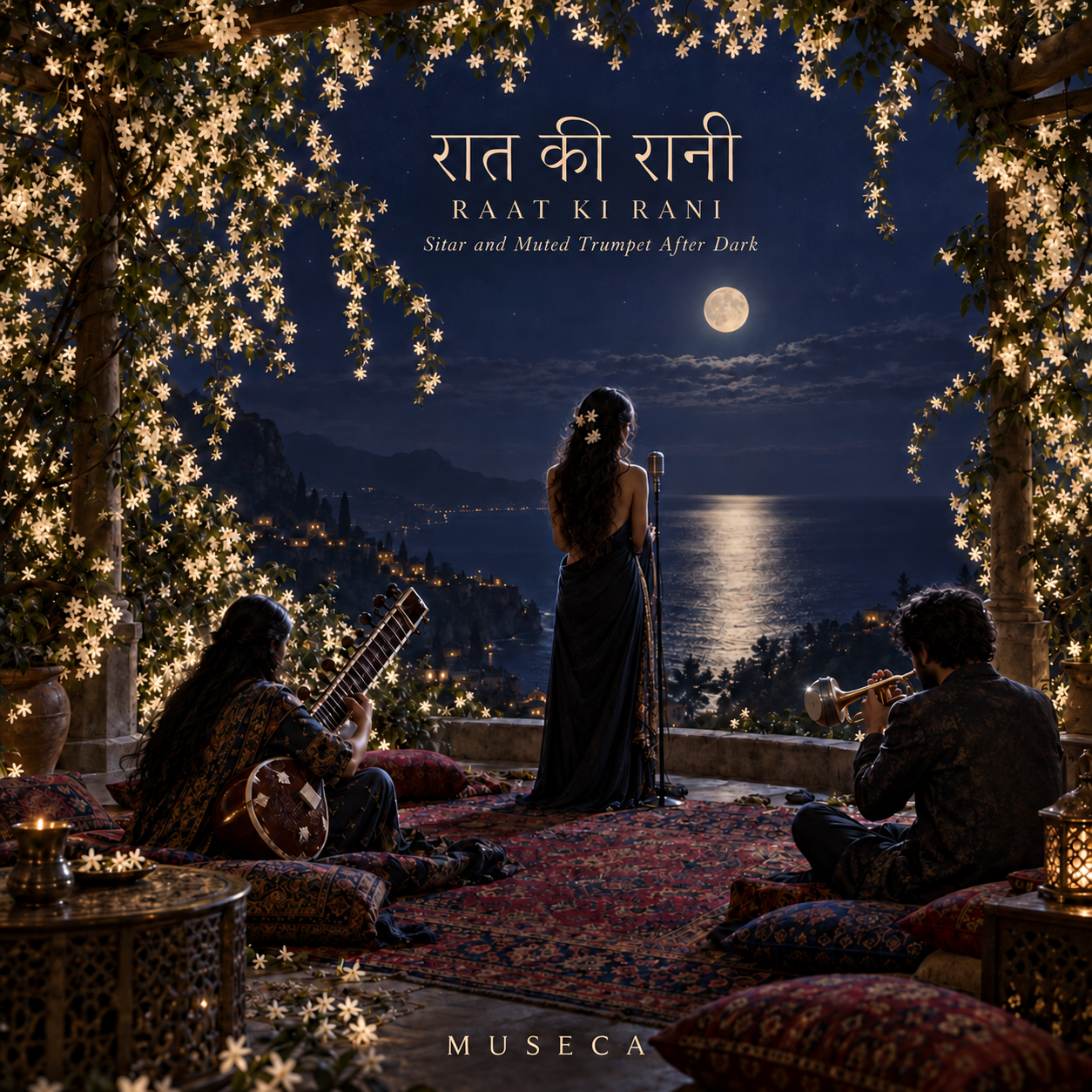
Raat Ki Rani
Maun’s jasmine at dawn finds its companion at nightfall. Sitar and muted trumpet trace the hours from dusk to sunrise, with the flower itself finding a voice.
Explore album ↗
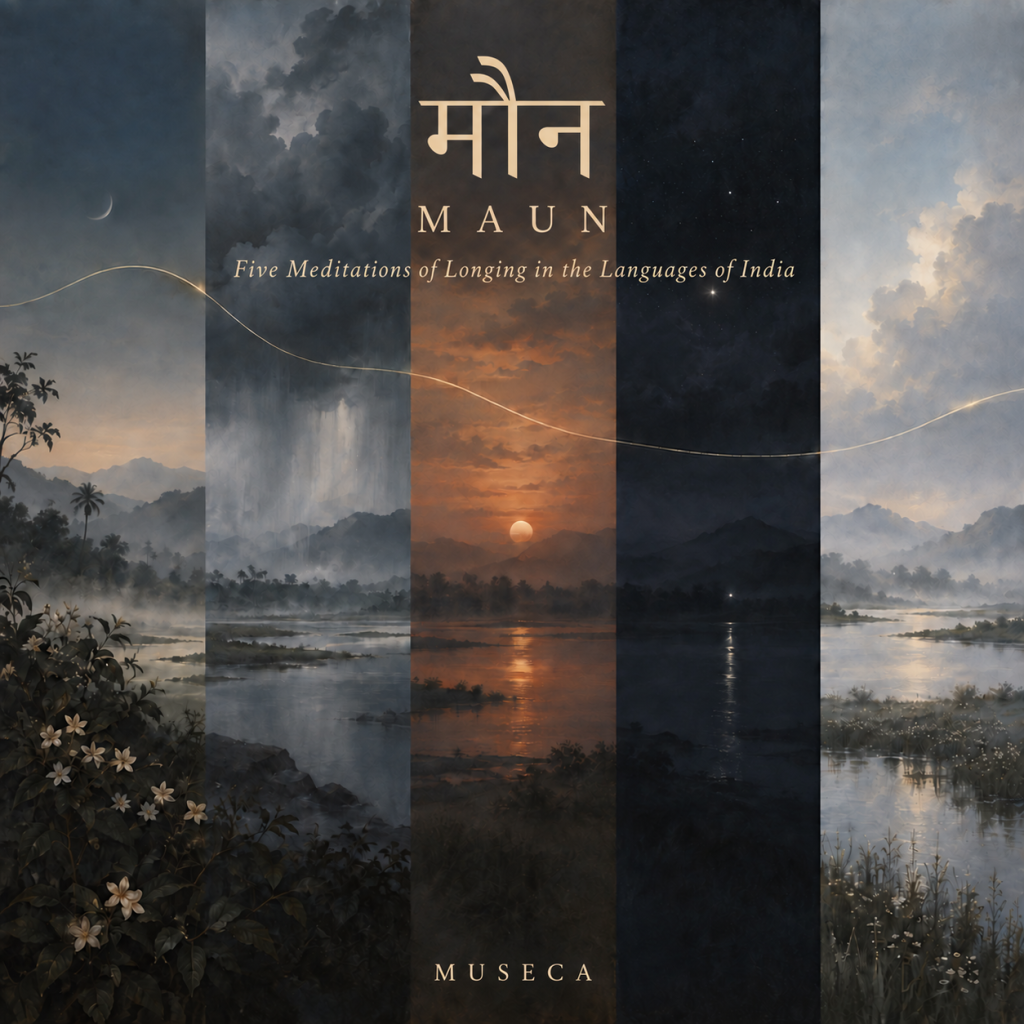
Maun is the Sanskrit word for silence — not the absence of sound, but the silence one keeps on purpose, the quiet of someone listening rather than someone who has nothing to say. It is what Italian musicians mean by sotto voce: under the voice. Four of this album’s five languages share the word, inherited from the same Sanskrit root: maun in Hindi, moun in Bengali, mauṉam in Tamil. Only the language of the fifth song, sung at midnight, reaches for a different word for silence. That seemed right. Midnight is where the shared quiet is lost.
This is a chamber album in five songs and four instrumental interludes, and one voice sings all five languages. It travels two thousand years and the length of a subcontinent, and it is about one thing: the ache of being apart from what you love. Sanskrit poetics has a word for that ache — viraha, the longing of separation — and every poetic tradition in India has circled it. This album follows it through five of them, in the order they entered the world.
Tamil opens the album because Tamil begins the story. Its Sangam poetry, composed between roughly 300 BCE and 300 CE, is among the oldest surviving literature in any living language, and its love poems work by a device no other tradition has: each emotional state is assigned a landscape. Mountains mean union, seashore means anxious waiting, wasteland means separation. Our song belongs to mullai, the forest pasture, whose emotion is patient waiting and whose flower is the jasmine. A woman waits through the night for a man who promised to return when the rains came. Sangam convention forbids naming its characters — the woman, the beloved and the friend she confides in are all nameless, so that any listener can be the one who waits. We kept that rule.
Sanskrit follows, the language of classical courtly poetry, and with it Kalidasa’s fifth-century Meghaduta, “The Cloud Messenger.” An exile, banished far from home, sees the first monsoon cloud settle against a mountain peak and asks it to carry a message north to his beloved. The whole poem is the route: rivers, forests, cities, the snow mountains. It is written in a meter called mandākrāntā — “advancing slowly” — which is as good a description of this album’s tempo as anything we could have written ourselves. Sanskrit is here because it is the language in which longing was given distance, and a landscape to cross.
Hindi brings the turn, in the plain vernacular of Kabir, the fifteenth-century weaver-poet who belonged to no religion and was claimed by all of them. Kabir wrote in the rough speech of the road, not the polished language of courts, and he used it to tell everyone searching through temples, mosques and holy rivers that they were the musk deer: running through the forest after a fragrance that rises from its own body. Hindi is here because it is the language in which Indian devotional poetry became most fiercely direct — and because Kabir is the one poet on this album who would have objected to the whole idea of being far from anything.
Urdu carries the album’s darkest hour, in the voice of Ghalib, writing in nineteenth-century Delhi as the world he belonged to was ending. Urdu shares its spoken roots with Hindi but reaches toward Persian for its vocabulary and its manners — where Kabir’s language is the village road, Ghalib’s is the court and the poetry salon. Its great form is the ghazal, built from self-contained couplets bound by a repeating end-phrase, and its great subject is the sleepless night. Every couplet in our song ends with the same two words, rāt bhar: all night long. Urdu is here because it is the language in which longing learned irony — the refusal to make one’s own sorrow grand.
Bengali closes the album, in the tradition of Rabindranath Tagore, whose songs are still sung daily across Bengal a century after he wrote them. Tagore is the least sectarian devotional poet in any Indian language: his songs address a presence he never names and no creed can claim, in language plain enough to be spoken. His own song tradition, Rabindra Sangeet, is sung quietly and with almost no ornament, the words carried foremost. Bengali is here because it is the language in which longing turns, at last, into gratitude — and because Tagore, who translated Kabir into English and so carried the album’s third poet into the wider world, is the natural one to give the last word.
The five songs move through a full turn of the day and of the year: dawn, the first day of the monsoon, dusk, midnight, and daybreak. Each is set in a raga traditionally sung at that hour, so the album’s second architecture is a clock. It begins before sunrise and ends at first light the following morning, with the rain that was missing at the start.
Each song leaves behind a single word, sung once and never repeated. Yearning. Message. Near. Why. Grace. Read in order, they make a sentence: longing sends its message; it was near all along; then why this darkness? — and then, at the end, grace, all of it grace, and a bow.
The music is deliberately small. A veena, a bamboo flute, a cello, a sarangi and an esraj each carry one song, and in the four interludes between them, each soloist hands the melody to the next — the journey made audible, one instrument at a time. A tanpura drone runs beneath everything. There are no drums anywhere on this record. Nothing ever rises above a quiet that was already quiet, and the album’s loudest moment is barely louder than its softest.
One thing waits eight tracks to come back. In the first song, the veena ends on a bent note left hanging, unresolved: the sound of waiting. In the last song, as the rain begins to fall, the same phrase returns and finally settles. The question the album opens with is never answered in words. It is answered by an instrument, at the end, when there is nothing left to ask for.
Maun is silence kept on purpose. Sanskrit distinguishes it from mere quiet: maun is the silence of someone listening, or holding something back, or choosing not to say a thing that could be said. It is the nearest Indian equivalent to the Italian sotto voce — under the voice — which gives this series its name.
The word travels. From its Sanskrit root it lives on as maun in Hindi, moun in Bengali, mauṉam in Tamil. Four of this album’s five languages share it. Urdu, the language of the midnight song, reaches instead toward Persian for its word for silence. The album’s darkest hour is also the one place where the shared quiet is lost.
Indian classical music assigns ragas to times of day — a raga sung at dawn is not sung at midnight. That tradition gave the album a second architecture, hidden beneath the first.
The Tamil song is set at vaikaṟai, earliest dawn, in Bilahari, a Carnatic morning raga. The Sanskrit song takes Megh, the monsoon raga, literally the cloud raga, the only possible choice for the Cloud Messenger; it marks a day of the year rather than an hour. Kabir’s song is set at dusk in Yaman, whose raised fourth gives it the luminous quality the awakening needed. Ghalib’s is Darbari Kanada, the grave midnight raga, with its slow oscillation on the flattened third. Tagore’s is Bilawal, the plain major scale, at daybreak.
Dawn, monsoon, dusk, midnight, daybreak. The album makes one full turn of the day and one of the year, and ends where it began — except that the rain, absent at the start, has come.
The drone descends by thirds through the album: E, then C, then A♭, and finally F. That last descent happens in the third interlude, and from that moment the drone never moves again.
What changes instead is a single note. The midnight song sits in F with a flattened third. The interlude that follows has no third at all, only the open fifth. The final song has the raised third, F major. Grace, on this album, does not arrive from somewhere else. It is the same ground, in morning light. The whole turn happens in one note.
The final cadence is plagal — the amen cadence, arrival without assertion. It is the only full cadence on the record.
Five instruments carry the five songs: veena for the Tamil, bansuri for the Sanskrit, cello for the Hindi, sarangi for the Urdu, esraj for the Bengali. The four interludes exist to pass the melody from one to the next — the journey made audible, one instrument at a time.
The cello is the one Western voice, placed at the center, where Kabir’s song bridges south and north. In the interlude before it, the bansuri glides and the cello answers with long bowed slides: the same gesture in two accents. That interlude is the album’s crossover in miniature.
The last interlude breaks the pattern. The sarangi hands off to no one. It simply falls silent, because the Fall does not pass itself on.
Three things come back.
The bansuri that carried the cloud’s journey returns at the height of Kabir’s awakening, where it becomes the flute of the Infinite that his songs describe.
A single phrase of the cello from that awakening surfaces once in the middle of Ghalib’s night, beneath the sarangi, then withdraws. It is the only light in the dark, and the listener does not need to notice it. The album remembers that the awakening happened, even when the singer cannot.
And the veena. In the first song it ends on a bent note left hanging, unresolved — the sound of waiting. It does not return for eight tracks. In the last song, as the rain begins to fall, the same phrase comes back and finally settles onto the tonic. The question the album opens with is never answered in words. It is answered by an instrument, at the end, when there is nothing left to ask for.
Each song leaves behind one word, sung once and never repeated:
Ēkkam, yearning. Sandeśa, the message. Pās, near. Kyūñ, why. And then karuṇā, grace — which alone is allowed to grow, into sobi karuṇā, all is grace, and then praṇām, a bow.
Read in order they make a sentence. Yearning sends its message. It was near all along. Then why this darkness? Grace. All is grace. I bow.
The shape of each song carries its meaning.
The Tamil song’s refrain returns complete and unchanged, because waiting repeats itself. The Sanskrit song has no refrain at all, because a journey never passes the same place twice. Kabir’s refrain breaks off unfinished, because the question in it has been answered. Ghalib’s shrinks to a single phrase at the end of every couplet — until the last, where it changes: rāt bhar becomes subah tak, all night long becomes until morning. It is the first hint of dawn, three lines before the dark ends.
And Tagore’s refrain returns with one word changed. Where it first said I waited, it now says you came. Nothing else in the line moves. Nothing else needed to.
There are no drums on this record. No tabla, no mridangam, no hand percussion of any kind — the first thing anyone expects from Indian music, and the album’s defining absence. What motion there is comes from a low pulse beneath the strings, felt rather than heard, which runs unbroken from the first song until it fades at the end of the night.
No one is named, in any of the five languages: no deity, no beloved, no poet’s signature. This follows the oldest rule in the Tamil tradition, and it lets the album stay where this series lives — sacred, without religion.
And nothing on the record is loud. The loudest moment is barely above the softest. The album does not build toward its ending; it empties toward it. The last thing heard is the drone that has been beneath every note from the beginning, fading until you cannot say when it stopped.
The album begins before sunrise, at the edge of a forest pasture, in the oldest language it will use.
Tamil Sangam poetry assigns each emotional state a landscape. Mountains mean union; seashore means anxious waiting; wasteland means separation. This song belongs to mullai, the forest pasture, whose season is the monsoon and whose emotion is patient waiting — the dignified kind, not the desperate kind. Its flower is the jasmine.
A woman has waited through the night. She speaks to her tōḻi, the confidante who hears everything in these poems, and remembers what he said: when the rains come, I will come. Then the clouds gather on the horizon. The rains have come. He has not.
One Tamil verb carries the whole song. Varu, to come, binds the rains and the beloved together in his promise and splits them apart in the final verse. The grammar breaks before the heart does.
Nobody in this song is named — not the woman, not the man, not the friend. That is Sangam law, so that any listener can be the one who waits, and it became the rule for the entire album.
The veena opens alone and closes alone. Its last phrase rises, bends, and hangs unresolved. Eight tracks will pass before it comes back.
[Intro]
[Refrain]
தோழி, இரவு கழிந்தது —
முல்லை இன்னும் மலர்ந்தபடி.
[Verse 1]
“கார் வரும்போது வருவேன்” என்றான்,
என் கண்ணீர் துடைத்துச் சென்றான்.
அந்தச் சொல்லை நெஞ்சில் வைத்து,
ஒவ்வொரு இரவும் காத்திருந்தேன்.
[Refrain]
தோழி, இரவு கழிந்தது —
முல்லை இன்னும் மலர்ந்தபடி.
[Verse 2]
தோழி, அதோ பார் — கார் முகில்,
தொடுவானில் திரண்டு வந்தது.
கார் வந்தது, அவன் வரவில்லை —
நெஞ்சம் முழுதும் — ஏக்கம்.
[Refrain]
தோழி, இரவு கழிந்தது —
முல்லை இன்னும் மலர்ந்தபடி.
[Outro]
[Intro]
[Refrain]
Friend, the night has passed —
the jasmine is still in bloom.
[Verse 1]
“When the rains come, I will come,” he said,
and wiped away my tears, and went.
Keeping that word in my heart,
every night I have waited.
[Refrain]
Friend, the night has passed —
the jasmine is still in bloom.
[Verse 2]
Friend, look there — the dark rain cloud
has gathered on the horizon.
The rains have come; he has not come —
the whole heart — yearning.
[Refrain]
Friend, the night has passed —
the jasmine is still in bloom.
[Outro]
The woman is left at the horizon, still watching. This interlude leaves with the rains, travelling north across the country toward a man who will send a cloud in the other direction.
The veena carries its unresolved phrase in from the song before, and a bamboo flute answers it from a great distance — the first time the instrument is heard. They trade the phrase until the flute takes it. Underneath, the drone slides from E down to C, so the change of key is heard as a change of place rather than a cut between tracks.
The phrase is handed over still unresolved. It will be, every time, until the end.
In Kalidasa’s fifth-century poem, an exile far from home sees the first monsoon cloud settle against a mountain peak and asks it to carry a message to the one he loves, beyond the snow mountains. The poem is mostly the route: rivers, forests, cities, the whole subcontinent between them. It is written in a meter called mandākrāntā — advancing slowly.
The earth, touched by the first rain, releases its scent. The exile speaks to the cloud, and the cloud becomes the second listener on this album, as the friend was the first. He calls it megha, a form of address used for someone close.
Then the voice falls silent and the flute travels alone: rivers, forests, the long way north. When the voice returns, it comes back exactly on the beat, because a message must be understood. Three words carry it: I live, I remember, and the promise that the separation will end.
On the last word the voice holds its final note, and the flute enters on the same pitch as the voice fades. The message passes from one to the other without a break, and the cloud goes on alone.
[Intro]
[Verse 1]
प्रथमदिवसे वर्षाणाम्,
शैलशिखरे मेघः स्थितः।
प्रथमजलेन सिक्ता भूमिः,
गन्धं वहति मधुरम्।
[Verse 2]
हे मेघ, उत्तरां दिशं गच्छ,
नदीः वनानि च लङ्घय।
हिमगिरेः पारे मम प्रिया,
दूरे वसति — दूरे।
[Instrumental]
[Verse 3]
तां वद — जीवामि, स्मरामि,
विरहोऽयं शाम्यति शीघ्रम्।
हे मेघ, वह मम —
सन्देशम्।
[Outro]
[Intro]
[Verse 1]
On the first day of the rains,
the cloud rests on the mountain peak.
The earth, touched by the first water,
gives off a sweet fragrance.
[Verse 2]
O cloud, go to the north,
cross over rivers and forests.
Beyond the snow mountain, my beloved
lives far away — far.
[Instrumental]
[Verse 3]
Tell her: I live, I remember;
this separation will soon end.
O cloud, carry my —
message.
[Outro]
Here the album’s two worlds meet. The flute drifts on from the song before, still heading north, and a cello enters from underneath — one long low note beneath the flute, so that the ground seems to change rather than an instrument arrive.
They trade the same gesture in two accents: the flute glides between notes, the cello answers with long bowed slides. Translation, not collision. As the cello takes the phrase, the ground descends from C to A♭, and the flute falls away — withheld now until it is needed again, inside the next song.
Kabir wrote in the rough vernacular of the road, not the polished language of courts. He belonged to no religion and has been claimed by several. He addressed his listener as sādho — seeker — and this song addresses the same one.
The seeker has looked everywhere: a lamp lit in the temple, the call heard at the mosque, a plunge into the river, mountain after mountain, door after door. Everyone says the same thing: it is on the far shore.
Then the deer. It runs the forest night and day, chasing a fragrance, never knowing the scent rises from its own body. Only when it tires, sits down at dusk, and its breath slows does it understand.
Two words rhyme in Kabir’s language: bās, scent, and pās, near. The second verse plants the sound of the answer four lines before the answer arrives. At the recognition, the cello steps back and the bamboo flute returns from the cloud’s journey — because Kabir’s best-known song says that the flute of the Infinite plays without ceasing, and its sound is love. The image the song is about walks into the room.
Then everything thins, and one word is sung into near-silence. Near.
The refrain returns afterward, but only its first line. The question breaks off. It has been answered.
[Intro]
[Refrain]
साधो, किस दिस ढूँढे रे,
साँझ ढली, पग थक गए।
[Verse 1]
मंदिर दीया बालिया, मस्जिद सुनी अज़ान,
नदिया में डुबकी लई, फिर भी रहा अनजान।
परबत परबत मैं फिरा, खटकाया हर द्वार,
जो भी मिला, यही कहा — वो तो है उस पार।
[Refrain]
साधो, किस दिस ढूँढे रे,
साँझ ढली, पग थक गए।
[Verse 2]
बन बन भटके हिरन रे, ढूँढे कहाँ से बास,
रात-दिन दौड़ा किया, बुझी न मन की प्यास।
थक कर बैठा साँझ में, धीमी हुई जब साँस,
अपने ही तन से उठी, वही अनोखी बास।
[Instrumental]
[Bridge]
जिसे दूर ढूँढा किया, वो था सदा —
पास।
[Refrain]
साधो, किस दिस…
[Outro]
[Intro]
[Refrain]
O seeker, in which direction do you search?
Dusk has fallen, the feet are weary.
[Verse 1]
I lit a lamp in the temple, heard the call in the mosque,
bathed in the river, and still I did not know.
Mountain after mountain I wandered, knocked at every door;
whoever I met said only: it is on the far shore.
[Refrain]
O seeker, in which direction do you search?
Dusk has fallen, the feet are weary.
[Verse 2]
Forest to forest the deer wanders, seeking where the scent comes from;
it ran night and day, and the heart’s thirst was never quenched.
Tired, it sat down at dusk, and when its breath grew slow,
from its own body rose that same wondrous scent.
[Instrumental]
[Bridge]
What you searched for far away was always —
near.
[Refrain]
O seeker, in which direction…
[Outro]
The cello comes in quieter than it left, the awakening already receding. The strings descend from A♭ to F, the drone goes with them — and then stops. This is the last key change on the album. From here the ground never moves again.
Over the settled ground, a sarangi enters so quietly, and so close to the sound of a human voice, that it is not immediately clear whether someone has begun to sing. As it takes the phrase, the third flattens, and the night arrives. The light gives way with the instrument that carries it.
The cello falls away. It will surface once more, for one phrase, in the dark.
Ghalib wrote in nineteenth-century Delhi as the world he belonged to was ending. Urdu shares its spoken roots with Kabir’s Hindi but reaches toward Persian for its vocabulary and its manners: where Kabir’s language is the village road, Ghalib’s is the salon.
This is the album’s dark night — the doubt that follows illumination. If it was near, why can’t I feel it now?
The ghazal form binds its couplets with a repeated end-phrase. Here it is rāt bhar: all night long. The world sleeps and the waiting remains, all night long. The message was sent by cloud and the call echoed through the sky, all night long. Everything the album has lived through returns as a rhyme, the way a sleepless mind reviews everything it has.
The sarangi shadows the voice a moment behind, all night, which is right for a song in which the only listener left is one’s own heart. At the centre, the voice loses the beat entirely and asks the one question with no answer: why? It falls rather than rises. Ghalib’s questions expect nothing. Beneath it, one phrase of the cello from the awakening surfaces, and withdraws.
Then the candle, burning alone, its smoke still rising. And in the last line the refrain breaks: rāt bhar becomes subah tak. All night long becomes until morning. For the first time the line reaches past the night.
The sarangi’s bow lifts, and its sympathetic strings go on ringing after it has stopped. The low pulse that has run beneath every track since the first dawn fades away here. Only the drone is left.
[Intro]
[Verse 1]
सो गया सारा जहाँ, बाक़ी रहा इंतज़ार रात भर,
ऐ दिल, न आया वो यार रात भर।
[Verse 2]
भेजा था बादल से पैग़ाम, सुना था वो क़रीब है,
गूँजती रही आसमाँ में मेरी पुकार रात भर।
[Verse 3]
जो क़रीब था, वो दूर है —
क्यूँ?
आया न इस दिल को क़रार रात भर।
[Verse 4]
जलती रही शमा अकेली, उठता रहा धुआँ,
ऐ दिल, करेगी ये इंतज़ार सुबह तक।
[Outro]
[Intro]
[Verse 1]
The whole world fell asleep; only the waiting remained, all night long.
O heart, the beloved did not come, all night long.
[Verse 2]
I sent a message by the cloud; I heard that it was near.
My call kept echoing through the sky, all night long.
[Verse 3]
What was near is far —
why?
This heart found no rest, all night long.
[Verse 4]
The candle burned alone; the smoke kept rising.
O heart, it will keep waiting until morning.
[Outro]
Everything is taken away.
There are no strings, no pulse, no melody, and nothing keeping time. One instrument is heard here that is heard nowhere else on the record: a hand-pumped reed organ, held back for eight tracks, breathing long chords over the drone — the sound of air through reeds, swelling and receding, with silence between.
The chord is an open fifth. There is no third in it at all: not the flattened one the night held, not the raised one the morning will bring. The whole album turns on that one absent note.
Near the end, an esraj enters alone and begins a phrase.
Tagore’s songs are still sung daily across Bengal a century after he wrote them. He is the least sectarian devotional poet in any Indian language: he addresses a presence he never names, in words plain enough to speak. There is a quiet justice in his having the last word here — it was Tagore who translated Kabir into English and carried this album’s third poet out into the world.
The ground has been dry for as long as anyone can remember, and the speaker does not know what she has been waiting for. Then the first drop falls, and the scent of wet earth rises from dry ground, and the santoor returns — absent through the whole of the night — as the rain itself.
Grace, sung on the beat. Nothing was called for. Nothing was earned.
Then a held breath, and the veena returns for the first time since the first dawn. The phrase that rose and hung unresolved eight tracks ago comes back and settles. Over it: all is grace. The album’s only full cadence is a plagal one — the amen cadence, arrival without assertion.
Everything recedes. The last sung word is praṇām, a bow, barely voiced.
And then the refrain, one last time, exactly as it was sung at the start — the same two lines, with one line added. I do not know what I was waiting for. You have come. In Bengali that verb is the intimate form, the one used for someone close. The Tamil verb that split apart at dawn is answered at daybreak, two thousand years later, by its own relation.
The esraj and the veena sound together briefly, the only moment on the record where two soloists share the foreground. Then the veena is silent, the esraj holds its last note, and the drone that has been beneath every note of this album fades until you cannot say when it stopped.
[Intro]
[Refrain]
এতদিন শুকনো ছিল মাটি,
আমি জানি না কিসের অপেক্ষায় ছিলাম।
[Verse 1]
তারপর এল প্রথম ফোঁটা,
শুকনো মাটি থেকে উঠল সোঁদা গন্ধ।
আমি ডাকিনি, তবু এল —
করুণা।
[Refrain]
এতদিন শুকনো ছিল মাটি,
আমি জানি না কিসের অপেক্ষায় ছিলাম।
[Verse 2]
কিছু চাইনি, কিছু পাইনি বলে নয়,
এমনি এল, বিনা কারণে।
সবই করুণা।
[Bridge]
আর কিছু চাওয়ার নেই —
প্রণাম।
[Refrain]
এতদিন শুকনো ছিল মাটি,
আমি জানি না কিসের অপেক্ষায় ছিলাম —
তুমি এসেছ।
[Outro]
[Intro]
[Refrain]
All this time the earth was dry;
I do not know what I was waiting for.
[Verse 1]
Then came the first drop,
and from the dry earth rose the scent of wet soil.
I did not call, and still it came —
grace.
[Refrain]
All this time the earth was dry;
I do not know what I was waiting for.
[Verse 2]
Not because I asked, not because I deserved —
it simply came, for no reason.
All is grace.
[Bridge]
There is nothing left to ask for —
I bow.
[Refrain]
All this time the earth was dry;
I do not know what I was waiting for —
you have come.
[Outro]