
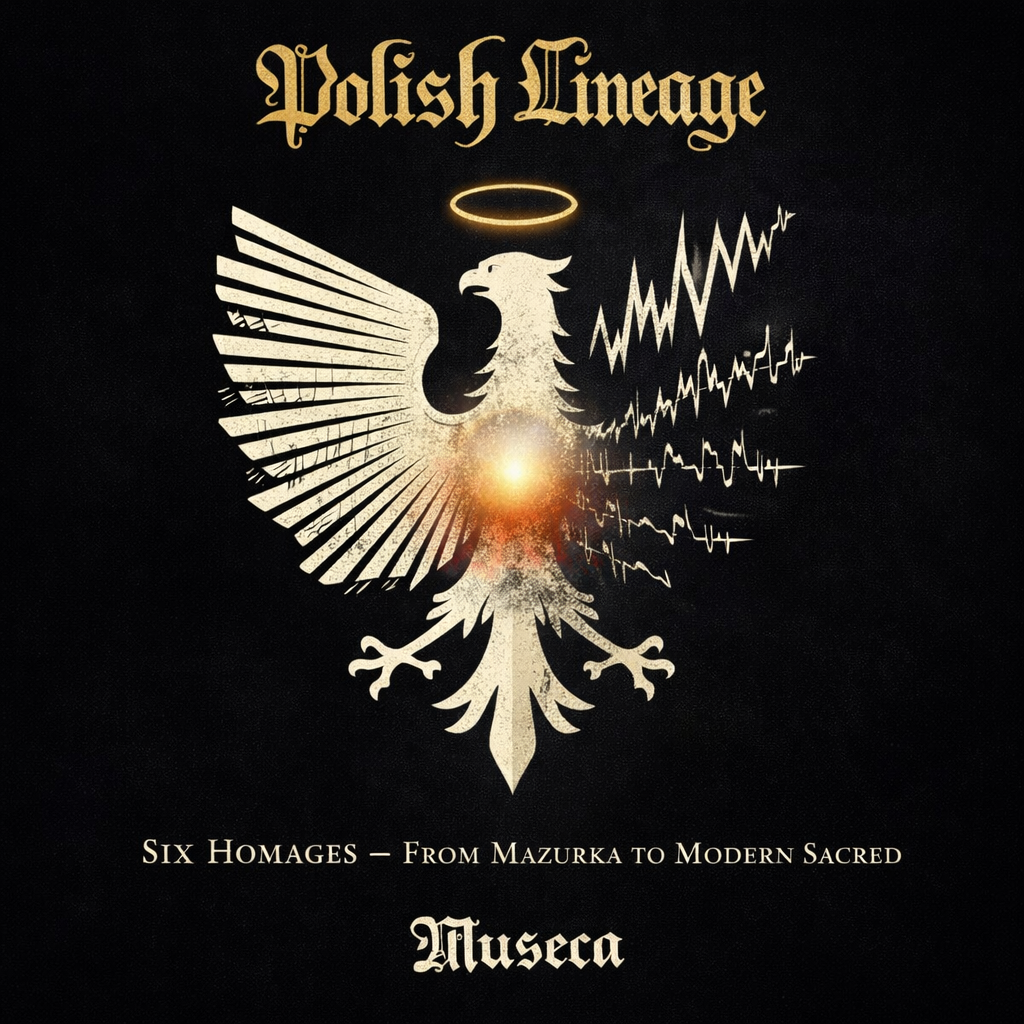
Polish Lineage traces a single idea across centuries: that Polish music is never only “style,” but identity encoded in technique. From the earliest courtly and sacred traditions through the national dance forms that became cultural emblems, and into the postwar avant-garde and modern sacred renewal, Polish composers repeatedly turned musical craft into a kind of portable homeland—rhythm, harmony, timbre, and form serving as history you can hear.
This album is constructed as a six-station lineage study. We begin where Poland’s musical signature became unmistakable in the European ear: the mazurka as transformed by Frédéric Chopin—not as folk quotation, but as compositional grammar. Track 1 takes his “national rhythm as micro-syntax” approach: mazurka accent displacement (the lifted second/third beat), rubato that breathes against the barline, and inner-voice chromaticism that makes a simple dance feel psychologically infinite. From there we widen the frame into the ceremonial polonaise lineage (Track 2), drawing on the nobility and procession logic associated with Michał Kleofas Ogiński and the late-Romantic public rhetoric of Ignacy Jan Paderewski: steady triple-meter stride, broad thematic arcs, and harmonic bloom that turns dance into civic statement.
At the album’s center the emphasis shifts from national dance to national color. Karol Szymanowski becomes the hinge figure: a composer who reimagined Polishness through harmonic perfume, modal ambiguity, and orchestral iridescence—often filtering highland energies and archaic myth through modernist refinement. Track 3 honors this by treating harmony and timbre as the primary narrators: luminous extended sonorities, floating modality, and a “shimmering” orchestral palette where melody emerges like light through mist rather than as a declared theme.
From there, the lineage enters the post-1956 Polish modernist breakthrough, where form and sound themselves become the carriers of meaning. Track 4 is built in the spirit of Witold Lutosławski, whose music is defined by architectural clarity and controlled freedom: stratified blocks, tight cue-point coordination, and the impression of aleatory motion without surrendering structural control. The focus is not on Romantic development, but on designed volatility—textures that ripple, align, fracture, and re-cohere with deliberate precision.
Track 5 then steps into the shock-frontier of the Polish postwar imagination through Krzysztof Penderecki—the sonorist moment when timbre becomes form and the orchestra becomes a laboratory of new gestures. Here the composition is engineered around clusters, glissandi, harmonics, and metallic punctuation; melody is minimized so that the listener hears massed sound moving like a physical substance. This is the album’s inflection point: Poland’s lineage as the courage to reinvent the instrument itself.
Finally, Track 6 resolves the journey through the sacred slow-time dramaturgy associated with Henryk Mikołaj Górecki—a modern Polish voice that can be radically simple without being simplistic. The music honors his approach to emotional truth through restraint: slow harmonic rhythm, modal lament, long-line phrasing, and silence used as structure. After the timbral extremity of Track 5, the album closes by letting time open outward—grief refined into clarity, intensity transmuted into stillness.
In that sense, Polish Lineage is not an anthology; it is an argument made in sound. Each homage isolates a compositional parameter that a Polish master made distinctive—Chopin’s rhythmic micro-inflection and pianistic inner life, Ogiński/Paderewski’s dance-rhetoric and public breadth, Szymanowski’s harmonic perfume and mythic color, Lutosławski’s architectural modernism and controlled aleatory energy, Penderecki’s timbre-as-form sonorism, and Górecki’s sacred economy of time. The album’s intent is practical as well as reverent: to study how a national tradition can evolve from dance to modern sacred speech without losing its identity—because the identity was never only in melody, but in the deeper craft beneath it.
Liner Notes
Mazurka Cipher (Chopin Study)
A chamber-sized mazurka where Polish identity is carried by micro-accent and breath. The groove is built on mazurka lift—subtle weight on the second or third beat—so the barline feels elastic rather than mechanical. The right hand sings in long, cantabile spans while the left hand keeps a soft, dancing pedal, and the inner voices thread chromatic “whispers” that blur major/minor certainty. Ornaments are treated as grammar, not decoration: turns and grace notes function like consonants shaping the phrase, with rubato designed to feel inevitable rather than indulgent.
Polonaise of Smoke (Ogiński → Paderewski Line)
A processional polonaise, broad-shouldered and dignified, where the national dance becomes public rhetoric. The triple meter is steady but subtly lifted—less waltz than ceremonial stride—while the harmony expands into late-Romantic bloom. The piano leads with declamatory theme-shapes, and the supporting strings behave like a halo rather than accompaniment, swelling to underline cadences and thinning to expose the polonaise rhythm. The result is a noble silhouette: restrained grandeur, melancholy under polish, and a sense of history moving forward one measured step at a time.
Myth in the Tatra Air (Szymanowski Study)
Here the lineage pivots from dance to color. Harmony becomes the protagonist: extended chords, modal and whole-tone inflections, and a luminous ambiguity that refuses to “solve” itself too quickly. Woodwinds and high strings shimmer in layered transparency, with harp as a binding agent—gluing timbres together and turning transitions into glints rather than seams. Folk energy is present only as an atmosphere—rhythmic contour and melodic contour hinted at, then dissolved—so the track feels like a myth remembered rather than a tune quoted.
Architect of Winds (Lutosławski Study)
A study in modernist architecture, where clarity is achieved through motion, not through simplicity. The music is organized in lucid blocks that interlock—textural planes that ripple independently and then align at cue points with sudden precision. The sensation is “controlled freedom”: figures that feel spontaneous but are structurally calibrated, with percussion used to define edges and synchronize arrivals rather than to create groove. Harmonic fields shift like weather systems—consistent within a span, then abruptly re-lit—so form is perceived as a sequence of designed states.
Threnody Spark (Penderecki Sonorism Study)
Timbre becomes form. Instead of melody-led development, the track evolves through massed string sound: clusters that tighten and loosen, glissandi that smear pitch into motion, harmonics that flash like cold light, and bow pressure that turns tone into texture. Percussion is sparse and metallic—punctuation rather than pulse—so silence and resonance carry equal weight. The drama is physical: you hear sound as substance, moving through density, register, and friction, with tension produced by proximity and spectral bite rather than by harmonic progression.
Sorrow Made Light (Górecki / Modern Sacred Study)
A slow-time lament that closes the album by making restraint feel monumental. Harmony moves with large, deliberate steps—modal gravity, simple verticals, and long-held tones that allow overtones and room resonance to become part of the orchestration. The melodic writing favors stepwise ascent and fall, as if prayer is being spoken through pitch rather than performed. Silence is structural: pauses are not gaps but pillars, giving the listener time to feel the weight of each arrival. After the sonorist shock of the previous track, the cadence of this final movement is transfiguration—grief clarified into stillness, intensity resolved into light.
Instrumental
Vocal
Lyrics
(Polish)
Światło w ciszy — prowadź mnie,
Light in silence — lead me,
przez cień, przez noc, przez łzę.
through shadow, through night, through tear.
(Latin)
Lux in silentio,
Light in silence,
miserere cordis mei.
have mercy on my heart.
(Polish)
Niech ból się modlitwą stanie,
Let pain become a prayer,
niech serce znajdzie dom.
let the heart find its home.
(Latin)
Dona pacem,
Grant peace,
dona lucem.
grant light.
Playlist
- Track 1 — “Mazurka Cipher (Chopin Study)” Museca 1:25
- Track 2 — “Polonaise of Smoke (Ogiński → Paderewski Line)” Museca 2:28
- Track 3 — “Myth in the Tatra Air (Szymanowski Study)” Museca 3:58
- Track 4 — “Architect of Winds (Lutosławski Study)” Museca 3:41
- Track 5 — “Threnody Spark (Penderecki Sonorism Study)” Museca 3:47
- Track 6 — “Sorrow Made Light (Górecki / Sacred Poland Study)” (Instrumental) Museca 4:06
- Track 6 — “Sorrow Made Light (Górecki / Sacred Poland Study)” (Lyrics) Museca 1:04