Pluck
Mizrab
A plectrum traditionally worn on a picking finger excites the playing string. The precise onset gives the sitar a characteristic ringing attack.

Museca · Curated Listening Collection No. 24
From Raga to Modern Conversations
The sitar is not simply a distinctive sound. It is a musical voice that can pluck, glide, ring, wait, ornament, and answer. Its resonant strings and expressive pitch bends make melody feel as if it were speaking. In twenty-four Museca recordings, this instrument travels from raga-inspired melodic architecture and cyclic rhythm to nocturnal conversations with muted trumpet, cinematic romance, and modern organic soul-house grooves. Six movements reveal how an instrumental identity can remain recognizable while the music around it changes completely.
One string can begin the conversation. A bent note can change everything that follows.
A short introduction to an extraordinary instrument
The sitar is a fretted, plucked-string instrument closely associated with North Indian Hindustani music. Its expressive identity arises from the interaction of attack, pitch inflection, resonant bridge, and sympathetic strings. The details vary by instrument and playing tradition, but four qualities offer especially useful listening landmarks.
Pluck
A plectrum traditionally worn on a picking finger excites the playing string. The precise onset gives the sitar a characteristic ringing attack.
Bend
Lateral pulling of a string across a fret allows a tone to glide expressively toward another pitch. The gesture can sound strikingly vocal.
Bridge
The broad, carefully shaped contact surface of the bridge helps produce the instrument’s characteristic buzzing, overtone-rich color.
Resonate
Sympathetic strings respond to other sounding pitches, adding a delicate halo around the main notes. Their tuning contributes to tonal character.
Traditional musical architecture
In many Hindustani instrumental performances, a rāga unfolds through a characteristic relationship between melodic behavior and musical time. A simplified educational outline helps explain the idea—but no single outline describes all performances, and Museca’s pieces are original raga-inspired compositions rather than traditional concert recitals.
These terms describe important Hindustani practices, not compulsory sections of every piece. In the homage, they function as compositional inspirations and listening analogies.
Rhythm has a circular architecture
Tāla is a recurring rhythmic cycle with an organized pattern of emphasis, gesture, and return. The sixteen-beat tīntāl is one familiar example, organized into four groups of four beats.
The return to sam, the cycle’s first beat, can create strong formal arrival. A tihāī often repeats a rhythmic phrase three times so that its final stroke lands on a chosen point in the cycle.
This is a conceptual tīntāl example, not a claim that every track in this collection follows a sixteen-beat cycle. Museca also uses modern 4/4, 12/8, and other grooves.
A rāga is more than a Western scale: it includes characteristic phrase behavior, note hierarchy, ornaments, and performance conventions. Similarly, tāla is more than generic meter. Museca’s compositions draw inspiration from these systems while creating original dialogues with film music, orchestration, and contemporary dance production.
Throughout this playlist, the emphasis is on hearing the sitar as an expressive instrument rather than presenting every track as a traditional classical performance.
One instrument · Six expressive personalities
The journey begins with the sitar alone, discovers how it converses with muted trumpet, turns toward cinematic romance, meets contrasting solo voices, joins intricate grooves, and finally returns to the quietest instrumental hour before dawn.
First pass: enjoy the music and notice the sitar’s distinctive voice. Second pass: focus on attack, pitch bending, decay, and sympathetic resonance. Third pass: listen to the relationships—what other instruments contribute, when the sitar leads, and when it becomes part of the groove.
Each track note is grounded in the published album’s liner notes and stated instrumentation. These suggestions are not claims of a separate note-by-note audio transcription.
Twenty-four recordings · One continuous musical narrative
The original Museca recordings are sequenced through six movements. The last piece, The Last Hour, in Bhairavi, returns the listener to the sitar’s nearly solitary voice.
The Cue player reuses existing Museca MP3 files. No audio has been duplicated. The WordPress editor may display the Cue shortcode; the player renders in Preview.
Six movements · Twenty-four annotated selections
Each movement has a short musical introduction, commentary for four recordings, direct links to the source album, and one practical listening experiment.
Movement I · Tracks 01–04
Raga-inspired architecture · Drone · Meend · Cyclic rhythm
Four studies from the Ravi Shankar homage introduce the sitar as a singing, thinking instrument. A drone establishes tonal home; pitch bends and melodic turns form an expressive statement; a recurring cycle then makes time audible. These are original homages and studies, not certified traditional raga performances.
Listen for the difference between a note’s initial pluck and its subsequent bend or resonance. When the pulse enters, can you locate repeated rhythmic arrivals without simply counting Western bars?
A continuous drone introduces tonal home before the sitar unfolds a raga-inspired melodic identity. Hear patient ornament and long bends giving way to a more definite pulse. Compare the freedom of the opening gesture with the rhythmic section that follows.
The melodic argument now meets a cyclic rhythmic framework. Listen for the ways phrases play against the return of the pulse, and how patterned rhythmic arrivals can produce a sense of form without Western chord progressions.
The study brings controlled force to expressive pitch-bending. Hear articulate attack, quicker melodic movement, and rhythmic momentum; notice that technical intensity need not erase the line’s melodic personality.
A deliberate climb demonstrates how repetition and measured phrases can create growing intensity. Follow the recurring rhythmic landmarks rather than seeking a familiar dominant-to-tonic cadence.
Movement II · Tracks 05–08
Sitar · Harmon-muted trumpet · Shared pitch inflection
Four selections from Raat Ki Rani present the sitar and muted trumpet as equals. They can exchange phrases, hold a note against a resonant pluck, and sometimes bend through the same melodic contour. A night journey makes each change in timbre and harmony part of the drama.
Follow a single short phrase from the sitar into the trumpet. Where is the musical idea recognizably the same, and where does the change in attack, breath, and sustain transform its emotional quality?
The night opens with a sitar alone before gentle guitar, bass, and hand percussion enter. Its bending phrases establish the intimate musical grammar through which the trumpet will eventually respond.
Sitar and Harmon-muted trumpet share warm, slightly melancholy phrases above a relaxed Hammond-organ groove. Compare the sitar’s plucked shimmer with the brass instrument’s sustained breath.
A dramatic but restrained widening of the arrangement allows the two instruments to meet over piano and a later string bloom. Listen for where they bend together, and where the contrast between attack and sustain remains.
The sitar and trumpet encounter a blues-tinged melodic language inspired by Jog. Their shared ability to inflect pitches makes the partnership unusually close even when the instruments’ physical tone production differs.
Movement III · Tracks 09–12
Cinematic strings · Waltz · Romantic ornament
Three Silk & Smoke pieces and a short cue from the Shankar homage show how sitar colors can inhabit orchestral romance. Plucked attacks, sympathetic shimmer, and gliding gestures become small points of emotional focus inside strings, gentle dance, and rain-lit scenes.
Listen only to the foreground melody, then to the orchestral background. How does the sitar create intimacy inside a large texture? Is the effect different from a bowed melody that sustains its sound?
The sitar enters a lush cinematic string environment. Its airy, bending ornament becomes a distinct foreground voice without dissolving into the orchestral warmth around it.
Light, rising sitar phrases bring a brighter and more hopeful character. Hear how the instrument’s overtone-rich attack can feel delicate and luminous in a soft arrangement.
A gentle three-beat waltz frames the sitar alongside strings. The plucked and bowed voices create a mirage-like sense of time and movement as the rhythm stays graceful.
Rain texture, drone, breath-like woodwind gestures, and sitar-like glides create a short cinematic scene. Listen for how sparse elements can tell a melodic story without virtuosity or a large crescendo.
Movement IV · Tracks 13–16
Flugelhorn · Bass clarinet · Cello · English horn
The sitar is paired successively with four very different instrumental voices. These compositions allow a listener to study musical dialogue: call and response, overlapping phrases, contrasting registers, and the balance between plucked and sustained sound. Warm groove binds the sequence together.
Identify which instrument introduces the principal idea and which answers it. Does the second voice imitate, complete, or contradict the sitar? Notice how register and tonal weight affect the relationship.
Sitar ornament and mellow flugelhorn meet over a fluid organic soul-house groove. Notice the contrast between a short plucked phrase and a rounded brass answer.
The bass clarinet introduces dark, woody resonance against the brighter attack of the sitar. Attend to range and timbre: the two instruments can answer the same gesture while remaining unmistakably distinct.
The solo cello offers a sustained melodic partner to the sitar’s articulated phrase. Listen for tenderness created by the contrast between bowing and plucking, and by shared pitch inflection.
The English horn adds a reedy, searching sound above a swaying 12/8 pulse. Notice how a compound subdivision makes space for the sitar’s ornamented gestures and melodic responses.
Movement V · Tracks 17–20
Syncopation · Tabla and kanjira · Organic soul-house
Rhythm moves into the foreground. The sitar is not only a vehicle for sustained or ornamental melody; its clear plucked attacks can join repeating bass figures, percussion cycles, offbeat accents, and a dance-oriented framework. Four pairings show different ways of being both melodic and rhythmic.
Listen first to percussion and bass. Then hear where the sitar enters relative to the beat. What changes when an ornament, repeated pitch, or short phrase becomes part of the groove?
A syncopated organic soul-house groove with 3+3+2-inspired accents places the sitar beside Harmon-muted trumpet. Follow rhythmic gaps, bass movement, and how melodic fragments enter between beats.
Tabla and kanjira become a stronger rhythmic presence as sitar converses with bansuri. Hear the contrast between the sitar’s plucked ornaments and the flute’s sustained breath within repeating patterns.
The sitar meets a tenor trombone over a two-bar push-and-pull bass pattern. The surprise is not merely the pairing, but how both instruments can shape flexible, sliding melodic gestures inside a modern groove.
The flugelhorn returns and the pulse becomes more animated. Repeated motifs and interlocking percussion provide a culminating example of the sitar as both lyrical voice and rhythmic participant.
Movement VI · Tracks 21–24
Ensemble climax · Night music · Sitar returns alone
A brief concerto-like finale widens the sound before the curated sequence descends into quieter nocturnal pieces from Raat Ki Rani. Midnight introduces the low voice of surbahar; after midnight, tabla becomes the rhythmic focus; in the last hour, pulse withdraws and the sitar’s recurring melodic idea returns in altered form.
Compare the final sitar phrases with the first track of the playlist. Do you now hear the instrument differently—its attack, bend, resonance, ability to converse, and ability to finish a journey with very little accompaniment?
The Shankar homage closes its own narrative through a dialogue between soloist and larger ensemble, followed by a bright jhala-like coda. This track serves as the final opening-out before the curated collection turns toward midnight.
The nocturnal scene becomes sparse. Sitar and muted trumpet inhabit a dark, spacious texture while a deep surbahar voice appears beneath them. Listen for the expressive weight created by the missing fifth in the Malkauns-inspired pitch world.
Tabla finally takes over the pulse, with a gently rocking six-beat cycle and a quiet oud pattern. Sitar and trumpet continue their nocturnal exchange above this newly exposed rhythmic foundation.
The beat recedes and the sitar becomes almost solitary again. A changed return of the opening melodic idea brings the journey toward dawn. The instrument’s bending, resonant voice has the final instrumental word.
Return to these pairs after your first complete listen
These focused comparisons reveal the effects of form, instrumentation, timbre, and rhythmic organization while keeping the sitar at the center of attention.
Tracks 01 and 02
The first study lets the melodic idea breathe before a more formal pulse arrives; the second foregrounds rhythmic structure. Hear where free gesture ends and deliberate cycle begins.
Tracks 05 and 07
Compare the opening dusk with the more expansive night in Kirwani. How do the sitar and muted trumpet preserve their identity when the supporting arrangement changes?
Tracks 13 and 15
The flugelhorn and cello each sustain an answering phrase differently. Compare how those techniques complement the plucked sitar voice.
Tracks 17 and 18
A broken-beat sitar–trumpet conversation gives way to a tabla-centered encounter with bansuri. Both are rhythmic, but their accents and instrumental dialogue differ.
Four original Museca albums
Each selected track also belongs to its own larger composition cycle. Explore the original albums for their full musical arcs, companion videos, and contextual liner notes.
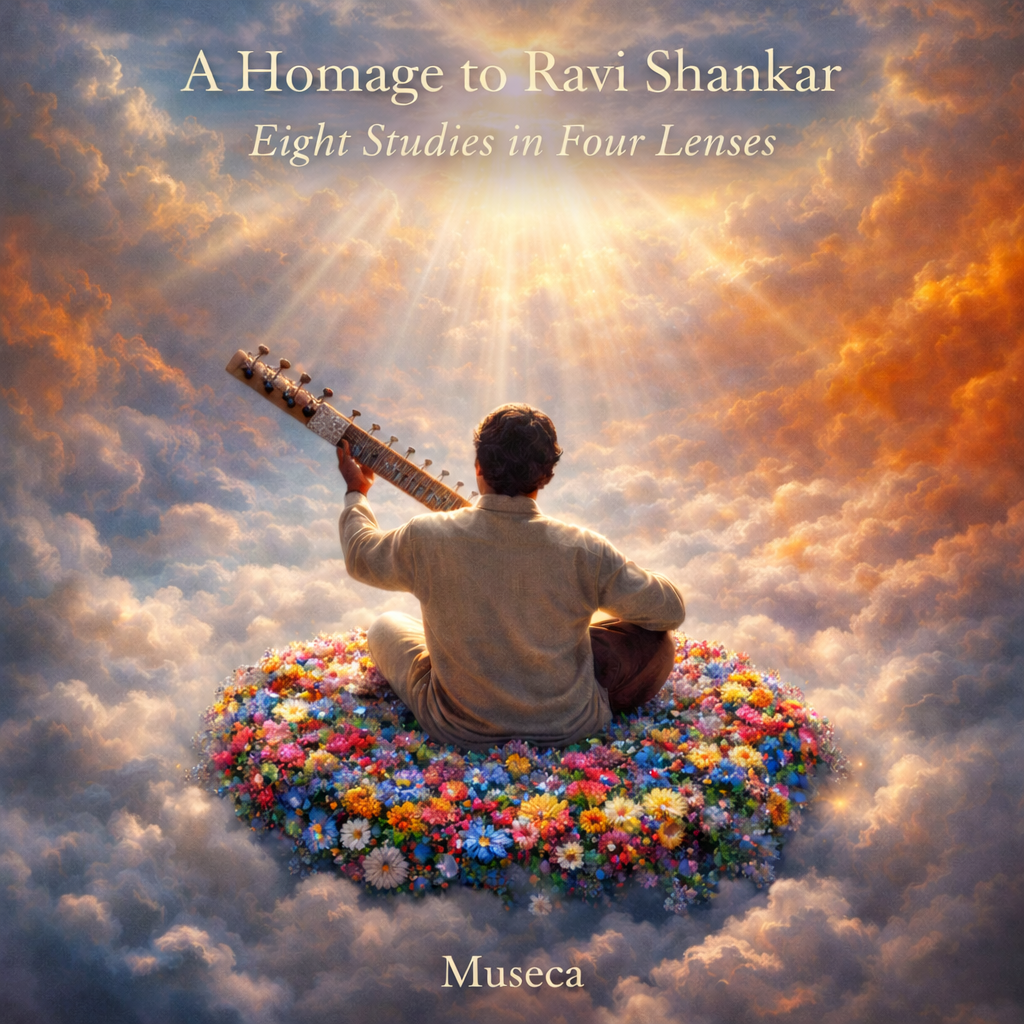
Raga-inspired architecture · Sitar study · Ensemble dialogue
Eight original studies in four creative lenses: raga-inspired architecture, rhythmic discipline, cinematic lyricism, and Indian–Western chamber dialogue. Six recordings contribute to this collection.
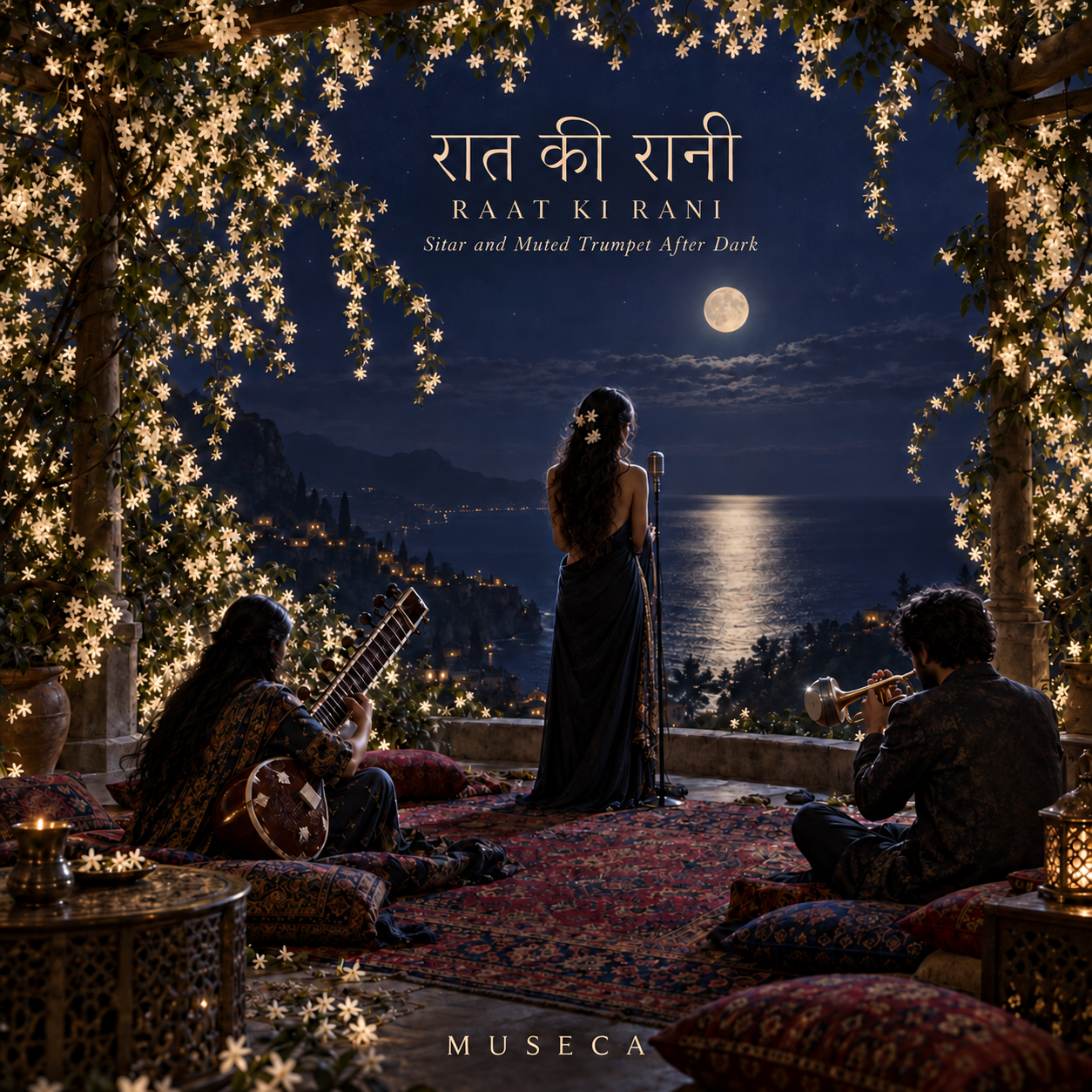
Sitar · Harmon-muted trumpet · Nocturnal raga colors
Twelve compositions follow a night-blooming flower from dusk toward dawn. The sitar and Harmon-muted trumpet act as melodic equals; seven instrumental pieces provide the nocturnal thread of this playlist.

Sitar · Cinematic strings · Romantic instrumentals
Ten cinematic instrumentals use sitar, sarangi, plucked-string colors, tabla-inspired percussion, and orchestral textures to explore romance, longing, and tonal beauty. Three clearly sitar-colored works are featured.
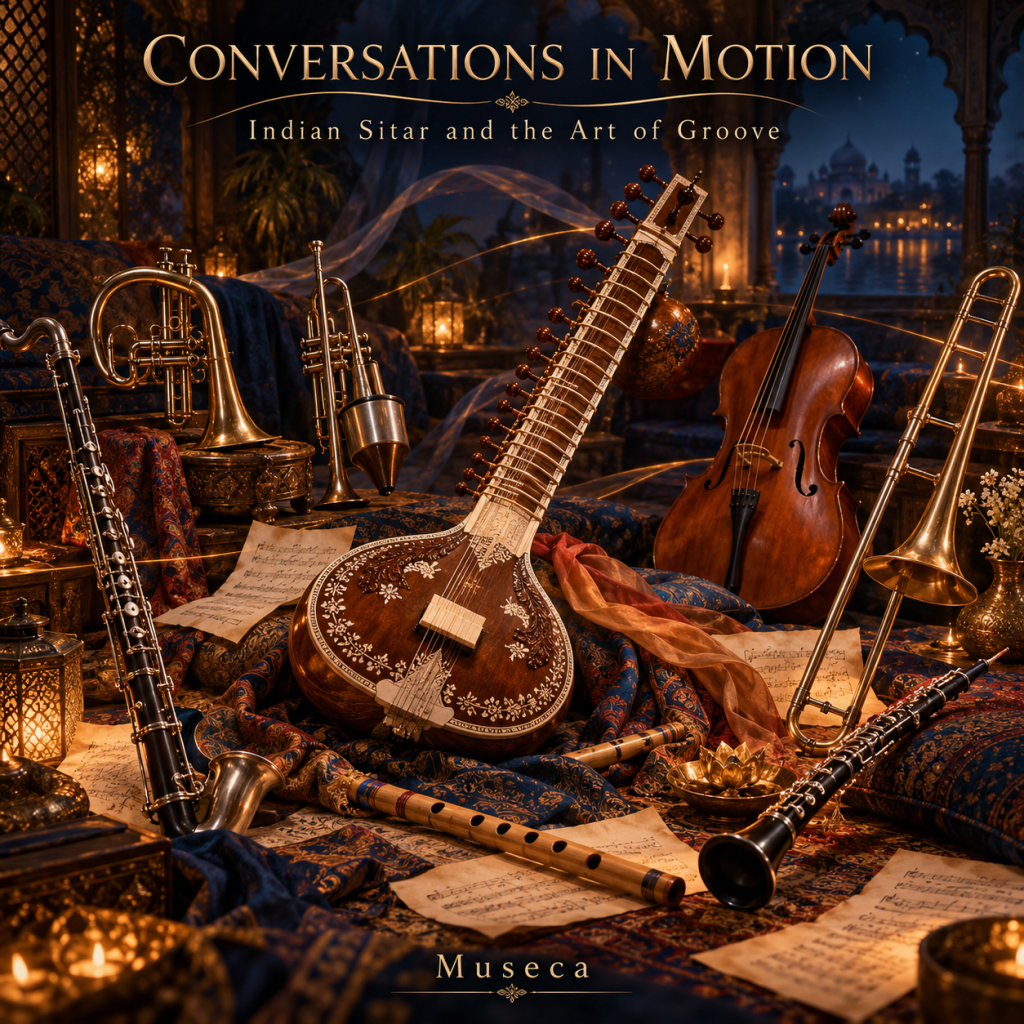
Indian sitar · Organic soul-house · Instrumental partnerships
Eleven compositions place the sitar at the center of changing partnerships with flugelhorn, bass clarinet, cello, English horn, bansuri, trombone, and voice over contemporary grooves. Eight tracks appear here.
Museca Music Library · Further education
These three Library resources offer complementary discussions of instrumental technique, rhythmic architecture, and melodic systems. Each is freely available to read or download.
Museca Music Library
A broad guide to instrumental families, sound production, registers, articulation, and orchestration. Use it to compare plucked strings with bowed, blown, and brass voices.
Museca Music Library
A resource for meter, rhythmic cycles, syncopation, cross-rhythm, and the differences between Indian tāla-inspired ideas and contemporary groove.
Museca Music Library
An introduction to pitch systems, modes, and scale traditions. A useful starting point for understanding why a rāga cannot be reduced to a Western scale alone.
Continue the musical exploration
This playlist follows a single instrument across several sound worlds. For other ways to hear the same musical principles, explore Museca’s studies in musical dialogue, world traditions, and rhythmic invention.
All twenty-four selections originate from four previously published Museca albums. The educational descriptions reference the original liner notes and intended musical language; no independent pitch-by-pitch transcription or assessment of historical raga authenticity is implied.