
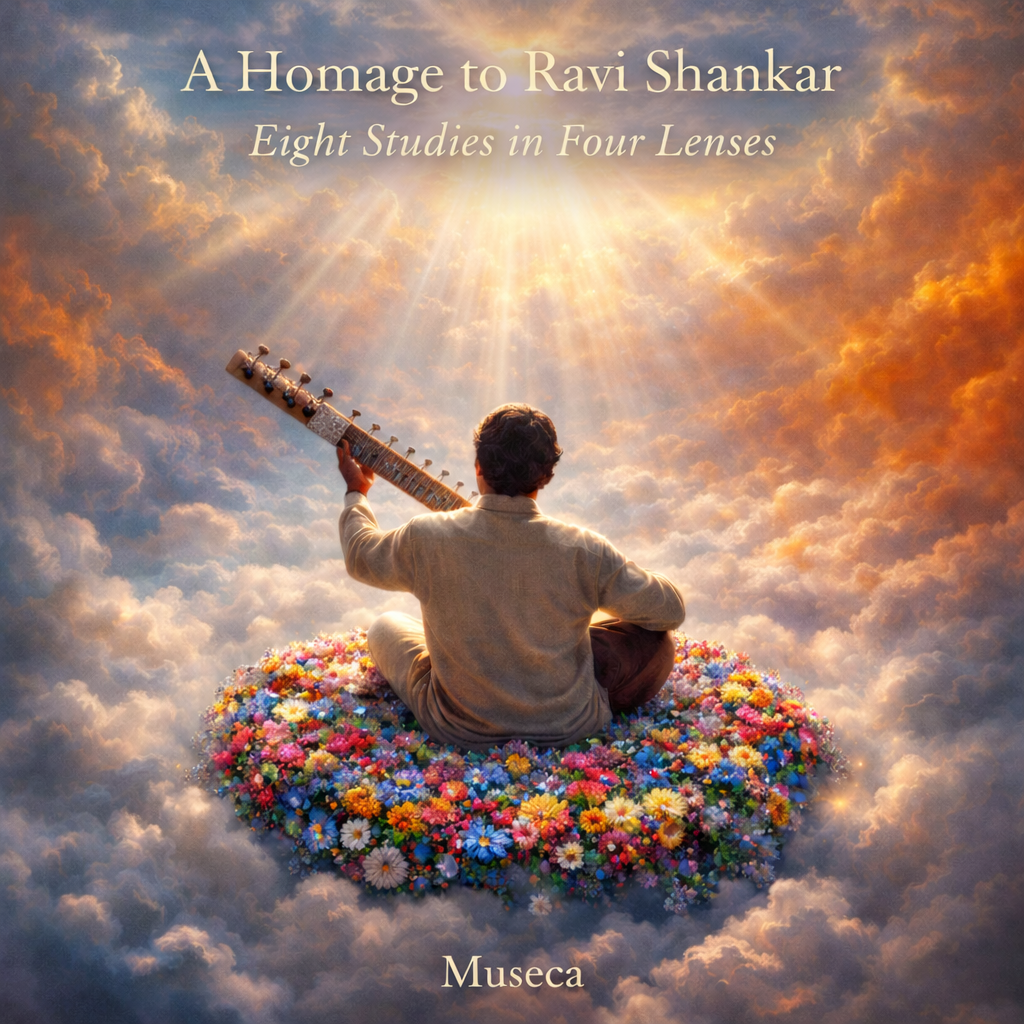
Album Introduction — A Homage to Ravi Shankar (Eight Studies in Four Lenses)
Ravi Shankar (1920–2012) occupies a singular place in twentieth-century music: a virtuoso who carried Hindustani classical tradition to global audiences without reducing it to novelty. His artistic formation began unusually early and publicly—touring internationally in his youth with his brother Uday Shankar’s dance troupe—before he chose the deeper, slower path of rigorous apprenticeship, studying sitar for years under Ustad Allauddin Khan of the Maihar gharana.
From that foundation came a career defined not only by performance but by institution-building and composition. In New Delhi, Shankar served as music director at All India Radio (AIR) and formed the Indian National Orchestra, experimenting with ways Indian classical language could converse with broader instrumental palettes—an early signal that his “East–West” work would be most persuasive when it remained structurally disciplined. His film work further demonstrated that discipline in miniature: he provided original music for Satyajit Ray’s Pather Panchali, and his sound-world became inseparable from the emotional realism of that cinema.
Shankar’s international impact was not merely a matter of fame; it was the gradual construction of a credible listening bridge. Asia Society notes his early U.S. presence—including a Carnegie Hall presentation in 1957—well before “fusion” became a marketing category. His collaborations with Yehudi Menuhin—especially West Meets East—were pivotal because the meeting point was not stylistic decoration but mutual seriousness: Indian material treated with the same respect normally reserved for canonical Western repertoire. And when his public stature was later leveraged for humanitarian awareness—most famously through the 1971 Concert for Bangladesh with George Harrison—music became a vehicle for conscience as well as craft.
This short homage album follows that same principle: honor the tradition by honoring its internal logic. It is not an attempt to “recreate” Shankar—no one can—nor to flatten Hindustani form into ambient wallpaper. Instead, it offers eight concise studies arranged as four creative lenses, each lens presenting a different way Shankar expanded what a sitar-led musical mind could be:
Purist raga architecture (form as living geometry),
Maihar gharana intensity (discipline, attack, controlled fire),
Film-score lyricism (motif, narrative tenderness, emotional economy), and
East–West chamber/orchestral fusion (integration without dilution).
Across these lenses, you will hear recurring structural touchstones—alap-to-gat pacing, tabla dialogue, layakari, and tihai cadence logic—not as “exotic color,” but as composition itself: tension, breath, arrival, and release. The intent is simple and serious: to point listeners back toward the source, and to offer a modern set of listening doors through which Shankar’s legacy can be felt as craft, ethics, and humanity—all at once.
Liner Notes
Homage to Ravi Shankar (8 Tracks / Four Lenses)
This eight-track homage is designed as a concise portrait in four rooms—four “creative lenses” that reflect distinct facets of Ravi Shankar’s contribution: the rigorous architecture of raga performance, the disciplined intensity of lineage, the narrative gift of cinematic composition, and the respectful meeting-point between Indian classical logic and Western ensemble language. Each lens receives two tracks: a clear “statement” followed by a complementary “variation,” allowing the album to remain short while still feeling complete.
Lens I — Purist Raga Architecture
Ravi Shankar’s foundation was the long-form logic of Hindustani performance: raga as a living grammar, tala as a cyclical cosmos, and the gradual awakening from unmetered contemplation into rhythmic certainty. These two pieces foreground traditional structure—not as museum reenactment, but as a modern listener’s entry into the discipline and patience that make raga music emotionally inevitable.
Track 1 — Alap to Flame (Dawn Raga Study)
The album opens with restraint on purpose. A continuous drone establishes the tonal home while the sitar line slowly reveals a raga personality through measured phrases and long gliding meend. The pulse arrives only after trust is earned: first as a quiet internal engine, then as a formal gat where the music steps into time. The track’s arc is a controlled ignition—meditation turning into motion, stillness turning into design.
Track 2 — The Tala Mirror (Evening Gat Study)
Where Track 1 teaches the listener how to listen, Track 2 rewards them with rhythmic intelligence. The alap is shorter, the tabla enters earlier, and the piece becomes a conversation between melody and cycle. Layakari (rhythmic play) is treated as elegant architecture rather than display—phrases bend around the tala and resolve with decisive tihai cadences, like doors closing perfectly on their hinges. The ending lifts into a bright, succinct jhala—an evening glint on polished stone.
Lens II — Maihar Gharana Intensity
This lens honors the seriousness of training and the “architectural” drive associated with the Maihar lineage: clarity of attack, stamina of form, and intensity achieved through control rather than chaos. The objective is not speed for its own sake, but inevitability—music that advances like a ritual procession.
Track 3 — Iron Meend, Brass Pulse
This is the album’s first declaration of force. The right hand speaks with a harder consonant: crisp articulation, bold entrances, and fast tans that remain grammatically disciplined. The tabla’s role is not accompaniment but propulsion—tight, precise, and relentlessly forward. The climax burns in a controlled jhala: a contained blaze, bright without becoming reckless.
Track 4 — Stone Steps (Pace & Pressure)
Intensity can also be slow. Here the music is heavy-footed and deliberate, building pressure through pacing and repetition rather than fireworks. The tala feels like a measured climb, each return to the cycle landing like a step on stone. When tihai cadences appear, they function as structural pillars—moments where the music asserts certainty. The closing remains restrained: a refusal to over-spark, leaving power in reserve.
Lens III — Film-Score Lyricism
Shankar’s public legacy is not only as a virtuoso, but as a composer who could translate raga sensibility into narrative emotion. This lens treats raga color as a storytelling palette: memorable motifs, scene-like transitions, and orchestration that behaves as character and setting.
Track 5 — A Scene in Three Colors
A single motif carries the track like a protagonist—introduced intimately, then reinterpreted across three “scenes” as the surrounding world changes. Strings and woodwinds do not “harmonize” in a Western pop sense; they paint atmosphere and response, widening the emotional frame around the solo voice. The piece returns home with a reprise that feels like memory: the same phrase, altered by what it has passed through.
Track 6 – Letter to the Moonson
This is the album’s most tender cue—wistful, romantic, and quietly luminous. Rain textures and a gentle drone set the stage; bansuri-like breath and sitar-like glides trade the melody as if exchanging a private message. The orchestral presence swells without spectacle, keeping intimacy intact. The ending does not resolve with triumph but with acceptance—an after-rain stillness.
Lens IV — East–West Chamber/Orchestral Fusion
Shankar’s cross-cultural work mattered because it insisted on mutual seriousness: Indian melodic and rhythmic logic remained central, while Western ensembles contributed counterpoint, timbral depth, and formal breadth—without collapsing into generic “worldbeat” gestures. This lens is a tribute to that standard.
Track 7 — Raga for String Quartet and Drone
A chamber dialogue: the solo line states a raga-shaped idea, and the quartet answers with imitation and counterlines rather than chords. The drone is the anchor; motion comes from interplay and register, not harmonic progression. When percussion enters, it is precise and sparing—another voice in the conversation, not a beat to flatten the form. The close is elegant, returning the listener to the drone as if to a shared center.
Track 8 — Concerto of the Crossing (Finale)
The finale enlarges the room. The opening motif is presented ceremonially, then developed through call-and-response between soloist and ensemble until the track reaches a broad, communal peak. A brief hush interrupts the momentum—an intentional breath—before a final jhala-like coda brings brightness and decisive closure. The ending is not fusion as novelty; it is fusion as meeting: two languages sharing one grammar of attention.
Playlist
- Track 1 — Purist Raga Architecture I Museca 5:23
- Track 2 — The Tala Mirror (Evening Gat Study) Museca 2:34
- Track 3 — Iron Meend, Brass Pulse Museca 5:00
- Track 4 — Stone Steps (Pace & Pressure) Museca 4:39
- Track 5 — A Scene in Three Colors Museca 2:37
- Track 6 — Letter to the Monsoon Museca 2:49
- Track 7 — Raga for String Quartet and Drone Museca 4:53
- Track 8 — Concerto of the Crossing (Finale) Museca 3:25