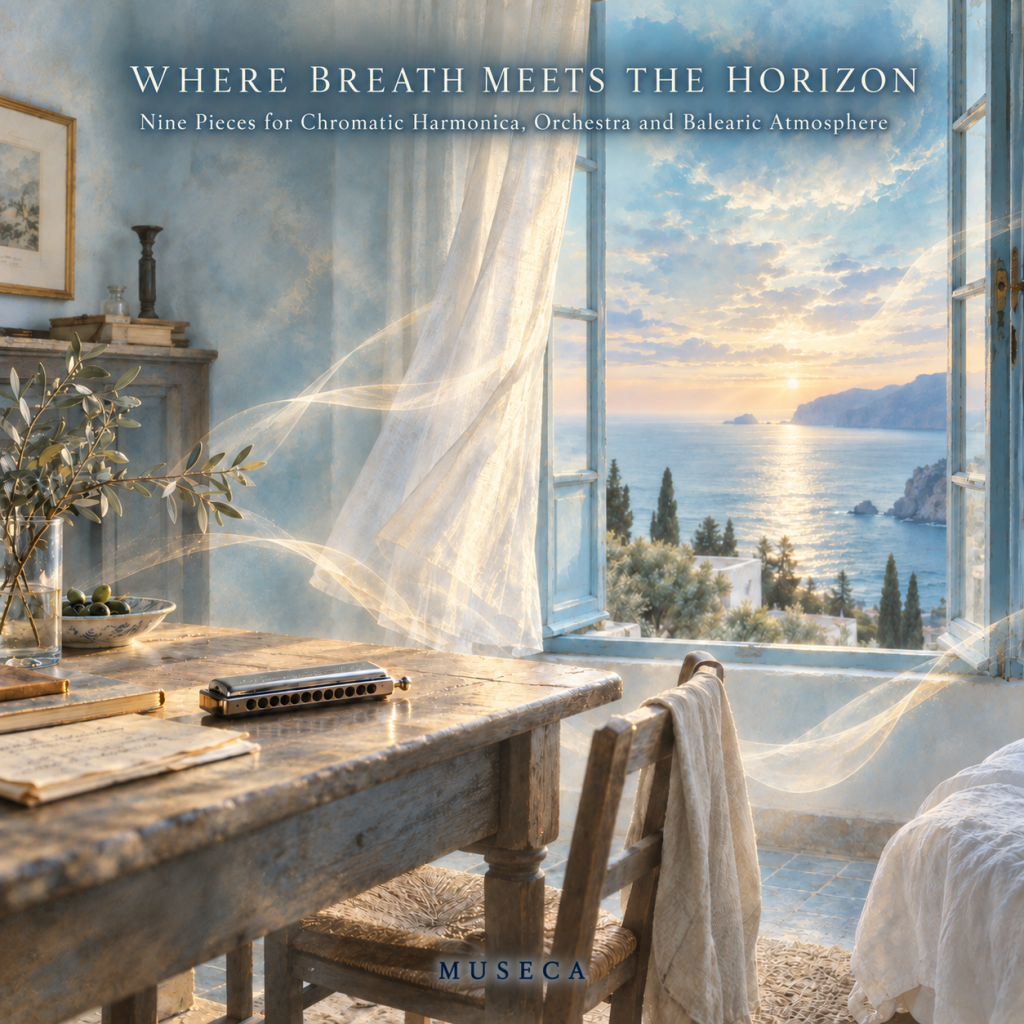
Where Breath Meets the Horizon began with a sound that has stayed with me for decades: the harmonica used not as a novelty or supporting color, but as a genuine melodic voice capable of carrying an entire emotional landscape.
Two pieces in particular helped inspire this album.
The first is John Barry’s “Midnight Cowboy,” from the Academy Award-winning film Midnight Cowboy. Against Barry’s orchestral writing and expansive strings, the harmonica possesses an extraordinary intimacy. It is a small, breath-driven instrument surrounded by the breadth of an orchestra, yet it never seems diminished by that scale. Instead, it becomes intensely human—solitary, vulnerable, wistful, and capable of expressing an emotion that might be diminished if put into words.
The second inspiration comes from a very different musical world: “The Rockford Files” theme, composed by the celebrated television composers Mike Post and Pete Carpenter for the 1970s series starring James Garner. The Rockford Files was one of my favorite television programs of that period, and its distinctive use of harmonica has remained in my musical imagination ever since. Where Midnight Cowboy revealed the harmonica’s capacity for melancholy and orchestral lyricism, The Rockford Files demonstrated something different: the instrument could be agile, contemporary, rhythmically alive, immediately recognizable, and completely at home within a modern ensemble.
Those two memories represent opposite but complementary qualities of the instrument.
The harmonica of Midnight Cowboy looks inward. The harmonica of The Rockford Files moves forward.
Between those two impulses lies much of the musical territory explored in this album.
Another essential inspiration is the extraordinary artistry of Toots Thielemans, whose chromatic harmonica helped establish the instrument as a serious lyrical voice in jazz, popular music, film music, and orchestral settings. Thielemans demonstrated that the harmonica could move far beyond its traditional associations with folk and blues. In his hands it could sing with the subtlety of a vocalist—bending into a phrase, hesitating before a note, breathing between thoughts, and communicating tenderness, melancholy, playfulness, longing, and warmth without a single word.
Where Breath Meets the Horizon takes these inspirations not as models to reproduce, but as points of departure.
Rather than creating a retrospective homage, the album places the chromatic harmonica at the center of a contemporary orchestral and Balearic sound world. Full strings, piano, Rhodes, fretless bass, nylon-string guitar, subtle percussion, and atmospheric electronics surround the harmonica while never displacing it. At times the music approaches the intimacy of chamber music; elsewhere it opens into the spacious, sunlit language of Mediterranean and Café del Mar-inspired downtempo music.
Three ideas form the musical architecture of the album.
The harmonica is breath: the individual human presence, immediate and vulnerable.
The orchestra is memory: the larger emotional field that gathers around what has been lived, remembered, lost, and retained.
The Balearic horizon is movement and space: the world continuing beyond the individual, expressed through rhythm, atmosphere, distant light, and the quiet sensation of traveling toward something not yet known.
Across nine pieces, these elements gradually learn to coexist.
The opening track, “First Breath,” introduces the harmonica almost alone, as though the album is discovering its own voice. From there the music moves outward toward sea and light, inward toward memory and silence, and eventually back into movement. The rhythmic pieces allow something of the forward energy that first fascinated me in The Rockford Files theme to enter the album, while the more orchestral compositions explore the sustained lyricism and emotional spaciousness that originally drew me to Midnight Cowboy.
At the center of the album, “The Long Blue Silence” removes nearly all rhythmic momentum and allows the harmonica to exist within stillness. Later, “What the Horizon Holds” places the instrument at its most openly lyrical. Here the harmonica becomes the singer of the piece, carrying a sustained melody through the orchestra in the tradition that first inspired the entire project.
For most of the album, the harmonica is the singer.
Only once does an actual human voice appear.
In “Until Breath Becomes Words,” a female voice enters into dialogue with the harmonica. The two do not compete for the melody; instead, they seem to emerge from the same source. Words finally enter a musical world that has spent seven tracks communicating without them. The voice then disappears, and the harmonica resumes its role as narrator.
The final composition, “Where Breath Meets the Horizon,” gathers the album’s different languages together: chromatic harmonica, acoustic orchestra, Balearic rhythm, piano, Rhodes, fretless bass, and Mediterranean color. Gradually these elements fall away until the harmonica is once again nearly alone.
But it is no longer the same solitude heard at the beginning.
The instrument has passed through movement and stillness, memory and light, orchestral grandeur and rhythmic motion, language and silence. What began as a solitary breath has become part of a larger landscape.
Where Breath Meets the Horizon is therefore not simply an album about the harmonica. It is an exploration of why this small instrument can feel so profoundly human—and of the remarkable range I first discovered in very different musical settings: the haunting orchestral voice of Midnight Cowboy, the unforgettable rhythmic personality of The Rockford Files, and the lyrical artistry of Toots Thielemans.
Its sound begins with breath.
And perhaps that is why, at its most expressive, the harmonica can seem less like an instrument playing a melody than a person trying to say something for which words have not yet been found.
Liner Notes
First Breath
The album begins almost at the point before music becomes music. A single chromatic harmonica emerges from space, followed gradually by piano, cello, and strings. The piece introduces the central metaphor of the album: breath becoming melody.
The harmonica does not announce itself with virtuosity. It hesitates, pauses, and allows silence to remain part of the phrase. Around it, the orchestra slowly gathers, as though memory itself were taking shape. A faint Balearic pulse eventually appears, but only at the edge of perception. The world has begun to move, though the solitary voice at its center is still learning how to speak.
Toward the Open Sea
The inward stillness of the opening gives way to movement.
Fretless bass, Rhodes, restrained percussion, distant guitar, and strings establish the album’s Balearic dimension, while the chromatic harmonica remains the melodic traveler moving through that landscape.
There is greater rhythmic confidence here, but no urgency. The groove carries rather than drives. The harmonica seems to look outward for the first time, toward distance, possibility, and the open horizon.
If First Breath represents presence, Toward the Open Sea represents departure.
The Rooms We Remember
Memory rarely returns as a complete narrative. More often it arrives through fragments: a room, a certain light, the sound of an old floor, a window, a silence once shared.
The Rooms We Remember turns away from the broader landscape and enters that intimate territory.
Piano, cello, and chromatic harmonica form the center of the piece, with chamber strings gradually appearing around them. The harmonica speaks in shorter, more reflective phrases, while the cello answers from below.
The arrangement deliberately leaves space between musical statements. What is absent becomes almost as important as what remains.
The piece is not concerned with nostalgia so much as the strange persistence of places that no longer exist except within us.
Light on Mediterranean Water
Here the album opens fully into warmth.
A gentle 6/8 pulse carries nylon-string guitar, Rhodes, fretless bass, soft percussion, and luminous strings beneath the chromatic harmonica. The music has the relaxed motion of sunlight moving across water: always changing, yet never hurried.
The harmonica becomes more flowing and playful without losing its lyrical character. The orchestra does not overwhelm the scene; instead, it arrives in flashes, widening the music momentarily before allowing the intimate textures to return.
This is one of the album’s clearest meetings between orchestral writing and the Mediterranean/Balearic atmosphere that helps define its sound.
The Long Blue Silence
At the center of the album, movement almost disappears.
There is no conventional beat. Piano notes are widely separated. Low strings move with extreme patience. A distant horn appears more as atmosphere than melody.
The chromatic harmonica speaks only occasionally.
Those silences are intentional.
The Long Blue Silence explores the point at which solitude ceases to feel empty and becomes instead a form of presence. The harmonica’s phrases rise out of stillness, remain briefly, and dissolve back into it.
The emotional climax comes not through volume but through illumination: minor harmony gradually gives way to a brighter orchestral field, as though light has entered a space without disturbing its quiet.
Everything Begins to Move Again
After the suspension of The Long Blue Silence, rhythm returns almost like circulation returning to the body.
Fretless bass, Rhodes, pizzicato strings, and a stronger Balearic pulse give the composition forward motion. The chromatic harmonica responds with shorter, more rhythmically active phrases, while retaining the melodic warmth established earlier in the album.
As the piece develops, pizzicato strings gradually become bowed strings. What begins as physical motion expands into emotional motion.
The title is intentionally simple. Nothing dramatic has happened.
The world has merely started moving again.
Sometimes that is enough.
What the Horizon Holds
This is the album’s most direct expression of the orchestral harmonica tradition that helped inspire the project.
The chromatic harmonica becomes the unmistakable singer of the composition, carrying a sustained lyrical melody through full strings, piano, French horn, and a restrained contemporary pulse.
Unlike earlier pieces, where the harmonica often enters into dialogue with the surrounding instruments, here the orchestra largely exists to support and deepen its melodic statement.
The result pays emotional tribute to the kind of orchestral harmonica writing that first captured my imagination in John Barry’s Midnight Cowboy, while remaining within the contemporary musical world established throughout this album.
The harmonica does not decorate the orchestra.
It leads it.
Until Breath Becomes Words
For seven compositions, the harmonica has served as the album’s human voice.
Here, for the first and only time, language appears.
An intimate female vocal enters into dialogue with the chromatic harmonica. Neither voice dominates the other. Instead, the human voice and harmonica seem to arise from the same emotional source—one speaking in words, the other in breath and melody.
The harmonica answers the singer, anticipates her phrases, and later carries the melody after the words have disappeared.
At the center of the song lies the idea that some forms of understanding exist before language:
What I could not say in language, I have already played to you.
The song does not resolve the relationship between music and words.
It simply allows them to meet.
Lyrics
Verse 1
I thought the words would find me Somewhere waiting by the sea, But the silence kept on breathing What was already in me.
Verse 2
There are doors we never close, There are names we never say, Still the heart remembers quietly What the years have carried away.
Refrain
Stay with me Where nothing must be proved. Stay with me Until breath becomes words.
Final Verse
If I leave no final answer, Let the evening carry through: What I could not say in language, I have already played to you.
Outro
Stay with me Until breath becomes words.
Where Breath Meets the Horizon
The final composition gathers the album’s musical vocabulary into a single landscape.
Chromatic harmonica, acoustic piano, Rhodes, fretless bass, nylon-string guitar, Balearic rhythm, and full strings appear not as separate stylistic elements but as parts of one integrated sound.
The tonal world returns to that of First Breath, quietly completing the album’s circle.
Yet the harmonica now occupies a different relationship to its surroundings. At the beginning, it seemed solitary against an immense landscape. Here it moves naturally within that landscape.
Gradually, the other instruments disappear.
Percussion falls away.
Bass recedes.
Rhodes disappears.
The orchestra thins.
Piano becomes silent.
The harmonica remains.
It gives the album one final phrase and resolves completely.
Then there is only silence.
The breath has reached the horizon.
Playlist
Track 1 — First BreathMuseca3:24
Track 2 — Toward the Open SeaMuseca3:54
Track 3 — The Rooms We RememberMuseca2:45
Track 4 — Light on Mediterranean WaterMuseca3:29
Track 5 — The Long Blue SilenceMuseca3:24
Track 6 — Everything Begins to Move AgainMuseca3:34
Track 7 — What the Horizon HoldsMuseca2:59
Track 8 — Until Breath Becomes WordsMuseca3:28
Track 9 — Where Breath Meets the HorizonMuseca3:40
Continue exploring
Follow the breath-driven voice across the horizon
Hear another Barry-inspired world, let a different instrument sing quietly, or return to real island light.
The Shape of Farewell explores one theme from several emotional distances. It offers a focused companion to the expansive yet intimate screen language behind the harmonica’s horizon.
How Fair This Light treats trumpet, piano, and strings with intimate restraint. Compare two instruments whose breath can carry a deeply human melodic line.
Three Moments in Hawai’i responds musically to real scenes of moonlight, wind, and sunset. Another project lets broad natural space remain close to an individual act of listening.