
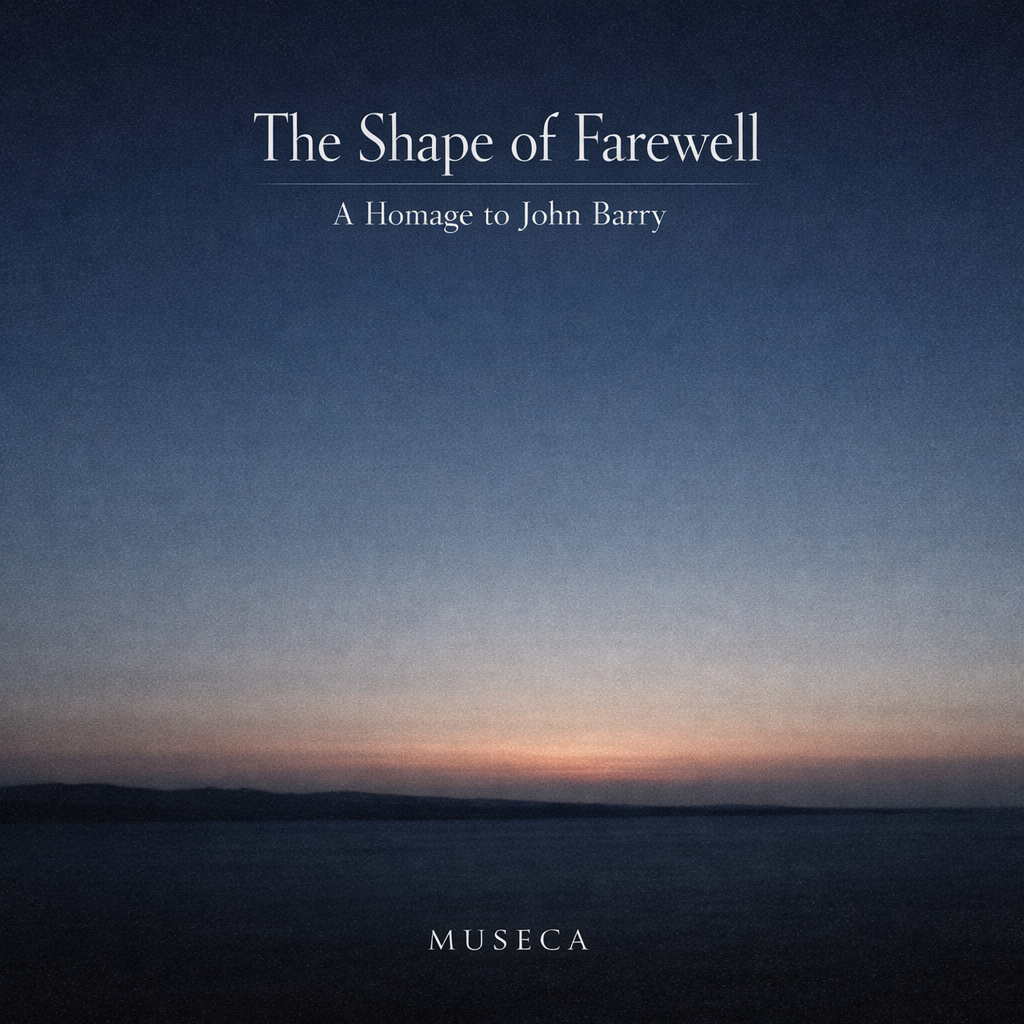
Introduction
John Barry wrote music that did not chase emotion — it allowed emotion to unfold. His scores were never crowded, rarely hurried, and almost never excessive. Instead, they occupied space with patience, dignity, and inevitability. This album is a meditation on that discipline.
Barry understood something fundamental about cinematic storytelling: that restraint can carry more weight than spectacle. Whether writing for epic landscapes, intimate romance, or quiet psychological tension, he relied on long harmonic breaths, deliberate melodic arcs, and orchestration that favored depth over density. His music often felt less like commentary and more like memory — as though the story had already happened and we were hearing its echo.
The Shape of Farewell is structured as six movements within a single emotional world. Rather than presenting separate songs, the album explores one thematic identity from different distances: arrival, expansion, intimacy, shadow, elegy, and afterimage. This mirrors Barry’s own architectural approach, where a small number of core musical ideas carry the full emotional narrative of a film.
The Musical Language of John Barry
Barry’s compositional techniques were deceptively simple yet profoundly effective. Several defining characteristics shaped his unmistakable sound:
- Tonal Loyalty and Harmonic Restraint
Barry often anchored his scores in a single tonal center, avoiding unnecessary modulation. Harmony moved slowly — sometimes remaining on a single chord for extended passages. When progressions did occur, they favored minor-key relationships such as:
i – ♭VI – ♭VII – i
i – iv – i
These progressions create a sense of noble melancholy and inevitability. The absence of dominant-driven urgency removes dramatic tension and replaces it with emotional gravity.
- Long-Breathed Melodies
Barry’s themes are rarely angular or rhythmically busy. Instead, they unfold in legato arcs, primarily stepwise, with carefully delayed climaxes. Melodies often enter after a sustained atmospheric introduction, as though emerging from silence rather than announcing themselves.
- Orchestration as Emotional Temperature
His orchestration is architectural rather than decorative:
Low strings establish emotional weight
French horns provide stoic nobility
Muted brass suggests tension without aggression
High strings and harp create atmospheric lift
Percussion is minimal or absent. When rhythm appears, it is implied rather than driven.
- Silence as Structure
Barry understood that space amplifies emotion. Pauses, held notes, and sustained textures give the listener time to feel. Density was avoided unless absolutely necessary.
- Emotional Ambiguity
Perhaps most importantly, Barry resisted overt triumph or melodrama. His music frequently suggests distance, memory, and acceptance rather than victory or defeat. Even in romantic passages, there is an undercurrent of farewell.
This Album’s Approach
The Shape of Farewell adopts these principles without imitation. The harmonic motion is slow and centered. The orchestration favors strings and horns. The tempo gradually decreases across the six movements, deepening the sense of gravity. Each piece explores a different emotional vantage point of the same thematic identity.
The final movement does not resolve — it recedes. In the tradition of Barry’s finest endings, the music does not conclude with emphasis, but with quiet persistence.
This is not an attempt to recreate the past. It is an act of listening closely to what made his music timeless: discipline, space, and the courage to let feeling linger.
Liner Notes
The Theme
The opening movement establishes the emotional center of the album with restraint and patience. Atmosphere precedes melody, allowing low strings to anchor the tonal gravity before the theme gradually emerges in long, legato arcs. The harmony moves slowly through minor-key terrain, favoring noble melancholy over dramatic tension. French horns provide dignified warmth without heroic emphasis. Nothing rushes; nothing insists. This is not an arrival of spectacle, but of identity — a theme that feels less introduced than remembered.
The Landscape
Here the thematic material widens its horizon. The orchestration expands, with broader string voicings and increased spatial depth, yet the harmonic language remains loyal to the original tonal center. Subtle modal color lifts the texture without brightening it. The melody is less personal, more panoramic — as if seen across distance rather than spoken directly. This movement reflects Barry’s gift for writing music that feels inseparable from open space, where memory stretches beyond the immediate moment.
Intimate Variation
The third movement brings the theme closer, reducing the orchestral density to expose its vulnerable core. A solo voice — often horn or restrained strings — carries the melodic line with minimal harmonic support. Silence becomes structural, framing each phrase with breath. The emotional tone is quiet and inward, avoiding sentimentality in favor of understatement. This is proximity without confession — closeness held in dignified reserve.
The Undercurrent
Beneath romance and landscape, Barry often suggested shadow. This movement explores that quiet inevitability. Low strings deepen the harmonic weight while muted brass introduces subtle tension without rhythmic drive. The harmony oscillates within minor gravity, avoiding resolution. The pulse is implied rather than stated. The result is psychological rather than dramatic — a sense of fate present but unspoken.
The Elegy
The album’s emotional center of gravity rests here. Harmonic motion slows further, at times holding a single chord long enough for its color to settle fully. The melodic phrases are sparse, elongated, and restrained. There is no climax, no grand release — only sustained resignation. This movement embodies the acceptance that defines many of Barry’s finest endings. The music does not seek closure; it remains suspended in quiet dignity.
The Afterimage
The final movement offers a distant return of the theme, thinner in orchestration and higher in register. The melody appears in fragments, partially veiled, as if recalled from afar. Harmonic loyalty persists, but the texture lightens and gradually dissolves. Rather than concluding, the music recedes — echoing Barry’s preference for endings that linger rather than declare. What remains is not resolution, but memory.
Playlist
- TRACK I — The Theme Museca 2:50
- TRACK II — The Landscape Museca 3:26
- TRACK III — Intimate Variation Museca 3:21
- TRACK IV — The Undercurrent Museca 3:02
- TRACK V — The Elegy Museca 4:29
- TRACK VI — The Afterimage Museca 1:25