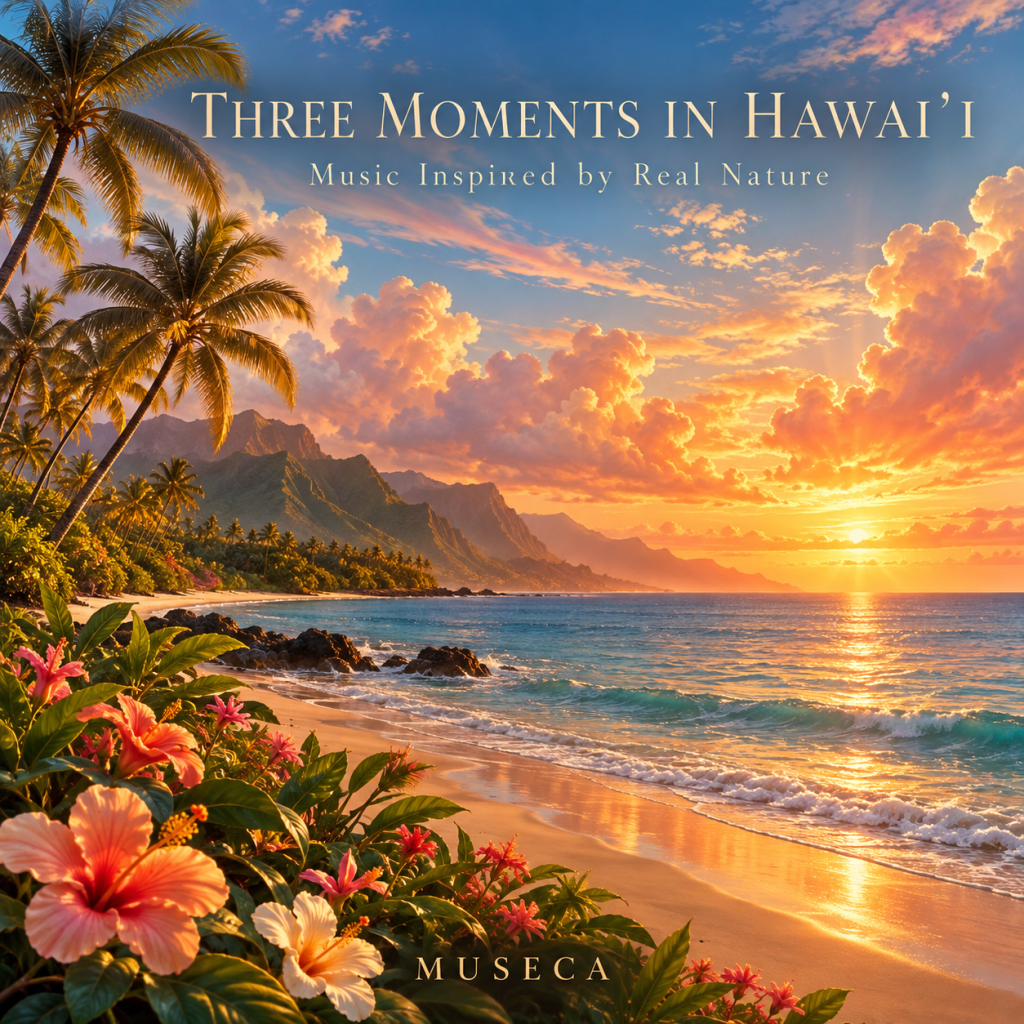
THREE MOMENTS IN HAWAIʻI Music Inspired by Real Nature
Three Moments in Hawaiʻi began not with a musical idea, but with three real encounters with the natural world.
Each film was recorded in Hawaiʻi as it happened: moonlight moving through clouds above the palms, trade winds bending the trees beneath a bright Pacific sky, and a sunset slowly dissolving into evening. The camera simply observed. Nothing was staged, and the music did not exist yet.
Only afterward did each scene become a composition.
The purpose of the project was to allow the natural world to determine the character of the music. Movement suggested rhythm. Light suggested harmony. Clouds, wind, water, and changing color suggested pacing, texture, and form. Rather than creating a soundtrack and then finding images to accompany it, the process was reversed: the visual experience came first, and the music was written in response to it.
The three works are therefore connected, but they are not variations on a single theme. Each has its own atmosphere and musical language because each began with a different moment.
The Moon Remains is built around stillness and contrast: the moon appears constant while clouds, palms, and the world beneath it continue to move.
Trade Winds is brighter and more kinetic, shaped by the visible force of wind passing through trees, sky, and ocean.
When the Sky Burns Slowly follows the opposite trajectory, moving toward quiet as sunlight fades and the horizon gradually releases its color.
Together, the three pieces form a brief visual and musical portrait of Hawaiʻi—not as a collection of familiar symbols, but as a sequence of observed moments in which nature itself becomes the first composer.
Museca
Liner Notes
The Moon Remains
There is something quietly reassuring about the moon at night. Clouds move across it. Palm fronds bend and shift below it. The ocean darkens and brightens as the light changes. Yet the moon itself seems almost untouched by everything happening around it.
The Moon Remains grew from that contrast.
The music does not try to imitate the image literally. Instead, it follows the feeling of watching something constant while everything else is in motion. The harmony moves slowly, the melodic lines unfold with restraint, and the atmosphere remains suspended between stillness and change.
The scene is nocturnal, but not lonely. It suggests continuity — the sense that some things remain present even when the world around them is restless.
Trade Winds
The trade winds are invisible until they move something.
In this film, their presence is everywhere: palm trees lean and recover, clouds shift across the sky, and the surface of the Pacific is never completely still. The landscape becomes animated by a force that cannot itself be seen.
The music of Trade Winds responds to that energy.
Its rhythms are lighter and more active, with a sense of forward motion that never becomes hurried. The instrumental textures move in layers, much as the wind passes through leaves, sky, and water at different speeds. The piece is less about depicting wind than about translating its character — buoyant, unpredictable, refreshing, and continuous.
Among the three works, this is the most outward-looking: bright, open, and alive with movement.
When the Sky Burns Slowly
Sunset is often treated as a climax, but this film suggested something different.
The sun gradually approaches the horizon and disappears. What follows is not an ending so much as a release. Warm color lingers in the sky, the ocean continues to move, and the landscape begins its slow transition toward evening.
When the Sky Burns Slowly was composed around that gradual transformation.
The opening retains warmth and luminosity, but the music progressively becomes more spacious. Harmonic tension softens. Instrumental textures thin. The emotional movement is not toward drama, but toward quiet acceptance.
The title refers not only to the color of the sky, but to the slowness of the change itself. Nothing happens abruptly. Light diminishes almost imperceptibly, and the music follows it until the scene becomes calmer than when it began.
Taken together, these three works form a small cycle of observation: permanence, movement, and release.
The moon remains. The wind passes through. The light fades.
Each moment is different, but each begins in the same place — with the natural world observed closely enough to suggest its own music.
Full Album
Three Moments in Hawaiʻi is a short visual album in which real scenes from the islands become the starting point for original music. Moonlight, trade winds, palms, clouds, ocean, and sunset were filmed first; each composition was then created in direct response to the movement, light, and atmosphere of the footage. Together, the three works form an intimate portrait of Hawaiʻi as observed through nature and translated into music.
Continue exploring
Carry the island light into another listening world
Continue with a breath-driven horizon, hear birds as musical partners, or follow seasonal imagery into a coastal reinterpretation.
Where Breath Meets the Horizon centers the harmonica as a human melodic presence. Another collection balances the small scale of breath with the breadth of an emotional landscape.
Voices of the Sky begins with real birdsong and builds responsive instrumental worlds around it. Compare music prompted by observed scenes with music composed around a natural voice.
Seasons of Light reframes Vivaldi through Mediterranean air and Balearic pulse. The recorded Hawaiian scenes open onto another approach to landscape, light, and changing atmosphere.