
Album Introduction
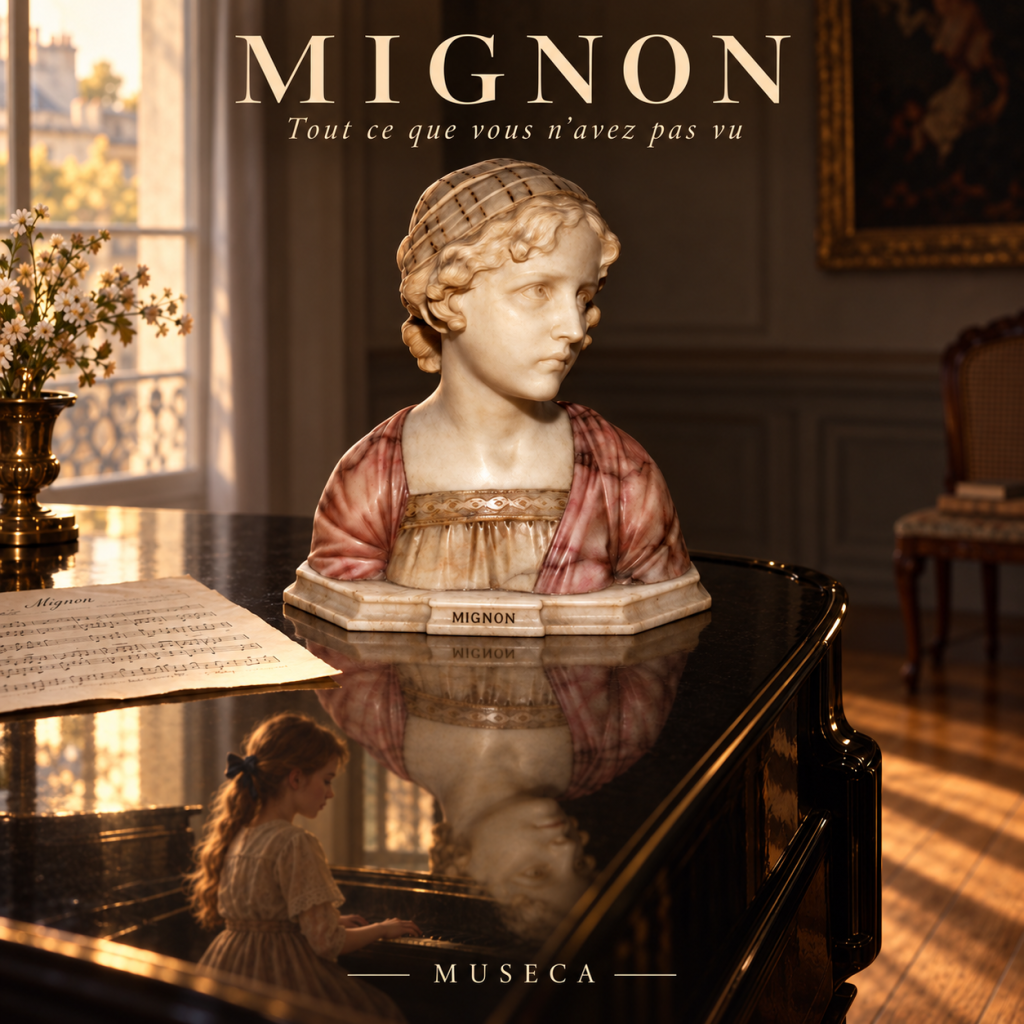
Many years ago, I walked into an antique store with my mother and saw a small sculpture of a young girl carved from pale stone. On its base was a single name:
Mignon.
I was immediately drawn to her. I remember telling my mother that I needed to take the sculpture home.
As I was paying for it, the shopkeeper told me that it had come from the estate of the actress Joan Fontaine and had been in her home for many years. I had no way then—and have no surviving documentation now—to establish the sculpture’s complete provenance independently, but I never forgot what I was told that day.
More importantly, I never forgot the girl.
For years I knew almost nothing about her. I simply knew the name carved into the stone: Mignon—a French word associated with something sweet, charming, dear, or darling. To me, she had always seemed like a beautiful young girl caught in a moment of quiet thought.
Only while creating this album did I search for the sculpture again and discover something I had never known: Mignon was a work associated with the Italian sculptor Giuseppe Bessi. The discovery made the object I had remembered for so long suddenly acquire a history of its own.
But the musical Mignon presented here is not an attempt to reconstruct Bessi’s sculpture literally.
She is the girl I imagined within it.
And the album began with one simple question:
What if Mignon had a voice?
The Girl Who Notices
In Tout ce que vous n’avez pas vu—Everything You Didn’t See—Mignon becomes a ten-year-old French-speaking girl who sings and plays piano.
She is not a child celebrity. She is not a theatrical prodigy. And these are not children’s songs.
Mignon simply notices things.
She notices the square of afternoon light slowly crossing a wooden floor.
She notices the elderly woman who puts bread outside for the birds every morning.
She notices that grown-ups sometimes say the rain will stop because they desperately want it to stop.
She notices when adults lower their voices in another room and understands, even without knowing the words, that something has changed.
She notices the perfume that remains after someone leaves.
She wonders where yesterday goes.
She notices the chair that remains beside a window after the person who once occupied it is no longer there.
And when the birds return in spring, she discovers that something can return without making the world exactly as it was before.
Mignon does not explain these things.
She observes them.
The meaning comes later.
Perhaps that is part of what childhood gives us: a brief period when we can look at the world before we have learned which things are supposedly important and which things we are expected to ignore.
Mignon has not yet learned to look away.
Music Made in Rooms
Unlike a conventional performer, Mignon does not belong primarily to a stage.
Her music happens in rooms.
Sometimes she is alone at the piano. At other times adult musicians quietly join her—a cellist, clarinetist, violist, flutist, guitarist, or bassist. There is no sense that they are accompanying a child novelty act. They simply listen to her as musicians listen to one another.
Mignon plays.
Someone waits for her phrase.
A cello answers.
A clarinet enters.
The song grows.
The musical language of the album combines intimate French chanson with chamber music, impressionistic harmony, piano, strings, woodwinds, and occasional restrained percussion. The arrangements become gradually broader as Mignon’s emotional world expands, then return at the end to the simplicity with which the album began.
At the center remains the same unmistakably young voice: gentle, clear, curious, and unforced.
Mignon never sings like an adult pretending to be a child.
She simply sings what she sees.
From Observation to Participation
The ten songs form a quiet emotional journey.
At first, Mignon is primarily an observer.
In “La lumière sur le parquet,” she watches sunlight cross the floor.
In “Madame Louise donne du pain aux oiseaux,” she sees an elderly woman repeating a small daily act of kindness.
In “Papa a dit que la pluie finirait,” she discovers that adults sometimes speak their hopes as though they were facts.
Then the album moves inward.
“Les adultes parlent doucement” introduces the unsettling realization that silence itself can communicate.
“Le parfum après ton départ” explores the way a person can remain present through the objects and sensations they leave behind.
In “Où va hier ?,” Mignon asks one of childhood’s enormous questions in the simplest possible terms:
Where does yesterday go?
By “La chaise près de la fenêtre,” absence has become visible. A chair remains exactly where it has always been, yet because someone no longer sits there, it is no longer the same chair.
Then something changes.
The birds return.
In “Les oiseaux sont revenus,” Mignon remembers Madame Louise feeding them and chooses to carry the bread downstairs herself.
For the first time, she does more than observe.
She participates.
The title song, “Tout ce que vous n’avez pas vu,” gathers these apparently small moments together: light, rain, trembling hands, empty places, forgotten objects, returning birds, things that remained visible while everyone else was looking elsewhere.
And finally, in “Je laisse la fenêtre ouverte,” Mignon returns to the piano.
But she is not quite the same girl who began the album.
At the beginning, she watched light enter a room.
At the end, she deliberately leaves the window open.
Everything You Didn’t See
The title is not an accusation.
Mignon is not telling adults that they have failed.
She is simply showing us what was there.
A movement of light.
A lowered voice.
An empty chair.
A little bread scattered for birds.
A familiar scent fading from a room.
A day becoming yesterday.
The strange thing about these moments is that they often seem unimportant while they are happening.
Only later do we understand that they were the substance of a life.
And perhaps this is why Mignon remained with me for so many years.
Long before there was an album, there was simply a small stone girl in an antique shop, seen one afternoon while I was with my mother.
I thought I was buying a sculpture.
Decades later, she became music.
And now the girl who had been silent for so long finally has something to tell us:
look again.
Liner Notes
La lumière sur le parquet (The Light on the Floorboards)
Mignon first appears alone at the piano, watching a patch of sunlight move slowly across the floor. Nothing dramatic happens, and that is precisely the point. Her attention gives significance to something everyone else might ignore. The sparse piano, suspended harmony, and youthful voice establish the intimate scale of the album: a child, a room, and the world quietly revealing itself.
Lyrics in French and English
[Verse 1]
Il y a du soleil par terre,
(There is sunlight on the floor,)
un carré près du fauteuil.
(a square beside the armchair.)
Il était là tout à l’heure,
(It was over there a little while ago,)
maintenant il touche le seuil.
(now it touches the threshold.)
Je crois qu’il avance tout seul,
(I think it moves all by itself,)
très doucement, sans faire de bruit.
(very slowly, without making a sound.)
Personne ne regarde par terre.
(No one is looking at the floor.)
Alors je regarde pour lui.
(So I watch it for them.)
[Chorus]
La lumière sur le parquet
(The light on the floorboards)
se promène dans la maison.
(wanders through the house.)
Elle passe sans rien demander,
(It passes without asking for anything,)
elle ne donne pas de raison.
(it gives no reason.)
La lumière sur le parquet,
(The light on the floorboards,)
personne ne la voit partir.
(no one sees it leave.)
Moi, je reste encore un peu
(I stay a little longer)
pour la regarder finir.
(to watch it come to an end.)
[Verse 2]
Elle a touché le vieux livre,
(It touched the old book,)
la table et le pied du piano.
(the table and the leg of the piano.)
Elle est montée sur ma chaussure
(It climbed onto my shoe)
comme si elle disait bonjour.
(as if it were saying hello.)
Puis elle devient plus petite.
(Then it becomes smaller.)
Je ne sais pas où elle va.
(I don’t know where it goes.)
Peut-être derrière les maisons,
(Maybe behind the houses,)
peut-être beaucoup plus loin que ça.
(maybe much farther away than that.)
[Chorus]
La lumière sur le parquet
(The light on the floorboards)
se promène dans la maison.
(wanders through the house.)
Elle passe sans rien demander,
(It passes without asking for anything,)
elle ne donne pas de raison.
(it gives no reason.)
La lumière sur le parquet,
(The light on the floorboards,)
personne ne la voit partir.
(no one sees it leave.)
Moi, je reste encore un peu
(I stay a little longer)
pour la regarder finir.
(to watch it come to an end.)
[Bridge]
Est-ce que la lumière se souvient
(Does the light remember)
des chambres où elle est passée ?
(the rooms it has passed through?)
Est-ce qu’elle sait
(Does it know)
que j’étais là ?
(that I was there?)
Moi, je m’en souviendrai.
(I will remember.)
[Final Chorus]
La lumière sur le parquet
(The light on the floorboards)
n’est presque plus là maintenant.
(is almost gone now.)
Il reste seulement une ligne
(Only a line remains)
qui tremble un peu dans le blanc.
(that trembles a little in the white light.)
[Outro]
Demain, si elle revient,
(Tomorrow, if it comes back,)
je regarderai encore.
(I will watch again.)
Madame Louise donne du pain aux oiseaux (Madame Louise Gives Bread to the Birds)
The musical room grows larger as cello and clarinet join Mignon. She observes Madame Louise, an elderly neighbor who faithfully feeds the birds each morning and remembers their arrival even when she sometimes forgets other things. The song introduces one of the album’s recurring ideas: small rituals can hold a life together. Madame Louise’s simple explanation—she feeds the birds because they return—will become far more meaningful later.
Lyrics in French and English
[Verse 1]
Madame Louise ouvre sa fenêtre
(Madame Louise opens her window)
tous les matins vers huit heures moins dix.
(every morning at about ten minutes to eight.)
Elle pose une soucoupe bleue
(She places a little blue saucer)
sur le rebord, juste ici.
(on the windowsill, right here.)
Elle garde les miettes du dîner
(She saves the crumbs from dinner)
dans un petit sac de papier.
(in a little paper bag.)
Et quand les moineaux la reconnaissent,
(And when the sparrows recognize her,)
ils viennent tous se disputer.
(they all come and squabble.)
[Chorus]
Madame Louise donne du pain aux oiseaux,
(Madame Louise gives bread to the birds,)
un morceau pour les petits,
(a piece for the little ones,)
un morceau pour les gros.
(a piece for the big ones.)
Elle leur parle tout doucement,
(She speaks to them very softly,)
comme s’ils connaissaient son nom.
(as if they knew her name.)
Madame Louise donne du pain aux oiseaux,
(Madame Louise gives bread to the birds,)
et les oiseaux lui répondent à leur façon.
(and the birds answer her in their own way.)
[Verse 2]
Parfois elle cherche ses lunettes
(Sometimes she looks for her glasses)
quand elles sont déjà sur son nez.
(when they are already on her nose.)
Elle rit quand je lui montre,
(She laughs when I point them out,)
puis elle dit : « Je le savais. »
(then she says, “I knew that.”)
Elle oublie où elle met ses clés,
(She forgets where she puts her keys,)
ou le livre qu’elle lisait hier,
(or the book she was reading yesterday,)
mais jamais l’heure où les moineaux
(but never the time when the sparrows)
se posent devant sa fenêtre.
(land outside her window.)
[Chorus]
Madame Louise donne du pain aux oiseaux,
(Madame Louise gives bread to the birds,)
un morceau pour les petits,
(a piece for the little ones,)
un morceau pour les gros.
(a piece for the big ones.)
Elle leur parle tout doucement,
(She speaks to them very softly,)
comme s’ils connaissaient son nom.
(as if they knew her name.)
Madame Louise donne du pain aux oiseaux,
(Madame Louise gives bread to the birds,)
et les oiseaux lui répondent à leur façon.
(and the birds answer her in their own way.)
[Bridge]
Je lui ai demandé un matin :
(One morning I asked her:)
« Pourquoi vous leur donnez toujours du pain ? »
(“Why do you always give them bread?”)
Elle a regardé les oiseaux,
(She looked at the birds,)
puis elle m’a regardée.
(then she looked at me.)
Elle a dit :
(She said:)
« Parce qu’ils reviennent. »
(“Because they come back.”)
[Verse 3]
Alors maintenant, quand je la vois
(So now, when I see her)
préparer son petit sac de papier,
(preparing her little paper bag,)
je regarde aussi par la fenêtre
(I look out the window too)
pour voir lesquels vont arriver.
(to see which ones will arrive.)
Il y en a un avec une plume blanche.
(There is one with a white feather.)
Je crois qu’elle le connaît très bien.
(I think she knows him very well.)
Elle l’appelle toujours « Monsieur Paul ».
(She always calls him “Monsieur Paul.”)
Je ne sais pas pourquoi.
(I don’t know why.)
[Final Chorus]
Madame Louise donne du pain aux oiseaux,
(Madame Louise gives bread to the birds,)
un morceau pour les petits,
(a piece for the little ones,)
un morceau pour les gros.
(a piece for the big ones.)
Elle leur parle tout doucement,
(She speaks to them very softly,)
comme s’ils connaissaient son nom.
(as if they knew her name.)
Madame Louise donne du pain aux oiseaux,
(Madame Louise gives bread to the birds,)
et les oiseaux lui répondent à leur façon.
(and the birds answer her in their own way.)
[Outro]
Demain matin, vers huit heures moins dix,
(Tomorrow morning, at about ten minutes to eight,)
je regarderai encore.
(I will watch again.)
Peut-être que Monsieur Paul
(Maybe Monsieur Paul)
sera le premier.
(will be the first.)
Papa a dit que la pluie finirait (Papa Said the Rain Would Stop)
Mignon discovers that adults sometimes speak their hopes with the certainty of facts. Her father confidently predicts that the rain will stop, while the rain continues with no apparent interest in his forecast. Piano, nylon-string guitar, viola, and brushed percussion create one of the album’s warmer and more playful moments. Beneath the humor lies an affectionate observation: grown-ups do not always know what will happen, but sometimes their attempts to reassure us are acts of love.
Lyrics in French and English
[Verse 1]
Papa a dit ce matin :
(Papa said this morning:)
« La pluie va bientôt finir. »
(“The rain will stop soon.”)
Il a regardé par la fenêtre
(He looked out the window)
comme s’il pouvait le savoir.
(as if he could know.)
J’ai mis mes bottes quand même,
(I put on my boots anyway,)
mon manteau bleu, mon chapeau gris.
(my blue coat, my gray hat.)
Quand j’ai ouvert la porte,
(When I opened the door,)
il pleuvait encore plus qu’avant midi.
(it was raining even harder than before noon.)
[Chorus]
Papa a dit que la pluie finirait.
(Papa said the rain would stop.)
Peut-être qu’elle n’a pas entendu.
(Maybe it didn’t hear him.)
Elle tombe encore sur les fenêtres,
(It is still falling on the windows,)
elle tombe encore dans la rue.
(it is still falling in the street.)
Papa a dit que le ciel changerait.
(Papa said the sky would change.)
Moi, j’attends pour voir un peu.
(I am waiting to see.)
Peut-être que la pluie a décidé
(Maybe the rain has decided)
de rester encore avec nous deux.
(to stay a little longer with the two of us.)
[Verse 2]
Papa a fait du chocolat chaud
(Papa made hot chocolate)
et il a posé deux tasses sur la table.
(and put two cups on the table.)
Il a dit : « Dans une heure, tu verras,
(He said, “In an hour, you’ll see,)
le soleil sera formidable. »
(the sunshine will be wonderful.”)
Une heure après, j’ai regardé.
(An hour later, I looked.)
Le ciel était toujours tout gris.
(The sky was still completely gray.)
Papa aussi a regardé dehors,
(Papa looked outside too,)
puis il m’a demandé si j’avais fini.
(then he asked me if I was finished.)
[Chorus]
Papa a dit que la pluie finirait.
(Papa said the rain would stop.)
Peut-être qu’elle n’a pas entendu.
(Maybe it didn’t hear him.)
Elle tombe encore sur les fenêtres,
(It is still falling on the windows,)
elle tombe encore dans la rue.
(it is still falling in the street.)
Papa a dit que le ciel changerait.
(Papa said the sky would change.)
Moi, j’attends pour voir un peu.
(I am waiting to see.)
Peut-être que la pluie a décidé
(Maybe the rain has decided)
de rester encore avec nous deux.
(to stay a little longer with the two of us.)
[Bridge]
Je crois que les grands disent parfois
(I think grown-ups sometimes say)
ce qu’ils espèrent très fort.
(what they are hoping for very strongly.)
Comme si les mots pouvaient pousser
(As if words could push)
les nuages dehors.
(the clouds away.)
Alors j’ai demandé à Papa :
(So I asked Papa:)
« Tu crois vraiment qu’elle va finir ? »
(“Do you really think it will stop?”)
Il a souri.
(He smiled.)
Il a dit :
(He said:)
« Un jour, sûrement. »
(“Someday, certainly.”)
Ça, je veux bien le croire.
(That, I can believe.)
[Verse 3]
Alors nous sommes restés dedans,
(So we stayed inside,)
avec nos deux tasses presque vides.
(with our two almost-empty cups.)
Papa lisait près de la fenêtre.
(Papa was reading by the window.)
Moi, je regardais tomber la pluie.
(I watched the rain fall.)
Et finalement je me suis dit
(And eventually I thought)
qu’elle pouvait rester si elle voulait.
(that it could stay if it wanted to.)
Parce qu’avec Papa et le chocolat,
(Because with Papa and the hot chocolate,)
ce n’était pas si mal qu’il pleuvait.
(it wasn’t so bad that it was raining.)
[Final Chorus]
Papa a dit que la pluie finirait.
(Papa said the rain would stop.)
Peut-être qu’elle n’a pas entendu.
(Maybe it didn’t hear him.)
Elle tombe encore sur les fenêtres,
(It is still falling on the windows,)
elle tombe encore dans la rue.
(it is still falling in the street.)
Mais maintenant, si elle veut rester,
(But now, if it wants to stay,)
ça ne me dérange plus beaucoup.
(I don’t mind very much anymore.)
Papa peut garder son soleil.
(Papa can keep his sunshine.)
Moi, j’ai la pluie et nous deux.
(I have the rain and the two of us.)
[Outro]
Demain matin,
(Tomorrow morning,)
je regarderai le ciel.
(I will look at the sky.)
Et si Papa dit :
(And if Papa says:)
« Je te l’avais bien dit »…
(“I told you so”…)
je ne dirai rien.
(I won’t say anything.)
Les adultes parlent doucement (Grown-Ups Speak Softly)
The atmosphere changes. Mignon hears adults lowering their voices in another room and realizes that quietness itself can communicate. She does not know exactly what has happened, but she understands expressions, gestures, silences, and the difference between someone saying “I’m fine” and actually being fine. Cello and bass clarinet darken the chamber palette without turning the song into melodrama. Mignon begins to perceive emotional realities that have not been explained to her.
Lyrics in French and English
[Verse 1]
Les adultes parlent doucement
(Grown-ups speak softly)
quand ils ne veulent pas qu’on entende.
(when they don’t want us to hear.)
Ils ferment un peu la porte
(They close the door a little)
et leurs phrases deviennent plus lentes.
(and their sentences become slower.)
Je connais pourtant leurs voix.
(But I know their voices.)
Je sais quand elles ont changé.
(I know when they have changed.)
Même si je ne comprends pas les mots,
(Even if I don’t understand the words,)
je sais quand quelque chose est arrivé.
(I know when something has happened.)
[Chorus]
Les adultes parlent doucement,
(Grown-ups speak softly,)
comme si le silence pouvait cacher
(as if silence could hide)
ce qu’ils ne veulent pas nous dire,
(what they don’t want to tell us,)
ce qu’ils ne savent pas expliquer.
(what they don’t know how to explain.)
Les adultes parlent doucement.
(Grown-ups speak softly.)
Moi, je n’écoute pas exprès.
(I am not listening on purpose.)
Mais quand une maison devient si calme,
(But when a house becomes so quiet,)
on entend même ce qui n’est pas dit.
(you can even hear what isn’t being said.)
[Verse 2]
Maman a posé sa tasse
(Mama put down her cup)
sans boire ce qu’il restait dedans.
(without drinking what was left inside.)
Papa regardait la fenêtre
(Papa was looking at the window)
depuis déjà très longtemps.
(and had been for a very long time.)
Puis quelqu’un a dit mon prénom.
(Then someone said my name.)
Après, personne n’a parlé.
(After that, no one spoke.)
J’ai regardé mes deux mains
(I looked at my two hands)
comme si elles pouvaient m’expliquer.
(as if they could explain it to me.)
[Chorus]
Les adultes parlent doucement,
(Grown-ups speak softly,)
comme si le silence pouvait cacher
(as if silence could hide)
ce qu’ils ne veulent pas nous dire,
(what they don’t want to tell us,)
ce qu’ils ne savent pas expliquer.
(what they don’t know how to explain.)
Les adultes parlent doucement.
(Grown-ups speak softly.)
Moi, je n’écoute pas exprès.
(I am not listening on purpose.)
Mais quand une maison devient si calme,
(But when a house becomes so quiet,)
on entend même ce qui n’est pas dit.
(you can even hear what isn’t being said.)
[Bridge]
Je voudrais leur dire
(I would like to tell them)
que je ne suis pas trop petite.
(that I am not too little.)
Je ne comprends peut-être pas tout.
(Maybe I don’t understand everything.)
Mais je comprends les visages.
(But I understand faces.)
Je comprends les mains
(I understand hands)
qui ne savent plus où se poser.
(that no longer know where to rest.)
Je comprends quand quelqu’un dit :
(I understand when someone says:)
« Ça va »
(“I’m fine”)
et que ce n’est pas vrai.
(and it isn’t true.)
[Verse 3]
Alors je suis restée près de la porte
(So I stayed near the door)
sans demander ce qui se passait.
(without asking what was happening.)
Maman m’a vue dans le couloir
(Mama saw me in the hallway)
et elle est venue m’embrasser.
(and she came and hugged me.)
Elle n’a rien expliqué.
(She didn’t explain anything.)
Moi non plus, je n’ai rien demandé.
(I didn’t ask anything either.)
Pendant un moment, dans ses bras,
(For a moment, in her arms,)
je n’avais plus besoin de savoir.
(I didn’t need to know anymore.)
[Final Chorus]
Les adultes parlent doucement,
(Grown-ups speak softly,)
peut-être pour nous protéger.
(maybe to protect us.)
Peut-être aussi parce que parfois
(Maybe also because sometimes)
ils ne savent pas quoi nous raconter.
(they don’t know what to tell us.)
Les adultes parlent doucement.
(Grown-ups speak softly.)
Moi, je n’écoute pas exprès.
(I am not listening on purpose.)
Mais quand quelqu’un me prend dans ses bras,
(But when someone takes me in their arms,)
je comprends déjà un peu mieux.
(I already understand a little better.)
[Outro]
Je n’ai toujours pas compris les mots.
(I still didn’t understand the words.)
Mais j’ai compris
(But I understood)
que quelque chose avait changé.
(that something had changed.)
Le parfum après ton départ (The Perfume After You Leave)
Absence acquires a physical presence. Someone has left, but their perfume remains, a cup is still on the table, and a chair still seems shaped by the person who once occupied it. Mignon wonders whether rooms and objects remember the people who pass through them. Piano, cello, celesta, and faint viola colors create a fragile suspended world in which memory seems to linger inside ordinary things. The identity of the absent person is deliberately left unknown.
Lyrics in French and English
[Verse 1]
Ton parfum est resté dans la chambre
(Your perfume stayed in the room)
même après que tu sois partie.
(even after you left.)
Il est encore près de la fenêtre,
(It is still near the window,)
un peu sur l’oreiller aussi.
(and a little on the pillow too.)
Ta tasse est toujours sur la table.
(Your cup is still on the table.)
Il reste un peu de thé au fond.
(There is a little tea left at the bottom.)
Je pourrais tout ranger maintenant,
(I could put everything away now,)
mais je préfère attendre encore.
(but I would rather wait a little longer.)
[Chorus]
Il reste toujours quelque chose
(There is always something left)
quand quelqu’un vient de partir.
(when someone has just gone.)
Un parfum, une tasse, une chaise,
(A perfume, a cup, a chair,)
des choses qui savent se souvenir.
(things that know how to remember.)
Il reste toujours quelque chose,
(There is always something left,)
même quand la porte s’est fermée.
(even when the door has closed.)
Je ne sais pas combien de temps
(I don’t know how long)
les choses savent nous garder.
(things know how to keep us.)
[Verse 2]
Ton manteau n’est plus sur la chaise,
(Your coat is no longer on the chair,)
mais la chaise a gardé sa place.
(but the chair has kept its place.)
Le coussin est encore un peu creux
(The cushion is still a little hollow)
là où tu posais ton bras.
(where you used to rest your arm.)
J’ai ouvert la fenêtre un moment
(I opened the window for a moment)
pour laisser entrer un peu d’air.
(to let a little air come in.)
Puis je l’ai refermée très vite.
(Then I closed it again very quickly.)
Je ne voulais pas tout faire disparaître.
(I didn’t want to make everything disappear.)
[Chorus]
Il reste toujours quelque chose
(There is always something left)
quand quelqu’un vient de partir.
(when someone has just gone.)
Un parfum, une tasse, une chaise,
(A perfume, a cup, a chair,)
des choses qui savent se souvenir.
(things that know how to remember.)
Il reste toujours quelque chose,
(There is always something left,)
même quand la porte s’est fermée.
(even when the door has closed.)
Je ne sais pas combien de temps
(I don’t know how long)
les choses savent nous garder.
(things know how to keep us.)
[Bridge]
Est-ce qu’une chambre se souvient
(Does a room remember)
des personnes qui l’ont habitée ?
(the people who lived in it?)
Est-ce qu’un oreiller peut garder
(Can a pillow keep)
un rêve après qu’on s’est levé ?
(a dream after someone has gotten up?)
Est-ce que les murs savent
(Do the walls know)
qui a ri ici ?
(who laughed here?)
Moi, je crois que oui.
(I think they do.)
[Verse 3]
Ce soir la chambre sera plus sombre.
(Tonight the room will be darker.)
Le soleil passera de l’autre côté.
(The sun will pass to the other side.)
Mais peut-être que demain matin,
(But maybe tomorrow morning,)
ton parfum sera encore resté.
(your perfume will still be there.)
Et s’il disparaît peu à peu,
(And if it slowly disappears,)
je crois que ce n’est pas grave.
(I don’t think that’s so bad.)
Parce que maintenant je sais
(Because now I know)
où le retrouver quand je ferme les yeux.
(where to find it when I close my eyes.)
[Final Chorus]
Il reste toujours quelque chose
(There is always something left)
quand quelqu’un vient de partir.
(when someone has gone.)
Un parfum, une tasse, une chaise,
(A perfume, a cup, a chair,)
des choses qui savent se souvenir.
(things that know how to remember.)
Il reste toujours quelque chose,
(There is always something left,)
même quand on ne le voit plus.
(even when we can no longer see it.)
Peut-être que certaines choses restent
(Maybe some things remain)
simplement autrement qu’avant.
(simply in a different way than before.)
[Outro]
Ton parfum est presque parti.
(Your perfume is almost gone.)
Mais pas toi.
(But not you.)
Pas encore.
(Not yet.)
Où va hier ? (Where Does Yesterday Go?)
At the conceptual center of the album, Mignon turns her attention toward time itself. Where does yesterday go once today begins? Where do spoken words go after the room becomes quiet? What happens to forgotten things? The fuller chamber setting of piano, clarinet, viola, cello, and soft strings gives her questions a wider space without answering them. Mignon does not attempt philosophy; she simply asks the questions that adults often learn to stop asking.
Lyrics in French and English
[Verse 1]
Hier était là ce matin,
(Yesterday was here this morning,)
enfin… je crois que c’était hier.
(well… I think it was yesterday.)
J’ai mangé une pomme à la cuisine,
(I ate an apple in the kitchen,)
et il pleuvait encore dehors.
(and it was still raining outside.)
Puis j’ai dormi toute la nuit.
(Then I slept all night.)
Le matin est arrivé.
(Morning arrived.)
Mais où est parti tout ce temps
(But where did all that time go)
quand aujourd’hui a commencé ?
(when today began?)
[Chorus]
Où va hier
(Where does yesterday go)
quand aujourd’hui prend sa place ?
(when today takes its place?)
Est-ce qu’il reste quelque part,
(Does it remain somewhere,)
ou bien est-ce qu’il s’efface ?
(or does it simply fade away?)
Où va hier
(Where does yesterday go)
quand on ne peut plus le toucher ?
(when we can no longer touch it?)
Est-ce qu’un jour peut disparaître
(Can a day disappear)
sans vraiment s’en aller ?
(without really going away?)
[Verse 2]
Les mots qu’on a dits hier,
(The words we said yesterday,)
où sont-ils maintenant ?
(where are they now?)
Est-ce qu’ils restent dans la chambre
(Do they remain in the room)
après que les gens sont partis ?
(after the people have left?)
Et les rires de la semaine dernière,
(And the laughter from last week,)
est-ce qu’ils sont encore dans l’air ?
(is it still in the air?)
Si je revenais au même endroit,
(If I went back to the same place,)
est-ce que je pourrais les entendre ?
(could I hear it?)
[Chorus]
Où va hier
(Where does yesterday go)
quand aujourd’hui prend sa place ?
(when today takes its place?)
Est-ce qu’il reste quelque part,
(Does it remain somewhere,)
ou bien est-ce qu’il s’efface ?
(or does it simply fade away?)
Où va hier
(Where does yesterday go)
quand on ne peut plus le toucher ?
(when we can no longer touch it?)
Est-ce qu’un jour peut disparaître
(Can a day disappear)
sans vraiment s’en aller ?
(without really going away?)
[Bridge]
Peut-être qu’hier
(Maybe yesterday)
ne va nulle part.
(doesn’t go anywhere.)
Peut-être qu’il devient
(Maybe it becomes)
ce dont on se souvient.
(what we remember.)
Mais alors…
(But then…)
qu’est-ce qui arrive
(what happens)
aux choses qu’on oublie ?
(to the things we forget?)
Est-ce qu’elles continuent
(Do they continue)
sans nous ?
(without us?)
[Verse 3]
J’ai retrouvé sous mon lit
(I found under my bed)
un ruban que j’avais perdu.
(a ribbon I had lost.)
Je ne pensais plus à lui,
(I wasn’t thinking about it anymore,)
mais lui était toujours là.
(but it was still there.)
Alors peut-être que les jours aussi
(So maybe days too)
restent quelque part en silence.
(remain somewhere in silence.)
Pas dans une boîte,
(Not in a box,)
pas sous le lit…
(not under the bed…)
mais dans un endroit
(but in a place)
que je ne connais pas encore.
(that I don’t know yet.)
[Final Chorus]
Où va hier
(Where does yesterday go)
quand aujourd’hui prend sa place ?
(when today takes its place?)
Peut-être qu’il reste avec nous
(Maybe it stays with us)
d’une manière qu’on ne voit pas.
(in a way we cannot see.)
Où va hier
(Where does yesterday go)
quand on ne peut plus le toucher ?
(when we can no longer touch it?)
Je ne connais pas la réponse.
(I don’t know the answer.)
Mais demain,
(But tomorrow,)
je pourrai encore demander.
(I can ask again.)
[Outro]
Demain deviendra aujourd’hui.
(Tomorrow will become today.)
Et aujourd’hui deviendra hier.
(And today will become yesterday.)
C’est drôle.
(It’s strange.)
La chaise près de la fenêtre (The Chair by the Window)
A familiar chair remains exactly where it has always been, yet it is no longer the same because the person who sat there is absent. Mignon does not know what should happen to the chair, whether someone else should sit there, or how long a place can continue belonging to someone who no longer occupies it. Piano, low cello, and bass clarinet leave considerable silence around her voice. This is the album’s quietest confrontation with loss.
Lyrics in French and English
[Verse 1]
Il y a une chaise près de la fenêtre.
(There is a chair by the window.)
Elle était toujours occupée.
(It was always occupied.)
Quelqu’un s’asseyait là chaque matin
(Someone sat there every morning)
pour regarder la rue se réveiller.
(to watch the street wake up.)
Maintenant la chaise est toujours là.
(Now the chair is still there.)
Personne ne l’a déplacée.
(No one has moved it.)
Mais depuis quelques jours, je trouve
(But for the past few days, I think)
qu’elle n’est plus tout à fait pareille.
(it isn’t quite the same anymore.)
[Chorus]
La chaise près de la fenêtre
(The chair by the window)
attend quelqu’un qui ne vient pas.
(is waiting for someone who does not come.)
Les gens passent devant sans regarder.
(People walk past without looking.)
Moi, je la regarde chaque fois.
(I look at it every time.)
La chaise près de la fenêtre
(The chair by the window)
n’a rien fait pour être triste.
(has done nothing to be sad.)
Elle est simplement restée là,
(It has simply remained there,)
à la place où quelqu’un n’est plus.
(in the place where someone no longer is.)
[Verse 2]
Le coussin garde encore sa forme.
(The cushion still keeps its shape.)
Un livre est posé juste à côté.
(A book is lying right beside it.)
Il y a même une petite marque
(There is even a little mark)
sur le bois de l’accoudoir usé.
(on the wood of the worn armrest.)
Je pourrais m’asseoir à cette place.
(I could sit in that place.)
Personne ne m’a dit de ne pas le faire.
(No one told me not to.)
Mais quand je m’approche de la chaise,
(But when I approach the chair,)
je préfère rester debout derrière.
(I prefer to stand behind it.)
[Chorus]
La chaise près de la fenêtre
(The chair by the window)
attend quelqu’un qui ne vient pas.
(is waiting for someone who does not come.)
Les gens passent devant sans regarder.
(People walk past without looking.)
Moi, je la regarde chaque fois.
(I look at it every time.)
La chaise près de la fenêtre
(The chair by the window)
n’a rien fait pour être triste.
(has done nothing to be sad.)
Elle est simplement restée là,
(It has simply remained there,)
à la place où quelqu’un n’est plus.
(in the place where someone no longer is.)
[Bridge]
Est-ce qu’une place
(Does a place)
appartient encore à quelqu’un
(still belong to someone)
quand cette personne n’est plus là ?
(when that person is no longer there?)
Est-ce qu’on doit attendre
(Should we wait)
avant de s’y asseoir ?
(before sitting there?)
Et combien de temps
(And how long)
faut-il attendre ?
(should we wait?)
Personne ne m’a expliqué.
(No one explained it to me.)
[Verse 3]
Ce matin, le soleil est entré
(This morning, the sunlight came in)
et il est tombé sur la chaise.
(and fell on the chair.)
Pendant un instant, j’ai cru voir
(For a moment, I thought I saw)
une main posée sur l’accoudoir.
(a hand resting on the armrest.)
Mais ce n’était que la lumière.
(But it was only the light.)
Je le savais.
(I knew that.)
Alors je suis restée près de la fenêtre
(So I stayed by the window)
jusqu’à ce qu’elle parte elle aussi.
(until it left too.)
[Final Chorus]
La chaise près de la fenêtre
(The chair by the window)
attend peut-être, ou peut-être pas.
(may be waiting, or maybe not.)
Je ne sais pas ce que pensent les chaises.
(I don’t know what chairs think.)
Je sais seulement ce que je vois.
(I only know what I see.)
Elle est encore près de la fenêtre.
(It is still by the window.)
La rue continue comme avant.
(The street goes on as before.)
Mais dans la pièce, il manque quelque chose
(But something is missing from the room)
que personne ne peut déplacer.
(that no one can move.)
[Outro]
Demain,
(Tomorrow,)
la chaise sera encore là.
(the chair will still be there.)
Je crois.
(I think.)
Moi aussi.
(Me too.)
Les oiseaux sont revenus (The Birds Have Come Back)
After the stillness of the previous songs, movement returns. The birds come back to the old wall and the familiar window, but Madame Louise’s window remains closed. Mignon begins to understand that returning does not mean restoring the past exactly as it was. Remembering what Madame Louise once did, she takes bread downstairs and feeds the birds herself. Flute, pizzicato cello, viola, and light percussion bring air and motion back into the music. For the first time, Mignon moves from observation into participation.
Lyrics in French and English
[Verse 1]
Ce matin, j’ai entendu quelque chose
(This morning, I heard something)
avant même d’ouvrir les rideaux.
(before I even opened the curtains.)
Un petit bruit près de la fenêtre,
(A little sound near the window,)
puis un autre un peu plus haut.
(then another a little higher up.)
J’ai regardé dans la cour.
(I looked into the courtyard.)
Ils étaient là, sur le vieux mur.
(They were there, on the old wall.)
Trois moineaux, peut-être quatre,
(Three sparrows, maybe four,)
comme s’ils n’étaient jamais partis.
(as if they had never left.)
[Chorus]
Les oiseaux sont revenus.
(The birds have come back.)
Je ne sais pas d’où ils reviennent.
(I don’t know where they are coming back from.)
Ils connaissent encore la fenêtre,
(They still know the window,)
ils connaissent encore le chemin.
(they still know the way.)
Les oiseaux sont revenus.
(The birds have come back.)
Le ciel paraît un peu plus grand.
(The sky seems a little bigger.)
Ils ne savent peut-être pas
(Maybe they don’t know)
qu’ici, des choses ont changé.
(that things here have changed.)
[Verse 2]
J’ai pensé à Madame Louise
(I thought of Madame Louise)
et à son petit sac de papier.
(and her little paper bag.)
Pendant un instant, j’ai attendu
(For a moment, I waited)
de voir sa fenêtre s’ouvrir.
(to see her window open.)
Mais la fenêtre est restée fermée.
(But the window remained closed.)
Les oiseaux, eux, sont restés là.
(The birds stayed there.)
L’un d’eux avait une plume blanche.
(One of them had a white feather.)
Alors j’ai pensé :
(So I thought:)
« Monsieur Paul. »
(“Monsieur Paul.”)
[Chorus]
Les oiseaux sont revenus.
(The birds have come back.)
Je ne sais pas d’où ils reviennent.
(I don’t know where they are coming back from.)
Ils connaissent encore la fenêtre,
(They still know the window,)
ils connaissent encore le chemin.
(they still know the way.)
Les oiseaux sont revenus.
(The birds have come back.)
Le ciel paraît un peu plus grand.
(The sky seems a little bigger.)
Ils ne savent peut-être pas
(Maybe they don’t know)
qu’ici, des choses ont changé.
(that things here have changed.)
[Bridge]
Je croyais que revenir
(I thought coming back)
voulait dire recommencer.
(meant starting again.)
Mais peut-être que revenir,
(But maybe coming back)
c’est retrouver quelque chose
(means finding something again)
qui n’est plus tout à fait pareil.
(that is no longer quite the same.)
Peut-être que nous aussi
(Maybe we too)
nous revenons différents.
(come back different.)
[Verse 3]
Alors j’ai pris un morceau de pain
(So I took a piece of bread)
et je suis descendue dans la cour.
(and went down into the courtyard.)
Je l’ai cassé en petits morceaux,
(I broke it into little pieces,)
comme je l’avais vue faire un jour.
(the way I had once seen her do.)
Les oiseaux ont attendu un peu.
(The birds waited for a moment.)
Puis le premier est descendu.
(Then the first one came down.)
Ce n’était peut-être pas Monsieur Paul.
(Maybe it wasn’t Monsieur Paul.)
Mais je lui ai donné du pain quand même.
(But I gave him bread anyway.)
[Final Chorus]
Les oiseaux sont revenus.
(The birds have come back.)
Ils ont retrouvé le vieux mur.
(They found the old wall again.)
Ils ont retrouvé notre fenêtre
(They found our window again)
et le morceau de ciel au-dessus.
(and the patch of sky above it.)
Les oiseaux sont revenus.
(The birds have come back.)
Moi aussi, je suis encore ici.
(I am still here too.)
Ce n’est pas exactement comme avant.
(It isn’t exactly the way it was before.)
Mais c’est beau quand même,
(But it is beautiful anyway,)
aujourd’hui.
(today.)
[Outro]
Demain,
(Tomorrow,)
je garderai quelques miettes.
(I will save a few crumbs.)
On ne sait jamais
(You never know)
qui peut revenir.
(who might come back.)
Tout ce que vous n’avez pas vu (Everything You Didn’t See)
The title track gathers the album’s small images into a single field of attention: the light on the floor, lowered voices, a trembling hand, a cup left behind, an empty chair, bread given to birds, the rain that would not stop, and the things that return altered. The album’s fullest chamber ensemble surrounds Mignon without overwhelming her. She does not accuse anyone of failing to see. She simply suggests that many important things were never hidden at all. Perhaps people were only looking somewhere else.
Lyrics in French and English
[Verse 1]
Vous n’avez peut-être pas vu
(Maybe you didn’t see)
la lumière traverser le parquet,
(the light crossing the floorboards,)
ni le petit carré de soleil
(or the little square of sunlight)
qui changeait de place sans parler.
(that moved without speaking.)
Vous n’avez peut-être pas entendu
(Maybe you didn’t hear)
quand les voix devenaient plus basses,
(when the voices became quieter,)
ou remarqué qu’une tasse restait
(or notice that a cup remained)
longtemps après qu’on quitte sa place.
(long after someone had left their place.)
[Chorus]
Tout ce que vous n’avez pas vu
(Everything you didn’t see)
était pourtant juste à côté :
(was right there beside you:)
la lumière, une main qui tremble,
(the light, a trembling hand,)
un morceau de pain partagé.
(a piece of bread being shared.)
Tout ce que vous n’avez pas vu
(Everything you didn’t see)
n’était pas caché, je crois.
(wasn’t hidden, I think.)
Peut-être que vous regardiez trop loin
(Maybe you were looking too far away)
pendant que c’était là.
(while it was right there.)
[Verse 2]
Vous n’avez peut-être pas vu
(Maybe you didn’t see)
la chaise près de la fenêtre,
(the chair by the window,)
ni compris pourquoi personne
(or understand why no one)
ne voulait encore s’y asseoir.
(wanted to sit there yet.)
Vous n’avez peut-être pas senti
(Maybe you didn’t notice)
le parfum resté dans une chambre,
(the perfume left behind in a room,)
ou pensé qu’un objet ordinaire
(or think that an ordinary object)
pouvait se souvenir de quelqu’un.
(could remember someone.)
[Chorus]
Tout ce que vous n’avez pas vu
(Everything you didn’t see)
était pourtant juste à côté :
(was right there beside you:)
la lumière, une main qui tremble,
(the light, a trembling hand,)
un morceau de pain partagé.
(a piece of bread being shared.)
Tout ce que vous n’avez pas vu
(Everything you didn’t see)
n’était pas caché, je crois.
(wasn’t hidden, I think.)
Peut-être que vous regardiez trop loin
(Maybe you were looking too far away)
pendant que c’était là.
(while it was right there.)
[Bridge]
Je ne sais pas si je vois mieux.
(I don’t know if I see better.)
Peut-être que je suis seulement
(Maybe I am simply)
un peu plus près.
(a little closer.)
Peut-être que les enfants regardent
(Maybe children look at)
les choses avant de savoir
(things before they know)
lesquelles sont importantes.
(which ones are important.)
Et peut-être qu’après,
(And maybe afterward,)
on apprend à regarder ailleurs.
(we learn to look somewhere else.)
Mais les choses restent là.
(But the things remain there.)
[Verse 3]
J’ai vu Madame Louise sourire
(I saw Madame Louise smile)
aux oiseaux près de sa fenêtre.
(at the birds near her window.)
J’ai vu les mêmes oiseaux revenir
(I saw the same birds return)
quand sa fenêtre ne s’ouvrait plus.
(when her window no longer opened.)
J’ai vu la pluie rester tout le jour,
(I saw the rain stay all day,)
même quand Papa disait le contraire.
(even when Papa said otherwise.)
Et j’ai vu qu’on pouvait être heureux
(And I saw that we could be happy)
sans obliger le ciel à changer.
(without making the sky change.)
J’ai appris qu’hier disparaît
(I learned that yesterday disappears)
sans vraiment partir tout à fait.
(without ever completely going away.)
Et qu’une chose peut revenir
(And that something can return)
sans redevenir comme avant.
(without becoming the way it was before.)
[Final Chorus]
Tout ce que vous n’avez pas vu
(Everything you didn’t see)
était pourtant juste à côté :
(was right there beside you:)
un regard, une place vide,
(a glance, an empty place,)
quelqu’un qui revient transformé.
(someone returning changed.)
Tout ce que vous n’avez pas vu,
(Everything you didn’t see,)
je ne l’ai pas tout compris non plus.
(I didn’t understand all of it either.)
Mais parfois il suffit de rester
(But sometimes it is enough to stay)
un peu plus longtemps devant ce qu’on a vu.
(a little longer with what we have seen.)
Tout ce que vous n’avez pas vu
(Everything you didn’t see)
n’était pas caché, je crois.
(wasn’t hidden, I think.)
Il fallait seulement regarder
(You only had to look)
avant que ça ne soit plus là.
(before it was no longer there.)
[Outro]
Alors demain,
(So tomorrow,)
je regarderai encore.
(I will look again.)
Pas parce que j’ai peur d’oublier.
(Not because I am afraid of forgetting.)
Juste parce que c’est là.
(Just because it is there.)
Je laisse la fenêtre ouverte (I Leave the Window Open)
The album ends where it began: with Mignon at the piano. But her relationship to the world has changed. She now knows that some things return and some do not, that memory can remain after objects disappear, and that not everything must be understood in order to be accepted. A cello enters only late in the song, leaving most of the music to Mignon and the piano. At the beginning of the album, she watched light enter the room. At the end, she deliberately leaves the window open and makes space for whatever may come next.
Mignon does not finish the album with an answer. She finishes with attention.
Lyrics in French and English
[Verse 1]
Ce matin, j’ai ouvert la fenêtre
(This morning, I opened the window)
avant même de faire mon lit.
(before I even made my bed.)
L’air était déjà un peu chaud.
(The air was already a little warm.)
Les rideaux ont bougé tout seuls.
(The curtains moved by themselves.)
Dans la rue, quelqu’un riait.
(In the street, someone was laughing.)
Un vélo est passé très vite.
(A bicycle went by very quickly.)
Un oiseau s’est posé un instant
(A bird landed for a moment)
sur le bord du toit d’en face.
(on the edge of the roof across the way.)
Je n’ai rien fait.
(I did nothing.)
J’ai seulement écouté.
(I simply listened.)
[Chorus]
Je laisse la fenêtre ouverte
(I leave the window open)
pour que le jour puisse entrer.
(so the day can come in.)
Je ne sais pas ce qu’il apportera.
(I don’t know what it will bring.)
Je n’ai pas besoin de savoir.
(I don’t need to know.)
Je laisse la fenêtre ouverte.
(I leave the window open.)
Le rideau bouge doucement.
(The curtain moves gently.)
Tout ce qui vient peut rester un peu,
(Everything that comes can stay for a while,)
puis repartir quand vient le moment.
(and then leave when the time comes.)
[Verse 2]
Il y a des choses qui reviennent
(There are things that return)
et d’autres qui ne reviennent pas.
(and others that do not.)
Il y a des voix qu’on entend encore
(There are voices we can still hear)
même quand elles ne parlent plus.
(even when they no longer speak.)
Il y a des chaises qui restent vides,
(There are chairs that remain empty,)
des parfums qui finissent par partir,
(perfumes that eventually fade away,)
des oiseaux qui retrouvent une fenêtre,
(birds that find a window again,)
des jours qu’on ne peut pas retenir.
(days that cannot be held back.)
Je pensais qu’il fallait comprendre
(I thought we had to understand)
pour ne pas avoir peur.
(so that we wouldn’t be afraid.)
Maintenant,
(Now,)
je ne crois plus.
(I don’t think so anymore.)
[Chorus]
Je laisse la fenêtre ouverte
(I leave the window open)
pour que le jour puisse entrer.
(so the day can come in.)
Je ne sais pas ce qu’il apportera.
(I don’t know what it will bring.)
Je n’ai pas besoin de savoir.
(I don’t need to know.)
Je laisse la fenêtre ouverte.
(I leave the window open.)
Le rideau bouge doucement.
(The curtain moves gently.)
Tout ce qui vient peut rester un peu,
(Everything that comes can stay for a while,)
puis repartir quand vient le moment.
(and then leave when the time comes.)
[Bridge]
Peut-être que tout ne reste pas.
(Maybe not everything stays.)
Peut-être que ce n’est pas nécessaire.
(Maybe it doesn’t need to.)
La lumière part.
(The light leaves.)
Puis une autre revient.
(Then another light returns.)
La pluie finit.
(The rain ends.)
Puis un autre jour commence.
(Then another day begins.)
Les oiseaux s’en vont.
(The birds go away.)
Et parfois,
(And sometimes,)
ils reviennent.
(they return.)
Moi aussi,
(Me too,)
je change un peu.
(I change a little.)
[Verse 3]
Alors aujourd’hui,
(So today,)
je ne fermerai pas la fenêtre.
(I will not close the window.)
Même si le vent déplace mes feuilles.
(Even if the wind moves my papers.)
Même s’il fait tomber mon crayon.
(Even if it knocks down my pencil.)
Même si quelque chose entre
(Even if something comes in)
que je n’avais pas prévu.
(that I wasn’t expecting.)
Je crois que ça ira.
(I think it will be all right.)
[Final Chorus]
Je laisse la fenêtre ouverte
(I leave the window open)
pour que le monde puisse entrer.
(so the world can come in.)
Pas tout le monde à la fois.
(Not all of it at once.)
Juste ce qui vient.
(Just whatever comes.)
Je laisse la fenêtre ouverte
(I leave the window open)
et je retourne au piano.
(and I go back to the piano.)
Le jour continuera dehors.
(The day will continue outside.)
Moi aussi.
(Me too.)
[Outro]
Si la lumière revient sur le parquet,
(If the light returns to the floorboards,)
je la regarderai.
(I will watch it.)
Mais cette fois,
(But this time,)
je laisserai aussi
(I will also leave)
la fenêtre ouverte.
(the window open.)
Playlist
- Track 1 — La lumière sur le parquet Museca 3:35
- Track 2 — Madame Louise donne du pain aux oiseaux Museca 3:47
- Track 3 — Papa a dit que la pluie finirait Museca 4:24
- Track 4 — Les adultes parlent doucement Museca 4:38
- Track 5 — Le parfum après ton départ Museca 4:35
- Track 6 — Où va hier ? Museca 5:04
- Track 7 — La chaise près de la fenêtre Museca 5:10
- Track 8 — Les oiseaux sont revenus Museca 4:38
- Track 9 — Tout ce que vous n’avez pas vu Museca 5:28
- Track 10 — Je laisse la fenêtre ouverte Museca 4:55