
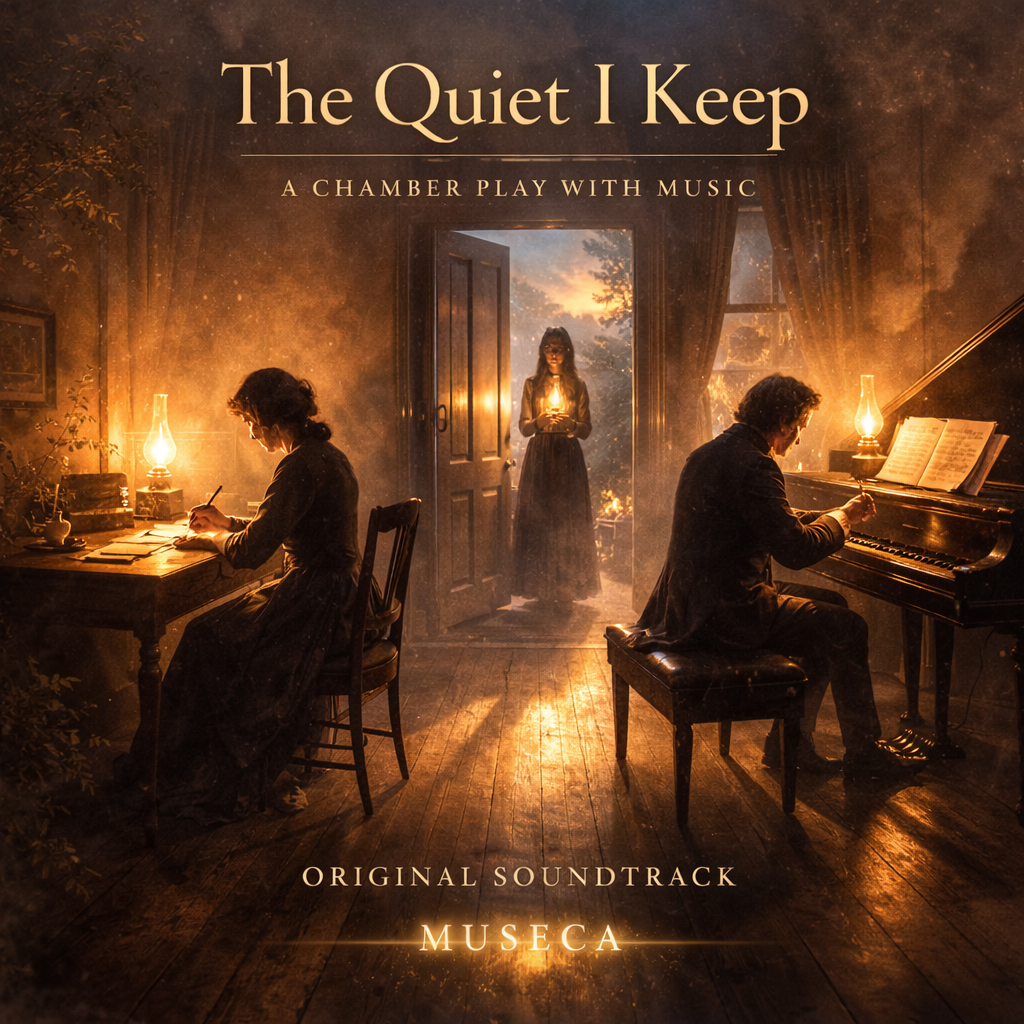
The Quiet I Keep
A Chamber Play with Music
Overview
The Quiet I Keep is an original chamber play with music inspired by the historical relationship between Frédéric Chopin and George Sand—one of the most compelling artistic partnerships of the nineteenth century. Chopin, the inward and fragile composer, and Sand, the brilliant, formidable novelist and public intellectual, are often remembered as a familiar legend: genius and caretaker, invalid and protector, artist and witness. This work begins with that history and reimagines it as an intimate theatrical world shaped not only by love and art, but by illness, labor, memory, silence, and the emotional cost of living beside brilliance.
Rather than offering a conventional historical biography, The Quiet I Keep enters the private spaces history tends to leave behind: the rooms, letters, stairways, thresholds, gestures of care, unfinished arguments, and silences that shape a life more powerfully than public events. It is a work of emotional interiority, where what is unspoken often matters as much as what is said.
Story Summary
For readers who do not wish to read the full Prose Version or Staged Script Version, the story unfolds as a chamber portrait of a relationship under increasing pressure.
The play begins at Nohant, George Sand’s country estate, where memory itself seems to linger in the room. From there it moves backward into the early Paris years: salons, admiration, wit, attraction, and the first emergence of intimacy between Sand and Chopin. What begins as fascination deepens into a relationship in which music, intellect, illness, domesticity, and public life become inseparable.
As the relationship develops, Sand takes on more than the role of lover. She becomes organizer, protector, practical caretaker, and architect of the emotional and physical space that allows Chopin to survive and work. Their journey to Mallorca becomes a major turning point: what should have been a healing retreat becomes a place of damp stone, cold air, worsening illness, and emotional strain. Love begins to transform into maintenance; admiration into burden; devotion into structure.
The middle of the play follows the household life at Nohant, where artistic life, family tensions, and private resentment begin to coexist. Solange, so often peripheral in simplified accounts, becomes a central emotional witness—watching, absorbing, and suffering the consequences of the adults’ unspoken conflicts. Paris remains a distant pull: ambition, selfhood, performance, freedom, and escape. As the play moves toward separation, it does so not through one single rupture but through a series of smaller thresholds—exits, omissions, compromises, and narratives that begin to harden around the living before life is fully over.
By the end, the play asks who gets remembered truthfully, who gets turned into legend, and what remains in the silence between the official story and the lived one.
The Music
The score of The Quiet I Keep is written for an intimate chamber ensemble:
Onstage Piano
Cello
Clarinet / Bass Clarinet
Flute / Piccolo
The musical language is rooted in a chamber-theatre aesthetic: original songs shaped by the emotional and harmonic atmosphere of Chopin’s world, but written for dramatic clarity and theatrical intimacy rather than operatic spectacle or Broadway scale. The score favors breath, motif, silence, and emotional precision. Songs emerge from argument, memory, labor, confession, irony, and grief. Silence is treated as an active musical element.
The soundtrack is not simply accompaniment to the play—it is one of its narrative engines. Songs such as “The Weight of a Key,” “Inventory of Care,” “Winter Island,” “Lessons in Distance,” “The House of Roles,” and “The Quiet Between the Pages” form an emotional arc from intimacy to fracture to remembrance. The result is a work that can be experienced both as a theatrical narrative and as a complete chamber song cycle.
Major Characters
George Sand
Writer, mother, lover, nurse, strategist, and witness. In this work, she is not only the famous author but the central consciousness struggling to balance love, artistic identity, practical duty, and the need to preserve her own interior life.
Frédéric Chopin
Composer, invalid, public legend, private man. He is presented not as a static icon of illness and genius, but as a living, thinking, vulnerable artist caught between the body’s weakness and the soul’s refinement.
Solange
Daughter, observer, and keeper of what others fail to record. Her presence gives the play one of its most important emotional dimensions: the child who grows up inside other people’s greatness and inherits their silence.
The Reader / Witnessing Presence
In the Epilogue and memory structure of the play, the act of reading and remembering becomes part of the drama itself. The story is not only lived—it is later assembled, softened, interpreted, and passed on.
Themes
Love and Labor
The play asks what love becomes when it must also function as care, management, endurance, and sacrifice.
Illness and Intimacy
Physical fragility is not treated merely as tragedy, but as a force that reshapes relationships, time, household structure, and artistic life.
Authorship and Memory
Who gets to tell the story? Who is softened, omitted, mythologized, or rearranged by the act of writing?
Silence and Witness
The central metaphor of the play is quiet—not as emptiness, but as the space where truth gathers when speech fails.
Available Editions
Prose Version
A literary rendering of the story for readers who want to experience the work as dramatic prose, with greater narrative immersion and continuity.
Staged Script Version
The production-facing edition, designed for directors, actors, designers, music directors, and readers who want to experience the play in its full theatrical form, including songs, cues, staging, and scene architecture.
Why This Work Exists
The Quiet I Keep was created to explore the human reality beneath a cultural legend. It asks what happens when history remembers the brilliance, but not the maintenance; the masterpiece, but not the room that made it possible; the public myth, but not the private cost. This play and soundtrack were written to inhabit that hidden space—with tenderness, intelligence, musical intimacy, and respect for the living contradictions of everyone involved.
You can download a PDF copy of the Prose Version for a fuller narrative experience of The Quiet I Keep. This edition is ideal for readers who want a more in-depth understanding of the story, emotional arcs, and character relationships in a continuous literary form, without the formatting of a performance script.
You can also download a PDF copy of the Staged Script Version to experience the play as it is structured for performance. This edition includes the dramatic scenes, musical numbers, staging architecture, and theatrical flow of the work, offering the closest view of The Quiet I Keep as a fully realized chamber play with music.
Liner Notes
The songs from The Quiet I Keep are currently produced in single female voice versions for consistency of tone, continuity, and musical development across the full cycle. This approach allows the melodic architecture, harmonic language, and dramatic pacing of each number to be established clearly while the score is still being shaped.
In a full theatrical production, these songs would be reassigned to their intended singers and dramatic voices—including George, Chopin, Solange, ensemble, duet, trio, and echo structures—according to the staged script. These present recordings should therefore be heard as developmental performance versions of the score, not as the final vocal casting of the play.
PROLOGUE
The Weight of a Key
Singer(s): George Sand
This opening solo establishes the chamber language of the entire work: intimate piano-led writing, lyrical but restrained melodic motion, and a text-driven structure that treats memory as action. The music carries a grave, inward pulse, while the lyrics frame Sand as keeper of the domestic and emotional architecture that made artistic life possible. The song introduces the central idea that objects of care—a lamp, a room, a key, a gesture—can hold as much dramatic weight as public events.
Lyrics
[Sand solo — soft, spoken-sung]
[VERSE 1 — Objects]
Here is the lamp I tended,
here is the fire I fed,
here is the key I carried
to every room he wed.
Here are the folded letters,
ink running as it dries…
Quiet can be a shelter
if someone keeps the quiet alive.
[REFRAIN A — Thesis]
Oh, the weight of a key—
small in the hand, heavy in time.
Every lock it opens asks something of me;
every door it closes is mine.
[VERSE 2 — Invisible Work]
People speak of the waltzes,
of candles in mirrored halls…
But I remember the ledgers,
the medicine, winter walls.
I was the ink that bargained,
the breath behind each page,
the quiet room he needed
to hold his lungs—and rage.
[REFRAIN B — Invitation]
Oh, the weight of a key—
you have your own, I know.
We all keep quiet chambers,
we open doors no one sees…
and carry them where we go.
[BRIDGE — Cost]
Doors aren’t only beginnings,
they end things, too.
Every room I guarded for him
cost a room of my own I never grew.
[FINAL REFRAIN / CODA]
So I keep what I can keep—as gently as night will allow,
the hush that lets a fragile man
write the storm inside him down.
In the quiet… I keep… somehow.
Version 1
Version 2
CHAPTER 1
Paris, A Door Opens
Singer(s): Ensemble / Host / George / salon voices
Musically, this is a salon-inflected chamber patter number, driven by piano ostinato, agile clarinet writing, and a lightly theatrical rhythmic motor. The lyrics present Paris as glamour, performance, rumor, and social machinery, while also allowing Sand’s practical perception to cut through the surface. Dramatically, it marks the threshold where fascination begins and the public world first frames Chopin as both spectacle and object of desire.
Lyrics
[INTRO — PATTER]
Names on lips like ribbons,
stories sharp as pins,
Paris keeps its tally
of losses dressed as wins.
Tonight the mirrors sparkle,
tonight the wine is thin,
and every rumor whispered
wants a place to begin…
[VERSE — ANNOUNCEMENT]
And speaking of beginnings—
prepare your hearts, my dears,
for the poet of the keyboard,
the angel of our ears!
[SPOKEN]
A very small taste.
[INSTRUMENTAL BREAK — 15–20s (piano fragment)]
(Delicate Chopin-adjacent fragment; then return immediately to tempo.)
[WHISPERED]
sublime… divine… too delicate… above us…
[SPOKEN ASIDE]
He shouldn’t be sitting in a draft.
And the fire is too far from his hands.
[VERSE 1 — PATTER]
See how he glows in candlelight,
the pale and perfect guest!
Who needs lungs or mortal breath
when genius does the rest?
He is art made flesh and fever,
fragile as a rhyme—
We adore his every weakness,
it makes him so sublime!
[COUNTERLINE — UNDER THE ROOM]
Count the steps he took to reach the chair,
the way he tests the weight of air…
Windows leaking cold at night,
a fire placed too far from sight.
[REFRAIN A — HOOK]
In Paris, a door opens—
the world steps through to see!
In Paris, a door opens—
for fame, for charm, for company!
[VERSE 2 — SALON VS. TRUTH]
Toast the man of vapor,
the poet coughing gold!
Let fragile be fashionable,
and brilliance break the mold!
He seeks air, not applause,
warmth, not awe.
He needs a room that listens
to the needs of breath and bone.
[BRIDGE — MOMENT OF STILLNESS]
Your hands are shaking,
the room is wrong.
Your body speaks a different song.
[SPOKEN]
Pardon me… just a moment.
[REFRAIN B — DUAL MEANING]
In Paris, a door opens!
For stories yet to be—
A door opens… but someone must keep
the cold from entering.
[CODA — SAND’S DECISION (SMALL, CLEAR)]
If I step through this door tonight,
it will not be as ornament,
but as architect of air and quiet.
Version 1
Version 2
CHAPTER 2
Inventory of Care
Singer(s): George Sand
This aria is built around a counting impulse: measured piano patterns, careful pacing, and a sense of emotional order imposed on instability. The lyrics transform practical acts of care into dramatic poetry—air, blankets, medicines, doors, letters, warmth—revealing Sand’s love as labor, discipline, and survival strategy. It advances the storyline by showing that their relationship is already becoming structured by maintenance, not merely passion.
Lyrics
[VERSE 1 — THE TANGIBLE LIST]
One window latched, one opened from the top,
two blankets folded where the drafts will stop.
Three logs stacked to keep the fire from dying,
four cups of broth for mornings spent replying.
One doctor crossed off, one doctor kept,
two letters sent before the children slept.
Three times I count his footsteps to the chair,
four silent prayers that he finds gentler air.
[REFRAIN A — PATTERN EMERGING]
This is my inventory—
not of feelings, but of doors.
Air and ink and quiet hours,
shoes left waiting by warm floors.
Call it love or call it labor,
call it habit, call it art—
I rearrange the world he breathes in
so he can listen to his heart.
[VERSE 2 — THE INVISIBLE WORK]
One visitor turned kindly from the door,
two letters burned that would have hurt him more.
Three times I smile at gossip I ignore,
four little storms I sweep from off his floor.
One child impatient with the man I guard,
two publisher’s demands grown stiff and hard.
Three nights awake to catch his restless breath,
four half-filled cups of medicine and death.
[REFRAIN B — FROM LIST TO VOW]
This is my inventory—
not of glory, not of praise.
Fires lit and evenings softened,
hours stolen from my days.
If I choose this quiet labor,
then I choose it as my way:
Courting not with words or flowers,
but with thresholds I re-lay.
[BRIDGE — COST AND LIMIT]
Every count is also ledger,
every line, a hidden cost.
Pages of my own unwritten,
pieces of myself half-lost.
How long can a spine keep holding
both a house and someone’s lungs?
How long till the ink I give him
drains the stories from my tongue?
[FINAL REFRAIN / CODA — CLAIMING HER FORM OF LOVE]
Still, I stand here with my numbers,
stacking days and folding care—
if I step through this, I’ll do it
with my eyes and ledgers bare.
Call it love or call it keeping,
call it selfish, call it kind—
I will court him with my competence,
with rooms rearranged in mind.
(very soft)
This is my inventory.
This is how I say: “Be mine.”
Version 1
Version 2
CHAPTER 3
Winter Island
Singer(s): George / Chopin / offstage locals / murmured ensemble textures
The music creates a cold chamber atmosphere through spare voicings, shadowed clarinet color, and a slow rocking pulse that feels like damp stone and unsettled air. The lyrics portray Mallorca not as healing refuge but as a place of exposure, gossip, and worsening fragility. The number deepens the sense that the lovers have entered a sealed environment where illness, judgment, and dependence intensify.
Lyrics
[VERSE 1 — SUNG]
Stone above, stone below,
stone in every breath we take.
They promised us a southern sun,
but winter followed in its wake.
Walls that ring like empty shells,
ceilings high enough for prayer—
still the cold climbs up from under,
still the damp lives in the air.
[SPOKEN (wry)]
You have found a monastery
for an unbelieving composer.
[SPOKEN]
We believe in work.
That will have to satisfy the saints.
[VERSE 2 — SUNG (as if “locals,” but still one voice)]
Strangers in the cloister,
ink and coughing in their wake.
Children out of wedlock,
hearts that no priest wants to take.
Frenchwoman with foreign ways,
thin man pale as chapel wax—
winter on our island now
wears a Paris woman’s tracks.
[SPOKEN (low, under)]
Let them gossip.
We have fever to manage,
pages to fill.
Version 1
Version 2
Our Sick Man, Our House
Singer(s): George and Chopin
This duet uses a gentle, rocking structure to create the feeling of a makeshift domestic pact formed under pressure. Musically it blends tenderness with fatigue, letting cello warmth and soft harmonic suspensions hold the emotional ambiguity. The lyrics move from blame and rueful observation toward a shared recognition: whatever this house is, and however inadequate it may be, it is now the chosen site of care, work, and mutual endurance.
Lyrics
[VERSE 1 — SUNG]
I dragged you to an island made of stone,
thinking sun would do what love alone
could never manage in that city’s air—
I thought I’d buy you breath just by getting you there.
Now every wall sweats winter in your chest,
and every bell tolls “You have misguessed.”
I line the cracks with cloth, I warm the chair,
but I cannot wring the dampness from this prayer.
[VERSE 1 — SUNG]
You plucked me from a room that choked on praise,
from nights of playing through a perfumed haze.
In Paris, they adored me as I drowned;
here, at least, the silence makes a sound.
The wind is cruel, the gossip just as sharp,
but when the coughing stills, I find my harp:
ideas that do not care for who is near—
only for the house that holds them here.
[REFRAIN A — SUNG]
Our sick man, our house—
no palace, no cure.
Just two stubborn souls
making damp walls endure.
Call it folly, call it fate,
call it just a season kept—
our sick man, our house;
we’re the ones who pay the debt.
[VERSE 2 — DIALOGUE-LIKE, SUNG]
I count your breaths like pages left to write,
I guard your mornings, bargain with the night.
I choose which knock is welcome at our door—
which letter I will burn before you see it soar.
And I agree to fewer crowds, less noise,
to treat my lungs as instruments, not toys.
I’ll work when hours are kind and bodies spare,
rest when you decree that rest is part of care.
Then we will chart each day like it’s a score—
two quiet bars of work, one rest, then more.
And when the island sneers and shakes its head,
we’ll answer with new pages, not with dread.
[REFRAIN B — STRONGER THEN SOFTEN, SUNG]
Our sick man, our house—
not tragic, not grand.
A fragile set of lungs,
a pair of willing hands.
No cathedral miracle,
no saint to intercede;
our sick man, our house—
we’ll be the faith we need.
[BRIDGE — EXPOSED, SUNG]
I am afraid—
afraid that every plan I make
might be the one that costs you one more ache.
I’m not a nurse, a saint, or anything divine—
just a woman who keeps moving walls in line.
And I am afraid—
afraid that every note I pen
asks too much of you again and again.
But if we’re counting debts, then let us say:
I live because you choose me, day by day.
[FINAL REFRAIN / CODA — ACCEPTANCE, SUNG]
Our sick man, our house—
it’s broken and it’s true.
Not the home you would have chosen,
not the life I’d planned with you.
But until we find a kinder roof,
a gentler field of air,
our sick man, our house
will be the work we choose to share.
(very soft)
Our sick man, our house…
held together by our care.
Version 1
Version 2
CHAPTER 4
The Garden Lessons
Singer(s): George and Chopin
The musical language here opens into lighter air: a lilting pulse, brighter instrumental transparency, and a gentle pastoral chamber flow. The lyrics turn the garden into a counter-school where breathing, pacing, light, and attention are relearned outside the pressure of salons and illness. In story terms, the song offers one of the play’s rare spaces of tenderness and provisional balance, where healing seems briefly imaginable.
Lyrics
[VERSE 1 — GEORGE (sung)]
Here is the bench where the winters dissolve,
Here is the path where the questions resolve…
The_Quiet_I_Keep_STAGED_SCRIPT_…
Here is the walnut that remembers your hand,
Here is the air that asks nothing—just stand.
Here is a rose that refuses applause,
Here is a bee that obeys its own laws.
Here is the morning, unbought and unbrave—
take it like medicine, quietly saved.
[VERSE 2 — CHOPIN (sung)]
I have chased answers in cities of stone,
Never been taught how to breathe here, alone…
The_Quiet_I_Keep_STAGED_SCRIPT_…
My lungs learned salons, and candles, and strain,
learned to be noble while hiding the pain.
But here the birds do not flatter my name—
they sing as they are, without shame, without claim.
If I am fragile, then let me be true:
teach me this light the way you do.
[REFRAIN — DUET (sung)]
We will learn the garden’s tempo,
Let the heart keep slower time…
The_Quiet_I_Keep_STAGED_SCRIPT_…
Breathe with the trees—one, two, three—
rest is also a kind of art.
Breathe with the trees—one, two, three—
let the day be kind to the heart.
[BRIDGE — playful exchange (sung)]
The birds objecting to your nocturne—
good! Let them file their complaints.
We’ll answer with counterpoint and walking,
with getting lost like grateful saints.
Left, then right—no, not that path—
the hens will testify!
If you break our little contract,
you’ll face their wrath… and mine.
[FINAL REFRAIN — softer, harmonized (sung)]
If the world demands our thunder,
Let it rage beyond these trees.
Here we measure days in sunlight,
Here we learn to heal… in three.
The_Quiet_I_Keep_STAGED_SCRIPT_…
We will learn the garden’s tempo,
Let the heart keep slower time…
Breathe with the trees—one, two, three—
and call it life, not compromise.
Version 1
Version 2
CHAPTER 5
House of Small Catastrophes
Singer(s): George / Chopin / household voices / family voices
This is a quick patter ensemble, propelled by rhythmic piano, cello pizzicato, and clarinet chatter that mirrors domestic fragmentation. The lyrics catalogue the absurd, exhausting, and cumulative crises of daily life—debts, repairs, interruptions, frictions, emotional spillover. It furthers the storyline by showing how the household has become an unstable machine in which every person is overburdened and every small failure carries emotional consequence.
Lyrics
[VERSE 1 — SUNG]
Bills and letters, ink and soot,
Soup too thin and muddy boot,
Printers waiting, Paris calling,
Roofs that leak when rain is falling.
Servants gossip, woodpile low,
Who has paid and who says “no,”
House of genius, house of debts,
House of bargains, house of threats.
[REFRAIN 1 — SUNG]
In this house of small catastrophes,
Nothing breaks but all of us.
[VERSE 2 — SUNG]
Nail is cracked, the key is stiff,
Cough has stolen half my riff,
Draft sneaks in beneath the door,
Every phrase I wrote before
Leaks like water from a sieve,
How am I supposed to live
In a house that hums and rattles,
While I’m fighting private battles?
[SPOKEN (sotto voce)]
Even silence here is loud.
[REFRAIN 2 — SUNG]
In this house of small catastrophes,
One wrong note becomes a fuss.
[VERSE 3 — BRIDGE (SUNG)]
Run to town and back again,
Fetch the doctor, quill, and pen,
Be a courier, be a ghost,
Be the son who’s needed most.
Smile on cue and tread on air,
Always told to “take more care,”
Never child and never grown,
Tiptoe through a fragile tone.
This is not the life we chose,
Playing roles in someone’s prose…
[ENSEMBLE BUILD — SUNG (rapid-fire list)]
Wood is low—
Tea is cold—
Mother’s heart is growing old—
Sketchbook lost—
Pan is burned—
Manuscript has been returned—
Visitor in three days’ time—
No one hears my perfect rhyme—
Hens escaped—
Dog’s at large—
Who decided I was in charge?
[FINAL REFRAIN — SUNG (strong, rhythmic unison)]
In this house of small catastrophes,
We collapse beneath the dust,
Every panic just a pebble
On a hill that’s built of trust.
In this house of small catastrophes,
Nothing’s truly come undone…
But the cracks between our footsteps
Mean the breaking’s…
Just begun.
Version 1
Version 2
Lessons in Distance
Singer(s): George and Chopin
The music slows into an inward, nocturne-like duet texture, with restrained harmonic movement and a sustained sense of emotional suspension. The lyrics articulate a painful truth: love may require distance, boundary, and breath if it is to survive at all. This number moves the relationship from raw closeness toward conscious separation, not yet as rupture, but as an attempt to prevent suffocation.
Lyrics
[VERSE 1 — SUNG]
I have counted all your letters,
Every name and every claim,
Watched you stretch your mind to meet them,
While I circle the same frame.
I have grown a little jealous
Of the worlds that call your name,
Of the pages that you mother
While you tend my wounded flame.
[VERSE 2 — SUNG]
I have counted all your coughings,
All the nights I did not write,
Sat and held your hand in darkness
Till the ink ran out of light.
I have grown a little weary
Of the way you fill the room,
Of the guilt that keeps me circling
Round your music and your gloom.
[REFRAIN — SUNG]
Love must learn the art of distance,
Or it suffocates the air,
We must learn to leave each other
Just enough of our despair.
If we cling too close in shadows,
We will never see the sun,
Lessons in a little distance
Are the hardest…
To be done.
[VERSE 3 — SUNG]
I am angry at your freedom,
At the streets that know your stride,
At the voice that fills the papers
While I stay here… tucked inside.
Yet I fear the days you’re absent,
When the house becomes a tomb;
You are both the open window
And the jailer of this room.
[VERSE 4 — SUNG]
I am angry at your fragance—
At your frailty and your hold,
At the way one little fever
Makes my heart feel twice as old.
Yet I fear a life without you,
All those pages I won’t write,
If I never learned this loving,
Would I ever learn the light?
[FINAL REFRAIN — SOFTER TRUCE, SUNG]
Love must learn the art of distance,
Or it withers into blame,
We must give each other hours
Where we answer our own name.
We can try a little breathing,
We can part and still be one,
Lessons in a little distance
Won’t be perfect…
But begun.
Version 1
Version 2
The Silent Room
Singer(s): George / Chopin / Solange / Maurice / shared ensemble whisper
This atmospheric ensemble number uses a heartbeat-like ostinato and hushed chamber textures to create the feeling of multiple private inner rooms existing within one house. The lyrics give each character a secret interior question—what they do not say, what they cannot write, what they fear to reveal. Dramatically, it marks the household as a site of parallel loneliness, where silence itself has become communal architecture.
Lyrics
[SOLO 1 — SUNG (almost spoken)]
There are words I never write,
Lines I cannot let you see,
If I put them on the paper,
Would they disappear from me?
[SOLO 2 — SUNG (barely above a whisper)]
There are notes I never play,
Fears I try to hold at bay,
If I set them in a measure,
Would they frighten you away?
[SOLO 3 — SUNG (from bed; vulnerable)]
There are things I never say,
Dreams that won’t make sense by day,
If I showed you how I see you,
Would you choose to look away?
[SOLO 4 — SUNG (half-asleep; gentle)]
There are pictures in my head,
Lines and shapes the grown-ups dread,
If I draw them in the margins,
Will they see the words instead?
[REFRAIN — ALL (soft, together)]
This house remembers what we never say,
Its quiet walls keep turning night to day.
Every secret, every unshed tear,
Lives in the silent room we’re building here.
[REFRAIN 2 — EVEN SOFTER (almost a hum)]
We lie awake and think we’re all alone,
But every thought has found another home.
This house is listening when we think we’re free,
The silent room is where we’ll…
Always be.
Version 1
Version 2
CHAPTER 6
The City in the Margins
Singer(s): George Sand
Musically, this song introduces a more urban chamber motor: restless piano motion, clarinet-led edge, and a sense of inward movement pressing against confinement. The lyrics reveal Sand’s divided self—guardian of the sickroom and woman still claimed by ambition, city, authorship, and public life. It advances the storyline by making Paris once again an emotional force, not just a location, but a rival claim on identity.
Lyrics
[VERSE 1]
Paris breathes in my ink,
Crowded streets in every line,
Voices tugging at my sleeve,
Asking me to come, be mine.
I pretend I’ve left it all,
But the city paints my dreams,
Every silence in this house
Echoes with those Paris schemes.
[VERSE 2]
Here the snow is soft and deep,
Here the nights are sharp with frost,
Here the walls hold every ache
Of the man I nearly lost.
And I guard him, as I must,
But my spirit strains the seams—
I am two lives on one page,
Chasing two conflicting dreams.
[REFRAIN]
So I sketch the city in the margins,
Afraid to write it bold and true,
For if I ink its streets too clearly—
Will I walk away from you?
I am torn between the winter
And the fire that waits in town…
When a woman writes in margins
Something else is burning down.
[BRIDGE]
What is duty? What is longing?
What is mother? What is lover?
What is woman, when her pages
Show a life she can’t recover?
[FINAL REFRAIN]
So I sketch the city in the margins,
And I fear the choice I know…
Love and ink don’t share a house
When one burns bright
And one burns slow.
Version 1
Version 2
Daughter of No One
Singer(s): Solange
This solo is written as a haunted adolescent chamber lament, with a close emotional profile and a refusal of overt theatrical excess. The lyrics give Solange her clearest self-definition: she is the child shaped by others’ greatness, yet unseen by it. In the narrative, the song shifts the audience’s understanding of the family by centering the cost borne by the daughter who has lived inside the margins of the adults’ story.
Lyrics
[VERSE 1]
I was raised among the echoes
Of two brilliant, burning minds,
Taught to tiptoe round their tempests,
Leave my own small storms behind.
I was laughter in the hallway,
I was errands through the snow,
Child of genius, child of shadows—
But a child who didn’t grow.
[VERSE 2]
She writes worlds that never need me,
He plays notes that never see me,
I’m the quiet in their thunder,
I’m the hinge they never name.
When they quarrel, I am nothing—
When they love, I am the same.
[REFRAIN]
I’m the daughter of no one
In a house with love for two,
Built for brilliance, built for heartbreak,
Built for everything but truth.
I’m the daughter of no one,
And the snow keeps falling through
All the cracks in this cold family
Where the warmest light…
Is you.
[BRIDGE]
If I shouted, would they hear me?
If I vanished, would they grieve?
If I choose a path unspoken—
Would they beg me not to leave?
[FINAL REFRAIN (softly)]
I’m the daughter of no one,
But I know what I must do:
Carve a place that’s truly mine
In a world that won’t make room.
Version 1
Version 2
The Threshold of Leaving
Singer(s): George / Chopin / Solange / trio texture
This hinge song is built around a threshold motif: repeating harmonic steps, suspended cadences, and the sense of standing before a crossing that cannot be undone. The lyrics ask what remains of love when movement away from one another becomes necessary, and they include Solange in the emotional reckoning. It propels the story toward separation, not as melodrama, but as an inevitable realignment of lives.
Lyrics
[VERSE 1]
There is ink that waits in Paris,
Pages crowded in the night,
Rooms that hum with restless thinking,
Streets that glow with borrowed light.
But this doorway stands before me,
Asking who I dare to be—
If I step into my future,
What becomes of you and me?
[VERSE 2]
You will walk on cobbled stories,
I will breathe this winter air,
You will take the fire with you,
I will guard the quiet here.
But this threshold feels like choosing
What we tried so long to blend—
Can we walk in separate rhythms
Without calling it an end?
[INTERJECT (soft)]
And what place is left for children
When the grown hearts rearrange?
When the lovers shift their seasons,
Everything begins to change.
[REFRAIN]
We are standing on the threshold,
Half in love and half in leaving,
Caught between the home we made
And the world that won’t stop breathing.
We are standing on the threshold,
Where the years turn sharp and true—
And the steps we take tomorrow
Will be different…
Without you.
[BRIDGE (hesitation; duet logic implied)]
If I go, will you forgive me?
If you stay, will you forgive yourself?
Will the distance make us falter?
Or protect what we have left?
[FINAL REFRAIN (softer)]
We are standing on the threshold,
Not of endings—but of change,
We will walk in different shadows
Till our paths can join again.
Version 1
Version 2
CHAPTER 7
The Return Threshold
Singer(s): George and Chopin
This song revisits threshold material in a more reflective, homeward form, using hesitant chamber textures and softened motif recall. The lyrics frame return not as restoration but as a second crossing: one in which illness, memory, and altered expectations come back through the door with them. It shows that homecoming itself can be unstable, and that returning does not erase what happened elsewhere.
Lyrics
[VERSE 1]
I have stood in borrowed doorways,
Listening for my name,
With the sea against the shutters,
And a fever in the frame.
I have counted every echo,
Every cough against the stone,
Wondering if a house remembers
Or if I return alone.
[VERSE 2]
I have walked through foreign mornings,
With your breath a metronome,
Measured by the step and silence,
Not by any place called “home.”
I have bargained with the weather,
With the saints and with the bed,
For a sky that would not drown you,
For a storm to pass instead.
[REFRAIN / BOTH]
And now the door swings inward,
And now the floorboards know our weight,
We cross again this threshold,
Too early and too late.
We bring back all our fragments,
Our unnamed fears and prayers,
We ask this room to hold them
With its ink and with its airs.
[SOLO QUESTION]
Do you trust these walls to keep you?
Do you trust this light to stay?
Can you write another winter
When your lungs are made of clay?
[SOLO ANSWER]
I trust only what I hear, love,
In the space between your words,
Where the silence bends but doesn’t break,
Like a lamp the hallway girds.
Version 1
Version 2
CHAPTER 8
The House of Roles
Singer(s): George / Chopin / Solange / household ensemble
Musically this is a poised quasi-waltz, with elegance edged by irony. Each verse presents identity as theatrical assignment, while the refrain gathers those assignments into a larger recognition that the house itself has become a stage of obligations and performed selves. The song advances the storyline by making explicit what has long been implicit: everyone is trapped inside a role, and no one controls the script.
Lyrics
[VERSE 1]
I am author, nurse, and hostess,
Mother, fortress, midnight scribe.
They demand I be a nation
With a single-woman tribe.
[VERSE 2]
I am genius, ghost, and patient,
Ornament and fragile saint,
A collection of descriptions
In someone else’s paint.
[VERSE 3]
I am color in the margins,
Supporting cast at best,
A daughter used as background
In the opera of the rest.
[VERSE 4]
We are stagehands in the parlor,
We see more than we say,
For Nohant is not a household—
It’s a theatre by day.
[REFRAIN / TRIO]
In this house of roles and costumes,
Where no script is ever done,
We perform our obligations
Till the final scene is won.
Version 1
Version 2
Scenes for a Living Man
Singer(s): George and Chopin
This intimate argument-song uses restrained chordal pressure and close counterpoint rather than melodic sweep. The lyrics confront the ethics of authorship: what may be written, who gets to shape the other’s life into narrative, and whether one can preserve truth without violating the living subject. Dramatically, it sharpens the conflict between memory, representation, privacy, and love.
Lyrics
[VERSE 1]
Must every sigh be catalogued,
Must every night be read?
Will I be staged before I’m gone,
And mourned before I’m dead?
[VERSE 2]
I write so storms don’t swallow me,
I write so light can stay,
I write to keep the truth alive
When life slips far away.
[INTERCHANGE]
I’m living still—please let me live
Outside the public scroll.
And I am living too, my love,
I must record my soul.
[COUNTERPOINT / BOTH]
Give me one unwitnessed chamber,
One untranscribed breath of night—
Let me carve the fire’s meaning,
Let me testify in light—
Our truths will not align just yet,
But love still binds the seam,
For life resists the narrative
That tries to make it clean.
Version 1
Version 2
Rooms with Windows
Singer(s): George / Chopin / Solange
This trio returns to a transparent, reflective chamber texture in which separate inner spaces are braided gently together. The lyrics use windows as a metaphor for perception, exposure, and the longing for a room that is truly one’s own. In the storyline, it serves as a lyrical pause of self-recognition before the departures and reckonings of the final chapters.
Lyrics
[VERSE 1]
My mind is full of windows
I cannot shutter tight,
They open in the silence
And flood me with the night.
[VERSE 2]
My heart is full of windows
I long to veil from view,
A chamber for my weakness
Where the world cannot look through.
[VERSE 3]
My life has lacked a window
Not mirrored back at me,
A place that isn’t borrowed,
A room where I am free.
[BRAIDED FINAL SECTION]
Light is duty, fierce and bright—
Shadow comforts, soft as sleep—
Somewhere in between them lies
The promise one might keep.
Version 1
Version 2
CHAPTER 9
Paris in the Margins
Singer(s): George / Chopin / Solange / ensemble
The music adopts a fractured waltz character: urbane, restless, elegant, and faintly haunted. The lyrics present Paris differently for each character—as ambition, injury, escape, cost, and rumor—before the number resolves into a shared acknowledgment that the city inhabits them even at a distance. It advances the plot by making Paris the emotional counter-house to Nohant.
Lyrics
[VERSE 1]
Paris calls like restless ink,
A page I haven’t turned,
A room where every word I speak
Is signed and underscored.
It is the stage that claimed my tongue,
My proving ground of fire,
A city that remembers me
As nothing but desire.
[VERSE 2]
Paris was my crowded heaven,
My polished, brutal friend,
A place that drank from every note
And never said “The end.”
It took my breath and fed my name,
It cheered and watched me fade,
It loves a man most fiercely
When it thinks he’s half-decayed.
[VERSE 3]
I see it as a distant stage
Where I am not assigned,
A balcony I hear about
But never get to find.
Perhaps it is escape for me,
A script that’s not my mother’s,
A city where I might exist
As something more than “daughter.”
[VERSE 4]
Paris is a rumor,
A cost we cannot name,
It takes the ones we care for most
And never sends back the same.
[FINAL SECTION]
Paris in the margins,
Written on the side,
A dream that lives in footnotes,
A tide we cannot ride.
It circles round our country house,
It sits in every chair,
Even when we’re far from it
We breathe its hungry air.
Version 1
Version 2
A Kindness of Exits
Singer(s): George and Chopin
This slow duet is built from delicate arpeggios and unresolved harmonic tenderness. The lyrics ask whether departure can be shaped by mercy rather than violence, whether endings can be handled with dignity rather than accusation. In story terms, it prepares the emotional ground for separation by reimagining exit not as betrayal alone, but as an act that might still preserve tenderness.
Lyrics
[VERSE 1]
If I must leave this house one day,
Let me leave it like a friend,
With no slammed doors or shouted words,
No arguments to mend.
I do not want the walls to keep
The sound of how we break,
I want them full of what we were,
Not what we couldn’t take.
[VERSE 2]
If you must leave this house one day,
I want the story told
In terms of how we chose to love,
Not how we lost our hold.
I’ve known too many exits
As wounds that never heal,
I want your leaving—if it comes—
To feel almost like… a seal.
[COUNTERPOINT / BOTH]
Let me slip away with kindness,
Let the door close soft and slow—
Let the chapters end with mercy,
Not with winter’s heavy snow—
We cannot choreograph the end,
Or script how lungs will fail,
But we can choose the words we use
When we must fold the tale.
Version 1
Version 2
The Quiet I Keep (Reprise)
Singer(s): Solange / George / Chopin (echo textures)
The reprise slows the earlier motif world into a more inward, ghosted reflection. Musically it functions as memory returning in thinner, more fragile form. The lyrics place Solange at the center of quiet-keeping, while George and Chopin recede into the status of echoes. It advances the storyline by transferring witness and emotional custody away from the central couple and toward the daughter who remains.
Lyrics
[VERSE 1]
I keep the quiet they don’t hear,
The echoes in the hall,
The way the house holds every sigh
And files away each call.
I keep the moments no one writes,
The glances on the stair,
The rooms half-packed, the plans half-made,
The fears they do not share.
[VERSE 2]
I keep a quiet in my throat,
The words I will not say,
The certainty that if I speak,
I’ll drive his life away.
[VERSE 3]
I keep a quiet in my chest,
Between each fragile breath,
A secret pact to walk a bit
With one who fears my death.
[BRAIDED FINAL SECTION]
This quiet isn’t absence,
It’s how I learn to see—
The things I cannot utter
Still live inside of me—
The silence we are holding
Is louder than we know—
[FINAL WHISPER]
The quiet that we keep tonight
Decides where we will go.
Version 1
Version 2
CHAPTER 10
Apartment in G Minor
Singer(s): George / Chopin / neighbors / landlady / ensemble voices
This number shifts into urban chamber comedy under strain: G minor compression, rueful wit, cramped phrasing, and thin-wall rhythmic tension. The lyrics turn the Paris apartment into a symbol of reduced circumstance, public scrutiny, and exhausted adaptation. It furthers the story by showing how the lovers’ life together persists under conditions that are physically and emotionally undersized.
Lyrics
[VERSE 1]
I’ve traded fields for stairwells,
A garden for a wall,
The silences of Nohant
For neighbors down the hall.
They argue at ungodly hours,
They drop their pots at three,
I write between the crashes
Like a ship in stormy sea.
[VERSE 2]
I play one phrase in whispers,
The ceiling starts to creak,
Someone bangs the plumbing
Every time I touch a key.
I cough, they sigh with boredom,
“The famous invalid,” they say,
As if my lungs were rented rooms
That inconvenience their day.
[SPOKEN INTERJECTIONS]
Can he keep it softer?
Is he always sick?
Just remember, rent’s due weekly—
Illness doesn’t pay the brick!
[REFRAIN]
Apartment in G minor,
With paper-thin décor,
The city doesn’t ask your past,
It only counts the floor.
They stacked a house in stories,
Then sold each tale for rent,
You live inside a chapter
That no one ever meant.
[VERSE 3]
I pace in tiny circles,
A queen with no estate,
My kingdom measured in square feet,
My throne a kitchen crate.
[VERSE 4]
Yet somewhere in this cramped motif,
A theme refuses flight:
A little room for music,
A little room for light.
[FINAL REFRAIN]
Apartment in G minor,
Off-key and undersized,
We’ll make this narrow compass hold
What once felt… civilized.
Version 1
Version 2
What the City Hears
Singer(s): Chopin / salon echo voices
Musically, this is elegant on the surface and injured underneath: refined piano writing, spectral salon air, and chamber textures that reveal strain beneath polish. The lyrics expose the gap between what audiences admire and what the body pays, contrasting beautiful public hearing with the private cost of performance, illness, and myth. It deepens the narrative by showing Chopin’s awareness of being consumed as an image.
Lyrics
[VERSE 1]
They hear a lace of phrases,
A porcelain cascade,
A fragile man in evening clothes,
A drama softly played.
They hear a rumor of my cough
Wrapped up in pretty notes,
A legend in a waistcoat
Whose ribs are made of quotes.
[DISTANT MURMUR (very soft)]
Exquisite… so delicate…
He’s fading… such beauty…
[VERSE 2]
They hear the echo, not the cave,
The surface, not the deep,
They do not hear the bargain
My lungs make so I can speak.
They do not hear the country lamp,
The room that watched me fall,
The quiet witness down the hall
Who heard my soul, not just my call.
[VERSE 3]
They clap for what the fingers do,
Not what the body pays,
They praise the snow on mountain tops,
Not how the mountain frays.
[REFRAIN]
What the city hears is pretty,
What I’m playing is the cost,
Every cadence, every sigh
Is how much breath I’ve lost.
They hear the notes; I hear the debt,
The price of every chord,
They take the melody and leave
The man they can’t afford.
Version 1
Version 2
The Quiet I Couldn’t Keep
Singer(s): George / Chopin / Solange / braided trio
This confession-trio draws on sparse repeating chords and intimate braided lines rather than spectacle. The lyrics reckon with what could not remain unsaid: writing, mythmaking, consent, omission, witness, and the stories that survive at the cost of truth. It moves the play into its late moral and emotional reckoning, where all three voices confront what has been preserved and distorted.
Lyrics
[VERSE 1]
There were things I couldn’t silence,
Words that burned my tongue,
Griefs that would have drowned me
Had I left them all unsung.
I put our life on paper,
I carved you into ink,
I know I blurred the edges
Each time I chose what not to think.
[VERSE 2]
There were things I tried to shelter,
Songs I kept from public ears,
The rooms where I was only flesh,
Not legend made of fears.
I let you steal my music,
I let you steal my pain,
For every page you made of me,
I gave you one more vein.
[VERSE 3]
There were things I kept in margins
That neither of you wrote,
The quiet of a daughter
Watching parents stay afloat.
I kept the creaks and glances,
The nights you did not speak,
The truth that never made the page
Because it was too weak.
[BRAIDED SECTION]
I couldn’t keep the quiet
When writing was my air—
I couldn’t keep on breathing
Without someone to care—
I couldn’t keep from seeing
How stories twist and bend—
The quiet that we could not keep
Is how this had to end.
[VERSE 4]
They’ll say I shaped your suffering,
That I betrayed your trust,
They will not know the nights I stood
And watched you cough through dust.
[VERSE 5]
They’ll say I was your martyr,
Your fragile paper man,
They’ll never hear the fierce consent
That lived inside our plan.
[VERSE 6]
They’ll read you both as fable,
As myth they can consume,
But I will know the lamp that burned
In one small country room.
[FINAL REFRAIN / CODA]
The quiet we could not sustain,
The words we had to speak,
Will echo on in other mouths
Long after we grow weak.
A city that forgets our names,
A house that still remembers,
A book that gets the order wrong,
A daughter who remembers.
Version 1
Version 2
CHAPTER 11
Dividing the Days
Singer(s): George / Chopin / Solange / trio
This is a ledger-song, measured and deliberate, with piano ostinato suggesting calendars, pages, objects, and inheritances being sorted. The lyrics divide time differently for each character—by pages, coughs, absences, letters, silences—and reveal that no clean accounting of a life is ever possible. It advances the storyline by making memory itself a contested act of arrangement.
Lyrics
[VERSE 1]
We divide the days by pages,
Some to keep and some to burn,
Nohant holds the early chapters,
Paris keeps the late return.
[VERSE 2]
We divide the nights by coughing,
By the silences between,
By the hours I pretended strength
And the ones you’d not be seen.
[VERSE 3]
You divide the years without me,
As if I lived offstage,
I inherit only margins
When you try to turn the page.
[VERSE 4]
I divide the letters carefully,
Choosing which ones to restore—
[VERSE 5]
I divide the truths more sparingly,
You don’t need to know them all.
[VERSE 6]
I divide what’s left in silence,
In the quiet that I keep,
The kind that never makes the book,
The kind that stays too deep.
[FINAL TRIO SECTION]
There is no perfect dividing,
No way to mark the days,
Every object holds a story
Neither mind nor page conveys.
Version 1
Version 2
What I Will Not Write
Singer(s): George Sand
Musically austere and text-forward, this refusal aria is built from deliberate chords, silence, and withheld release. The lyrics concern ethical omission: what Sand will preserve, soften, distort, or leave unwritten because truth, grief, and self-protection cannot be perfectly reconciled. It is one of the play’s clearest statements about authorship as both care and betrayal.
Lyrics
[VERSE 1]
There are things I will not write,
The truths that sting too deep,
The nights I watched you breathing,
Afraid you wouldn’t keep.
There are things I cannot write,
The words that twist with shame,
The grief that makes me soften you
To keep myself the same.
[VERSE 2]
They’ll read us as a legend,
Or lovers carved in ink,
They’ll never know the quiet fear
I could not bear to think.
I cannot write you as you were,
Too fragile for the page,
I’ll write the version grief allows,
And hope it bends with age.
[CODA]
But I will write enough of you
To keep your breath in mine,
A story shaped by trembled hands,
The rest… I leave to time.
Version 1
Version 2
The Quiet I Keep (Finale)
Singer(s): Solange / George / Chopin / ensemble
The finale gathers the play’s principal motifs—quiet, page, music, memory—into one chamber-scaled braid. The lyrics allow each figure to name what they “keep,” before joining in the recognition that the world receives only a partial and incomplete totality of their truths. It functions as a non-triumphant summation: a final act of witness before the Epilogue passes the story onward.
Lyrics
[VERSE 1]
I keep the quiet no one kept,
The space between the words,
The footsteps on a country stair,
The truths that go unheard.
[VERSE 2]
I keep the pages I composed,
The ones the world will see,
The grief I turned to sentences
So it would not keep me.
[VERSE 3]
I keep the music that remains,
Unchanged by what you write,
A language neither sharp nor soft,
A lamp without a night.
[VERSE 4]
And all our truths together make
A story incomplete,
A house of many silences,
A room where shadows meet.
[FINAL REFRAIN]
The quiet that we could not keep
Is all the world will know,
A lamp that burns in memory,
A gentle, final glow.
Version 1
Version 2
EPILOGUE
The Quiet Between the Pages
Singer(s): Reader / George / Chopin / Solange / ensemble memory texture
The epilogue song is gentle, light in texture, and designed as release rather than climax, weaving softened echoes of earlier songs into a final chamber meditation. The lyrics move from reading and record into what no page can contain, asking the audience to inhabit the breathing space between text and life. As the final track, it leaves the play not with closure, but with continuation: memory passing from the characters into the listener.
Lyrics
[VERSE 1]
I have read the careful letters,
I have read the sharpened lies,
I have turned the pages slowly
Till the ink blurred in my eyes.
There are versions of your story
That no record can contain,
Lives that spill beyond the margins
Of the paper and the pain.
[VERSE 2]
I wrote what I could bear to write,
I softened where I must,
I hardened where the world would not
Believe a woman’s trust.
I know I leave you questioning
Which parts of us are true,
But every word I kept inside
Was also love for you.
[VERSE 3]
I never asked to be a tale,
A fragile, gilded frame,
I only wished that, when you played,
You’d call me by my name.
The music does not argue,
It does not choose a side,
It simply keeps on breathing
Long after we have died.
[VERSE 4]
I kept the rooms you left behind,
The hallways and the stairs,
The nights I watched you quietly
And learned what no one shares.
I hold a book that’s never bound,
A truth I rarely tell,
Not every honest memory
Belongs in ink as well.
[REFRAIN 1]
Between the lines and silences,
Between what’s shown and said,
There lives a quiet, breathing space
Where we are never dead.
[FINAL REFRAIN]
The quiet between the pages,
The space you cannot see,
Is where our lives keep living on
In you, who come to read.
So close the book with tender hands,
And let the music fade,
The lamp will wait for someone else
To see the shapes we made.
Version 1
Version 2
Playlist of 26 Songs from Soundtrack
- Song 1: "THE WEIGHT OF A KEY" Museca 4:15
- Song 2: "PARIS, A DOOR OPENS" Museca 4:10
- Song 3: "INVENTORY OF CARE" Museca 4:13
- Song 4: “WINTER ISLAND” Museca 2:10
- Song 5: “OUR SICK MAN, OUR HOUSE” Museca 5:23
- Song 6: “THE GARDEN LESSONS” Museca 3:54
- Song 7: “HOUSE OF SMALL CATASTROPHES” Museca 2:52
- Song 8: “LESSONS IN DISTANCE” Museca 5:23
- Song 9: “THE SILENT ROOM” Museca 3:56
- Song 10: “THE CITY IN THE MARGINS” Museca 3:03
- Song 11: “DAUGHTER OF NO ONE” Museca 3:20
- Song 12: “THE THRESHOLD OF LEAVING” Museca 4:34
- Song 13: “THE RETURN THRESHOLD” Museca 3:59
- Song 14: “THE HOUSE OF ROLES” Museca 2:30
- Song 15: “SCENES FOR A LIVING MAN” Museca 2:23
- Song 16: “ROOMS WITH WINDOWS” Museca 1:34
- Song 17: “PARIS IN THE MARGINS” Museca 4:00
- Song 18: “A KINDNESS OF EXITS” Museca 3:03
- Song 19: “THE QUIET I KEEP (REPRISE)” Museca 1:25
- Song 20: “APARTMENT IN G MINOR” Museca 3:12
- Song 21: “WHAT THE CITY HEARS” Museca 3:02
- Song 22: “THE QUIET I COULDN’T KEEP” Museca 3:56
- Song 23: “DIVIDING THE DAYS” Museca 3:07
- Song 24: “WHAT I WILL NOT WRITE” Museca 2:08
- Song 25: “THE QUIET I KEEP (FINALE)” Museca 3:25
- Song 26: “THE QUIET BETWEEN THE PAGES” Museca 4:12