
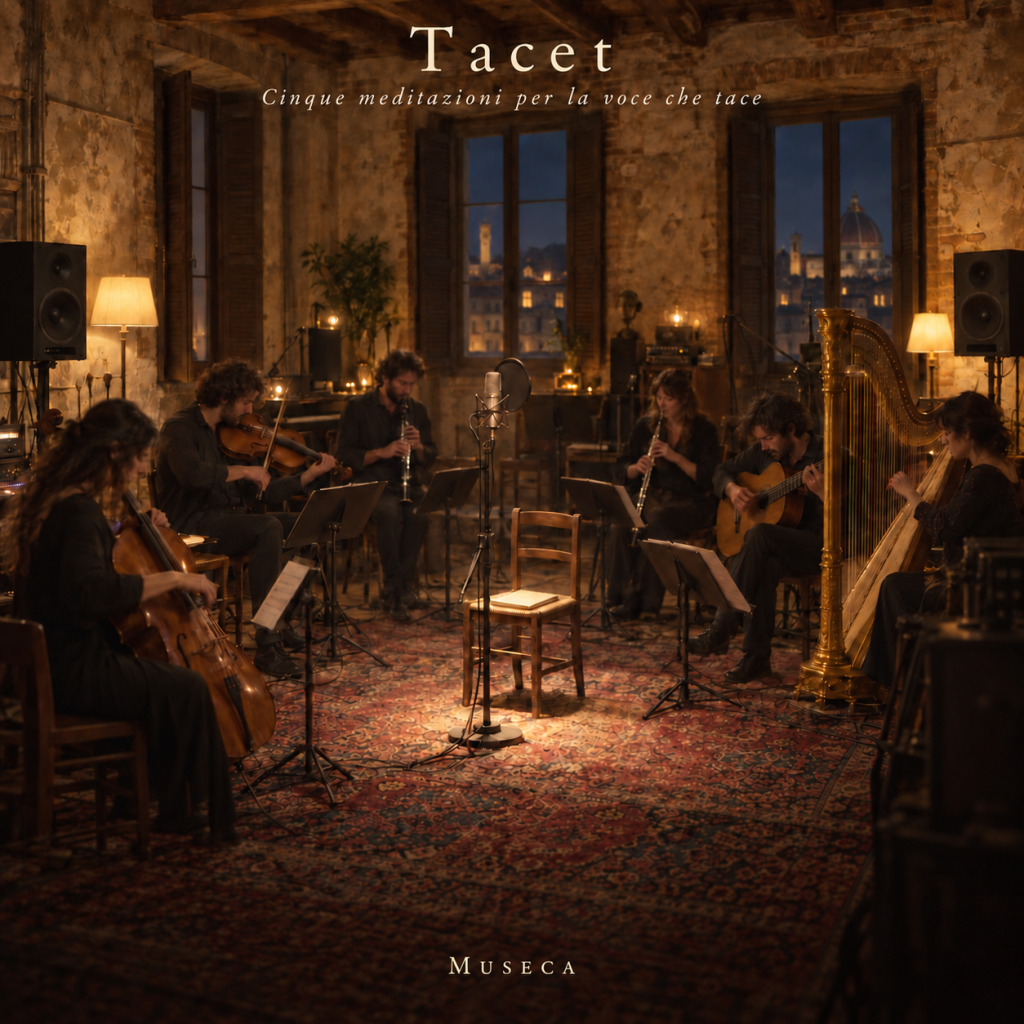
Tacet: Cinque meditazioni per la voce che tace
In a score, tacet is the instruction to a part that it does not play. The singer sits in the room, holding her text, and stays silent for the whole piece. Tacet is a Sotto Voce album in which the mezzo-soprano has that marking for all nine tracks. It is the eleventh album in the series and its coda — the silence after À meia-voz, the series’ last sung word.
Everything else the series asks for is here, unchanged. Nine tracks, five meditations alternating with four interludes. E major at the opening, F major at the close. The low pulse that runs beneath every track and crosses every boundary, fading to silence only in the last bars of the last one. The dynamic ceiling that lets nothing rise above a murmur. The instrumental memories that return, tracks later, at the moment they are needed. What is removed is the one thing every previous album leaned on: the word. My claim in this album is that Sotto Voce was never a way of writing lyrics. It was a way of listening, and a listener who knows the other ten albums will hear the words anyway.
Each meditation gives the singer’s line to one instrument, played strictly in her range and phrased as if singing a text — breath-length lines, a held note at the end of each, a rest where the poem would turn. A cello sings Vicino, the nearness the series opens on. A cor anglais sings Ancora, the still-word, holding its middle note as though it could go on holding it. A viola sings Dentro, the darkest interior room, over a piano that leaves real silence between its notes. A clarinet sings Resta, the plea to stay, dropping into its lowest register only for the two syllables of the word. And the cello returns for Grazia, with the other three voices entering inside it one by one, each on the shape of the word it carried, before the cello sounds the series’ closing sentence and, for the first time in the series, hands the arrival signature’s last word to another voice.
The anchor words survive without text because each has become a small melodic shape with the word’s own stress — the rise and settle of vicino, the sustained middle of ancora, the fall of dentro, the leaning second syllable of resta, the opening upward of grazia. They are played where the words would have been sung. Under each meditation, the lyrics page prints only the anchor word and the one line the voice was silent on.
Between the meditations, the interludes are the room without a singer: a guitar figure heard first in evening shadow, then in morning light, then as the ground the cello comes home on; low strings sustaining while the light goes; and at the threshold, Limen, the album’s only organ, entering over low strings with no line at all — the emptiest track on an album about emptiness, the singer’s chair in the light.
Tacet is for the listener the whole series was written for: the one who attends to every layer, and who will recognize, in a cello’s phrasing with no words present, a word they have heard sung ten times before.
Liner Notes
Tacet is the marking in a score that tells a part it does not play. On this album the mezzo-soprano has that marking for all nine tracks; the instruments sing in her place, in her range, and the words are the shapes they leave.
Vicino
E major. The cello opens the album alone, out of tempo, two phrases before any other sound, as the series has always opened: with nearness. A nylon guitar enters beneath it and the pulse begins. The cello sings in a mezzo-soprano’s range on the A string, almost without vibrato, and twice it sounds the shape of the word — a rise to the middle and a settling. Once, in passing and unaccented, it plays two notes that open upward and let go. That is grazia, eight tracks early. The guitar falls silent and the cello ends alone on a low note, the pulse continuing into the evening.
Vesper
C-sharp minor. The room after someone has spoken. A guitar figure — six notes rising through the chord and falling back to where they began, one to a bar — over cellos and violas sustaining in long bows. No harp yet, no line anywhere. Halfway through the figure drops an octave; near the end the violas fall silent. Remember the figure. It returns twice.
Ancora
A major, with a raised fourth that never resolves. The cor anglais opens alone and out of tempo, and the harp enters for the first time on the album. This is the still-word, and the instrument was chosen because it can hold a note as though it could go on holding it. Twice, at the end of a verse, it sounds three notes with the middle one sustained far past its length, and the second time longer than the first. There is no rise in this track. Its only event is that held note.
Penumbra
D-flat major. The half-shadow before the full one. Low strings, now with soft double basses beneath them, sustain while the guitar is reduced to single plucked notes spaced further and further apart until it stops. No harp, no piano; the piano must not sound before the next track. The last bars lean toward the relative minor without stating it.
Dentro
F minor. The album’s darkest room, and the key is grace’s own, in shadow: this is F minor without a single major chord, so that when F major arrives four tracks later it is a recognition and not a modulation. The viola opens alone, and the piano enters for the first time — sparse, low, bare fifths, with real silence between the notes. The word falls inward: two notes descending, the second shorter. Near the end the viola stops for longer than anywhere else on the album and the piano is alone in the cold. Then the word, and the viola’s lowest sustained note, alone.
Lumen
A-flat major. The one place the album breathes upward: the only track whose tempo lifts against the descent, and the only one where the guitar and harp sound together. The Vesper figure returns, in light now and a register higher, and midway it lifts an octave with the harp opening above it — a rise in brightness with no rise in volume. The last bars lean toward the relative minor, preparing the plea.
Resta
C minor. The clarinet sings in its soft middle register over the harp, the still-word’s floor returned. The plea to stay is two notes, the second lower and leaned on and repeated once, and the clarinet drops into its darkest register only for those two syllables. Near the end it falls silent and the cor anglais enters for the first time since Ancora, sounding the held middle note of the still-word inside the plea. Still. Stay. The clarinet answers low, and ends alone, fading to almost nothing.
Limen
A-flat Aeolian. The threshold, and the album’s only organ: soft flute stops, breathing, cathedral-slow, over cellos, violas and basses in long bows. No guitar, no harp, no pulse, no line. Four held harmonies moving by whole-tone slips, a faint shimmer in the upper organ that widens and then clears to a bare open fifth. The singer’s chair, in the light. The strings fall silent and the organ fades alone.
Grazia
F major. The cello opens alone and out of tempo with the two phrases it opened the album on, now in the closing key, and under its first phrase in time the pulse returns. The guitar enters with the Vesper figure, heard for the third time and for the first time under a singer. Twice the cello opens upward and lets go — the seed from Vicino, arrived. Then the others come back, one to a verse, in the order they sang: the cor anglais with ancora, the viola with dentro, the clarinet with resta, each entering alone on the shape of its word and then staying, so the room fills without getting louder. The cello sounds the series’ closing sentence, five notes: everything is grace. And in the coda it begins the arrival signature — three notes, and I, here — and the cor anglais completes it: ancora, still. The harmony lifts toward B-flat and settles on F. The guitar stops, the voices leave one by one, the cello holds alone, and the pulse fades to silence.
Playlist
- Track 1 — Vicino Museca 3:32
- Track 2 — Vesper Museca 3:04
- Track 3 — Ancora Museca 3:33
- Track 4 — Penumbra Museca 3:09
- Track 5 — Dentro Museca 4:04
- Track 6 — Lumen Museca 3:15
- Track 7 — Resta Museca 3:38
- Track 8 — Limen Museca 2:55
- Track 9 — Grazia Museca 3:29