
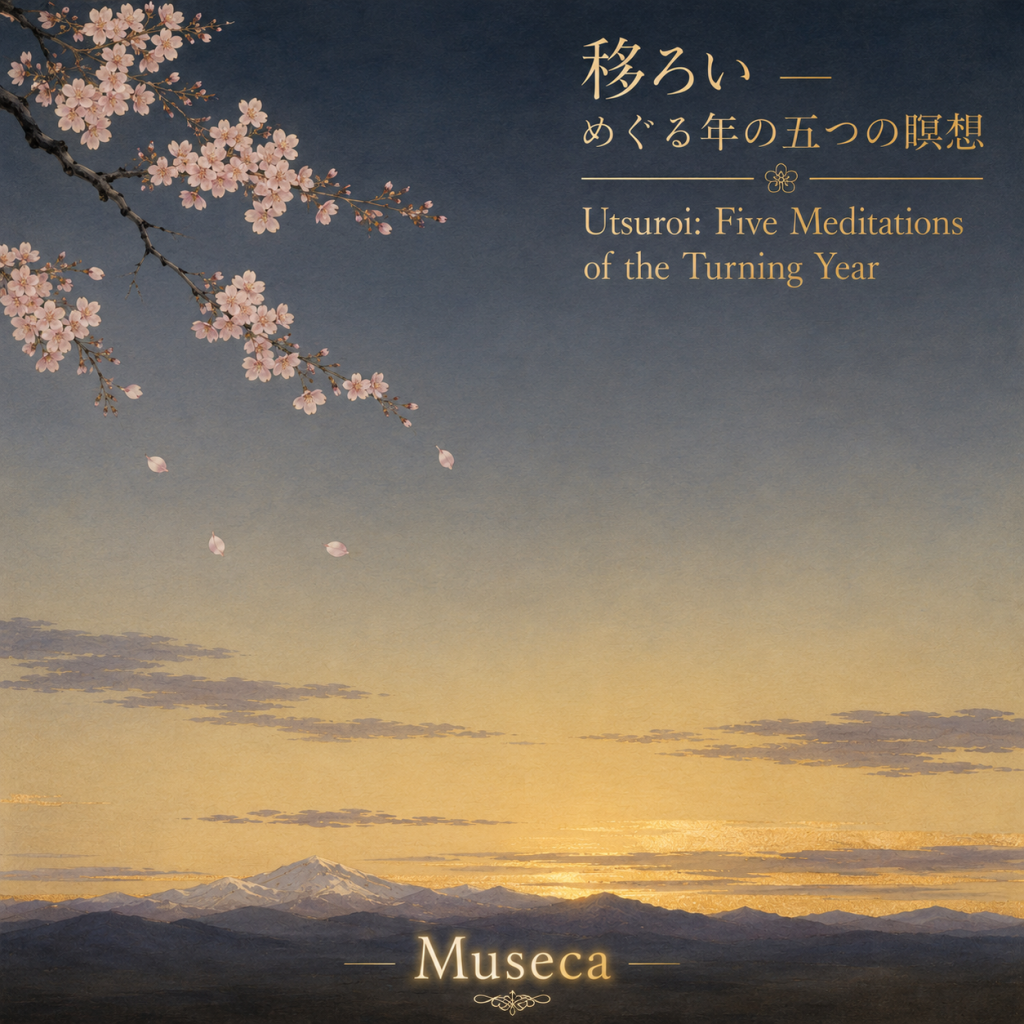
移ろい — めぐる年の五つの瞑想
Utsuroi: Five Meditations of the Turning Year
An Introduction
Some languages must be taught the Sotto Voce discipline. Japanese already knew it. Every album in this series begins the same way: before a note is written, I look for the place where the language already contains the style — its native containment. Italian holds it in bel canto’s mezza voce; French in the poise of the mélodie; German in the Lied’s inwardness; Spanish in the cry held inside the contained throat. In every previous case the containment had to be found, a room within the house of the language. In Japanese, the containment is the house. The tradition has a name for the charged interval where meaning gathers — ma (間) — and names for beauty that refuses to announce itself: wabi, shibui, yūgen. A style built on the conviction that withholding is expressive, that a peak is the most concentrated moment rather than the loudest, arrives in Japan and finds its principles codified centuries ago. I did not bring the discipline to the language. I brought the language home to it.
The armature is the oldest structure in Japanese art: the turning of the seasons. Every Sotto Voce album is built on an armature chosen before any music exists. The French album walked a single day; for Japan, the day was too small. Seasonal consciousness is the deepest architecture in Japanese art and life alike — every haiku carries its kigo, and the classical calendar divides the year into seventy-two whispered micro-seasons. So this album expands the day-journey into a year-journey, taking its stations from the most universally known passage in classical Japanese literature: the opening of Sei Shōnagon’s Pillow Book. In spring, the dawn. In summer, the night. In autumn, the evening. In winter, the early morning. Four seasons, and — Shōnagon’s genius — four hours: each season named as the time of day when its beauty concentrates. Her litany supplies the four seasonal meditations by name; a Japanese listener reads the tracklist and knows the album’s architecture before hearing a note.
And then the album writes the station Shōnagon never wrote. Her list ends with winter. The fifth meditation is the return of spring — the same dawn, the same mountain rim, the same blossoming branch as the first track, one year later. The blossoms fall again, and the falling, which the whole year has taught the listener to read, arrives this time not as loss but as gift. The title names the subject: utsuroi — the shifting, the fading, the turning of the seasons. The final track names what transience becomes when it is fully received: megumi — grace.
The journey. The album opens before dawn with a single unaccompanied breath — the shakuhachi alone, unmeasured — and time begins only when the sky whitens and the album’s heartbeat is born: the slow pulse that runs felt-not-heard beneath the entire year. Spring is itoshisa, tenderness, the light growing until it finds one blossoming branch — a seed left undwelt-upon for eight tracks. Summer is a moonless night crossed by fireflies, wonder rendered as minimal light in maximal dark, a solo flute appearing and fading like the sparks themselves. Autumn is the album’s emotional center: the sun touching the same rim it rose over, the moon rising — and into the present beauty the summer night returns: the flute comes back at the climax, dimmed, and the listener hears the remembering happen as an event — natsukashisa, the warm ache of a past arriving inside a beautiful present. Winter is the early morning cold, a garden erased by snow, one ember carried cupped through the dark — a meditation that refuses every consolation, whose one word is ite: stay. Between winter and the return stands the threshold: a track with no scene, no watcher, no pulse — the interval itself — before spring returns and the year arrives where it began, changed.
Three Japanese instruments, each with an architectural office. The album’s national voice could only be the shakuhachi — the bamboo flute whose solo tradition is literally called suizen, “blowing Zen”: the human breath as the work’s first and last sound. The koto takes, across the whole album, the role the harp plays in every other Sotto Voce work — light and ornament, never engine: blossom-figures, river-ripples, falling leaves — and then total silence in winter, because winter has no ornament. And the shō — the gagaku mouth organ, whose sustained clusters represented light shining down from heaven — is the reserved color, withheld until the sacred turn. The Method’s reserved color has always had the organ as its archetype; Japan supplies an organ made of breath. It sounds twice in the whole work: at the threshold, and once beneath the final cadence — where it meets the shakuhachi at last, the human breath and the heavens’, joined only at grace.
The interludes walk Japan’s modern musical century. Between the meditations stand four instrumental interludes, each written in the manner of one canonical composer — original music, never transcription. Hanaikada, spring’s petals carried downstream, belongs to Taki Rentarō and the Meiji dawn, where Schumann-warm parlor harmony first carried Japanese melody. Akatombo no sora, summer hesitating at autumn’s edge, belongs to Yamada Kōsaku, master of the Japanese art song, who bent Fauré’s colors to the falling contours of Japanese speech. Haru no umi e — toward the spring sea — is the album’s single lift against the descent and belongs to Miyagi Michio, the blind koto modernist whose masterwork sounds in every Japanese home each New Year; the title’s single particle e, “toward,” holds the design: homage at one remove, and midwinter already turning toward the light. And the fourth, titled with the single character 間, belongs to Takemitsu Tōru, whose lifelong subject was precisely this character: the pulse falls away, the shō breathes for the first time, and single string tones stand alone in the quiet like stones in a garden. Four ways of passing: the river flows, the dragonfly hovers, the lantern gathers, the interval holds.
The voice: clarity instead of darkness. Every previous album found its register by darkening — the Italian raccolto, the German mezzo, the Spanish contralto. Japanese containment runs the other way: the vocal ideal is sunda koe, the clear voice — pure, transparent, almost without weight. So this album’s voice is the lightest in the series: a contained soprano of near-vibratoless purity, speech-close, singing as if to one person in a small room. Her coloring is the album’s own word for itself — hakanasa, evanescence, the quality of something beautiful about to dissolve: a voice that always sounds as if it might not finish the phrase, not from weakness but from the same place the falling blossom falls from. It deepens with the year — warmest in spring, luminous in summer, weighted in autumn, reduced almost to breath in the snow — and at grace it transfigures: the fragility remains, but held inside assurance. Things end, and the voice singing it is unafraid.
The harmonic gift: the series’ signature turns out to be Japanese. Every Sotto Voce album travels from E major, on the language’s tenderness word, to F major, on its grace word — a half-step lift, the smallest rise carrying the largest arrival. The miyako-bushi scale — the semitone-shadowed pentatonic that gives Japanese melody its particular dusk — when built on E, begins: E, F. The series’ permanent signature is literally the first two notes of Japan’s own contemplative scale. No other language could have claimed this. Grace haunts the opening track as a native shading, so that when F major arrives eight tracks later, the Japanese ear has known it from the first phrase — and the album’s whole year, in pitch, amounts to the interval the tradition itself sighs on.
The threads that bind the year. The Method builds every album as a lattice, and this one is its densest. A phrase — chiisana hi, the small fires — travels the whole year: plural fireflies in summer, remembered verbatim in autumn, reduced to one literal coal in winter’s hands. A single sentence inverts across seven tracks: summer’s everything is here becomes winter’s everything is erased becomes the finale’s everything is grace. The cello that completed the singer’s sentences in autumn returns in the deepest cold at the moment the word stay is spoken — and, alone among the album’s memories, it stays. And the series’ signatures land in Japanese for the first time, closing with the refrain that has ended every album in this catalog: そして、わたしは、ここに、いまも — and I, here, still.
The close. In the final track the petal-wind — hanafubuki — arrives at its fullest exactly as the last anchor phrase is sung: subete wa megumi, everything is grace. The year’s voices gather quietly around it — the fireflies’ flute, autumn’s cello, winter’s viola, the koto’s petals, the two breaths together at last — the album’s most populated moment and one of its gentlest, because in this style abundance must never become mass: petals, not power. Then the layers release, and the pulse that has run beneath the whole year fades, alone, to true silence. Grace, in this music, is the moment the ground itself can be released — the moment the music no longer needs to be held up. The year turns; the blossoms fall; the falling and the blossoming were one blessing all along.
移ろい — Liner Notes
春はあけぼの (Haru wa akebono — In Spring, the Dawn)
The album opens as the honkyoku tradition opens: a single shakuhachi breath-phrase, alone, unmeasured, in the pre-dawn dark — and only when the sky begins to whiten is time itself born, the sub-bass pulse fading in from nothing to begin the heartbeat that will run beneath the entire year. E major, the series’ tenderness key, shaded by the miyako-bushi semitone — grace’s F natural passing through the spring dawn like the last of the night. The voice enters over a low string bed, speech-close and transparent; the koto arrives with sparse falling figures, the thin violet clouds; a single high violin harmonic hovers as the fading morning star. The meditation gathers by degrees, the way light does, toward its one quiet concentration: a brief wordless vocalise, and the anchor word itoshii as the light finds a single blossoming branch. The shakuhachi’s closing exhale hands the pulse onward — the tenderness meditation, and the planting of the album’s furthest seed.
Lyrics
春はあけぼの (In Spring, the Dawn)
夜明けまえ、山ぎわに
ひとり、目をあけて
そばに、ひかりのそばに
まだ見えない朝の
Yoake mae, yamagiwa ni
Hitori, me o akete
Soba ni, hikari no soba ni
Mada mienai asa no
すこしずつ、白くなる空
むらさきの雲が
ほそく、たなびいて
夜のなごりを つれてゆく
Sukoshi zutsu, shiroku naru sora
Murasaki no kumo ga
Hosoku, tanabiite
Yoru no nagori o tsurete yuku
いつのまに、闇は終わった
さかいめも、なく
うつろう空の下で
心が、ほどけてゆく
Itsu no ma ni, yami wa owatta
Sakaime mo, naku
Utsurou sora no shita de
Kokoro ga, hodokete yuku
ひかりが見つけた
ひと枝の、花
いとしい — この世界
Hikari ga mitsuketa
Hitoeda no, hana
Itoshii — kono sekai
朝が、ここに
Asa ga, koko ni
English translation
Before dawn, at the mountain rim
alone, eyes open
near — near the light
of a morning not yet visible
Little by little, the sky whitening
violet clouds
trailing thin
carrying away what remains of night
Before I knew it, the dark had ended
without any edge
beneath the shifting sky
the heart comes loose, unfolds
The light has found
one branch, in blossom
beloved — this world
Morning, here
花筏 (Hanaikada — Blossom Raft)
Spring travels. The first interlude carries the fallen petals downstream in the voice of Taki Rentarō and the Meiji era’s parlor Romanticism — Schumann-warm harmony bearing a singable, Japanese-contoured melody. A solo violin hums the songful line over the album’s first sustained motion: the koto in continuous rippling figuration, the river’s surface, with low strings as the deeper current, the whole in a gently rocking six-eight over the steady pulse beneath — two layers of time, the river’s lilt and the year’s heartbeat. At the melody’s one warm crest the album’s only piano appears, glowing quietly beneath the violin for a few bars — Taki’s own instrument, spent on his interlude alone — before the song does what songs cannot: it declines to end, fragmenting instead into shorter and shorter phrases, each dissolving into the koto’s ripple, petals separating on the water. A distant shakuhachi phrase watches the river go.
夏は夜 (Natsu wa yoru — In Summer, the Night)
The moonless dark, and wonder at the threshold of audibility. This is the album’s warmest night: the atmospheric ground at its most enveloping, the pulse quietly alive, no treble at all in the opening bars — until the first firefly. The solo flute is the spark itself: brief two- and three-note phrases, breathy and low, swelling from silence and fading back, never twice in the same place, never a connected melody — until the climax, when the drifting lights gather into a slow constellation and voice and flute entwine for the first time as the anchor word hora — look — is nearly whispered. A Lydian, the raised fourth glinting as the fireflies’ luminous wrong-right note; the koto reduced to two distant plucks deep in the dark; the high violin thread returning as the summer night’s one star. The final flute glows sound after the last words — the fireflies outlasting the watcher.
Lyrics
夏は夜 (In Summer, the Night)
月のない、夏の夜
やみは、ふかく、あたたかい
なにも見えなくて
すべてが、ここにある
Tsuki no nai, natsu no yoru
Yami wa, fukaku, atatakai
Nani mo mienakute
Subete ga, koko ni aru
ひとつ、ほのかに
ほたるが、ながれてゆく
ふたつめの光が
やみに、また、うまれる
Hitotsu, honoka ni
Hotaru ga, nagarete yuku
Futatsume no hikari ga
Yami ni, mata, umareru
いつか、思いだすだろう
この夜の、ちいさな火を
目が、やみになれて
見えてくる、見えてくる —
Itsuka, omoidasu darō
Kono yoru no, chiisana hi o
Me ga, yami ni narete
Miete kuru, miete kuru —
ほら — ひかりが、ひかりが
よぞらのように
Hora — hikari ga, hikari ga
Yozora no yō ni
夜が、つつむ
Yoru ga, tsutsumu
English translation
A moonless summer night
the dark, deep and warm
nothing can be seen
and everything is here
One, faintly
a firefly drifts by
a second light
is born again in the dark
Someday, I will remember
the small fires of this night
the eyes grow used to the dark
and begin to see, begin to see —
Look — the lights, the lights
like a night sky
The night, enfolding
赤とんぼの空 (Akatombo no sora — Sky of Red Dragonflies)
Summer hesitates at autumn’s edge. The second interlude belongs to Yamada Kōsaku, master of the Japanese art song, whose harmony bent Fauré’s colors to the falling contours of Japanese speech — suspended ninths, mediant slips, resolutions that arrive late or not at all. The form is the dragonfly’s own motion: a solo oboe holds long trembling repeated tones — hovering — broken by quick two-note darts to a new harmonic light, each answered by a single bright koto glint, the sun catching the wings. Four hoverings, each shorter and cooler than the last, over an amber string bed with the violas foregrounded; the third hovering deepens into the interlude’s one saturation, the low sun at its reddest; and only the final dart falls — the dragonfly settling as the light fails. It ends by release, not resolution: the year has not resolved; it is about to turn.
秋は夕暮れ (Aki wa yūgure — In Autumn, the Evening)
The album’s emotional center, and its deepest art-song register. The solo cello enters first — a confiding tenor-voiced companion that answers and completes the singer’s phrases in true dialogue, catching each sentence as it falters, while the koto drops slow falling-leaf figures into the spaces between. B Aeolian with the miyako-bushi semitone as its ache-note; the mix itself performs the hour, a high gold thread fading as silvered harmonics rise with the moon. And then the album’s central event: at the climax, the flute from the summer night returns — the same breathy firefly phrases, one register lower, slightly farther away — and the listener hears the remembering happen in real time, three voices entwined as the still-word mada is fully sung: the small fires of that night, still glowing. The flute dissolves mid-phrase, as memories do; the voice hums two notes of its own opening melody, mouth closed — memory kept — and the evening settles.
Lyrics
秋は夕暮れ (In Autumn, the Evening)
夕日が、山ぎわに
ふれて、しずんでゆく
わたしは、まだ、ここに
おなじ空を、見ている
Yūhi ga, yamagiwa ni
Furete, shizunde yuku
Watashi wa, mada, koko ni
Onaji sora o, mite iru
からすは、いえじへ
みつ、よつ、ふたつ
かりの列が、ちいさく —
とおさは、さってゆくかたち
Karasu wa, ieji e
Mitsu, yotsu, futatsu
Kari no retsu ga, chiisaku —
Tōsa wa, satte yuku katachi
きんいろが、きえて
つきが、のぼってくる
しろい光のなかに
なにか、なつかしい —
Kin’iro ga, kiete
Tsuki ga, nobotte kuru
Shiroi hikari no naka ni
Nanika, natsukashii —
あの夏の夜の
ちいさな火が、ここに
まだ、ひかっている
Ano natsu no yoru no
Chiisana hi ga, koko ni
Mada, hikatte iru
夕暮れが、ここに
Yūgure ga, koko ni
English translation
The evening sun touches the mountain rim
and sinks
I am still here
watching the same sky
Crows, homeward
in threes, fours, twos
a line of geese, small —
distance: the shape of leaving
The gold fades
the moon rises
in the white light
something — familiar, longed-for —
The small fires
of that summer night — here
still glowing
Evening, here
春の海へ (Haru no umi e — Toward the Spring Sea)
The single lift against the year’s descent. In midwinter’s approach, Japanese tradition places its warmest interior hour — the New Year, when Miyagi Michio’s koto sounds in every home — and this interlude walks toward it: the tempo rises, the miyako-bushi shadows fall away entirely into the bright semitone-free yo scale, and the koto steps forward as featured voice for the only time in the album. The melody is assembled by approach — two notes, then three, then a half-phrase, music from a lit house reaching a walker in the cold — until the door opens and the full Miyagi manner blooms: the singable theme carried over the instrument’s own rolling wave-figuration, one high cascade, and a warm shakuhachi joining beside the koto for a few bars, honoring the masterwork’s famous pairing at one remove. The music dwells in the warmth, then thins to its first two-note fragment; a breath of cold crosses the sound’s rim, and one low foreign tone announces the world beyond the glass.
冬はつとめて (Fuyu wa tsutomete — In Winter, the Early Morning)
The deepest valley, scored by subtraction. The bed of six tracks is reduced to two sustained voices — a low drone and a solo viola, grainy, bow-hair audible, vibrato revoked; the koto falls silent for the first time, because winter has no ornament; the pulse thins to the edge of perception. The voice is reduced almost to breath, phrases contracted to what a lungful of freezing air allows, the intakes themselves audible. Across the track, five barely-voiced pizzicato touches — the ember’s own pulse — each softer than the last. The meditation refuses every consolation: the fire dims, nothing replaces it, and the harmony holds bare open fifths, withholding even its own warmth — until the climax, when the cello from the autumn evening enters low beneath the viola’s one pale rise, the fifths fill into a complete chord, and the anchor word ite — stay — is spoken to what is going out. The cello, alone among the album’s memories, stays: it holds through the final line and does not leave. No last ember-touch sounds. The pulse persists, faint, to the very end — its final station.
Lyrics
冬はつとめて (In Winter, the Early Morning)
夜明けは、こない
つめたい、ろうか
ひとり、目をさます
しろい、しずけさ
Yoake wa, konai
Tsumetai, rōka
Hitori, me o samasu
Shiroi, shizukesa
ちいさな火を、かかえ
くらい、ろうかをゆく
にわは、ゆきのした
すべてが、きえている
Chiisana hi o, kakae
Kurai rōka o yuku
Niwa wa, yuki no shita
Subete ga, kiete iru
火は、よわくなる
かわりは、こない
ゆきあかりだけが
しろく、しろく
Hi wa, yowaku naru
Kawari wa, konai
Yukiakari dake ga
Shiroku, shiroku
ちいさな、火よ
そばに — いて
Chiisana, hi yo
Soba ni — ite
あさは、しろいまま
Asa wa, shiroi mama
English translation
Dawn does not come
the cold corridor
alone, I wake
white stillness
Cradling a small fire
I walk the dark corridor
the garden, under snow
everything, erased
The fire grows weak
nothing comes to replace it
only the snow-light
white, white
Small fire
near me — stay
The morning, still white
間 (Ma — The Interval)
For the first time in the album, there is no pulse. The threshold opens on near-silence — the heartbeat of seven tracks undeniably gone — and what follows has no scene, no watcher, no meter: sound and silence alternating as equals, in the voice of Takemitsu Tōru, whose lifelong subject was this single character. The reserved color arrives at last: the shō, the gagaku mouth organ, an organ made of breath, in five slow cluster-swells that become audible from beneath perception, sustain, and dissolve — light shining down, in the old court music’s own theology. Between the breaths, single string tones stand alone like stones in a garden: one low cello note, one leaning viola tone, one high violin harmonic — the year’s voices reduced to pure sound — each completed by the silence around it. Within the final breath, the only motion in the piece: the cluster’s harmony settles downward by a third, too slowly to be heard happening, onto the open sonority from which grace is the only next step. The door stands open.
恵み (Megumi — Grace)
The station Shōnagon never wrote. The shakuhachi’s returning breath answers the threshold’s held suspension, the pulse is faintly restored, and the strings settle at last onto F major — the note that haunted the album’s first track now the ground it stands on. The watcher is at the same mountain rim, one year on; the same branch blossoms again. As the verses turn toward it, the year’s voices gather one by one — a firefly phrase from the flute, one confiding cello line, the viola’s leaning farewell — and at the climax the petal-wind arrives at its fullest exactly as the anchor phrase is sung: subete wa megumi, everything is grace — koto petal-cascades, the shakuhachi entwined beneath the voice at her one radiant height, the fullest and gentlest gathering in the album. Then, under the plagal cadence, the shō breathes once more, and the album’s two breath-instruments — the human and the heavens’ — sound together for the first time, joined only at grace. The closing refrain arrives nearly spoken — soshite, watashi wa, koko ni, ima mo: and I, here, still — the layers release, the shakuhachi seals the frame it opened, and the pulse that has crossed every boundary but the threshold’s fades, alone, to true silence. The ground itself is released. The year turns.
Lyrics
恵み (Grace)
一年が、めぐって
ふたたび、山ぎわに
わたしは、ここに
おなじ夜明けの、なかに
Ichinen ga, megutte
Futatabi, yamagiwa ni
Watashi wa, koko ni
Onaji yoake no, naka ni
あのひと枝が
また、花をひらいて
ひかりのなかで
はなびらが、ゆれている
Ano hitoeda ga
Mata, hana o hiraite
Hikari no naka de
Hanabira ga, yurete iru
ちることも、さくことも
おなじ、ひとつの めぐみ
ことしも、あたえられて —
かぜが、えだをわたる
Chiru koto mo, saku koto mo
Onaji, hitotsu no megumi
Kotoshi mo, ataerarete —
Kaze ga, eda o wataru
はなふぶきの、なかで
すべては、めぐみ
Hanafubuki no, naka de
Subete wa, megumi
そして、わたしは
ここに、いまも
Soshite, watashi wa
Koko ni, ima mo
English translation
The year has turned
again, the mountain rim
I am here
inside the same dawn
That one branch
blossoms again
and in the light
the petals are trembling
The falling and the blossoming
one and the same blessing
this year, too, given —
the wind crosses the branch
Inside the petal-wind
everything is grace
And I
here, still
Playlist
- Track 1 - 春はあけぼの (Haru wa akebono — "In Spring, the Dawn") Museca 3:49
- Track 2 - 花筏 (Hanaikada — "Blossom Raft") Museca 3:45
- Track 3 - 夏は夜 (Natsu wa yoru — "In Summer, the Night") Museca 4:05
- Track 4 - 赤とんぼの空 (Akatombo no sora — "Sky of Red Dragonflies") Museca 3:44
- Track 5 - 秋は夕暮れ (Aki wa yūgure — "In Autumn, the Evening") Museca 3:48
- Track 6 - 春の海へ (Haru no umi e — "Toward the Spring Sea") Museca 3:44
- Track 7 - 冬はつとめて (Fuyu wa tsutomete — "In Winter, the Early Morning") Museca 2:15
- Track 8 - 間 (Ma — "The Interval") Museca 3:23
- Track 9 - 恵み (Megumi — "Grace") Museca 3:59