
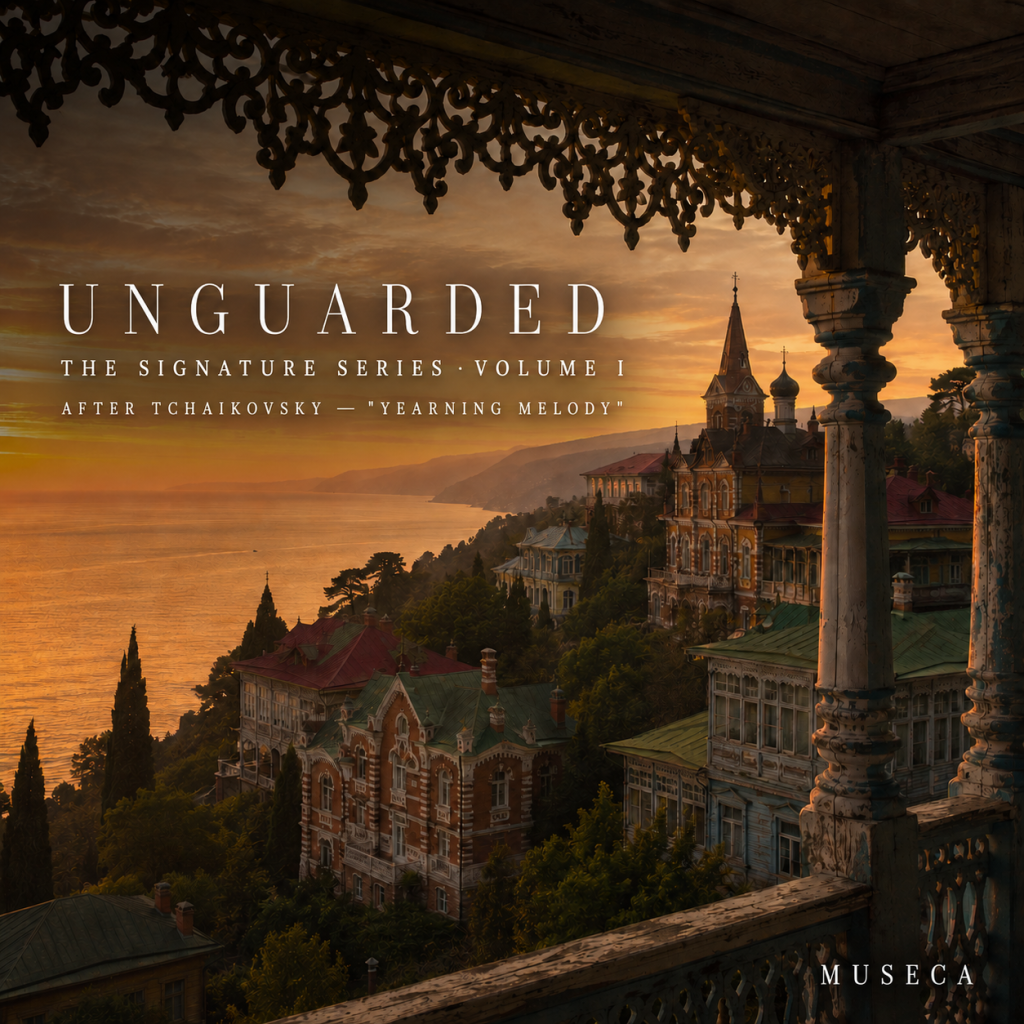
Unguarded
The Signature Series · Volume I
after Tchaikovsky — “Yearning Melody”
Museca
This album is an experiment with a simple premise: that what makes a composer recognizable is not the era they lived in, and can be carried out of it.
Unguarded is built entirely from the musical behavior of Pyotr Ilyich Tchaikovsky. There is no orchestra on it. There are no strings, no timpani, no ballet, no nineteenth century anywhere in the sound. It is a Balearic record — sunset downtempo, nylon guitar, warm analog pads, the music of a coastline at dusk. And it is, from first note to last, Tchaikovsky.
That claim needs explaining, which means explaining what a signature is.
Genre, style, signature
Most of what we say about composers is actually about one of two things.
Genre is the container — the symphony, the ballet, the concerto, the song. Tchaikovsky wrote symphonies, but so did Brahms, so did Mahler, so does anyone. A genre is a room many people have stood in.
Style is the shared language of a time and place — Russian Romanticism, the Baroque, Impressionism. Style is broader than one person. It is the accent of a period, and everyone in the period has it.
Signature is the third layer, and the only one that belongs to a single human being. It is the set of behaviors a composer performs that no one else performs in quite that combination — the way they treat a melody, what they do with time, where they place weight, what they refuse to do. It survives translation. It is not a sound; it is a set of decisions that produce sounds.
The distinction matters because signature and style are constantly mistaken for each other, and the mistake is expensive. If you think Tchaikovsky is the Romantic orchestra, then Tchaikovsky can only ever be reproduced by hiring one. If you understand that the orchestra was his costume and not his engine, the engine can go anywhere.
What Tchaikovsky actually does
His signature is the yearning melody: the long, soaring, intensely lyrical line that pours out direct emotion and goes straight to the listener. Around it sit five more behaviors — emotional directness, the open heart with nothing held back; the fate motif, a short figure that haunts a work and returns transformed; brilliant, characterful color; the waltz and the symphonic dance; and beneath all of it the Russian melancholy his countrymen call toska, the bittersweet ache of longing.
Not one of those requires a violin.
Why Balearic
Because it should have been impossible.
Café del Mar music is built on the sunset plateau: sustained mood, gentle groove, no dramatic peak. Its whole aesthetic is beautiful non-arrival. Tchaikovsky’s most defining move is the surging emotional climax — the thing the genre structurally forbids.
That collision is the point. If you place a composer’s engine in a genre that already suits it, nothing has been demonstrated; the composer has simply gone home. Tchaikovsky writing film music proves nothing, because he is an ancestor of film music. Tchaikovsky in a genre that outlaws his signature move — and surviving it — proves the method.
Four of his six behaviors turned out to be uncannily at home here. Toska and sunset melancholy are the same emotion in different languages. The long yearning line is exactly what Balearic wants from a lead and rarely gets. The characterful solo voice belongs. The fate motif, threaded across six tracks, gives the record an architecture that chillout albums almost never have.
Two behaviors had to be translated rather than transplanted. The climax survives here as texture rather than volume — filters opening, space widening — and it happens exactly once, on the fifth track. And the waltz survives as meter: the third track is in three, which this genre effectively never is.
The law
Every decision on this record was made against one sentence:
Everything yearns; only once does it arrive.
Five tracks reach and do not get there. One does. The final track reaches and can no longer manage it — Tchaikovsky’s own last gesture, the Pathétique principle, where the music does not triumph but sinks and dies away.
A four-note motto carries this. It appears three times across the album, and it is the same figure each time. On the first track it rises and falls back below where it began. On the fifth it rises and stays. On the sixth it tries to rise and cannot, reaching shorter and starting lower until it breaks off unfinished.
That is the whole record, and it is entirely Tchaikovsky’s.
The books
The framework behind this album is documented in full, and both volumes are free to download and read.
Volume I — The Signature Method sets out the theory: the distinction between genre, style, and signature; how to isolate a composer’s transferable engine from their period surface; and how to translate that engine into contemporary music without imitation.
Volume II — The Signature Cards applies it to fifty-one composers from Hildegard of Bingen to Philip Glass. Each entry gives a signature formula, a core statement, the primary elements at a glance, essential listening, and a map of the modern genres that composer’s engine translates into.
Tchaikovsky’s entry in Volume II is the source of everything on this album. You can read it, disagree with it, and make a completely different record from the same page. That is the intended use.
Volume I – The Signature Method
Volume II – The Signature Cards
Liner Notes
Motto
A four-note figure, stated plainly and left alone.
It rises a minor sixth — the yearning interval, the reach — then steps down and falls a fourth, landing lower than it started. It gestures toward arrival and ends further away than it began.
Tchaikovsky’s symphonies are haunted by a short motto that returns transformed across a work, carrying the drama of a life against a destiny that does not negotiate. This is that device, borrowed whole. Everything on this album grows from these four notes, and they will be back twice more.
Here the figure is simply presented: a solo reed voice over a groove that arrives late and asks for nothing. Nothing develops. Nothing builds. The track states its theme and withdraws, which is not how records usually begin, and is the first indication of what kind of record this is.
Sleeve
The open heart.
Tchaikovsky wore his feeling where anyone could see it — the quality his contemporaries found excessive and listeners have loved him for ever since. Emotional directness, without irony or defense. The heart on the sleeve.
Ambient and chillout music almost always treats the voice as texture: distant, reverbed, wordless, veiled. That would have been the easy choice and the wrong one. This vocal is close to the microphone, dry, mid-register, and nearly unprocessed — sitting forward of a bed that expects it to sit back. Plain rather than beautiful.
The words don’t rhyme. Rhyme creates the sensation of landing, and nothing lands yet. What’s here instead is a statement made without cover and without a rise to signal that it matters.
Lyrics
[Verse – solo voice, close and plain]
I won’t dress it up
I won’t hold it back
Here it is — plain
[Groove enters: soft kick, fretless bass, shaker]
[Verse – voice over groove]
No cover, no turn
nothing kept behind
Here it is — plain
[Double reed answers with motto fragment]
[Refrain – no lift, same level]
I meant it
I mean it still
[Verse – voice, thinner]
No cover
no turn
[Outro: voice withdraws, pad and ocean, unresolved]
I mean it still
Three
The album’s argument, hidden in a dance.
Tchaikovsky raised the waltz to symphonic art and wrote some of the supreme examples. Balearic music is, essentially without exception, in four. This track is in three.
Not a waltz — that would be costume, the ballroom reassembled, exactly what the method exists to avoid. What survives the translation is the lilt: a sway with three beats in it, carried by shaker and a sliding bass rather than announced by an oom-pah. The kick refuses most of the downbeats. The melody phrases across the barlines rather than inside them, so the meter is something you feel before you can count it.
A genre that has spent thirty years in common time, briefly in triple. This is the clearest evidence on the record that a signature is a behavior and not a sound.
Long Line
The engine, with nothing in front of it.
One melody, unfolding continuously, never repeating a phrase. It rises across the whole track — register climbing, minute after minute — while the arrangement stays deliberately still. Nothing enters. Nothing swells. The texture at the end is the texture at the beginning.
This is the supreme Russian melodist stripped of everything else: no orchestra, no drama, no fate. Just the long, soaring, intensely lyrical line that is the thing he did better than anyone. If it holds attention for six minutes on melody alone, the signature is real. If it becomes wallpaper, it never was.
The motto is absent here. This is the one place on the album where the music stops referring to itself and simply sings — which is what makes its return afterward land.
Arrival
Everything yearns; only once does it arrive.
This is the once.
The motto comes back transformed, as Tchaikovsky’s mottoes do. It rises the same minor sixth — and this time it stays up. The fall never comes. That single withheld gesture is the entire arrival, stated in four notes.
The climax is real but it has been translated rather than transplanted. There is no orchestral tutti and no drop. The energy arrives through texture: filters opening, layers widening, the stereo image expanding, reverb blooming outward. The voice opens fuller without ever belting. Something gives way, and it is difficult to point at what caused it.
And underneath, the harmony does not resolve. It stays minor. The record arrives here without concluding — emotional arrival, no harmonic closure. The peak is genuine and it settles nothing.
Lyrics
[Verse – voice close and plain]
I said it once
quiet, to no one
I’m saying it again
[Groove enters: soft kick, fretless bass, shaker]
[Verse – voice opening]
Not asking now
not waiting now
Here — this is it
[Motto rises on double reed, stays high]
[Peak – voice fuller, texture widening, filters opening, no drop]
This is the part I meant
This is the part I meant
I’m not taking it back
[Sustain the peak – do not fall away]
Not taking it back
[Voice thins, texture stays wide]
I said it
I said it
[Outro: pad and ocean, harmony still unresolved]
Still
Dying Away
Tchaikovsky’s last symphony ends not in triumph but in a slow lament sinking toward silence. It was, by some distance, the most personal structural decision he ever made.
The motto returns a third and final time, and it cannot get up. The interval shortens — a fifth, then a fourth, then a third — and each attempt begins lower than the one before. It is not a collapse. It is a reach running out of reach.
The instruments leave one at a time and do not come back, in a deliberate order: the Rhodes, then the kick, then the bass, then the shaker, until the melody is alone over a pad. The last attempt at the figure breaks off unfinished.
Then decay, then room, then nothing.
This is where the genre and the composer finally agree. A Balearic record fades out; a Tchaikovsky symphony dies away. For the length of this track they are the same gesture, and the album ends inside the only moment of the six where nothing had to be negotiated.
Playlist
- Track 1 — "Motto" Museca 3:34
- Track 2 — "Sleeve" Museca 2:04
- Track 3 — "Three" Museca 3:09
- Track 4 — "Long Line" Museca 3:35
- Track 5 — "Arrival" Museca 3:08
- Track 6 — "Dying Away" Museca 3:18