
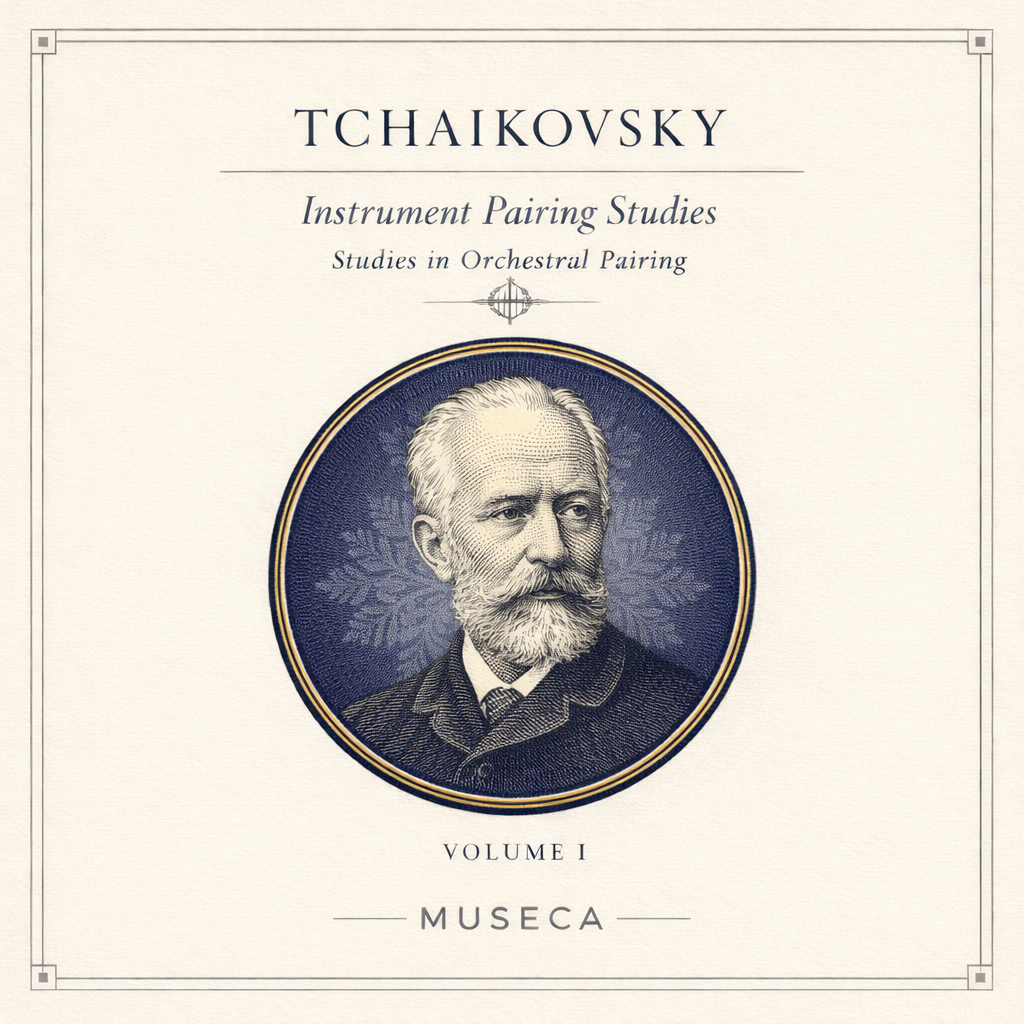
Pyotr Ilyich Tchaikovsky wrote melody as if it were a living voice—and he dressed that voice with timbre the way a dramatist dresses a character: not for decoration, but for psychological truth. Across his symphonies, ballets, overtures, and serenades, certain instrumental pairings return again and again—signature “blends” that feel unmistakably his. Horns joined to cellos to announce fate or nobility. Low clarinet fused with violas for private confession. Oboe carried on a halo of violins for lyric tenderness. Bassoon braided into low strings for grief. Flute-and-string shimmer—often gilded by harp and celesta—for the crystalline theatre of ballet. And, when the drama must stand upright, processional brass locked to timpani and low winds to create a Slavic march engine that can feel both proud and ominous.
This album is built as a set of eight original “pairing studies,” each track designed around one of those orchestral recipes. Rather than imitate a specific piece, each study isolates a Tchaikovsky pairing and lets it speak in its native emotional language: the horn-choir and cello unison that signals inevitability; the chalumeau clarinet and viola unison that turns inward; the ballet palette of flutes, violins, harp, and celesta that turns movement into light; the bassoon and cello lament over a bass pedal that slows time; the oboe line doubled by violins that makes sorrow sing; the brass-and-ostinato procession that turns harmony into marching architecture; the serenade-like dialogue of solo cello and horn framed by a woodwind chorale; and finally the muted-string descent with clarinet and bassoon in parallel—the shadow-coda gesture that feels like breath leaving the room.
Taken together, these tracks function like an orchestration atlas written in sound: a practical demonstration of how Tchaikovsky achieved such immediate emotional force by choosing the right instruments to share a line, and the right registers in which they meet. Each pairing is both a color and a narrative device. In that sense, the album is not a pastiche—it is a contemporary homage to a composer whose greatest secret was never “big melody” alone, but the intimate, repeatable craft of orchestral pairing that makes the melody unforgettable.
Liner Notes
Fate Brass & Velvet Strings
Paired instruments: Horn choir + Cellos (unison); Clarinets (chalumeau) + Violas
A slow-breathing declaration built on Tchaikovsky’s most fateful blend: horns that speak like a collective conscience, welded to cello unisons that feel bodily and inevitable. The clarinet–viola velvet sits beneath the statement like a dark lining inside formal clothing—soft, intimate, and quietly ominous. The result is not “loud tragedy,” but poised destiny: a theme that seems to arrive already knowing how it ends.
Chalumeau Confessional
Paired instruments: Clarinet (chalumeau) + Violas (unison); Bassoon + Cellos (answering phrases)
This study lives in the private room of the orchestra, where the low clarinet and violas merge into a single voice—human, close, and confessional. Tchaikovsky often uses this register as emotional handwriting: warm, shadowed, and truthful without spectacle. The bassoon and cellos respond like a heavier second thought, turning each phrase into a conversation between what is said and what is meant.
Ballet Snowglitter Waltz
Paired instruments: Flutes + Violins (octave/unison shimmer); Harp arpeggios + Celesta “glints”
Here the pairing is pure choreography: flutes and violins in bright union create the illusion of motion even when the harmony stands still. The harp supplies the air—continuous, weightless articulation—while the celesta appears like frost at phrase peaks, never constant, always magical. The waltz is less about dance steps than about light itself, a hallmark of Tchaikovsky’s ballet palette.
Elegy in Low Wood & String
Paired instruments: Bassoon + Cellos (unison lament); Horn (pp sustain) + Double bass pedal
Few composers make grief feel as physical as Tchaikovsky, and this is one of his most potent devices: bassoon and cello joined in a single descending thought over a bass pedal that will not move. The horn does not “sing” here—it breathes, coloring the silence between phrases. The music becomes processional without marching, sorrowful without melodrama: a slow, dignified lowering of the light.
Oboe Tearline, Violin Halo
Paired instruments: Oboe + 1st violins (unison/octave); Clarinet + Violas (cushion)
This is the Tchaikovsky lyric signature: an oboe line that speaks plainly, given radiance by a violin halo that does not compete, only glows. Underneath, clarinet and viola supply the soft upholstery that makes the melody feel supported, not exposed. The harmonic turn toward relative major is the emotional hinge—an instant of mercy—before tenderness returns with deeper meaning.
Slavic Processional Engine
Paired instruments: Trumpets + Horns (rhythmic calls); Trombones + Bassoons (weight); Timpani + String ostinato (motor)
Tchaikovsky’s public voice is architecture: brass calls that stand upright, rhythmic certainty, and a low foundation that makes the air vibrate. The string ostinato functions like wheels on stone—continuous and unsentimental—while timpani punctuates the structure with ceremonial authority. When trombones and bassoons lock together beneath the calls, the procession gains mass, turning pride into something almost ominous.
Serenade: Cello Speaks, Horn Replies
Paired instruments: Solo Cello + Horn (call/response); Clarinet + Bassoon (chorale pad)
A chamber-scale homage to Tchaikovsky’s gift for noble warmth. The cello speaks first—personal, vulnerable, unmistakably human—while the horn replies with restraint, like dignity answering emotion without dismissing it. Behind them, clarinet and bassoon form a quiet chorale, an inner choir that steadies the scene. The “bittersweet turn” in the harmony is where the heart shows: grace touched by a bruise.
Pathetique Shadow-Coda
Paired instruments: Clarinets + Bassoons (parallel lament); Muted Violas + Cellos (bed); Horns (distant breaths)
This final study draws on Tchaikovsky’s most devastating tactic: parallel woodwind lament over muted strings, with the bass descending as if the floor is slowly lowering. The horns appear only as distant air—an afterimage of warmth—then vanish again. Everything is designed to thin, darken, and recede until the music is no longer performing sorrow, but simply becoming quiet in its presence.
Playlist
- Track 1 — Fate Brass & Velvet Strings Museca 2:49
- Track 2 — Chalumeau Confessional Museca 4:27
- Track 3 — Ballet Snowglitter Waltz Museca 1:40
- Track 4 — Elegy in Low Wood & String [Revised] Museca 3:10
- Track 5 — Oboe Tearline, Violin Halo Museca 2:40
- Track 6 — Slavic Processional Engine Museca 1:30
- Track 7 — Serenade: Cello Speaks, Horn Replies Museca 2:07
- Track 8 — Pathetique Shadow-Coda Museca 2:02