
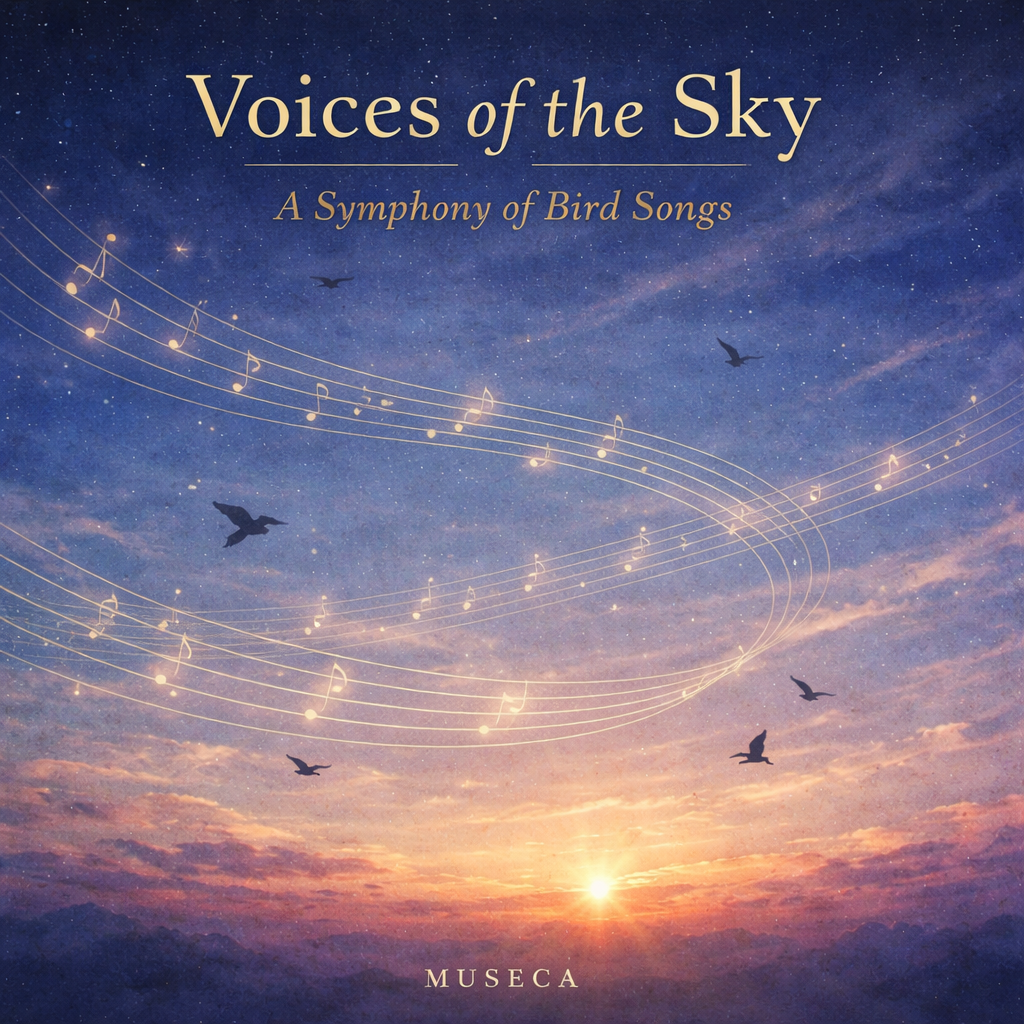
Voices of the Sky: A Symphony of Bird Songs is an album built on a simple but profound premise: that birdsong is not merely sound from nature, but music already in motion. Each track begins with the voice of a real bird and surrounds that voice with a carefully shaped musical world—never to overpower it, but to honor it, frame it, and enter into dialogue with it. The result is neither pure field recording nor conventional instrumental composition. It is an integration: the bird remains the first singer, and the music becomes its atmosphere, architecture, and emotional echo.
The album unfolds as a cycle of eight avian portraits drawn from different landscapes, climates, and emotional colors. Here, the nightingale becomes a dawn soloist, the blackbird sings at the open window, the thrush enters like a cantor in a natural cathedral, and the canyon wren sends its descending song through stone and twilight air. Each piece is composed not only around the identity of the species, but around the musical character already present in its call: repetition, contour, spacing, resonance, brightness, intimacy, altitude, or mystery. The accompaniment is therefore chosen as a response to the bird itself—flute, violin, English horn, harp, piano, strings, and subtle ambient colors serving as partners rather than replacements.
Although the album moves through Europe, North America, rainforest, canyon, and mountain air, it is designed as more than a travelogue of beautiful birds. It is a listening journey through different modes of presence. Some tracks feel domestic and close, as though heard just beyond a windowsill. Others open upward into reverence, solitude, or vast space. The birds are not treated as decorative samples; they are treated as melodic beings, each carrying its own phrase-logic, rhythm, timbre, and spiritual atmosphere. In that sense, the album asks the listener to hear birdsong with the same attention one gives to a human soloist or an instrumental line in chamber music.
The structure of the album is also intentional. It contains eight individual bird-worlds followed by a ninth and final track, The Eternal Choir. The number nine represents completion—the point at which a cycle fulfills itself before returning again to one. For that reason, the final track is not another portrait of a single species, but a collective arrival: a gathering of voices that transforms the earlier individual songs into a larger field of sound. What began as separate presences resolves into one shared sky.
In this way, Voices of the Sky stands at the meeting point of composition, listening, and reverence. It invites the listener to hear the natural world not as background, but as a source of form, beauty, and intelligence already singing. These tracks do not attempt to improve upon the birds. They attempt something more humble and more musical: to listen closely enough that the instruments know how to answer.
Liner Notes
Dawn of the Nightingale
The featured bird here is the Common Nightingale, a European songster celebrated for a voice of unusual range and drama: whistles, trills, rich low tones, and sudden crescendos, often delivered at night from concealed perches in shrubbery. It was chosen to open the album because its song already feels like an overture to listening itself—secretive, poetic, and immediately commanding. The piece treats the nightingale not as background nature, but as the first great soloist of the cycle.
The Blackbird’s Window
This track centers on the Eurasian Blackbird, a bird widely familiar across Europe, especially in gardens, parks, and woodland edges. Its song is mellow, slow-paced, and beautifully shaped, with short melodic phrases followed by finer twittering details. It was chosen because its voice feels intimate and domestic, as though music has drifted in through an open window at first light—less wild proclamation than elegant companionship.
Thrush Cathedral
The bird for this movement is the Song Thrush, a classic European thrush heard in Britain, Ireland, and across much of Europe. Its signature trait is repetition: loud, clear musical phrases delivered two, three, or four times before moving to the next idea. That architecture of recurrence is exactly why it was chosen. Its song already sounds built—like arches, pillars, and vaulted returns—so it naturally inspired a track with sacred space and resonant lift.
Echoes in the Maple Grove
Here the soloist is the Wood Thrush, native to the deciduous and mixed forests of the eastern United States. Its famous song is hauntingly flute-like, but it is more intricate than it first appears: a three-part structure whose ringing, ethereal quality comes from the bird’s ability to produce paired tones through its syrinx. It was chosen because few birds sound so immediately enchanted. This is the voice of the shaded forest interior—lyrical, reverberant, and deeply American in its woodland melancholy.
Crimson Whistle
The featured bird is the Northern Cardinal, a species of eastern North America whose range also reaches the southwestern United States, Mexico, and Guatemala. Its song is made of clear, whistled phrases—often down-slurred or two-parted—and both males and females sing. It was chosen because its voice is bold, recognizable, and full of clean melodic profile. After the more veiled thrush tracks, the cardinal brings brightness, color, and a directness of expression that feels like red made audible.
Sagebrush Lullaby
This movement belongs to the Canyon Wren, a bird of rocky canyons and cliffs across the western United States and much of Mexico. Its song is one of the most distinctive in North America: a descending cascade of liquid whistles that seems shaped by stone itself, echoing naturally through canyon walls. It was chosen because its sound already contains acoustics and landscape. The bird does not merely sing in the desert; it seems to reveal how the desert itself would sing.
Song of the Rainforest
The bird here is the Superb Lyrebird, native to the forests of southeastern Australia. It is renowned for extraordinary vocal mimicry—Australian Museum notes that roughly 80% of its song may consist of copied sounds woven into a larger medley. It was chosen because no other bird in the album embodies avian virtuosity so completely. The lyrebird turns the rainforest into theater: memory, mimicry, intelligence, and spectacle all concentrated in a single voice.
Echoes of the Andes
This track features the Andean Solitaire, a mountain thrush found through the Andes of Venezuela, Colombia, Ecuador, Peru, and Bolivia, often in humid montane forest, ravines, and stream-cut slopes. Its song is given from hidden perches, often at dawn or dusk, in well-spaced phrases of pure, flute-like liquid notes. It was chosen because its voice feels elevated in every sense—clearer, lonelier, and more suspended than the lower forest songs earlier in the album. It is the sound of altitude, distance, and thin luminous air.
The Eternal Choir
The final track is not built around a single species, but around the collective presence of the album’s earlier birds: Europe, North America, Australia, canyon, forest, rainforest, and Andes gathered into one closing field of sound. It was chosen as the conclusion because the album’s symbolism points toward completion: many distinct voices resolving into one living chorus before the cycle returns again to silence, and then to listening. In that sense, this finale is less a last portrait than a return to the whole sky.
Playlist
- Track 1 - Dawn of the Nightingale Museca 3:49
- Track 2 - The Blackbird’s Window Museca 2:46
- Track 3 - Thrush Cathedral Museca 3:59
- Track 4 - Echoes in the Maple Grove Museca 3:39
- Track 5 - Crimson Whistle Museca 2:30
- Track 6 - Sagebrush Lullaby Museca 5:40
- Track 7 - Song of the Rainforest Museca 3:32
- Track 8 - Echoes of the Andes Museca 3:44
- Track 9 - The Eternal Choir Museca 2:33