
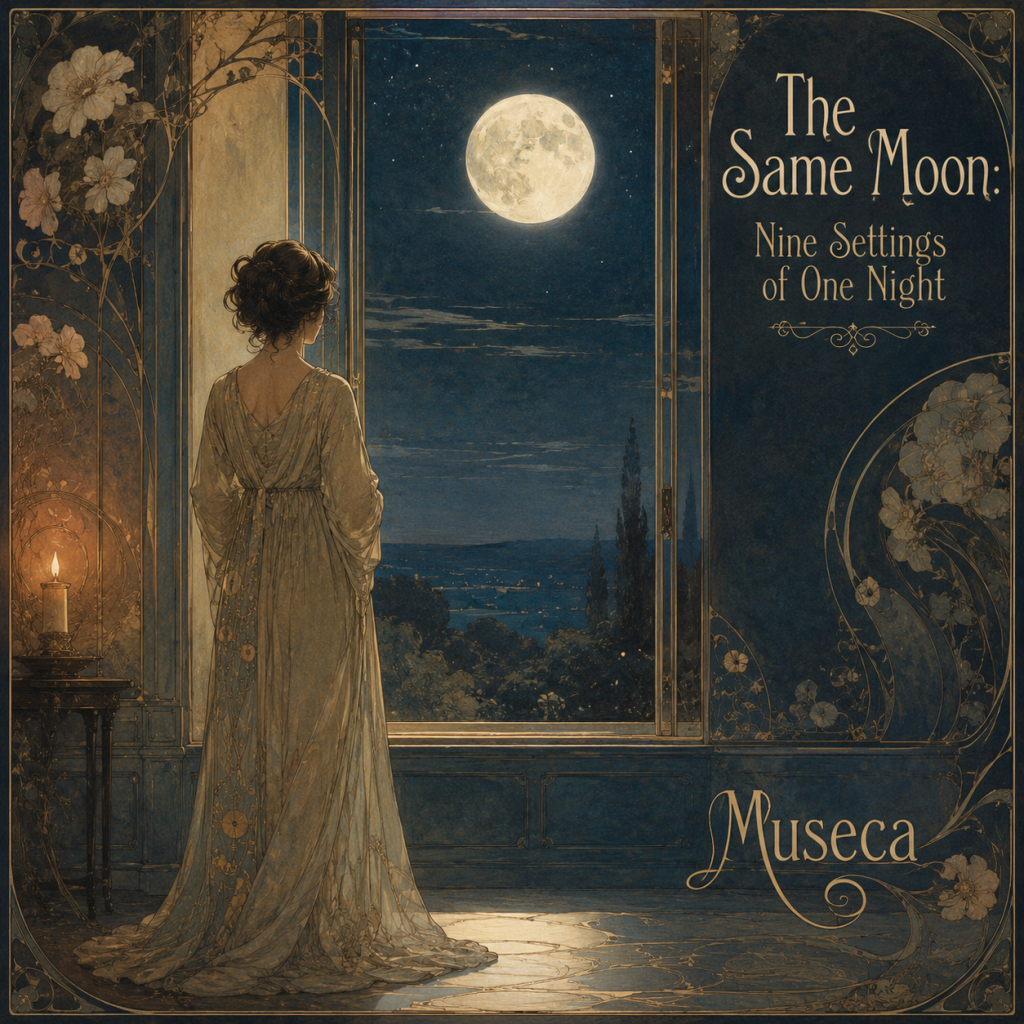
For two hundred years, composers have been quietly conducting an experiment without ever agreeing to it. Goethe wrote a short poem called “Kennst du das Land,” and eighty-four composers set it to music — Beethoven, Schubert, Schumann, Liszt, Wolf, even Tchaikovsky in Russian translation. Each setting is an argument about what the same words mean. Listeners have been comparing them ever since, in recital programs and late-night arguments, playing the oldest game in the art song tradition: who heard the poem best? The experiment was profound, but it was accidental — scattered across a century, conducted by composers who never knew they were collaborating. No single artist could run it on purpose, because no one lives in every era at once.
This album runs the experiment on purpose. I wrote one short poem — a watcher at a night window, an absent beloved, the moon they share — and set it nine times, across the full history of the art song, each setting in its tradition’s own language and its era’s own voice. One poem, one singer, one night: dusk to dawn, 1600 to now.
The template is the history itself. The art song — the setting of serious poetry for a solo voice and accompaniment, made for a listener who attends to every word — has a story with distinct chapters, and each track of this album is one chapter made audible. The night begins where the genre began: an English lute ayre, the voice and a single plucked instrument in a candlelit room, the poem in its plainest dress. Then the revolution: the German Lied, where the piano stopped accompanying feelings and started being them — here, a rippling figuration that is the moonlight itself. The same German words return a third of the way through the album, set again in the manner of sixty years later, when the Lied turned inward and the piano learned to think alongside the singer, doubting her cadences, arguing with her consolations. Across the Rhine, the French mélodie dissolved the self into atmosphere — a setting where nothing resolves and the song does not end so much as become too quiet to hear. In Russia, the romance turned the art song into confession: my setting lives in Tchaikovsky’s key and at his slow-waltz pulse, with a cello that carries what the singer cannot say, and it is the one song of the night that ends unresolved — some vigils are kept, not paid. The English pastoral school follows like a false dawn, a folk-plain tune under open sky with a violin arriving like a lark. Then the tradition’s grandest room: the orchestral song, the full late-Romantic orchestra carrying a whisper without raising it, holding the album’s single loudest moment. And then the hour when the words run out — a wordless vocalise, because the Russian tradition’s last act was to discover the melody could carry everything alone, set by the process-laws of sacred minimalism, the music that carried the art song’s devotion into our own time. The final track is the poem come home: sung whole, in my own idiom, with everything the night taught it.
The techniques are the connective tissue. Beneath the nine surfaces, the album is one composition, and its unity is built from a handful of devices any attentive listener can follow. A four-note melodic figure — the moon’s motif — appears in every track, sung at the line about the moon finding the window, then echoed once by each era’s signature instrument. It wears each tradition’s harmony differently: darkened in the chromatic German night, blurred to a tritone and corrected in the French haze, carrying a hidden major key inside the Russian minor, revealed as pure folk material in the English fields, and finally, in the wordless hour, becoming the entire substance of the music — six minutes unfolded from four notes. The album’s tonality is a single long gesture: it opens in E and closes in F, one semitone of light applied across the whole night, the last track’s rising bass performing in one bar the distance the album travels. Instruments remember each other across the tracks — the lute of the opening returns disguised as harp-glints in the French song and orchestral harp at the summit before coming home in the flesh at the finale; the Russian cello surfaces for one phrase beneath the orchestra’s climax and returns at dawn to resolve a note it left hanging four songs earlier; two bars of the second track’s piano are quoted, verbatim, inside the last. The forms themselves tell the genre’s history — strophic trust, through-composed reasoning, the suspended arch, the collapse, the folk-return, the process — and the tempo tells another: the rhythmic freedom of human performance grows from near-strictness through the conductor’s full elastic breath, dissolves entirely in the wordless hour, and arrives at the steady pulse of the present. One voice sings all nine settings, in five languages, changing her delivery with each era’s performance practice — near-straight tone for the Elizabethans, speech-weighted declamation for the late Germans, a veiled seamless line for the French, covered warmth for the Russian melancholy the language calls taska — so that the album’s deepest claim rests on the simplest evidence: it is recognizably the same woman, all night.
And everything is quiet. The whole album observes a discipline of dynamic restraint — one genuine forte in forty-two minutes, spent on a single line about gathering home — because the art song has always been music that trusts its listener to lean in. That trust is the real tradition this album inherits. The eras change, the languages change, the rooms change from candlelit chamber to concert hall to the open night itself. The moon’s four notes do not. Different windows, different tongues, four centuries of watchers — the same moon.
Liner Notes
Looke Up, My Friend
The night begins where the art song began: one voice, one lute, one room. Everything the album will become is already here in seed — the moon’s four notes, sung plainly; the first bowed string arriving on the word Sleepe; a final chord that turns from minor to major the way a candle steadies. I wanted the opening track to be the album’s reference point: the poem in its plainest dress, so that every later century’s transformation of it can be measured against this simplicity. The Elizabethans could not shade by volume, only by texture, and their restraint became the whole album’s law. Listen once for the song. Then listen again for the four notes at the moone that findes — you will be hearing them all night.
Lyrics
Verse 1
Looke up, my friend, from where thou art —
the moone that findes thy window, findeth mee;
betwixt us lies the whole darke world,
and over it one light for thee and mee.
Verse 2
Sleepe now, and I will keepe the watching;
distance is the moone’s undoing:
what so she toucheth, home she gathereth.
Beneath the selfsame moone, all is peace.
Final Line Reprise
Beneath the selfsame moone… all is peace.
Mondlicht
Two hundred years pass between the first track and this one, and the change is the piano. In the ayre, the lute answered the singer; here, the accompaniment has become the world — the rippling figuration is the moonlight itself, running under every word. This is the discovery Schubert’s generation made: that the instrument could stop accompanying a feeling and start being one. I kept the melody plain, the kind an earlier age would have approved, and let the piano carry the revolution beneath it. Listen for the moment in the second verse where the harmony slips somewhere far and warm — distance, made audible — and for the ending, where the voice stops and the light keeps moving.
Lyrics
Verse 1
Blick auf, mein Freund, aus deiner Ferne —
der Mond an deinem Fenster, der kennt auch mich;
es liegt die dunkle Welt dazwischen,
und über ihr ein Licht für dich und mich.
Verse 2
Schlaf nun, ich halte still die Wache;
die Ferne löst der Mond so lind:
was er berührt, das trägt er heimwärts.
Unter demselben Mond ist Frieden.
English translation:
Look up, my friend, from your distance — / the moon at your window, it knows me too; / the dark world lies between us, / and above it, one light for you and me. // Sleep now, I keep the watch in stillness; / the moon undoes the distance so gently: / what it touches, it carries homeward. / Under the same moon there is peace.
An den Fernen Freund
The same words as the last track — that is the point. Sixty years pass between these two settings, and what changed is not the poem but what music believes a poem is. In 1820, the words were a scene to be lit; by 1880, they are a mind to be entered. Here the piano no longer plays the moonlight — it thinks alongside the singer, murmuring between her phrases, doubting her cadences, refusing the very consolations the earlier setting took on faith. Listen for the moment the words ein Licht für dich und mich reach for their resolution and the harmony steps aside — and then listen to the ending, where the voice decides on peace and the piano, alone, argues its way to agreeing. The moon’s four notes are here too, wearing the minor key now. They are the only thing in the song that is not examined. Some things the night does not doubt.
Lyrics
Verse
Blick auf, mein Freund, aus deiner Ferne —
der Mond an deinem Fenster, der kennt auch mich;
es liegt die dunkle Welt dazwischen,
und über ihr ein Licht für dich und mich.
Schlaf nun, ich halte still die Wache;
die Ferne löst der Mond so lind:
was er berührt, das trägt er heimwärts.
Unter demselben Mond ist Frieden…
ist Frieden.
English translation:
Look up, my friend, from your distance — / the moon at your window, it knows me too; / the dark world lies between us, / and above it, one light for you and me. / Sleep now, I keep the watch in stillness; / the moon undoes the distance so gently: / what it touches, it carries homeward. / Under the same moon there is peace… / there is peace.
Le même clair de lune
Cross the Rhine and the whole question changes. The German settings asked what the poem means; the French setting asks only what the night is like — and answers: like this. Here the watcher stops watching and dissolves into the watched; the piano stops being moonlight or mind and becomes weather; the beloved is no longer across the distance but diffused through it, the way scent is in air. Nothing in this song resolves — that is its faith. The harmony hangs on chords that are beautiful because they never close, and the ending does not end: the room simply becomes too quiet to hear. Twice, though, the haze parts. Once for the moon’s four notes — sung first through cloud, blurred and wrong, then again, found and true. And once, if you listen at the very last line, inside the word paix itself, where the moon’s shape lies hidden in the peace it promised. In a song where everything dissolves, only the moon holds still.
Lyrics
Verse 1
Regarde, mon ami, de là où tu es —
la lune à ta fenêtre, elle me trouve aussi;
entre nous s’étend le monde obscur,
et au-dessus, une seule clarté pour deux.
Verse 2
Dors maintenant, je veillerai;
la lune défait toute distance:
tout ce qu’elle touche, elle le ramène.
Reprise
Sous la même lune, tout est paix.
Regarde, mon ami, de là où tu es…
English translation:
Look out, my friend, from where you are — / the moon at your window, she finds me too; / between us stretches the dark world, / and above it, a single light for two. // Sleep now, I will keep watch; / the moon undoes all distance: / all that she touches, she carries home. // Under the same moon, all is peace. / Look out, my friend, from where you are…
Другу
This is the tradition that taught me to hear the whole album. The Russian romance made the art song a confession — Tchaikovsky wrote more than a hundred of them, and again and again the person addressed is мой друг, my friend: the word his letters used for the men he loved and could not name. I set this song in his key, at his slow-waltz pulse — a dance remembered rather than danced — and let the melody move in the long regathering phrases Rachmaninoff perfected, the ones that descend, reach back up, and descend again. The Russians have a word for the feeling: taska — a soul-ache without address, longing that has learned to live in the house. Listen for the moment the minor turns major on a single held note — one light for two — and for how the second verse begins inside that light and loses it, not all at once but note by note, like a room going dark by degrees. The cello is the confidant: it enters carrying what the singer cannot say, protests the darkening, and at the end — after her voice has worn the last line down to one word, покой, peace — it says the moon’s four notes whole for her, and leaves one note hanging. The song ends in minor. Some vigils are not paid off; they are kept. And Усни — sleep now — is Tchaikovsky’s own word: he once set a poem that begins “Sleep, sad friend.” This song is my letter back.
Lyrics
Verse 1
Взгляни, мой друг, оттуда, где ты, —
луна в твоём окне, она находит и меня;
меж нами — целый тёмный мир,
а над ним — один свет на двоих.
Verse 2
Усни, а я останусь на страже;
луна разлуку побеждает:
всё, чего коснётся, — собирает домой.
Coda
Под одной луной — покой…
под одной луной…
покой…
покой.
English translation:
Look out, my friend, from there, where you are — / the moon in your window, she finds me too; / between us — the whole dark world, / and above it — one light for two. // Sleep now, and I will keep the watch; / the moon overcomes the parting: / all that she touches, she gathers home. // Under one moon — peace… / under one moon… / peace… / peace.
Under the Same Moon
Halfway through the night, the walls come down. This is the album’s first outdoor music — the English pastoral school, the generation that went into the fields with notebooks and came back convinced their folk tunes were cathedrals. I built the melody the way they built theirs: five notes at its spine, plain as a field-wall, square enough that you’ll feel you’ve known it all your life. You have, in a way — it opens with the moon’s four notes, and in this key, for the first time all night, they need no shading at all: the motif turns out to have been a folk tune waiting for its home. The second verse walks through a cloud — listen for the harmony darkening under whatever it touches, it gathers home — and then the same words are sung again, because that is what field-songs do: they return. And the second time, something answers from above. The violin is a lark: it doesn’t enter, it is simply there, already high, singing the land’s own notes on the sky’s own time. At the end the piano settles home and the lark declines to land — it lifts the moon’s four notes an octave and keeps climbing, out of hearing. This is the night’s false dawn. The rest is real. So is the dark still ahead.
Lyrics
Verse 1
Look out, my friend, from where you are —
the moon that finds your window finds me too.
Between us lies the whole dark world,
and over it, one light for two.
Verse 2
Sleep now, and I will keep the watching.
Distance is the moon’s undoing:
whatever it touches, it gathers home.
Under the same moon, all is peace.
Verse 3
Sleep now, and I will keep the watching.
Distance is the moon’s undoing:
whatever it touches, it gathers home.
Under the same moon, all is peace.
Nachtwache
The same words a third time — and now the orchestra. This is the tradition’s last great room: the intimate song carried into the full symphonic night without losing its intimacy, the discovery Mahler made that when eighty players take up a whisper, the whisper doesn’t get louder — the world gets larger around it. The horn begins alone, far off, calling the moon’s first two notes across the dark: the friend, at this hour, is already there. Everything in this song is something you’ve heard before, grown: the suspensions from the very first ayre, now chained across whole string choirs; the refused cadence from the third track, returned at ein Licht — and this time, granted, if you wait; the cello from the Russian song, surfacing for one phrase beneath the loudest moment of the whole album. And that moment — the only forte of the night, four hundred years of restraint spent in six slow bars on what he touches, he carries home — arrives not by driving but by opening: the wave crests and passes, the way the largest things do. Then listen to what happens to the last word. She sings Frieden and releases it unresolved — and the orchestra, two breaths later, resolves it for her. She begins the grace; the night finishes it. After this song, the words are done: what follows is the wordless hour. The epilogue already knows — the strings say the moon’s four notes twice, high and then low, handing them down into the dark, and the horn calls once more, farther now, and no one answers.
Lyrics
Verse
Blick auf, mein Freund, aus deiner Ferne —
der Mond an deinem Fenster, der kennt auch mich;
es liegt die dunkle Welt dazwischen,
und über ihr ein Licht für dich und mich.
Schlaf nun, ich halte still die Wache;
die Ferne löst der Mond so lind:
Climax
was er berührt, das trägt er heimwärts.
Final Line
Unter demselben Mond ist Frieden.
English translation:
Look up, my friend, from your distance — / the moon at your window, it knows me too; / the dark world lies between us, / and above it, one light for you and me. / Sleep now, I keep the watch in stillness; / the moon undoes the distance so gently: // what it touches, it carries homeward. // Under the same moon there is peace.
Vocalise: Луна
She has no words left. She spent them — English, German, French, Russian, German again — and what remains when everything has been said is not silence: it is singing. This hour fuses the two moments the art song escaped its own body. In 1912, at the very end of the Russian romance, Rachmaninoff wrote his Vocalise — a song with no words, because the melody alone could carry what a century of poems had carried. In 1976, Arvo Pärt began writing music where every melody-note is shadowed by a bell-tone from one unchanging triad — devotion reduced to process, prayer with the rhetoric removed. I have set her line by his law. Everything in this track is the moon’s four notes: the first phrase is just two of them, the rising fifth the lute played at dusk and the horn called across the valley; each phrase grows one step longer, like tide; the highest reach comes and goes without a single rise in volume; then the phrases shorten by the steps they grew by, and her last sound is the first two notes again. Beneath it all, one deep unmoving E — and if your ear has kept the whole night, you will know that note: it is the first track’s home. The whole vigil has been one held breath. Listen, near the end, for a dim warmth that drifts past in the strings — one chord, gone in a moment. That is the key of the dawn. It is closer than it seems: this track never resolves, because the next one is its resolution — do not let anything interrupt the join.
Lyrics
Луна —
(wordless)
The Same Moon
Dawn, and the poem comes home. The low note that held the whole wordless hour resolves on this track’s first beat — it was the first song’s home note all along; the night was one held breath — and she sings in her own language, in my own idiom, everything the night taught her. Nothing here is new, and that is the point. The lute from the first track is inside the electronics — listen for the only plucked sounds in a world of sustains. At one light for two, the warmth the Russian song glimpsed and lost is granted again — and this time it stays — and inside those bars, for two measures, you will hear the second track’s piano, the actual recording, rippling through the dawn like a window into 1820. The cello returns under the last lines and finally resolves the note it left hanging at the end of the fifth song: it lands on A — which is now, in the key of grace, simply a note the chord was already holding for it. And on the final word she sings a small four-note ornament: the same grace she sang on the same word, peace, in the first minutes of the album, four hundred years ago by the tracklist’s clock. The bass steps up one semitone — E to F, the whole album’s distance — and the last thing you hear, after the silence, is one far lute note. F. The first instrument, saying the dawn’s name. I have argued elsewhere that the art song never died — that its functions scattered into other musics and could be braided back together. This track is the braid. But arguments are for liner notes. The track is just a woman at a window, at first light, singing to someone far away that everything the moon touches, it carries home.
Lyrics
Verse 1
Look out, my friend, from where you are —
the moon that finds your window finds me too.
Between us lies the whole dark world,
and over it, one light for two.
Verse 2
Sleep now, and I will keep the watching.
Distance is the moon’s undoing:
whatever it touches, it gathers home.
Under the same moon…
Final Line
all is peace.
Playlist
- Track 1 — Looke Up, My Friend Museca 2:05
- Track 2 — Mondlicht Museca 1:52
- Track 3 — An den Fernen Freund Museca 2:02
- Track 4 — Le même clair de lune Museca 1:29
- Track 5 — Другу Museca 3:05
- Track 6 — Under the Same Moon Museca 2:33
- Track 7 — Nachtwache Museca 3:58
- Track 8 — Vocalise: Луна Museca 3:19
- Track 9 — The Same Moon Museca 3:09